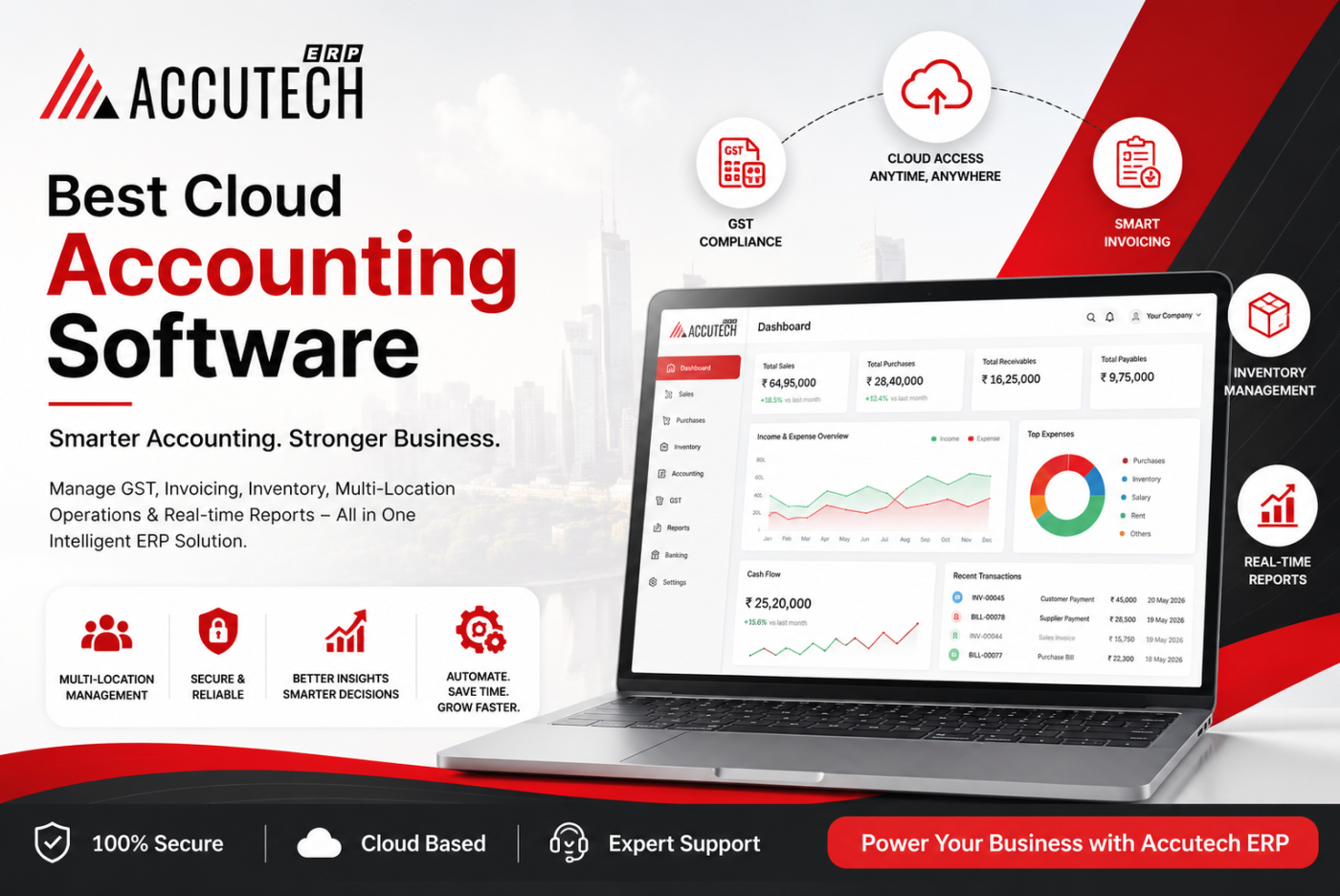
Why Cloud Accounting Software Matters More Than Ever
In 2026, managing your business finances with outdated accounting methods is like running a modern enterprise with yesterday's tools. Small business owners face unprecedented challenges: managing GST compliance, handling multi-location inventory, processing invoices from multiple channels, and making real-time financial decisions. This is where best cloud accounting software becomes not just helpful, but essential.
The accounting landscape has transformed dramatically. Gone are the days when spreadsheets and manual ledgers could keep pace with modern business demands. Today's businesses need integrated solutions that combine accounting, invoicing, inventory management, GST compliance, and real-time reporting all accessible from anywhere, on any device. The right cloud accounting software doesn't just record transactions; it gives you actionable insights, automates repetitive tasks, and ensures regulatory compliance.
This comprehensive guide will walk you through everything you need to know about small business accounting software, the critical features to look for, and why Accutech ERP stands out as the intelligent solution for modern SMEs, wholesalers, distributors, retailers, and FMCG businesses in 2026.
The Real Problems Small Businesses Face with Manual Accounting
Let's be honest: managing accounts manually or with outdated software is frustrating, time-consuming, and error-prone. Small business owners often spend countless hours on accounting tasks that should take minutes. Consider these real-world pain points that thousands of businesses experience every single day:
Data Entry Chaos and Human Errors: Manual data entry is tedious and mistake-prone. A single invoice mistyped, a decimal point in the wrong place, or a forgotten debit entry cascades through your entire financial system. These errors cost time, money, and credibility with your stakeholders.
GST Compliance Headaches: India's GST accounting requirements are complex and constantly evolving. Tracking IGST, CGST, SGST, managing input tax credits, filing returns on time it's overwhelming without dedicated software support.
Inventory Tracking Nightmares: If you're a wholesaler, distributor, or retailer, inventory management without proper systems means stock discrepancies, overstocking, understocking, and lost sales opportunities. Manual reconciliation takes forever and often reveals shocking inconsistencies.
Invoice Management Across Channels: Managing billing and accounting software that can handle invoices from online sales, retail points, distributors, and direct customers is nearly impossible without integration. You end up juggling multiple systems.
No Real-Time Financial Visibility: You can't make data-driven decisions if your financial data is days or weeks old. Waiting for month-end reports while your business moves at internet speed is a competitive disadvantage.
Multi-Location Accounting Complexity: If you operate multiple branches, stores, or distribution centers, maintaining separate accounting records and consolidating them is a nightmare. Different locations, different staff, different processes and you need unified visibility.
Time Wasted on Administrative Tasks: Your accounting staff spends 40-50% of their time on data entry and reconciliation instead of strategic analysis. That's wasted potential and increased operational costs.
Limited Remote Access and Collaboration: In 2026, your team needs to access critical financial data securely from anywhere. Traditional desktop software and disparate systems make remote work and team collaboration frustratingly difficult.
Why Traditional Accounting Methods Fail in 2026
We're in 2026 now, and businesses that still rely on spreadsheets, manual processes, or fragmented software are leaving money on the table. Here's why traditional methods are fundamentally broken for modern businesses:
Spreadsheets Are Not Scalable
Spreadsheets work fine for micro-businesses, but they collapse under real-world complexity. Version control nightmares, formula errors, data duplication, and the inability to track audit trails make spreadsheets a liability for growing businesses. When one person adjusts a number without documentation, your entire financial picture becomes questionable.
Desktop Software Is Not Collaborative
Legacy desktop accounting software keeps your data locked on a single computer. If you need multiple team members accessing accounting information simultaneously, or if you need to work from home, coffee shops, or on the road, desktop software becomes a bottleneck. Cloud accounting software solves this by allowing secure, simultaneous access from anywhere.
Disconnected Systems Create Data Silos
Most small businesses use separate systems for accounting, invoicing, inventory, and GST compliance. Data moves sluggishly between systems, creating delays, inconsistencies, and duplicate data entry. Worse, when you need to generate reports combining data from multiple systems, you're back to manual work.
Manual Processes Don't Scale with Your Business
What worked when you had 10 transactions per day breaks when you have 1,000. Manual invoicing, manual inventory updates, manual reconciliation these processes that feel manageable at small scale become completely unmanageable as your business grows. You'll spend more on hiring accounting staff than you would on proper software.
Essential Features to Look For in Cloud Accounting Software
Not all accounting software solutions are created equal. Before choosing a platform, understand these critical features that separate world-class software from mediocre options:
1. Integrated Accounting and Inventory Management
The best accounting solutions combine accounting with inventory tracking. When inventory decreases, accounting records automatically update. When you invoice a customer, inventory is deducted in real-time. This integration eliminates manual synchronization and ensures your financial records always match your physical stock.
2. GST Compliance Built In
India's GST billing software requirements demand dedicated compliance features. Look for automated GST calculations, GSTR filing support, input tax credit tracking, and compliance reporting. Your software should make GST compliance effortless, not an afterthought.
3. Real-Time Financial Reporting and Business Intelligence
You shouldn't wait until month-end to know how your business performed. The right software provides dashboards, automated reports, and business intelligence that give you instant visibility into revenue, profitability, cash flow, and key performance metrics. This enables fast decision-making.
4. Multi-User and Multi-Location Support
Growing businesses need systems that support multiple team members working simultaneously across different locations. The software should handle multi-branch operations, allow granular permission controls, track user activities, and consolidate data from all locations into unified reports.
5. Automated Invoice Generation and Payment Tracking
Manual invoice creation is tedious and error-prone. Modern invoicing systems should auto-generate professional invoices, handle recurring billing, track payment status, send payment reminders, and integrate with payment gateways for seamless transactions.
6. Cloud-Based Access with Security
Cloud delivery means your financial data is accessible anytime, anywhere, on any device. But cloud deployment is meaningless without robust security. Look for encrypted data transmission, regular backups, role-based access control, two-factor authentication, and compliance with data protection standards.
7. Scalability and Flexibility
Your accounting software should grow with your business. It should handle increasing transaction volumes, support new business units, integrate with additional systems, and evolve as your requirements change. Avoid software that forces you to migrate when you outgrow it.
8. API Integration and Automation
Your accounting software shouldn't exist in isolation. It should integrate with e-commerce platforms, payment gateways, banking systems, CRM tools, and other business applications. API-driven architecture enables seamless data flow and eliminates manual integration work.
9. Audit Trail and Compliance Features
Financial accountability requires complete audit trails. Every transaction should be logged with who created it, when, and what changes were made. This is essential for regulatory compliance, internal audits, and defending against fraud.
10. Excellent Customer Support and Regular Updates
Software is only as good as the support behind it. Choose vendors with responsive support teams, regular product updates, active development, and a commitment to staying current with regulatory changes. Your software partner should be invested in your success.
Benefits of Cloud-Based and ERP-Enabled Accounting Systems
When you shift from traditional accounting methods to modern cloud based ERP systems, the benefits extend far beyond accounting. Here's what you gain:
Dramatic Time Savings and Productivity Gains
Automation handles repetitive tasks invoice generation, payment processing, reconciliation, report generation. Your accounting team shifts from data entry to strategic analysis, cost optimization, and business planning. Studies show businesses save 30-40% of accounting time by implementing ERP systems.
Elimination of Costly Errors
Automated systems dramatically reduce human error. Consistent formatting, automatic calculations, and validation rules catch mistakes before they propagate. The savings from preventing even a few accounting errors quickly exceed the software investment.
Real-Time Business Intelligence
With real-time dashboards and automated reporting, you understand your business performance instantly. Which products are most profitable? Which customers are most valuable? Where is cash tied up? These answers enable smarter decisions faster.
Seamless Compliance Management
GST compliance, tax calculations, regulatory reporting and modern systems handle this automatically. You're always audit-ready because compliance is built into every process. This reduces compliance risks and eliminates last-minute scrambling during tax season.
Improved Cash Flow Management
With integrated billing, payment tracking, and reconciliation, you always know your true cash position. You can identify which invoices are overdue, optimize payment terms, and manage working capital more effectively. Better cash flow management is literally better cash in the bank.
Scalability Without Proportional Cost Increases
Whether you process 100 transactions or 100,000, cloud systems scale automatically. You don't need to hire proportionally more accounting staff. The software handles complexity while your team focuses on growth.
Enhanced Data Security and Backup
Your financial data is more secure in the cloud than on a single office computer. Cloud providers invest heavily in security infrastructure, encryption, and backup systems. Your data is protected against hardware failures, theft, and disasters.
Improved Team Collaboration and Accessibility
Team members can work simultaneously on financial data from different locations. No more email attachments, version confusion, or outdated information. Everyone works from the same, current source of truth.
How Automation Saves Time and Reduces Accounting Errors
Automation is the superpower of modern accounting software. Let's explore concrete examples of how automation transforms accounting operations:
Automated Invoice Creation and Delivery
Instead of manually creating invoices in Word or Excel, your system generates professional invoices automatically when sales are recorded. Customer names, addresses, item details, quantities, and pricing populate automatically from the sales order. Invoices are timestamped and numbered sequentially. This eliminates data entry errors and ensures consistency.
Automatic GST Calculations and Compliance
GST calculations are complex, different rates apply to different products, and input tax credits must be properly tracked. Automation handles this perfectly. When you invoice a customer, the system calculates CGST, SGST, and IGST correctly based on product classification and customer location. GSTR preparation becomes a matter of clicking a button.
Real-Time Inventory Updates
When you invoice a customer, inventory levels update immediately. When you receive goods from suppliers, stock increases. When you conduct physical counts, discrepancies are highlighted. No more manual inventory spreadsheets or month-end surprises about missing stock.
Automated Reconciliation
Bank reconciliation matching your records with bank statements is tedious manual work. Modern systems download bank data automatically and match transactions. Discrepancies are flagged for investigation. What used to take hours now takes minutes.
Automatic Payment Reminders and Follow-ups
Late payments hurt cash flow. Smart systems automatically send payment reminders to customers before and after due dates. This reduces collection time and improves cash flow without requiring manual intervention.
Scheduled Report Generation
Instead of preparing reports manually, set up automated daily, weekly, or monthly reports. Profit and loss statements, balance sheets, cash flow statements, GST summaries all generated automatically and delivered to your inbox. You always have current information.
Validation and Error Prevention
Modern systems validate data at entry time. Missing required fields are flagged before saving. Invalid values are caught immediately. This prevents corrupted data from entering your system and spreading errors downstream.
Addressing Key Business Accounting Challenges
Every business model faces unique accounting challenges. Let's address the most common ones and explain how modern software solves them:
GST and Taxation Complexity
Challenge: India's GST system is intricate. Different rates apply to different products. Inter-state supplies are handled differently. Input tax credits must be tracked meticulously. Return filings (GSTR-1, GSTR-3B, GSTR-9) require accurate data.
Solution: Modern accounting software includes GST configuration tables with all product categories and applicable rates. The system calculates taxes automatically on every invoice. It tracks all transactions needed for GSTR filings and can generate compliant GSTR reports with a few clicks. You remain audit-ready and compliant by default.
Inventory Management Across Multiple Stock Locations
Challenge: Managing inventory across warehouses, retail stores, or distribution centers is complex. Stock must move between locations, be tracked accurately, and reconciled regularly. Different locations have different stock levels, and consolidated visibility is essential.
Solution: Integrated inventory systems support multiple stock locations. You can track inventory by location, transfer stock between locations, and view consolidated stock levels. Inventory counts by location identify discrepancies. Stock movements automatically update financial records, ensuring accounting and inventory always match.
Multi-Channel Invoice Processing
Challenge: Wholesalers and distributors receive orders from multiple channels direct customers, online marketplaces, retail stores, dealers. Managing invoices from all these channels in a unified system is difficult. Integration is poor, and manual data movement between systems is required.
Solution: Modern ERP systems integrate with e-commerce platforms, marketplace APIs, POS systems, and direct order entry. Orders from all channels flow into a single system. Invoices are generated consistently regardless of source. Financial records consolidate all channels automatically.
Multi-User and Multi-Branch Operations
Challenge: When you operate multiple locations, different staff handle transactions at each location. You need real-time visibility across all locations, consolidated reporting, and the ability for team members to work simultaneously without conflicts.
Solution: Cloud-based systems support unlimited simultaneous users across all locations. Granular permissions control what each user can access and modify. All transactions from all locations flow into a central database. Reporting consolidates data across all locations instantly.
Compliance and Regulatory Reporting
Challenge: Regulatory requirements evolve constantly. GST rates change, filing deadlines shift, new compliance rules emerge. Staying compliant without dedicated systems is exhausting and error-prone.
Solution: Good software vendors update their systems regularly to reflect regulatory changes. Compliance features are built into core processes, not added as afterthoughts. Audit trails automatically track all transactions. Reports align with regulatory requirements. You stay compliant without manual effort.
Real-Time Financial Decision Making
Challenge: Waiting for month-end reports delays decision-making. By the time you know about a profitability problem or cash flow issue, it's often too late to respond.
Solution: Real-time dashboards show current performance instantly. You can see revenue, profitability, inventory levels, and cash position at any moment. This enables proactive decision-making and rapid response to challenges.
Why Accutech ERP Is the Ideal Cloud Accounting Solution for 2026 Businesses
We've covered what modern businesses need. Now let's discuss why Accutech ERP stands out as a comprehensive solution purpose-built for Indian SMEs, wholesalers, distributors, and retailers in 2026.
True End-to-End Business Integration
Accutech ERP isn't just accounting software, it's an integrated business management platform. It combines accounting, inventory, invoicing, GST compliance, multi-location operations, and reporting in a single unified system. This eliminates data silos and ensures complete consistency across your business.
Built for India's Business Environment
Unlike generic global solutions, Accutech ERP is designed specifically for Indian businesses. It includes complete GST compliance, supports Indian accounting standards, handles India-specific tax requirements, and understands the nuances of Indian business operations. You get a solution that speaks your language and understands your context.
Powerful Automation That Saves Hours Daily
Accutech ERP automates the repetitive tasks that consume accounting time. Automatic invoice generation, GST calculations, inventory updates, payment reminders, reconciliation all happen without manual intervention. Your team focuses on strategic work, not data entry.
Intelligent Reporting and Business Intelligence
Real-time dashboards give you instant business visibility. Profit margin analysis by product or customer. Inventory turnover analysis. Cash flow forecasting. Accounts receivable aging. All available in seconds. These insights enable smarter decisions faster.
Seamless Multi-Location and Multi-User Operations
Whether you operate one location or many, Accutech ERP supports unlimited simultaneous users across all branches. Each location can operate independently or consolidate data instantly. Granular permissions ensure data security while enabling collaboration.
Complete Cloud Security and Data Protection
Your financial data is critical. Accutech ERP provides enterprise-grade security with encrypted data transmission, automatic daily backups, role-based access control, two-factor authentication, and compliance with data protection standards. Your data is safer than it would be on an office computer.
Optimized for Every Business Type
Different business models have different requirements. Accutech ERP includes specialized modules optimized for different industries:
Wholesalers and Distributors: Manage multiple customer tiers, bulk pricing, distribution channels, and extensive inventory across multiple warehouses.
Retailers and FMCG: Handle multiple retail points, SKU tracking, expiry management, promotional pricing, and fast-moving inventory.
Pharmacies: Manage controlled medicines, expiry dates, batch tracking, regulatory compliance, and specific licensing requirements.
SMEs and Small Businesses: Affordable, scalable solution that grows with your business without unnecessary complexity.
Proven Track Record and Trusted by Thousands
Accutech ERP is trusted by thousands of businesses across India. The software has a proven track record of helping businesses streamline operations, reduce costs, improve compliance, and scale confidently.
FREQUENTLY ASKED QUESTIONS
1. What is the difference between cloud accounting software and desktop accounting software?
Cloud accounting software stores data on remote servers accessible via the internet, while desktop software runs on a single computer. Cloud software provides access from anywhere, enables team collaboration, automatically updates with new features, and requires no local maintenance. Desktop software is less flexible and lacks the accessibility and collaboration benefits of cloud solutions.
2. Is cloud accounting software secure? How is my financial data protected?
Yes, cloud accounting software is highly secure. Reputable providers like Accutech ERP use encryption for data transmission and storage, automatic daily backups, role-based access control, two-factor authentication, and maintain complete audit trails. Your data is actually safer in the cloud than on an office computer vulnerable to hardware failure, theft, or disasters.
3. Can cloud accounting software handle GST compliance and invoicing for Indian businesses?
Absolutely. Modern accounting software built for India includes complete GST functionality. Automated GST calculations apply the correct rates based on product classification and customer location. The software tracks input tax credits, generates GSTR-compliant reports, and simplifies filing. Accutech ERP specifically handles all India-specific accounting and tax requirements.
4. How does inventory management integrate with accounting in cloud ERP software?
In integrated ERP systems, inventory and accounting are tightly connected. When you invoice a customer, the system automatically deducts inventory. When you receive goods from suppliers, inventory increases and the purchase is recorded in accounting. This eliminates the need for separate inventory spreadsheets and ensures accounting records always match physical stock.
5. Can multiple users work simultaneously in cloud accounting software from different locations?
Yes, this is a major advantage of cloud software. Unlimited users can work simultaneously from different locations. The system handles concurrent access, prevents conflicting edits, and maintains data integrity. This enables true team collaboration and is essential for businesses with multiple locations or remote teams.
6. How much time can we save by switching to automated accounting software?
Businesses typically save 30-40% of accounting time by eliminating manual data entry, automating invoice generation, and streamlining reconciliation. For a business with 100 daily transactions, this translates to 50-75 hours weekly equivalent to 1-2 full-time employees. That freed-up time enables your team to focus on analysis, planning, and strategy.
7. What features should wholesalers and distributors look for in accounting software?
Wholesalers and distributors need software that handles multiple stock locations, supports bulk transactions, manages customer tiers with different pricing, tracks inventory across distribution channels, and provides visibility into multi-location operations. The software should generate reports by product, customer, location, and salesperson.
8. How does real-time reporting help in decision-making?
Traditional accounting waits for month-end reports, but by then important decisions have already been made. Real-time reporting shows current performance instantly revenue today, profitability by product, cash position, inventory levels. You can spot problems immediately and respond quickly. This enables proactive management instead of reactive crisis handling.
9. Can cloud accounting software integrate with e-commerce and POS systems?
Yes, modern cloud accounting software can integrate with multiple sales channels. Orders from e-commerce sites, online marketplaces, retail POS systems, and direct channels flow automatically into the accounting system. Invoicing is consistent across all channels. Inventory updates synchronize in real-time.
10. What happens if we outgrow the software? Do we need to migrate?
Good cloud accounting software is designed for scalability. You shouldn't need to migrate. The system should handle increasing transaction volumes, unlimited users, multiple locations, and new requirements without replacement. Accutech ERP grows with your business without disruptive migrations.
11. How does automation reduce accounting errors?
Automation eliminates the primary source of errors: manual data entry. When systems automatically calculate GST, generate invoices, post transactions, and reconcile accounts, the opportunity for human error vanishes. Validation rules catch mistakes immediately. Audit trails track all changes. Studies show automation reduces errors by 90%+.
12. Is cloud accounting software affordable for small businesses?
Cloud accounting software is very affordable for small businesses. Modern solutions are priced based on usage or features, not on company size. Small businesses often pay less than their accounting staff's monthly salary for software that saves multiple employees' time. The ROI is compelling. Accutech ERP offers affordable packages designed for small business budgets.
13. How important is mobile access to accounting software in 2026?
Mobile access is increasingly essential. Business owners and managers need to access critical financial information while traveling or from home offices. Modern accounting software provides mobile apps allowing you to check reports, approve invoices, or monitor cash flow from anywhere. This is especially important for remote teams.
14. What reporting and business intelligence should I expect?
Modern software provides real-time dashboards showing key metrics, customizable reports, profitability analysis by product/customer/region, cash flow forecasting, and inventory optimization insights. Reports should be generated instantly and be exportable to multiple formats. Visual dashboards with charts make data interpretation easier.
15. Why choose Accutech ERP specifically?
Accutech ERP is purpose-built for Indian businesses, unlike generic solutions designed for global audiences. It includes complete GST compliance, supports Indian accounting standards, and understands India-specific operational challenges. It's not just accounting software it's a comprehensive business management platform. Accutech is proven, trusted by thousands, and backed by vendors committed to Indian business success.