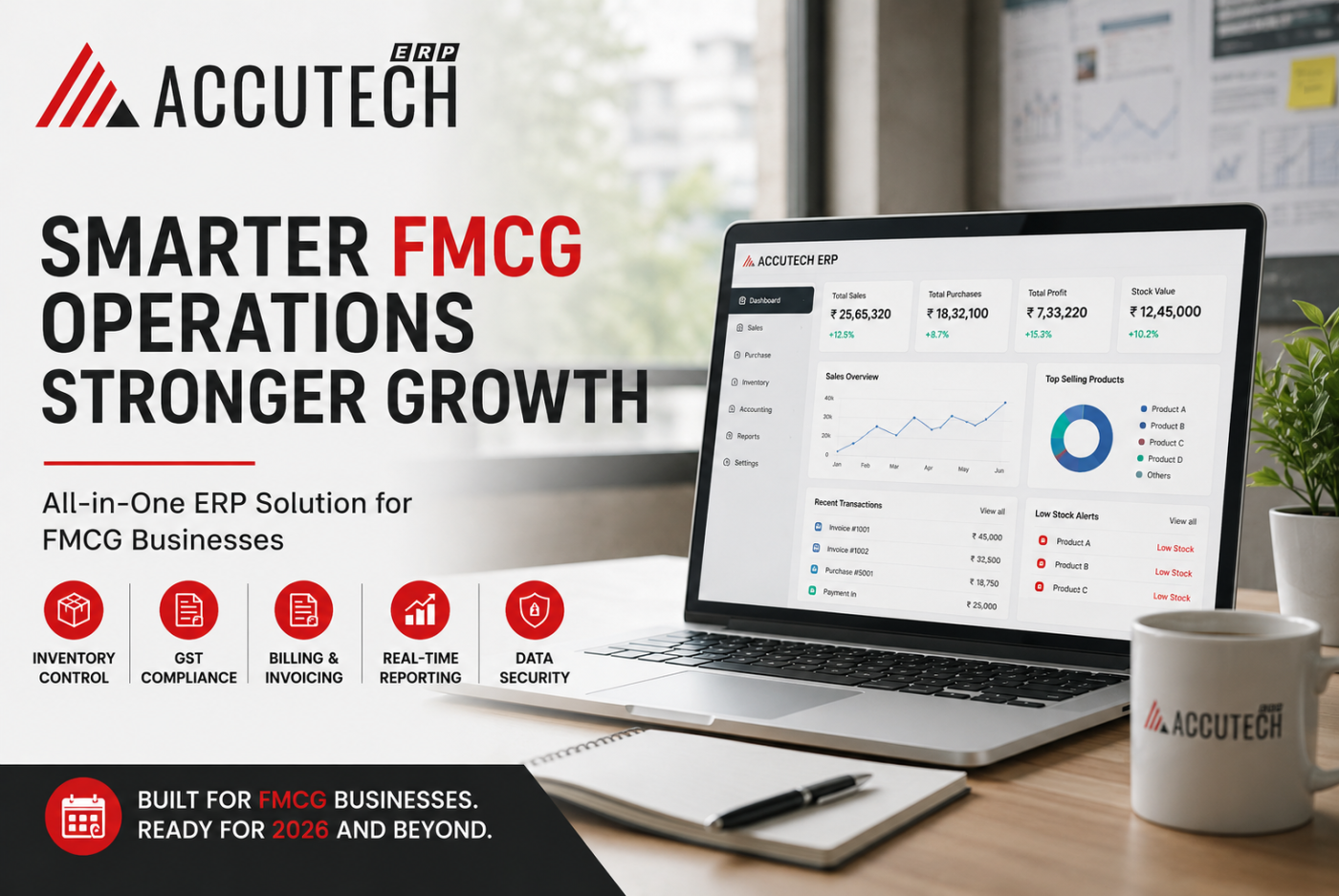
Best FMCG Management Software | Accutech ERP
Why FMCG Management Software Has Become Non-Negotiable
The fast-moving consumer goods industry operates in a world where every second counts. Product shelf life shrinks. Customer expectations explode. Supply chains fracture. And businesses that still rely on spreadsheets, manual records, and disconnected systems? They don't just fall behind. They fail.
In 2026, FMCG management software is no longer a luxury upgrade for enterprise corporations with unlimited budgets. It's the foundation that separates thriving wholesalers, distributors, retailers, and manufacturers from those struggling to keep pace.
Whether you manage a network of retail outlets, operate a wholesale warehouse, distribute pharmaceutical products, or manufacture consumer goods, the right FMCG management software solution transforms how you operate. It eliminates the chaos of manual stock tracking, fixes the nightmare of taxation compliance, prevents revenue leaks, and hands you real-time insights that actually inform decisions.
This comprehensive guide walks you through everything you need to know about FMCG management software, what it is, why your business genuinely needs it, which problems it solves, and how to choose the right solution for your specific business model.
What Is FMCG Management Software? A Clear Definition
FMCG management software refers to integrated business management solutions specifically designed to handle the unique operational, accounting, inventory, and compliance requirements of fast-moving consumer goods companies.
Unlike generic accounting software or basic point-of-sale systems, comprehensive FMCG management software combines multiple functions into one unified platform:
- Inventory Management: Real-time tracking across multiple warehouses and retail locations
- Financial & Accounting Systems: Automated invoicing, GST compliance, and financial reporting
- Sales & Distribution: Order management, delivery tracking, and customer relationship management
- Multi-User & Multi-Branch Support: Centralized control across distributed operations
- Tax & Compliance Automation: GST filing, statutory compliance, and audit trail generation
Modern FMCG management software operates as a cloud-based ERP (Enterprise Resource Planning) system, which means all your data synchronizes in real-time, all your teams work with current information, and you can access your business metrics from anywhere, a warehouse in Delhi, a distribution center in Mumbai, or your office in Bangalore.
Why Your FMCG Business Absolutely Needs This Software in 2026
The FMCG industry has fundamentally transformed. The businesses that dominated five years ago don't automatically lead today. What changed?
Customer Expectations Have Exploded
Retailers now expect to order online and receive shipments within 24 hours. They demand real-time inventory visibility. They want mobile access to place orders. They expect precise delivery windows and accurate billing. Businesses operating on paper records and manual phone calls simply cannot deliver this.
Compliance Complexity Keeps Growing
GST compliance, statutory reporting, audit requirements, and regulatory audits create an endless paperwork maze. One misstep costs money in penalties. Worse, one file missing creates audit liability. Manual systems don't cut it anymore.
Competition From E-Commerce Players
Large e-commerce platforms and organized retail chains operate with sophisticated logistics and inventory systems. If you compete against them with manual methods, you lose on speed, accuracy, and customer experience.
Data-Driven Decision-Making Became Mandatory
The winners in FMCG know their product velocity, their profit margins by category, their customer concentration risk, and their cash flow forecasts. None of this happens in spreadsheets. You need real data systems that generate instant reports.
The Real Business Problems You Face Without Modern FMCG Management Software
Let's be direct. If you're still managing your FMCG business without proper management software, you're experiencing real pain:
Inventory Chaos Kills Profitability
Picture this: Your Bangalore warehouse says it has 500 units of a product in stock. Your regional sales manager in Hyderabad orders accordingly. But when the order arrives, the actual count is 320 units. The discrepancy happened three days ago when someone forgot to update the spreadsheet after damaged goods were removed. Now you've oversold, upset the customer, and created a crisis.
Without real-time inventory visibility, you lose sales, damage customer relationships, and tie up working capital in dead stock. FMCG businesses especially suffer because products have short shelf lives. Holding extra inventory means waste and write-offs.
GST Compliance Becomes a Monthly Nightmare
You receive invoices from suppliers. You issue invoices to customers. You have internal transfers between warehouses and branches. Calculating the right input tax credits, filing returns correctly, and maintaining compliant documentation consumes enormous time. One entry error cascades through three months of filings. Your tax professional charges a fortune for manual compilation. You lose sleep over audits.
Manual GST accounting software solutions attempt to solve this, but without integration to your actual transactions, you still do manual data entry. Worse, spreadsheets lie. They don't automatically validate. They let you make mistakes.
Multi-Branch Operations Become Unmanageable
You run three distribution centers and supply to 150 retail outlets. Each branch maintains its own accounting records. Consolidating financial reports takes days. Identifying which branch is actually profitable requires painful manual analysis. Transferring goods between branches creates accounting nightmares. Controlling discrepancies across locations becomes impossible.
Without a unified system, you can't answer basic questions: Which branch has the highest inventory turnover? Which region generates the most profit? Where are we losing money?
Billing and Invoice Management Destroy Efficiency
Your sales team manually creates invoices in Word or Excel. They email PDFs. Customers call asking why they received a duplicate invoice. Payment follows days later. Someone manually reconciles bank deposits to invoice numbers. Discrepancies are found weeks later, creating an argument about what happened.
Your finance team wastes hours on invoice management that an automated system would handle in minutes. You lose visibility on receivables. Cash flow forecasting becomes guesswork.
Mobile Access Is Nonexistent
Your warehouse manager needs to check inventory before confirming orders. He's out on the floor. He can't access the information because it's only on the office desktop computer. He calls someone. They check. They call back. Thirty minutes pass. The customer hangs up and orders from someone who could respond in two minutes.
Modern businesses expect mobile access to critical information. Your team expects cloud accounting software they can access from anywhere.
Data Security & Backup Keep You Awake
Your company data lives on someone's desktop computer. There's one backup drive that's updated manually. If the hard drive fails, what happens to your financial records? If someone deletes a file by mistake, can you recover it? This level of risk would make any business owner anxious.
Why Traditional Systems and Spreadsheets Fail in the FMCG Industry Today
You might think: "We've used spreadsheets and basic accounting software for years. Why change now?"
The problem is that what worked five years ago doesn't work today. Here's why:
Spreadsheets Don't Scale
A spreadsheet with 1,000 rows of data feels manageable. One with 50,000 rows becomes unusable. It loads slowly. Formulas break. Data entry errors multiply. What starts as a simple tracking tool becomes a bottleneck that slows your entire business.
FMCG companies transacting hundreds of times per day quickly exceed spreadsheet capacity.
Manual Data Entry Creates Endless Errors
Someone in the warehouse receives goods. They write it on a paper form. Someone in the office types it into a spreadsheet. The warehouse person also texts the information to someone in accounting. Now you have the same data in three places. One has a typo. Which version is correct? You spend hours reconciling.
Modern business accounting solutions eliminate this by capturing data once and automatically syncing it everywhere.
Lack of Real-Time Information Kills Responsiveness
A customer calls asking about order status. Your sales team doesn't know because the information is updated once per day in an Excel file. You can't give them an answer for two hours. They get frustrated and find another supplier.
Real-time systems allow you to answer instantly. You're immediately more professional, more trustworthy, and more likely to keep the customer.
Compliance Becomes Increasingly Risky
GST auditors want to verify that your invoicing matches your financial records, which matches your inventory movements. If you're managing these in separate spreadsheets, they won't align perfectly. An auditor finds the discrepancy and starts asking questions. You can't quickly prove you didn't make a mistake or hide something. The situation escalates.
Integrated systems create automatic audit trails that prove compliance.
Key Features to Look For in Modern FMCG Management Software
Not all FMCG management software solutions are created equal. When evaluating options, ensure the system includes these essential features:
Cloud-Based Architecture
The software should run in the cloud, not on your local server. Cloud means automatic updates, automatic backups, access from anywhere, and automatic scaling as you grow. You never worry about server maintenance or data loss.
Real-Time Inventory Synchronization
When goods move into or out of your warehouse, the system updates instantly across all locations. Every branch, every manager, every decision-maker sees the same inventory numbers at the same time. No discrepancies. No surprises.
Automated Invoicing & Billing
The system should automatically generate professional invoices as orders are placed, captured sales data, and calculated taxes included. It should track unpaid invoices, send payment reminders, and reconcile payments automatically.
Integrated GST Compliance
GST calculations should be automatic. The system should properly track input tax credits across all transactions. It should prepare GST returns automatically. And it should maintain compliant audit trails that satisfy tax authorities.
Multi-User & Multi-Branch Capabilities
You should be able to create user accounts for unlimited employees with role-based permissions. The head office can view consolidated reports. Branch managers see only their branch data. Everyone works in the same system with consistent data.
Mobile App Access
The system must include a mobile app for iOS and Android. Warehouse managers, sales staff, and delivery personnel should access critical information and update data from the field. No need to go back to the office to record transactions.
Advanced Reporting & Business Intelligence
You should create custom reports instantly. The system should include pre-built dashboards showing key metrics. You should see profit margins by product, sales velocity by customer, inventory turnover by location, and cash flow forecasts.
Strong Data Security
The system must include encryption, role-based access control, automatic backups, and disaster recovery. Your data should be safer in the cloud than it would ever be on your servers.
Scalability
The system must grow with your business. If you add a new branch, you don't need to buy new software. If you start serving 10x more customers, the system keeps running smoothly. Cloud-based systems scale by design.
The Business Transformation: Benefits of Modern FMCG Management Software
When implemented properly, FMCG management software transforms how your business operates:
Inventory Accuracy Improves to 99%+
Real-time tracking combined with automated reconciliation means your recorded inventory matches physical inventory. You eliminate excess stock, reduce waste, optimize storage space, and improve cash flow. For FMCG businesses where shelf life matters, this alone can save hundreds of thousands annually.
GST Compliance Becomes Automatic
Tax calculations happen automatically. Returns file with one click. Audit trails prove compliance automatically. Your team stops spending hours on tax administration. The stress of potential audit penalties disappears.
Operational Efficiency Improves 30-50%
Your team spends less time on data entry, reconciliation, and manual reporting. More time goes toward actually serving customers and improving the business. The same team handles significantly higher transaction volumes.
Customer Service Becomes Exceptional
Your team answers customer questions immediately with accurate information. Deliveries happen on time. Billing is accurate and transparent. Customers feel valued. They remain loyal. They recommend you to other businesses.
Financial Visibility Drives Better Decisions
Real reports show you exactly what's happening in your business. Which products are profitable? Which customers drive the most revenue? Where are you losing money? With this clarity, you make strategic decisions that actually work instead of decisions based on intuition or outdated data.
Scalability Becomes Seamless
Adding a new branch doesn't require new infrastructure or complicated implementations. Cloud systems scale effortlessly. Your business can grow without technology becoming a bottleneck.
Automation & Productivity: How FMCG Software Multiplies Your Team's Effectiveness
One of the biggest advantages of modern FMCG management software is the automation that eliminates repetitive work:
Automated Invoicing
Every time a sale is recorded, an invoice is generated automatically with all relevant tax calculations. The customer receives a PDF immediately. No manual typing. No delays. No errors.
Result: Your billing team goes from spending eight hours per day on invoicing to 30 minutes. They can focus on customer service instead.
Automatic Stock Adjustments
When goods arrive from suppliers, scanning them into the warehouse automatically updates inventory. When products expire, the system flags them for removal and automatically reduces inventory counts. When goods are damaged, one note adjusts everything.
Result: Warehouse staff spends less time on manual recording and more time on actual warehousing work.
Automated Bank Reconciliation
The system automatically matches invoices paid to the corresponding bank deposits. Discrepancies flag for review. The final reconciliation that used to take a full day now takes 20 minutes.
Result: Your accountant handles monthly close-outs in hours instead of days, with greater accuracy.
Automated Reporting
Managers receive daily or weekly reports automatically. No one spends time compiling data. Reports appear in email inboxes generated from real-time data.
Result: Your leadership team stays informed without asking for reports, which allows faster decision-making.
Accounting, GST, Taxation, Inventory & Invoice Management: Complete Integrated Solutions
For FMCG businesses, the combination of accounting, GST compliance, inventory management, and invoice handling creates the most complex operational challenge. Modern FMCG management software integrates all of these:
Comprehensive Accounting Features
- Double-entry bookkeeping automatically captures all transactions
- Chart of accounts customizable to your business structure
- Journal entries, balance sheets, and profit & loss statements generated instantly
- Cash flow forecasting built into the system
Automated GST Compliance
- Sales invoices include SGST, CGST, IGST as appropriate
- Input tax credits automatically captured from purchase invoices
- GST returns (GSTR-1, GSTR-2, GSTR-3B) prepared automatically
- Compliant audit trails maintained automatically for tax authority verification
Intelligent Inventory Management
- Real-time stock levels across all locations
- Batch and serial number tracking for quality control
- Expiry date tracking and alerts for products nearing end of shelf life
- Cycle counting and physical inventory reconciliation features
Professional Invoice Management
- Auto-generated invoices with all tax calculations
- Customer receivables aging reports
- Payment tracking and automatic dunning notices
- Credit note and debit note management
Multi-Branch and Multi-User Management: Central Control with Local Flexibility
Many FMCG businesses operate multiple locations warehouses, distribution centers, retail outlets, or franchisee locations. The right FMCG management software handles this complexity effortlessly:
Centralized Data, Decentralized Control
All branches report to a single database. The head office sees consolidated reports and can drill down into any location. Each branch manager sees only their location data, keeping operations confidential while maintaining central oversight.
Example: Your Mumbai distribution center manager can see their inventory and sales. They cannot see confidential pricing or performance data from competing regions.
Unlimited User Accounts with Role-Based Permissions
You create accounts for your entire team with granular permissions. The warehouse manager can update inventory but cannot see financial data. The sales team can create orders but cannot modify pricing. The accountant can view reports but cannot delete transactions.
This combination of access and control protects your business while keeping everyone productive.
Inter-Branch Transfer Management
When you move goods from one warehouse to another, the system handles the transaction properly. Inventory decreases at the source. It increases at the destination. Both locations' records stay accurate. The transfer happens instantly without manual reconciliation.
This is critical for FMCG businesses because products might move between locations multiple times before reaching final customers.
Consolidated Financial Reporting
Generate complete financial reports at the company level consolidating all branches or at individual branch level. You can see total revenue, profit margins, and expense ratios instantly without manual compilation.
Smart Reporting and Business Intelligence: Making Data Work for Your Growth
Raw data alone doesn't help your business. You need insights. Modern FMCG management software transforms data into actionable intelligence:
Sales Analytics
Understand your top products, fastest-moving items, and best customers. Track sales trends over time. Identify seasonal patterns. See which salespeople drive the highest volume. This data guides inventory planning, marketing campaigns, and sales strategies.
Example: You realize that 20% of your customers represent 80% of your revenue. You can make strategic decisions to nurture these relationships while optimizing support for other customers.
Profitability Analysis
Reports show profit margins by product, customer, salesperson, and branch. You identify which products are cash generators and which are margin drains. You stop pushing unprofitable products. You negotiate better pricing on high-volume, low-margin items.
Example: You discover that your "best-selling" product has a 2% margin while a less-popular product has a 15% margin. You shift focus to the higher-margin product without changing your total sales volume or team size.
Inventory Insights
Reports show inventory turnover rates, aging analysis, and slow-moving items. You optimize stock levels. You prevent waste from slow-moving products. You improve working capital by reducing inventory holding costs.
Example: You see that certain products are sitting for 90 days before selling. You reduce orders for these items or run promotions to accelerate movement.
Cash Flow Management
The system forecasts cash requirements weeks in advance. You avoid cash crunches. You time large purchases strategically. You negotiate better payment terms with suppliers based on your actual cash needs.
Example: You see a forecast showing a cash deficit in month three. You negotiate extended payment terms with suppliers or accelerate customer collections to cover the gap.
Customer Insights
Reports show customer purchase history, average order value, order frequency, and payment behavior. You identify at-risk customers before they leave. You identify high-value customers deserving extra service. You personalize sales approaches based on customer patterns.
Data Security & Backup: Protecting What Matters Most
Your business data is your most valuable asset. Your customer information, supplier terms, financial records, and trade secrets require robust protection. Cloud-based FMCG management software provides security levels that small businesses typically cannot afford to build themselves:
Bank-Grade Encryption
All data is encrypted in transit (while traveling over the internet) and at rest (while stored in the cloud). If someone intercepts network traffic, they cannot read it. If someone somehow accesses the server, they cannot read the data without encryption keys.
Result: Your financial data and customer information are more secure than they would be on your office computer.
Automatic Daily Backups
The system automatically backs up all your data every day. If something happens to the primary system, backups exist to restore from. Your team never worries about data loss from hardware failures.
Result: Your data is recoverable even in unlikely disaster scenarios.
Role-Based Access Control
Only people with appropriate permissions can view specific data. A warehouse worker cannot access financial information. An accountant cannot access employee passwords. This limits damage if an account is compromised.
Result: Even if one person's credentials are stolen, damage is limited to their specific role.
Audit Trail
Every action in the system is logged. Who made a change? When? What changed? This creates accountability and helps detect unauthorized activity or fraud.
Result: You can investigate any discrepancy and identify exactly what happened and who caused it.
Compliance Certifications
Reputable cloud providers maintain ISO 27001, SOC 2, and other security certifications. They undergo regular audits to verify security practices. This means your data meets global security standards.
Scalability: Growing Your Business Without Outgrowing Your Software
One of the biggest mistakes growing FMCG businesses make is choosing software that works fine until it doesn't. They outgrow it quickly. Then they're stuck choosing between:
- Staying with inadequate software and dealing with constant workarounds
- Migrating to a new system mid-operation, losing data and disrupting business
- Building custom solutions at massive cost
Cloud-based FMCG management software solves this by scaling seamlessly:
Unlimited Transaction Volume
Processing 100 invoices per day? Tomorrow 1,000? The system handles it without slowdown. Cloud infrastructure automatically scales to meet demand.
Result: Your business can grow without upgrading software or hardware.
Unlimited Users
Growing from 10 employees to 100? The system accommodates everyone simultaneously without degradation.
Result: You scale your team without technology becoming a bottleneck.
Unlimited Branches
Operating one branch? Expanding to 50? The software accommodates growth. Adding a new location is simple, no complicated implementation projects.
Result: Your infrastructure grows with your business strategy, not ahead of it or behind it.
Future-Ready Features
Cloud software is continuously updated with new features and improvements. Integrations with new third-party tools become available. Your software gets better over time without additional investment from you.
Manual Processes vs. Automated ERP: The Real Comparison
Let's quantify the difference between manual operations and modern FMCG management software
Operation: Processing Customer Order
Manual Process (Spreadsheet/Email-Based):
- Customer calls with order
- Sales staff manually checks inventory spreadsheet (which may be outdated)
- Sales staff creates order in Excel
- Email sent to warehouse staff
- Warehouse staff picks goods
- Someone updates inventory spreadsheet
- Someone manually creates invoice in Word
- Invoice emailed to customer
- Someone manually enters transaction in accounting software
- Invoice recorded in accounts receivable
- Payment tracked manually
Automated ERP Process:
- Customer places order through portal or app
- System instantly verifies real-time inventory
- Order automatically routed to warehouse
- Picking list automatically generated
- Warehouse scans goods during packing
- Inventory automatically updated
- Invoice automatically generated with tax calculations
- Accounting entries automatically created
- Customer automatically receives invoice
- Payment tracking automatic when funds arrive
For a business processing 200 orders daily, the difference is staggering: Manual processes require dedicated staff just for order processing. ERP processes handle the same volume with minimal human intervention. The team's time goes to customer service and strategic work instead.
Future Trends in FMCG Technology: Staying Ahead in 2026
The FMCG software landscape continues evolving. Forward-thinking businesses should be aware of emerging trends:
Artificial Intelligence for Demand Forecasting
Modern systems increasingly incorporate AI that predicts product demand based on historical sales, seasonality, and market trends. This helps you stock the right products in the right quantities, preventing both stockouts and excess inventory.
Benefit: Better inventory planning means less waste and more satisfied customers.
Real-Time Logistics Integration
Integration with delivery partners provides live tracking of shipments. Customers know exactly when to expect deliveries. Your team knows if delays will impact other customers. This transparency builds trust.
Benefit: Better customer experience and reduced delivery-related customer service inquiries.
Mobile-First Design
Increasingly, FMCG software is designed for mobile first, with desktop as secondary. This acknowledges that modern workers often work in the field, not at desks. Apps provide full functionality, not stripped-down versions of desktop software.
Benefit: Your field teams are as productive as office teams, without commuting to the office.
Advanced Analytics & Dashboards
Moving beyond static reports, modern systems offer interactive dashboards where you ask questions and get instant answers. "Which customers are most profitable?" "What's my inventory position tomorrow?" "Which products are at risk of stockout?" Real-time answers.
Benefit: Better decision-making based on current data, not outdated reports.
Why Accutech ERP Is One of the Best Modern Solutions for FMCG Businesses
If you're evaluating FMCG management software options, you want a solution that combines comprehensive features with the specific understanding of FMCG complexity. This is where Accutech ERP stands out.
Accutech ERP is specifically designed for the needs of small and medium-sized FMCG, wholesale, distribution, retail, pharmaceutical, and manufacturing businesses.
Cloud-Ready Modern Architecture
Built on cloud infrastructure, Accutech ERP eliminates the headaches of server management. Your data is automatically backed up. Automatic updates roll out without disrupting your business. You access the system from anywhere, warehouse, branch, home office.
No more worrying about your local server dying and losing critical data.
Specifically Built for FMCG Complexity
Accutech ERP understands the specific operational challenges of FMCG: rapid inventory movement, shelf life management, multi-level distribution networks, complex tax compliance, and integration with third-party suppliers and retailers.
This isn't a generic ERP that you have to customize heavily. It comes optimized for your industry.
Complete GST & Compliance Automation
GST compliance is built into every transaction, not bolted on as an afterthought. Your returns file automatically. Your audit trail is automatically maintained. You work with confidence that your compliance is correct.
For FMCG businesses where GST complexity multiplies with every new location, this is a huge advantage.
Real-Time Multi-Branch Management
Managing multiple locations should be effortless. Accutech ERP handles it. You see consolidated reports for your entire business or drill into specific branches. Inventory moves between locations seamlessly. Financial consolidation is automatic.
Whether you have 3 branches or 30, you manage them all from one system.
Mobile App for Your Entire Team
Accutech ERP includes comprehensive mobile apps for iOS and Android. Your warehouse staff updates inventory on the go. Your sales team places orders from the field. Your delivery team confirms shipments. Everyone works with current information from anywhere.
Modern FMCG businesses require mobile access. Accutech ERP doesn't make this optional, it's built in.
Scalability Built In
Whether you're currently doing 100 transactions daily or 10,000, Accutech ERP scales smoothly. Growing from 5 employees to 50? From 2 branches to 20? The system grows with you without replacement or complicated migrations.
Build your business on a foundation that grows with your ambitions.
Suitable for Your Business Model
Accutech ERP serves wholesalers, distributors, retailers, pharmaceutical companies, FMCG manufacturers, and small businesses across the consumer goods space. Regardless of your specific business model within FMCG, Accutech ERP adapts to your needs.
You get industry-specific functionality, not generic software requiring heavy customization.
Reliable Support When You Need It
Implementation, training, and ongoing support from professionals who understand FMCG businesses. Not just technical support business support. They understand your challenges and can guide you toward best practices.
Conclusion: The Choice Is Clear
In 2026, the question is not whether your FMCG business needs management software. The question is which solution best serves your specific situation.
Spreadsheets and email-based processes don't just slow you down. They create risks: inventory discrepancies, compliance violations, missed sales, angry customers, and sleepless nights worried about data integrity.
Modern FMCG management software provides a foundation for growth. Real-time inventory visibility. Automated compliance. Integrated accounting. Mobile access. Business intelligence. Scalable infrastructure.
The right solution like Accutech ERP combines all these capabilities with deep industry understanding. It's not just software. It's a strategic advantage.
Stop managing your business with spreadsheets. Start managing it with confidence.
Take the next step. Explore how Accutech ERP can transform your FMCG business today.
Frequently Asked Questions About FMCG Management Software
1. Can FMCG Management Software Help With AI-Powered Automation?
Absolutely. Modern FMCG management software increasingly includes AI-powered features like demand forecasting, inventory optimization, and predictive analytics. These help you anticipate market needs, optimize stock levels, and make data-driven decisions. Accutech ERP incorporates AI for demand forecasting, helping you order exactly the right quantities.
2. How Does FMCG Software Simplify GST Filing?
GST filing becomes automatic. All your invoices, purchases, and transfers feed into the system automatically. The software calculates SGST, CGST, and IGST on every transaction. When GST return deadlines approach, returns are pre-populated with all required information. You review and file with confidence. Accutech ERP specifically automates GST return preparation (GSTR-1, GSTR-2, GSTR-3B), reducing filing time from days to minutes.
3. Do I Need Mobile Access to FMCG Management Software?
In 2026, mobile access is not optional it's expected. Your warehouse manager needs to check inventory without walking to the office. Your delivery team needs to confirm shipments in the field. Your sales team places orders from customer locations. Mobile apps for iOS and Android are essential. Accutech ERP provides full-featured mobile apps, ensuring your team works productively regardless of location.
4. What Does "Cloud Accounting Software" Mean for FMCG Businesses?
Cloud accounting software means your financial system runs on internet-connected servers maintained by your software provider, not on your local computers. Benefits: automatic backups, access from anywhere, automatic updates, built-in security, and no server maintenance burden. For FMCG businesses with multiple locations, cloud systems mean everyone works with real-time data. Accutech ERP is cloud-native, offering all these benefits.
5. How Does Inventory Sync Work in Real-Time Across Locations?
When goods move in or out of any location, the central database updates immediately. Every user sees current stock levels. If your Mumbai warehouse ships 100 units to a retailer, Delhi headquarters sees that inventory decrease instantly. If goods arrive at your Bangalore distribution center, inventory increases immediately system-wide. This real-time synchronization prevents overselling, stock-outs, and customer disappointment. Accutech ERP synchronizes inventory instantly across unlimited locations.
6. Can FMCG Software Handle Complex Invoice Management?
Yes, entirely. When sales occur, invoices generate automatically with customer details, product information, quantities, prices, and all applicable taxes. The system tracks invoice status (unpaid, partially paid, paid), sends payment reminders to customers, and reconciles payments automatically. Credit notes and debit notes are handled seamlessly. For FMCG businesses with hundreds of daily invoices, this automation is transformative. Accutech ERP automates the entire invoicing lifecycle.
7. How Important Is Data Security in FMCG Management Software?
Critically important. Your financial records, customer information, supplier terms, and business strategies are your most valuable assets. Cloud FMCG software provides bank-grade encryption, role-based access control, automatic backups, and compliance with security standards like ISO 27001. Your data is more secure in the cloud than it would be on your office computer. Accutech ERP maintains enterprise-grade security with daily backups, encryption, and audit trails.
8. What Kind of Reports Can I Generate From FMCG Software?
Comprehensive reports: sales by product, sales by customer, profit margins by category, inventory turnover, accounts receivable aging, cash flow forecasts, branch-wise financial performance, product-wise profitability, and much more. Most systems allow you to create custom reports and set up automated email reports. This business intelligence drives better decisions. Accutech ERP includes extensive pre-built reports and custom report builder functionality.
9. How Does FMCG Software Support Multi-User Access?
You create unlimited user accounts with role-based permissions. Your warehouse manager sees inventory data but not financial details. Your accountant views reports but cannot delete transactions. Your CEO sees everything. Multiple users can work simultaneously without conflicts. The system handles concurrent access smoothly. Accutech ERP supports unlimited concurrent users with granular permission controls.
10. Is FMCG Management Software Scalable for Growing Businesses?
Absolutely essential. Your business might handle 500 daily transactions now and 5,000 in two years. Cloud FMCG software scales seamlessly. Adding branches, users, products, or customers doesn't require system upgrades. The infrastructure grows transparently. Accutech ERP is designed to scale from startup businesses to enterprises without replacement or migration.
11. Can FMCG Software Enable Remote Business Operations?
Yes. Cloud-based software means your team works from anywhere home, cafe, client location, or branch office. As long as they have an internet connection, they access all business data and functionality. This flexibility has become essential in modern business. During disruptions or for flexible working arrangements, your business continues seamlessly. Accutech ERP's cloud and mobile capabilities enable fully remote operations.
12. What Financial Management Features Do FMCG Software Solutions Offer?
Comprehensive financial management: automated invoicing, expense tracking, account reconciliation, profit and loss reporting, balance sheet generation, cash flow forecasting, and more. Everything integrates into a unified system. Manual accounting spreadsheets become obsolete. Accutech ERP provides complete financial management with full accounting integration.
13. How Is Automated Accounting Software Different From Manual Processes?
Night and day difference. Manual accounting: Someone receives an invoice, manually enters it. Another person records a payment. A third person reconciles bank deposits. Errors multiply. Reports take days to compile. Automated accounting: Invoices import automatically. Payments reconcile automatically. Reports generate instantly. Errors near zero. Your team focuses on analysis and strategy rather than data entry. Accutech ERP automates accounting completely.
14. Why Choose an ERP System Over Standalone Point-of-Sale Software?
Point-of-sale software handles only sales transactions. Full ERP handles sales, inventory, accounting, purchasing, reporting, and more as an integrated system. All data is connected. A sale automatically updates inventory and accounting. You get complete business visibility, not fragmented views. For FMCG businesses with complex operations, ERP is essential. Accutech ERP is a complete business system, not a single-function tool.
15. How Do I Choose Between Different FMCG Management Software Options?
Evaluate based on: cloud-based architecture, industry-specific features for FMCG, real-time multi-branch capabilities, mobile access, GST compliance automation, reporting features, scalability, security, and support quality. Request demos. Ask for references from similar businesses. Calculate total cost of ownership, including implementation, training, and support. Choose the solution that best matches your current needs while offering room to grow. Accutech ERP checks all these boxes for FMCG businesses.