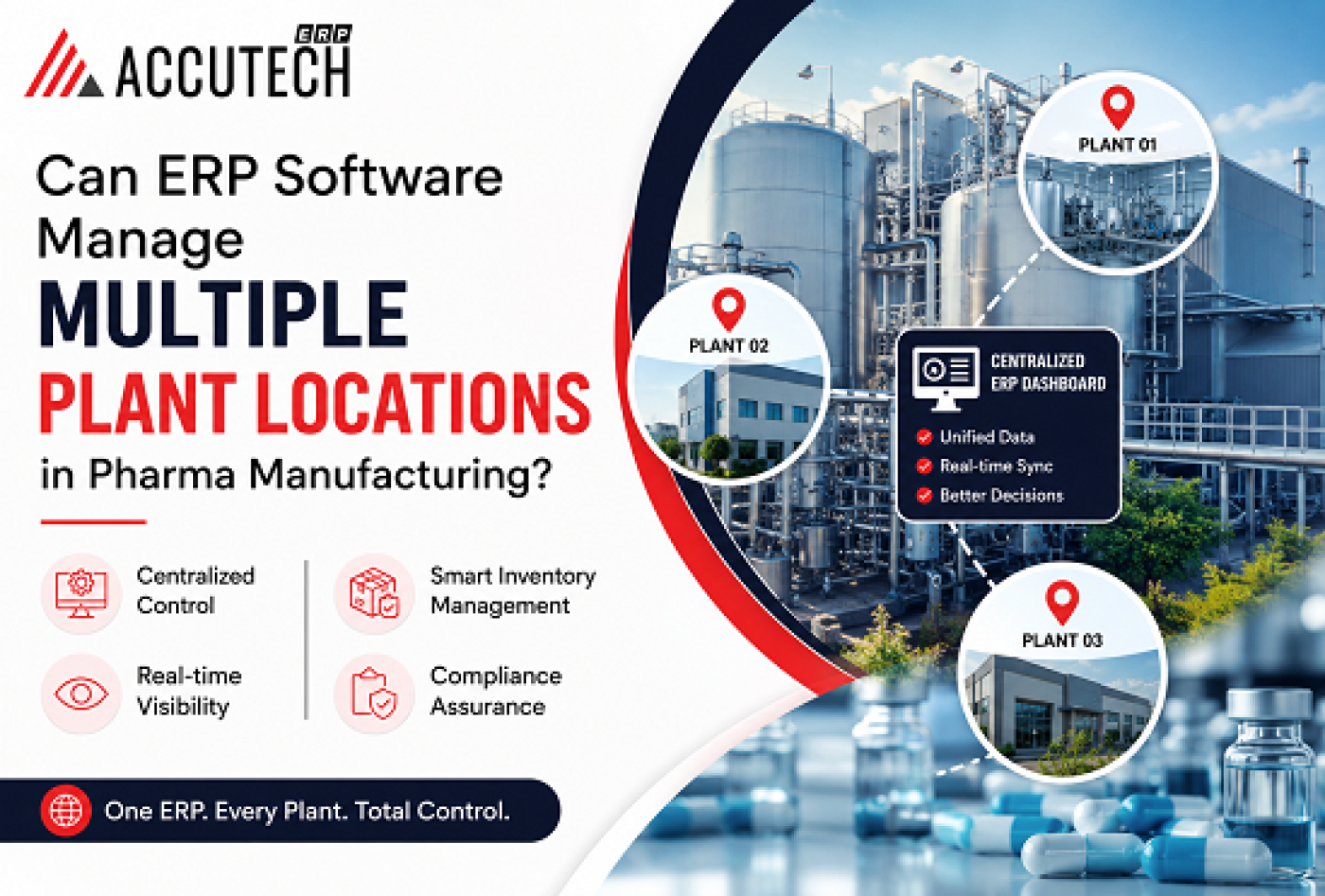
The pharmaceutical industry operates under extraordinary pressure regulatory compliance, batch traceability, quality assurance, and inventory precision are non-negotiables. But when a pharma company operates across multiple manufacturing locations, these challenges multiply exponentially. Managing distributed operations across several plants used to mean fragmented data, siloed systems, manual reconciliations, and inconsistent processes. Today, enterprise-grade pharma ERP software has fundamentally transformed how pharmaceutical manufacturers orchestrate multi-plant operations.
The answer to whether ERP software can manage multiple plant locations in pharma manufacturing is an emphatic yes but with important nuances. The right pharmaceutical ERP doesn't just collect data from multiple sites; it creates a unified operational ecosystem where inventory flows seamlessly, production schedules align, compliance standards are enforced consistently, and real-time visibility spans from the raw materials warehouse in Plant A to the finished goods dispatch center in Plant C.
This comprehensive guide explores how modern pharma ERP systems handle multi-plant complexity, the specific features that enable seamless coordination, real-world implementation strategies, and why choosing the right platform matters more than ever in 2026.
1. Can ERP Software Truly Manage Multiple Plant Locations?
The short answer: Yes, absolutely. But this requires a pharmaceutical ERP platform specifically designed for regulated manufacturing environments, not a generic enterprise system.
Pharmaceutical manufacturers operating multiple plants face a complex puzzle. Each facility must maintain compliance with FDA 21 CFR Part 11, GMP standards, and DSCSA serialization requirements independently. Yet, at the enterprise level, operations must be coordinated. Raw materials procured for Plant A might need redistribution to Plant B. Product formulations must be standardized across all locations. Financial consolidation, tax compliance, and profitability reporting must reflect the entire organization.
Modern pharma ERP software solves this through a unified architecture that combines:
- Centralized master data (products, formulations, suppliers, customers) synchronized across all plants
- Site-specific operational controls that preserve local autonomy while enforcing global standards
- Real-time visibility dashboards showing production, inventory, and compliance status across all locations
- Consolidated financial reporting with full traceability to individual plants and cost centers
- Integrated workflow automation that routes transactions through multi-site approval chains
According to industry research, multi-site pharmaceutical manufacturers using integrated ERP systems report 20-40% improvements in batch release time, reduced compliance audit findings, and significantly improved inventory accuracy across locations. These outcomes don't happen by accident; they result from thoughtful system architecture and deliberate implementation practices.
2. How Pharma ERP Software Enables Multi-Plant Operations
Understanding how a pharmaceutical ERP system manages multiple plant locations requires examining the technical and operational architecture that makes distributed operations possible.
Unified Data Architecture
The foundation of multi-plant ERP is a single database with multi-tenant, multi-site capabilities. Rather than separate instances for each plant which creates integration nightmares, a modern pharmaceutical ERP maintains one authoritative data repository. This means:
- A single product master file with one source of truth for formulations, packaging materials, and specifications, yet allowing site-specific manufacturing parameters
- Unified supplier and customer databases with site-specific agreements and price lists overlaid on the corporate master
- Consolidated chart of accounts with site-specific cost center allocation for financial clarity
Cloud-Based Infrastructure
Modern pharma ERP platforms are increasingly cloud-based, which dramatically improves multi-site coordination. Cloud architecture provides:
- Instant real-time data synchronization across geographically dispersed facilities without complex network infrastructure
- Automatic backup and disaster recovery capabilities protecting operations at all sites simultaneously
- Scalability to add new manufacturing locations without hardware investments or complex integrations
- Validated cloud infrastructure certified for FDA and GMP compliance, reducing implementation burden
Multi-Site Role-Based Access
A critical differentiator in pharma ERP is sophisticated role-based access control that permits different permission levels across locations. Plant A's production manager might have full visibility into their facility's batch records but limited access to Plant B's data. This simultaneously enables operational autonomy and corporate oversight.
3. Critical Features for Multi-Location Pharmaceutical Manufacturing
Not all ERP systems are created equal when it comes to multi-plant pharmaceutical operations. Certain features become non-negotiable when your business depends on coordinating operations across multiple facilities.
Multi-Site Inventory Management
The complexity of multi-plant pharmaceutical inventory is extraordinary. Raw materials might be stored at a centralized procurement hub but consumed across three manufacturing facilities. Finished goods produced at Plant A might be packaged at Plant B and shipped from Plant C's distribution center. Work-in-progress materials need exact tracking across production stages at different locations.
Advanced pharma ERP systems handle this through:
- Lot-level tracking that maintains complete genealogy across multiple warehouses and production stages
- Real-time stock visibility showing available inventory at each location with immediate updates when materials are transferred between sites
- Automated inter-site transfer processing with full audit trails and no double-counting of inventory
- Expiry tracking with FEFO (First Expired, First Out) logic preventing use of expired materials across the entire network
- Safety stock calculations considering aggregate demand across all plants, not just individual facility needs
Electronic Batch Records (EBR) Across Sites
Pharmaceutical batch records are sacred documents; they're the complete production history that regulators audit and upon which product release decisions depend. In multi-plant environments, EBR systems must enforce consistent processes across all facilities while allowing site-specific manufacturing parameters.
Top-tier pharma ERP platforms provide:
- Standardized batch record templates applied consistently across all plants with validation oversight
- Automated data capture from production equipment at each facility feeding directly into electronic batch records
- In-process testing results logged immediately during production at any site, with quality holds enforced automatically
- Digital signatures and audit trails meeting 21 CFR Part 11 standards at every approval stage across all locations
Quality Management and CAPA Coordination
When a quality deviation occurs at Plant B, how does the organization ensure similar deviations don't occur undetected at Plants A and C? How are process improvements discovered in one facility systematized across the network?
Integrated quality management within pharma ERP enables:
- Centralized deviation and CAPA tracking showing all quality events across the organization with cross-site investigation workflows
- Automated deviation alerts triggered when similar parameters or processes appear at other facilities
- Best practice documentation captured from one site and deployed to others with change management controls
- Trend analysis showing quality patterns across the entire manufacturing network, not just individual plants
4. Centralized Inventory Management Across Multiple Sites
Inventory is often where multi-plant pharmaceutical operations show their greatest dysfunction if not properly coordinated through ERP. Here's why this matters so critically:
The Challenge of Distributed Inventory
Imagine a pharmaceutical manufacturer with three plants across different states. Raw materials are purchased centrally but consumed at varying rates at each facility. Some materials are specialized for one location's product portfolio. Others are generic and used universally. When Plant A runs low on a material, can they take it from Plant B's inventory? Who tracks this? How does it affect batch costing? When materials expire, which plant bears the loss?
Without a unified inventory system, these questions lead to:
- Duplicate safety stock at multiple locations (capital inefficiency)
- Materials expiring at one facility while other plants face shortages (regulatory and financial risk)
- Inaccurate product costing when material allocation across plants isn't properly tracked
- Delayed production starts due to inventory visibility gaps requiring manual investigation
How ERP Solves Multi-Plant Inventory Complexity
Modern pharmaceutical ERP systems treat the entire multi-plant network as a unified inventory ecosystem. Here's how:
Single Inventory Database with Location Tagging
Every unit of inventory exists in the system with precise location data not just which warehouse, but which shelf, zone, or production line. When inventory is physically transferred between plants, the system records updates in real-time, eliminating double-counting and inaccuracy.
Demand Forecasting and Supply Planning
The ERP aggregates demand forecasts across all plants to determine optimal centralized procurement quantities. This prevents the common scenario where aggregate company needs are 500 units but individual plants order independently, resulting in over-purchasing and waste. Instead, procurement looks at network-wide demand, places one economical purchase order, and distributes materials optimally to locations where they're needed.
Expiry Management and FEFO Enforcement
The ERP tracks expiry dates across all warehouses and automatically routes materials to the facility where they'll be used first, minimizing waste. If Plant A receives material expiring in 6 months and Plant B's received material expires in 8 months, the system prompts allocation of the earlier-expiring batch to whichever plant will consume its earliest intelligent efficiency.
Inter-Plant Transfer Processing
When Plant A has excess inventory and Plant B faces a shortage, the ERP enables one-click inter-site transfer with complete documentation. The transferring plant issues inventory, the receiving plant receives it, and costing adjustments flow through the system automatically. There's no manual spreadsheet reconciliation, no ambiguity about who owns the material, and no lost transactions.
5. Real-Time Production Coordination and Batch Management
Production coordination across multiple plants is where ERP delivers some of its most tangible value.
The Challenge: Scheduling Without Visibility
A pharmaceutical company receives an order for 100,000 units of Product X. Which plant should manufacture it? Where is the raw material currently located? Which facility has available production capacity? What's the current quality status at each plant? Which facility can meet the delivery date?
Without integrated ERP, answering these questions requires emails, phone calls, spreadsheets, and manual investigations, a process that eats time and delays production decisions. With ERP, the answer is available instantly on a dashboard.
ERP-Enabled Production Intelligence
Real-time dashboards across pharma ERP platforms show:
- Current capacity utilization at each manufacturing facility
- Equipment status and maintenance schedules preventing unexpected bottlenecks
- In-process batch status showing exactly where every production order is in each step of the workflow
- Quality hold status identifying if any batches are waiting on testing results
- Lead time visibility showing how long batches typically take from release to completion at each facility
Using this intelligence, production planners at the enterprise level can make optimal decisions: Route Product X to Plant B if it has lower current load, or to Plant A if it has material already staged and ready to go. The decisions are data-driven rather than guesswork.
6. Financial and Compliance Control in Multi-Plant Environments
Compliance and financial accuracy are non-negotiable in pharmaceuticals. When operations span multiple locations, maintaining consistent compliance and clear financial reporting becomes exponentially more complex.
Unified Regulatory Compliance Framework
Each pharmaceutical plant operates under FDA oversight, and compliance documentation must be audit-ready. But when you have three plants, regulators expect to see coordinated systems, consistent processes, and unified quality standards.
An integrated pharmaceutical ERP ensures:
- Master batch record (MBR) and batch processing record (BPR) formats standardized across all plants with version control and change tracking
- Deviation investigation procedures consistent across the network while accommodating site-specific details
- Audit trail and electronic signature compliance enforced identically at every facility
- 21 CFR Part 11 validation applied once to the ERP platform, protecting all manufacturing locations simultaneously
Consolidated Financial Reporting with Site-Level Transparency
Corporate finance teams need to understand profitability at multiple levels: by product, by facility, by customer, and by cost center. ERP systems designed for multi-plant pharma provide:
- Integrated costing that allocates raw material, labor, and overhead expenses accurately by production location
- Profitability analysis showing which products are most profitable at which facilities, informing production location decisions
- Consolidated financial statements combining all plants with drill-down capability to individual location details
- Tax compliance automation handling state-specific regulations and transfer pricing between internal plants
GST and Regulatory Returns Automation
For pharmaceutical companies operating in India, GST compliance is mandatory and complex. When you're tracking materials and products moving between multiple plants across different states, GST automation within ERP becomes critical. Advanced systems automatically generate GSTR-1 and GSTR-3B returns, categorizing inter-plant transfers and state-wise sales accurately.
7. Implementation Best Practices for Multi-Location Rollout
Implementing a pharmaceutical ERP is complex. Implementing one across multiple locations multiplies that complexity. However, following proven strategies significantly improves success rates.
Phased Rollout Approach
Rather than deploying simultaneously to all plants, successful implementations typically follow a phased approach:
- Phase 1: Pilot at one facility (often the most mature or cooperative plant)
- Phase 2: Refine processes and documentation based on pilot learnings
- Phase 3: Roll out to remaining plants using standardized processes and documentation
- Phase 4: Activate multi-site integration features and optimize coordination workflows
This approach prevents cascading failures if something goes wrong at one location during a pilot, it doesn't impact entire operations. Once processes are validated and staff are trained, expanding to other facilities becomes significantly faster.
Center of Excellence Model
Establish a centralized ERP management team responsible for:
- Master data governance and consistency across all plants
- Standard operating procedure documentation and updates
- Change management and configuration updates across the network
- Training, support, and continuous improvement initiatives
This prevents a situation where Plant A configures a process one way and Plant B does it differently; inconsistency becomes a compliance and operational risk.
Validation and Regulatory Readiness
Pharma ERP validation isn't optional, it's a regulatory requirement. Successful multi-site implementations plan for:
- Validation executed once for the core ERP platform (IQ/OQ/PQ), protecting all locations
- Site-specific validation addendums documenting plant-unique configurations
- Multi-site integration testing ensuring data flows correctly between plants
- Ongoing compliance monitoring post-implementation with periodic revalidation
8. Challenges and How ERP Systems Overcome Them
Multi-plant pharmaceutical ERP implementations face distinct challenges. Understanding these and knowing how modern platforms address them helps organizations prepare realistically.
Challenge 1: Data Consistency and Master Data Governance
Problem: When multiple plants operate independently, they often develop different naming conventions for materials, different product packaging hierarchies, and different supplier classifications.
ERP Solution: Centralized master data repositories with role-based edit controls. A product record created by Plant A's team is immediately available to all other facilities. Data governance policies ensure consistent standards supplier classification rules apply everywhere, product naming follows corporate standards, and any deviations require documented approval.
Challenge 2: Network Latency and Real-Time Synchronization
Problem: When a plant updates inventory or completes a batch, that data needs to be immediately visible to planners at other locations. In some older implementations, data sync delays created windows where information was stale.
ERP Solution: Cloud-based pharma ERP platforms use distributed database architectures with sub-second data replication. Transactions recorded at Plant A are mirrored to Plant B and Plant C's view almost instantaneously. This eliminates data inconsistency and ensures everyone is working from current information.
Challenge 3: Regulatory Audit Complexity
Problem: When FDA or other regulators inspect a multi-plant manufacturer, they expect to see coordinated systems and consistent compliance. Finding one plant doing something one way and another plant doing it differently raises red flags.
ERP Solution: Integrated ERP systems standardize processes across all facilities. Electronic batch records follow the same template at all plants. Deviation investigations follow identical procedures. Change management is centralized, so approved changes are implemented consistently network-wide. When regulators inspect, they see a unified system protecting all manufacturing locations.
Challenge 4: User Training and Adoption Across Sites
Problem: Training operators, supervisors, and QA personnel at three separate facilities is logistically complex and expensive. Variations in training quality lead to inconsistent system usage.
ERP Solution: Modern ERP platforms include comprehensive training modules (instructor-led and self-paced), role-based guides, and integrated help systems. Video training can be produced once and deployed to all locations. Certification programs ensure consistent competency. Digital performance monitoring shows which user groups need additional support.
9. Top ERP Solutions for Pharma Multi-Plant Operations
Several enterprise ERP platforms have proven strong capabilities for multi-plant pharmaceutical operations in 2026:
ERP Platform | Multi-Site Capability | Best For |
SAP S/4HANA | Excellent - Native multi-plant, multi-country | Large global manufacturers |
Oracle Fusion Cloud ERP | Excellent - Validated cloud multi-site | Enterprise pharma with cloud strategy |
Infor CloudSuite (M3) | Very Good - Pharma-specific modules | Mid-market to large pharma manufacturers |
Microsoft Dynamics 365 | Good - Flexible multi-site with extensions | Mid-market pharma with Microsoft preference |
Accutech ERP | Good - Cloud-based, supports Pharma PCD multi-location | Pharma PCD distributors and mid-market manufacturers |
For companies specifically in the Pharma PCD segment (pharmaceutical company's own distribution model), platforms like Accutech ERP offer specialized features for multi-location management including:
- Distributor network management across multiple locations
- Real-time stock and billing control at distributor level
- GST-ready compliance for multiple state locations
- Comprehensive reporting across the entire distribution network
10. Frequently Asked Questions:
Q1: Can a single ERP instance really manage operations across geographically distant plants?
Yes. Modern cloud-based pharmaceutical ERP systems operate on globally distributed infrastructure with real-time data synchronization. Geographic distance is no limitation; a plant in California and a plant in New Hampshire operate on the same database with sub-second data updates. Bandwidth, not geography, is the only practical constraint, and cloud ERP platforms operate reliably on standard internet connections.
Q2: What happens if one plant goes offline does it affect the entire system?
Well-designed pharmaceutical ERP platforms include failover and disaster recovery architecture. If Plant A experiences a network outage, its system continues operating in local mode (cached data), and when connectivity is restored, new transactions sync to the central system. Other plants are unaffected. Redundant infrastructure ensures centralized databases remain available even if one facility loses connectivity.
Q3: How does ERP handle different manufacturing processes at different plants?
Modern pharma ERP platforms support multiple master batch record (MBR) templates for different products and processes. Plant A might manufacture tablets using one set of procedures, while Plant B manufactures injectables using a different set. The ERP maintains separate MBRs for each product and plant, but enforces consistent standards (21 CFR Part 11 compliance, deviation procedures, etc.) across all variations.
Q4: What about inter-plant transfers of work-in-progress batches?
Modern ERP systems support this through inter-facility transfer orders. When a batch produced at Plant A needs to move to Plant B for further processing, the ERP creates a digital shipment record. Plant A reduces inventory (and closes the batch at that facility), Plant B receives it (and continues batch processing), and complete traceability is maintained. Costing flows through automatically, and regulatory traceability is preserved.
Q5: Can the ERP generate consolidated financial statements across multiple plants?
Absolutely. Integrated ERP systems maintain consolidated financial reporting with drill-down capability. Corporate controllers see consolidated P&L, balance sheets, and cash flow statements automatically. They can drill down to individual plant performance, cost center analysis, and even specific transaction details if needed. This eliminates the need for manual consolidation spreadsheets.
Q6: How does ERP ensure different plants don't use incompatible material lot numbers?
The ERP maintains a single lot master with globally unique lot identifiers. All plants use the same lot numbering system configured within the platform. This eliminates confusion and ensures batch traceability is consistent. When a batch from a specific material lot is investigated, regulators can immediately see which plants processed material from that lot.
Q7: What type of implementation timeline should we expect for multi-plant ERP?
A typical multi-plant pharmaceutical ERP implementation takes 12-18 months following a phased approach. Initial pilot at one plant (4-6 months), refinement and process documentation (2-3 months), then rollout to remaining plants (6-9 months total depending on number of facilities). Organizations can streamline this by using pre-configured pharma templates rather than custom development.
Q8: How are different plant-specific preferences handled in a unified ERP?
Modern ERP platforms use configuration (not customization) to accommodate plant-specific needs. Master batch record templates, approval workflows, and reporting can all be configured per plant within a unified system. Standards are centralized, but implementation details can be adapted to specific facility requirements while maintaining consistency in compliance and audit trails.
Q9: Can the ERP support expansion to new manufacturing locations?
Yes this is one of the key advantages of cloud-based ERP. Adding a new manufacturing facility typically requires minimal system changes. Master data and processes are already configured; new facilities simply configure site-specific parameters and connect to the existing infrastructure. No hardware installation or complex system architecture changes are needed.
Q10: How does ERP support regulatory inspections across multiple plants?
An integrated ERP demonstrates regulatory compliance more effectively than siloed systems. When FDA or other regulators inspect, they see unified systems, consistent processes, standardized documentation, and comprehensive audit trails across all plants. The ERP can generate regulatory inspection readiness reports showing deviation history, CAPA status, validation records, and batch record completeness for any period across all facilities.
Conclusion:
The question is no longer whether ERP software can manage multiple plant locations in pharmaceutical manufacturing clearly it can. The better question is: Can pharmaceutical manufacturers afford NOT to implement integrated multi-plant ERP?
The business case is overwhelming. Manufacturers operating multiple plants with integrated ERP report:
- 20-40% faster batch release cycles through elimination of manual coordination
- Significantly reduced audit findings and regulatory risk through standardized, auditable processes
- 30-50% reduction in inventory carrying costs through network-wide optimization
- Improved profitability visibility enabling better pricing and production location decisions
- Elimination of manual reconciliation across plants, freeing finance teams for strategic analysis
For companies like pharmaceutical PCD distributors, specialized platforms like Accutech ERP offer tailored capabilities for managing multiple distribution locations while maintaining GST compliance, real-time stock visibility, and centralized billing control.
The pharmaceutical industry's regulatory environment demands excellence. Trying to achieve that excellence across multiple plants without integrated ERP is manageable only in theory; in practice, it leads to inconsistency, risk, and inefficiency.
The right pharmaceutical ERP platform transforms multi-plant operations from a coordination nightmare into a managed, optimized, scalable business system.