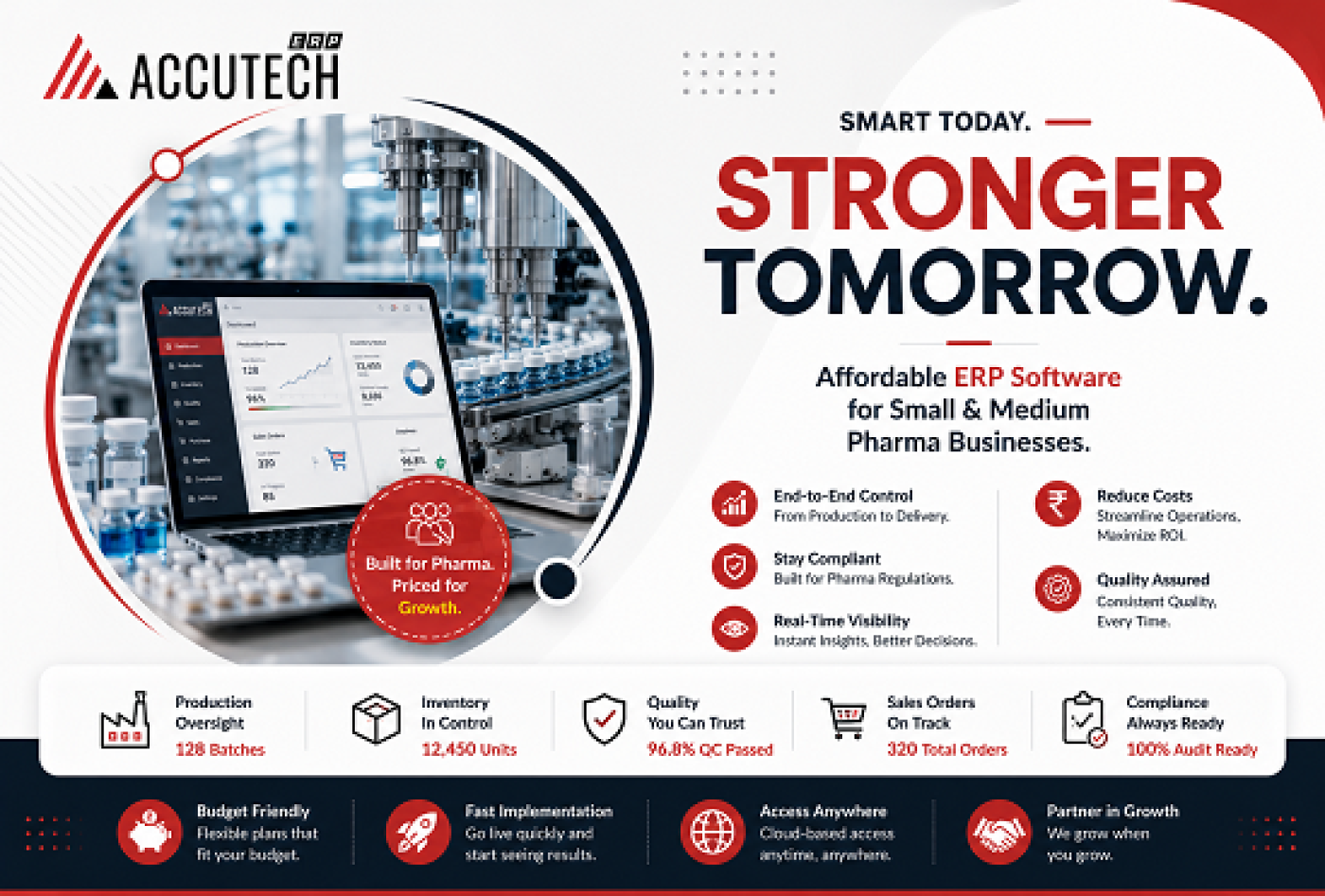
If you're running a small or medium-sized pharmaceutical business in 2026, you've probably asked yourself this question at least a hundred times: "Can we actually afford an ERP system?" The cost seems intimidating. The implementation looks complex. And frankly, when you're already stretched thin managing production, compliance, and delivery, adding software implementation to your plate sounds like a nightmare.
Here's the truth that most software vendors won't tell you upfront: The real question isn't whether you can afford ERP software. It's whether you can afford not to have it. I'm going to walk you through exactly what you need to know, with real numbers, honest assessments, and practical guidance to help you make the right decision for your business.
Let me start with a story that might sound familiar
Rajesh runs a mid-sized pharma company in Ahmedabad that manufactures 25 different formulations. For the past eight years, he's managed everything through spreadsheets, WhatsApp messages, and a filing cabinet full of handwritten notes. His team works hard really hard but every month brings the same problem: discrepancies in inventory, delayed compliance reports, and angry customers because delivery timelines keep slipping. When his compliance officer told him they'd received a notice about incomplete batch traceability, Rajesh realized something had to change. He started researching ERP solutions, but every vendor quote made his stomach sink. The numbers looked impossible for a business his size.
Rajesh's story is not unique. It's the story of thousands of pharmaceutical business owners across India and globally who understand they need better systems but feel trapped by the cost.
The Real Cost of Pharma ERP Software: Breaking Down the Numbers
Let's talk honestly about what pharma manufacturing software actually costs. The pricing landscape has changed dramatically since 2024, and 2026 has brought even more accessible options for small and medium enterprises (SMEs).
Traditional Enterprise ERP Systems
If you're looking at enterprise-grade ERP solutions from global vendors, you're looking at ₹50 lakhs to ₹5 crores just for licensing before implementation, customization, training, or ongoing support. For a business with 50-200 employees, this is genuinely out of reach. These systems are built for large pharmaceutical corporations with hundreds of employees and multiple facilities.
Cloud-Based Pharma ERP Solutions
Here's where things get interesting for small and medium-sized pharma businesses. Cloud-based pharmaceutical manufacturing erp software has democratized access to powerful systems. You're now looking at:
- Monthly subscription: ₹5,000 to ₹25,000 depending on the number of users and modules
- Implementation cost: ₹1 lakh to ₹10 lakhs (often included or subsidized with annual plans)
- Training & setup: ₹50,000 to ₹3 lakhs
So realistically, a small pharma manufacturer could start with a comprehensive pharma erp software system for an initial investment of ₹2-15 lakhs, with ongoing monthly costs of ₹10,000 to ₹25,000. That's a completely different ballgame compared to the ₹5 crore option.
Why Small Pharma Manufacturers Are Saying YES to ERP in 2026
Three years ago, many small pharma businesses could get away without comprehensive digital systems. In 2026, that's simply not an option anymore. Here's why the calculus has shifted:
1. Regulatory Compliance Has Gotten Tougher
The pharmaceutical industry operates under increasingly stringent regulations. In India, CDSCO requirements, batch tracking, quality control documentation, and traceability audits demand digital precision. A single compliance failure can cost you far more than any ERP system we're talking fines ranging from ₹1 lakh to ₹10 lakhs, plus the nightmare of reputational damage and potential suspension of manufacturing licenses.
Using pharmaceuticals manufacturing software ensures that every batch is documented, tracked, and audit-ready. This isn't optional anymore it's a cost of doing business.
2. Supply Chain Vulnerability Has Become Real
The past few years taught us that pharma supply chains are fragile. When you don't have real-time visibility into your inventory, you can't respond quickly to disruptions. Customers demand real-time order tracking, and if you're manually checking spreadsheets, you're going to disappoint them. An ERP system for pharma gives you the visibility you need to handle disruptions intelligently.
3. Talent Retention Demands Modern Systems
Young, talented professionals in 2026 don't want to work with handwritten systems and spreadsheets. They expect to use modern software. When you're competing for talented production managers, quality assurance officers, and supply chain coordinators, having modern systems is a major recruitment advantage. It signals that your company is serious about professionalism and growth.
4. Customer Expectations Have Changed
Your B2B customers (hospitals, clinics, pharmacies, distributors) now expect digital integration. They want real-time order tracking, automated invoicing, and integrated payment systems. If you can't provide that, they'll find a competitor who can. A proper pharma manufacturing software system enables all of this seamlessly.
The Real ROI: What Pharma Businesses Are Actually Seeing
This is where the conversation gets concrete. If you're considering investing in an ERP system, you want to know: Will I actually get my money back?
Cost Savings From Reduced Manual Work
Most small pharma manufacturers spend 15-20 hours per week on manual data entry, reconciliation, and report generation. With an ERP system, this drops to 3-5 hours per week. If you value employee time at ₹200-300 per hour, that's a saving of ₹24,000 to ₹51,000 per month. Over a year, that's ₹2.9 lakhs to ₹6.1 lakhs in labor cost reduction alone.
Inventory Optimization
Better inventory management typically reduces working capital tied up in stock by 10-20%. For a manufacturing business turning over ₹10 crores annually with standard 30-day inventory turnover, this means freeing up ₹25 to 50 lakhs. That capital can be invested in growth, R&D, or working capital.
Faster Billing and Improved Cash Flow
An integrated pharma erp software system automates billing and payment tracking. This typically reduces the billing cycle from 2-3 days to a few hours, and improves on-time invoice payment by 15-25%. For a business with ₹10 crore annual sales, this means improved cash flow of ₹1.5 to 2.5 lakhs monthly.
Quality and Compliance Cost Savings
Audit-ready compliance systems mean fewer back-and-forth queries from regulatory agencies, reduced compliance-related errors, and zero risk of costly recalls due to traceability failures. These might seem like "insurance" costs, but in the pharma industry, they're absolutely critical. A single compliance failure can cost far more than annual ERP fees.
Revenue Growth Opportunities
With better data visibility, pharma manufacturers often identify new growth opportunities. They can serve more customers because they have reliable delivery capabilities. They can expand product lines because they understand demand patterns. Many report 5-15% revenue growth in the first year after implementing a proper ERP system.
Comparing Pharma ERP Solutions for Small and Medium Businesses
Not all ERP solutions are created equal, especially for the pharmaceutical industry. Let's look at how different approaches compare:
|
Factor |
Traditional ERP |
Cloud-Based SME ERP |
Spreadsheet-Based |
|
Initial Cost |
₹50 L - ₹5 Cr |
₹2-15 L |
₹0 |
|
Monthly Cost |
₹20K - ₹1 L |
₹5K - ₹25K |
₹0 |
|
Pharma-Specific? |
Yes, generic |
Yes, specialized |
No |
|
Scalability |
Grows with you |
Designed for growth |
Breaks down |
For small and medium pharma businesses, cloud-based pharmaceutical manufacturing erp software wins on almost every metric that matters: cost, deployment speed, compliance features, and scalability.
Myths vs. Facts: What's Really True About Pharma ERP Costs
Myth #1: ERP Systems Are Only for Large Companies
Fact: In 2026, cloud-based ERP systems are explicitly designed for small and medium businesses. Vendors have recognized that SMEs are the largest segment of pharmaceutical manufacturers globally. Solutions like Pharma PCD ERP are built with the specific needs of smaller manufacturers in mind, including batch operations, regulatory compliance, and PCD distribution models.
Myth #2: Implementation Will Disrupt Business for Months
Fact: Modern cloud-based ERP systems can go live in 4-12 weeks, depending on complexity. Many implement in phases, starting with core modules (inventory and billing) and adding others gradually. Your business continues running normally; you're just adding better tools alongside existing processes.
Myth #3: You Need a Large IT Team to Manage ERP
Fact: Cloud-based systems handle maintenance, updates, and security. Your business needs maybe one person who understands the system well enough to manage user access and handle basic troubleshooting. The vendor manages everything else. This is a massive advantage for small businesses that can't afford dedicated IT staff.
Myth #4: ERP Systems Are Inflexible
Fact: Modern pharma erp software is highly configurable. You can customize workflows, batch processes, reporting, and integrations to match your specific business model without expensive programming.
Myth #5: You'll Lose Control of Your Data
Fact: Reputable pharma manufacturing software vendors maintain multiple data backups, comply with data residency laws (like India's data localization requirements), and give you complete access to export your data anytime. You have more data security with a professional vendor than storing everything on your office computers.
Making the Decision: Is ERP Right for Your Pharma Business?
The real question isn't whether you can afford ERP. It's whether you can afford to wait any longer. Ask yourself these questions honestly:
- Are you spending more than 40 hours per week on manual data entry and reporting?
- Have you ever missed a delivery date because of inventory confusion?
- Are compliance audits stressful because traceability data is scattered across multiple systems?
- Do your customers complain about lack of order visibility?
- Is cash flow management difficult because invoicing and collection is manual?
If you answered yes to more than two of these questions, ERP is not optional anymore it's an operational necessity. The cost of not doing it is higher than the cost of implementation.
A Word About Pharma PCD ERP Software
One solution gaining significant traction among SME pharma manufacturers is Pharma PCD ERP, which is specifically designed for PCD (Propaganda Cum Distribution) distribution models. This is important because the pharma distribution and manufacturing ecosystem in India operates differently from what generic ERP systems assume.
A PCD-specific pharma manufacturing software handles:
- Multiple SKU management with different pack sizes and pricing
- Distributor and stockist management across regions
- Batch traceability and expiry management
- Compliance with pharma regulations and CDSCO requirements
- Real-time inventory sync across multiple locations
This specialization matters because it means you're not paying for features you don't need or struggling to adapt a generic system to your specific business model. The software speaks your language and understands your operational challenges.
Frequently Asked Questions About Pharma ERP Costs
Q1: How long does it take to break even on ERP investment?
Most small pharma businesses see ROI within 8-14 months through labor savings, inventory optimization, and improved cash flow. Some see positive ROI even faster if they were previously losing business due to reliability issues.
Q2: What if our business is smaller than most? Can we still afford ERP?
Cloud-based solutions start from as low as ₹5,000-10,000 per month with minimal setup costs. You only pay for the modules and users you actually need. As your business grows, you can add more features without reinvesting in infrastructure.
Q3: What about ongoing training and support costs?
Most modern ERP vendors include basic training and support in their packages. You might spend ₹20,000-50,000 in the first year for advanced training, but this typically decreases in subsequent years as your team gets comfortable with the system.
Q4: Can we customize the software or are we stuck with standard features?
Cloud-based pharma erp software is highly configurable. You can customize workflows, reports, and integrations. Heavy customization might cost ₹1-5 lakhs, but it's optional for most businesses.
Q5: What if we need to switch vendors later?
Reputable vendors provide complete data exports in standard formats. Switching is possible, though it involves data migration effort. This is why choosing a vendor carefully upfront is important, but the cloud model gives you more flexibility than old on-premise systems.
Q6: How does ERP help with regulatory compliance specifically?
ERP systems maintain complete audit trails, batch documentation, and traceability records automatically. When regulatory agencies audit you, everything is documented and accessible. This prevents costly compliance failures and shows regulators that you take safety seriously.
Q7: Is there a risk of data loss or security issues with cloud-based systems?
Professional cloud vendors maintain multiple redundant backups, advanced security, and comply with international data security standards. Your data is actually safer than storing everything on office computers, which can fail, be stolen, or be damaged.
The Practical Implementation Path for SME Pharma Businesses
If you're ready to move forward with ERP, here's a practical roadmap that minimizes risk and disruption:
- Assess Your Current State (Week 1-2): Document your current processes, identify pain points, and understand what success looks like for your business. You should also calculate what your current manual processes actually cost.
- Research Pharma-Specific Solutions (Week 2-3): Look for solutions specifically designed for pharmaceutical manufacturing and PCD distribution. Get demos from vendors. Ask for references from businesses similar to yours.
- Calculate Total Cost of Ownership (Week 3): Get detailed quotes that include implementation, training, monthly fees, and estimated customization. Also estimate the value of your labor savings.
- Pilot Implementation (Month 1-2): Start with one critical area (like inventory management) rather than trying to implement everything at once.
- Full Rollout (Month 2-3): Once you've learned from the pilot, expand to full implementation with all modules and users.
- Optimization Phase (Ongoing): Continuously refine your use of the system, add new features, and train new employees as they join.
Looking Ahead: The Future of Pharma Operations in 2026 and Beyond
The pharmaceutical industry in 2026 is fundamentally different from what it was even three years ago. Customers expect digital integration. Regulators demand comprehensive documentation. Competitors who have already implemented modern systems are eating into the market share of those who haven't.
The good news is that technology has caught up with the needs of small and medium pharma manufacturers. The cost barrier that existed five years ago has essentially disappeared. Modern pharma manufacturing software is affordable, implementable in weeks rather than months, and delivers measurable ROI quickly.
The real question is no longer "Can we afford ERP?" The real question is "Can we afford not to implement ERP?"
Final Thoughts:
If you're reading this as a pharma business owner wrestling with operational challenges, take this to heart: The tools to transform your business are now within reach. You don't need to be a large corporation to have professional, modern systems. Cloud-based pharmaceutical manufacturing erp software has leveled the playing field.
The businesses that will thrive in the next few years are those that embrace modern systems today. Not because it's trendy, but because it's operational necessity. Because your customers expect it. Because your employees need it. Because your regulators require it.
The investment in pharma erp software isn't about technology for its own sake. It's about giving yourself the tools to run a better business, serve your customers better, manage compliance better, and grow with confidence.
Your next step? Schedule a conversation with a pharma manufacturing software vendor who understands your specific business model. Get a demo. Ask hard questions. Understand the numbers. Then make an informed decision based on your business reality, not your fears.
The future of pharma manufacturing is digital, integrated, and compliant. You can be part of that future.