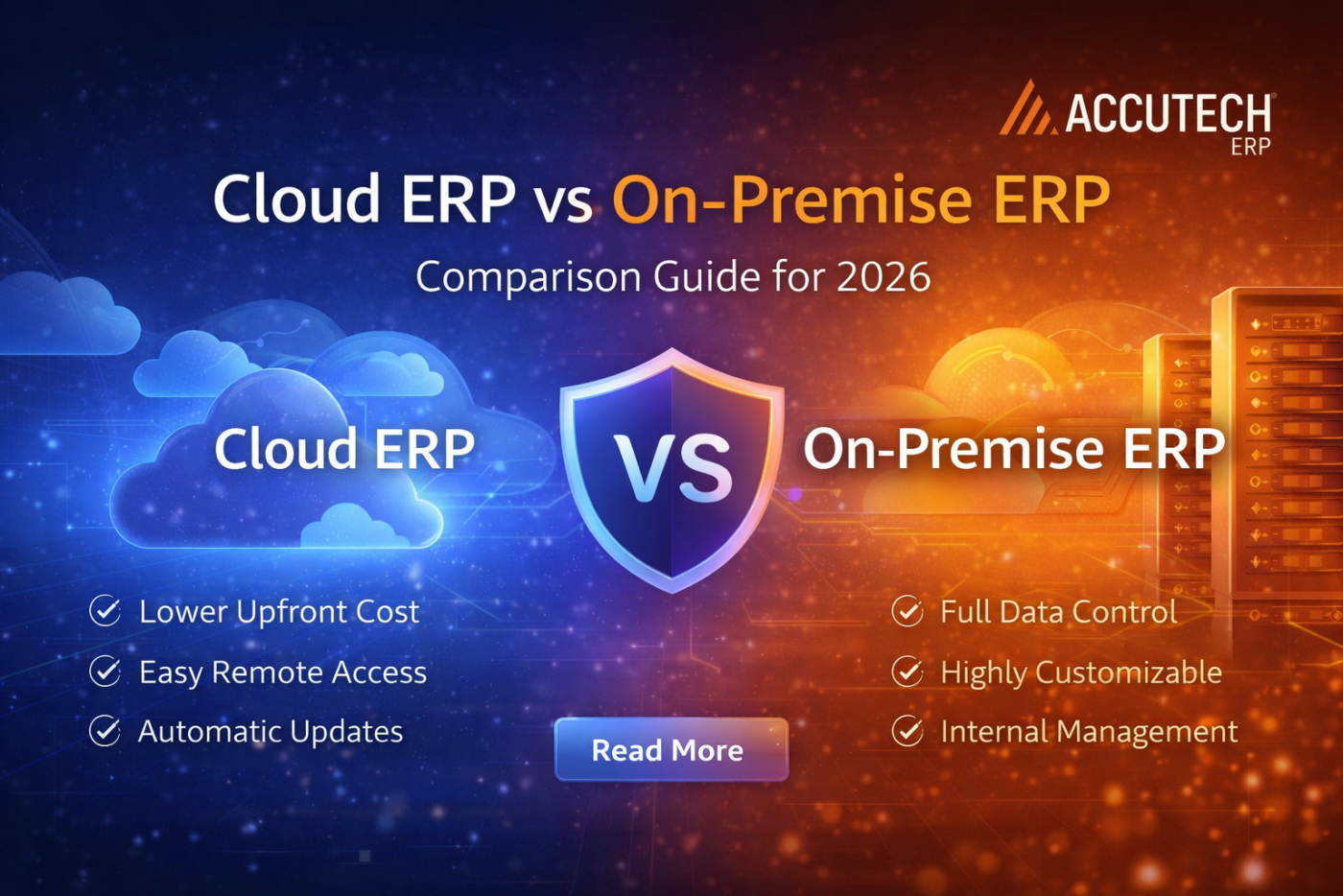
The selection of an ERP system is one of the most important decisions for any business. While choosing the right ERP features and software is essential, selecting the right deployment model is equally critical.
In today’s competitive environment, businesses often get confused between Cloud ERP and On-Premise ERP. Each model comes with its own advantages and limitations.
With digital transformation and the rise of remote work culture, choosing the right ERP model has become even more important in 2026.
What is Cloud ERP?
Cloud ERP is a modern ERP system hosted on remote servers and accessed through the internet. Users can access the system using a web browser without installing any software locally.
In this model, the ERP provider manages:
- Server infrastructure
- System maintenance
- Data backups
- Software updates
This makes Cloud ERP highly accessible, scalable, and easy to manage.
What is On-Premise ERP?
On-Premise ERP is a traditional system where the software is installed on the company’s own servers and managed internally by the organization’s IT team.
Businesses using On-Premise ERP are responsible for:
- Hardware setup
- System maintenance
- Security management
- Software updates
While this model offers complete control, it requires higher investment and technical expertise.
Key Differences Between Cloud ERP and On-Premise ERP
| Feature | Cloud ERP | On-Premise ERP |
|---|---|---|
| Setup | Quick and easy | Time-consuming |
| Initial Cost | Low upfront cost | High upfront investment |
| Maintenance | Managed by provider | Managed internally |
| Accessibility | Anywhere access | Limited to office network |
| Updates | Automatic | Manual |
| Scalability | Easily scalable | Limited scalability |
Advantages of Cloud ERP
✔ Easy Accessibility
Access your business data anytime, anywhere.
✔ Lower Initial Cost
No need for expensive infrastructure or hardware investment.
✔ Automatic Updates
Always stay updated with the latest features and security.
✔ Scalability
Easily scale your system as your business grows.
✔ Quick Implementation
Deploy faster compared to traditional ERP systems.
Advantages of On-Premise ERP
✔ Full Control Over Data
Complete ownership and control of your business data.
✔ High Customization
Customize the system based on specific business needs.
✔ No Internet Dependency
Access the system without relying on internet connectivity.
✔ Suitable for Complex Operations
Ideal for large businesses with complex workflows.
Which One Should You Choose?
Choose Cloud ERP if:
- You want a cost-effective solution
- You need remote access
- You prefer easy maintenance
- You want quick implementation
- You are a growing business
Choose On-Premise ERP if:
- You need full control over data
- You have an in-house IT team
- You require heavy customization
- You operate in regulated industries
Why Cloud ERP is Trending in 2026
- Remote work culture
- Cost efficiency
- Faster implementation
- Better scalability
- Advanced technology integration
Security: Cloud vs On-Premise
Cloud ERP Security
- Advanced encryption
- Regular updates
- Data backups
- Managed by experts
On-Premise ERP Security
- Full internal control
- Depends on IT team
- Manual updates required
Cost Comparison
Cloud ERP Costs
- Subscription-based pricing
- Low upfront investment
- Predictable expenses
On-Premise ERP Costs
- High initial setup cost
- Hardware investment
- Maintenance costs
How Accutech ERP Fits In
Accutech ERP offers flexible solutions designed for modern businesses.
- Easy implementation
- User-friendly interface
- Customizable modules
- Scalable architecture
- Reliable support
Future of ERP Systems
- Cloud-based ERP solutions
- Mobile access
- AI-powered analytics
- Real-time dashboards
Conclusion
Both Cloud ERP and On-Premise ERP have their advantages. The right choice depends on your business needs, budget, and future goals.
In 2026, Cloud ERP is becoming the preferred choice due to flexibility, scalability, and ease of use. Choosing the right ERP system can significantly impact your business growth and success.
FAQs
Q1. Which ERP is better: Cloud or On-Premise?
Cloud ERP is generally better for modern businesses due to flexibility and lower costs.
Q2. Is Cloud ERP secure?
Yes, modern cloud ERP systems use advanced security measures.
Q3. Is On-Premise ERP outdated?
No, but cloud ERP is becoming more popular.
Q4. Can small businesses use Cloud ERP?
Yes, Cloud ERP is ideal for small businesses.