FMCG Management Software: Complete Guide for Distribution & Accounting in 2026
Why FMCG Management Software is Critical in 2026
The Fast-Moving Consumer Goods (FMCG) industry in 2026 stands at a critical juncture where digital transformation is no longer optional but essential for survival. The landscape has changed dramatically compared to previous years, with increased competition, evolving consumer expectations, and stringent regulatory requirements. FMCG distributors and wholesalers face unprecedented operational challenges that demand sophisticated technological solutions. Managing inventory across multiple locations while ensuring product quality, handling high-volume transactions accurately, maintaining compliance with complex tax regulations, and tracking expiring products in real-time are no longer manageable with traditional spreadsheet-based systems or outdated accounting software.
The modern FMCG business operates in a highly competitive environment where margins are thin and efficiency gains directly translate to profitability. A single billing error can impact profit margins significantly. Expired products on shelves represent direct financial loss and potential brand damage. Inaccurate inventory information leads to either stockouts that lose sales or overstocking that ties up capital unnecessarily. Without proper technological infrastructure, FMCG businesses struggle to compete with larger, more organized competitors who have already invested in modern management systems. The question facing most FMCG businesses today is not whether to invest in software solutions, but how quickly they can implement them to avoid losing market share to more digitally advanced competitors.
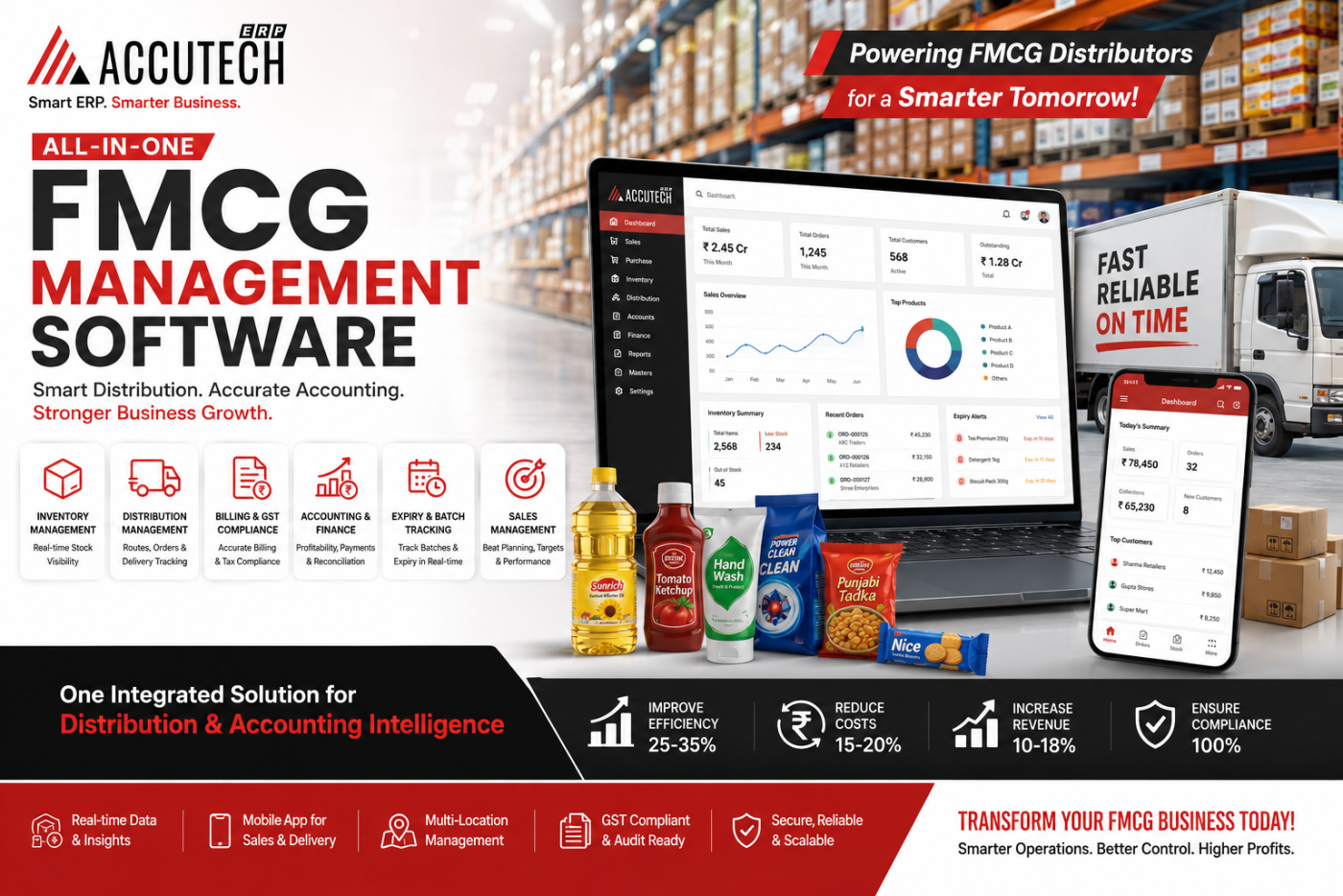
According to industry trends in 2026, leading FMCG distributors report that implementing specialization has resulted in operational efficiency improvements of 25-35%, cost reductions of 15-20%, and revenue increases of 10-18% within the first year of implementation. These are not theoretical gains but proven results from hundreds of businesses across India and South Asia that have transformed their operations using modern FMCG software solutions.
What is FMCG Management Software?
FMCG management software represents a specialized category of enterprise resource planning (ERP) solutions designed from the ground up to address the unique and complex requirements of fast-moving consumer goods distribution. Often referred to as distribution management systems (DMS), these platforms integrate all critical business functions into a single, unified ecosystem. Unlike traditional accounting software that primarily handles financial transactions, or generic CRM systems designed for sales pipeline management, FMCG software is purpose-built for the specific operational challenges of wholesale and distribution businesses.
In 2026, the evolution of FMCG software has moved beyond simple inventory and billing tools. Modern FMCG distribution software now incorporates artificial intelligence for demand forecasting, mobile-first architecture with offline-first capabilities, real-time analytics and business intelligence, advanced batch tracking with expiry date management, automated GST and tax compliance, and integration with payment gateways and financial systems. These systems can track individual product batches from purchase through warehouse storage to final delivery, automatically flag products nearing expiry dates, optimize delivery routes using AI algorithms, and provide real-time visibility into operations across multiple locations.
The fundamental difference between FMCG software and generic business solutions lies in understanding the operational reality of distribution businesses. FMCG companies deal with thousands of products, multiple distributors and retailers, complex pricing schemes, high transaction volumes, perishable inventory with limited shelf lives, and the need to maintain operations efficiently across geographical regions. A typical FMCG distributor might process hundreds of orders daily across dozens of customer locations, manage inventory across multiple warehouses, track dozens of product batches, and deal with multiple SKU variants all while maintaining GST compliance and managing complex promotional schemes. Generic software simply isn't equipped to handle this complexity effectively. Modern FMCG management solutions in 2026 focus heavily on automation, real-time visibility, mobile-first operations, and data-driven decision making. They are built to scale with your business growth, adapt to changing regulatory requirements, and provide the agility needed to respond quickly to market changes and customer demands.
Common Challenges FMCG Businesses Face Without Proper Management Software
Inventory Management Nightmares and Stock Visibility Issues
One of the most persistent challenges facing FMCG distributors in 2026 is maintaining accurate inventory visibility across multiple locations. Many distributors still rely heavily on spreadsheets, manual counting, and periodic physical stock verification, which create several critical problems. When inventory tracking is done manually or with outdated systems, discrepancies between physical stock and recorded inventory become inevitable. A distributor might have shown 1000 units of a product in the system but only 850 units actually exist in the warehouse due to unrecorded breakage, theft, or counting errors. These discrepancies compound over time and create confusion in ordering decisions.
The challenge becomes exponentially more complex when managing multiple warehouses, distribution centers, and retail outlets across different regions. Without a centralized system providing real-time inventory data, coordinating stock movements becomes nearly impossible. A manager might order more stock for a warehouse that already has sufficient inventory while another location faces critical shortages. This results in overstocking in some locations (tying up capital unnecessarily) and stockouts in others (losing sales). In the FMCG industry where margins are thin and inventory turnover is critical, these inefficiencies directly erode profitability.
Additionally, manual inventory management consumes enormous amounts of time and human resources. Staff spend hours counting, recounting, and reconciling stock. This is not only expensive but also error-prone. The opportunity cost is significant the time your team spends on manual inventory tasks could be spent on more value-added activities like customer relationship management, sales strategy, and business development. Many FMCG businesses report losing 4-6 hours daily just on inventory-related manual tasks when operating without proper management software.
Product Expiry and Perishable Inventory Loss
In the FMCG industry, products have limited shelf lives. Groceries, beverages, dairy products, personal care items, and pharmaceuticals all have specific expiry dates beyond which they cannot be sold legally or ethically. Without proper tracking systems, products expire on shelves while being counted as inventory assets. This represents a significant financial loss that directly reduces profit margins. Industry data from 2026 shows that FMCG businesses without proper expiry tracking systems lose between 5-15% of their inventory value annually to expired stock.
The problem extends beyond just the cost of lost inventory. When expired products somehow make it to retail shelves and reach customers, it creates serious brand damage. Customers who receive expired products lose trust in your business, leading to lost sales, negative reviews, and damaged reputation in the market. In the digital age of 2026 where reputation spreads instantly through social media, a single incident of selling expired products can have cascading negative consequences for your business. Additionally, selling expired products violates regulatory requirements and can result in legal penalties and fines.
Without proper batch tracking and visibility, managing expiry dates becomes a nightmare. Staff resort to manual inspections of products, which is time-consuming and unreliable. Some batches are overlooked, expiring unnoticed. Products purchased first might not be sold first if there's no system to enforce first-in-first-out (FIFO) inventory rotation. This means newer stock sells first while older batches approach expiry, creating waste. The financial impact of accumulated expired inventory both the cost of disposal and the lost revenue can be devastating, particularly for distributors with high-volume operations.
Furthermore, suppliers typically allow returns of goods before expiry, but only with proper documentation and within certain timeframes. Without visibility into which batches are nearing expiry, distributors miss opportunities to return goods to suppliers and recover value. Every day a batch sits in inventory without being sold is a day closer to the expiry deadline when it becomes non-returnable.
Complex Billing, Accounting, and Tax Compliance Challenges
Manual billing processes in FMCG businesses create multiple layers of complexity and errors. In 2026, with complex tax structures, multiple customer segments, and diverse product categories, the risk of billing errors has increased significantly. A distributor might need to apply different GST rates based on product category, maintain different pricing for different customer segments based on volume purchased, factor in various promotional schemes, and calculate applicable discounts all while ensuring tax compliance. When this process is manual, errors are almost inevitable.
These billing errors create cascading problems. An incorrect invoice creates confusion with the customer, potentially delaying payment. It creates mismatches between billing records and accounting books, requiring time-consuming reconciliation. Wrong tax calculations create compliance issues with government authorities. If you bill a customer at an incorrect GST rate, you create a liability that must be corrected through detailed reconciliation and amended returns. The administrative burden and potential penalties associated with billing errors far exceed the cost of implementing proper billing software.
The GST compliance burden in 2026 is particularly challenging for FMCG distributors. GST filing requirements demand accurate tracking of every transaction, proper categorization based on product and customer type, timely filing of returns, and maintenance of comprehensive documentation. A distributor processing hundreds of transactions daily must ensure each one is recorded correctly, categorized properly, and reported accurately. Manual processes make this nearly impossible without errors. Non-compliance results in penalties, interest charges, and potential business disruption. Many FMCG businesses spend days every month just compiling data for GST returns, and even then, they often miss filing deadlines or submit incorrect information.
Additionally, without integrated accounting, reconciling billing records with actual accounting books becomes a never-ending challenge. Sales data exists in one system, accounting data in another, and payment information in yet another. These systems don't communicate, requiring manual data entry and reconciliation. This not only creates inefficiencies but also introduces errors that compound over time. By the time quarterly or annual audits occur, the accounting records are a mess requiring extensive rework. The time and cost spent on reconciliation and audit preparation could be eliminated entirely with proper integrated accounting software.
Distributor and Sales Team Performance Tracking Blind Spots
In 2026, managing a distributed sales force across multiple regions presents significant visibility challenges without proper tracking systems. FMCG businesses with multiple salesmen visiting different customer locations struggle to answer basic questions: Which customers did each salesman visit today? How long did they spend at each location? How many orders were taken? Which customers didn't place orders? Is the salesman visiting customers in the right sequence? Are payment collections happening as planned? Without answers to these questions, managers are operating blind, unable to identify underperforming areas or optimize sales operations.
The consequences of poor field visibility are significant. Salesmen might be visiting less profitable customers repeatedly while neglecting high-potential customers. They might be taking inefficient routes, wasting time on travel and fuel. Payment collections might be delayed because there's no systematic follow-up process. Customer orders might be lost or forgotten because they're written in notebooks without any centralized tracking. Promotional schemes might not be applied correctly, causing customer disputes. Outstanding customer invoices might not be tracked, leading to credit limit violations and bad debt. The cumulative effect of these inefficiencies is significant lost revenue and operational chaos.
Furthermore, without proper tracking, identifying and rewarding top performers becomes difficult. Sales management becomes reactive rather than proactive. Managers don't have data to identify which products are moving fastest in which regions, so they can't make informed procurement decisions. They can't identify emerging customer needs or market trends because they lack real-time sales data. Performance issues are discovered only when it's too late after significant revenue loss occurs. In a competitive market, this lack of visibility puts FMCG businesses at a serious disadvantage compared to competitors with modern sales tracking systems.
Multi-Location Business Operations and Coordination Complexity
Managing multiple warehouses, distribution centers, and retail outlets across different regions or even different states presents immense coordination challenges without integrated systems. A company might have a central warehouse, regional distribution centers, and dozens of retail outlets. Each location needs to maintain appropriate inventory levels, but these must be coordinated to prevent both stockouts and overstocking across the network. Transfer of goods between locations happens regularly, but tracking these movements, updating inventory in all locations, and maintaining accurate financial records becomes incredibly complex.
Price management becomes another nightmare with multiple locations. In 2026, different locations might have different market conditions, competition levels, and customer segments, requiring location-specific pricing strategies. Without integrated systems, maintaining consistent prices across locations while allowing strategic variations becomes nearly impossible. Different locations might charge different prices for the same product, leading to customer confusion and potential disputes. Promotional campaigns might be applied inconsistently across locations, reducing their effectiveness.
Financial reporting across multiple locations without integrated systems is extremely challenging. To understand overall business performance, you need consolidated financial statements showing sales, costs, and profitability across all locations. With disconnected systems, compiling this information requires manual data collection and consolidation from each location, which is time-consuming and error-prone. By the time the consolidated data is available, it's often outdated. This delays decision-making and reduces management's ability to respond quickly to emerging issues in any location.
Additionally, inter-location transfers of goods create complex accounting entries that must be properly recorded and reconciled across different location accounts. Without proper systems, tracking the movement of goods between locations and ensuring accurate accounting in both the sending and receiving locations becomes a manual process prone to errors. Over time, account discrepancies accumulate, and understanding the true financial position of the business becomes nearly impossible without significant accounting cleanup effort.
Essential Features of Modern FMCG Management Software in 2026
Real-Time Inventory Tracking and Intelligent Stock Management
The cornerstone of modern FMCG management systems is real-time inventory visibility. Unlike traditional systems that provide inventory data only at the end of the day or after manual counting, modern inventory management software for FMCG provides instantaneous visibility into stock levels across all warehouses and retail outlets. Every transaction, every purchase, sale, return, or transfer updates the inventory immediately, ensuring that anyone querying the system sees current, accurate stock information. This real-time visibility is critical for making informed decisions about ordering, pricing, and promotion.
Beyond just showing current stock levels, modern FMCG software incorporates intelligent features that help prevent stockouts and overstocking. The system can be configured to automatically generate low-stock alerts when inventory for any product falls below a defined threshold. Rather than waiting for critical stockouts to occur, managers and procurement teams are immediately notified, allowing them to take corrective action before problems impact customer service. Similarly, the system can flag slow-moving inventory that hasn't sold in a specified period, preventing capital from being unnecessarily tied up in products that aren't selling.
In 2026, advanced FMCG software incorporates artificial intelligence and machine learning algorithms that analyze historical sales patterns to forecast future demand more accurately. These forecasting capabilities help distributors maintain optimal inventory levels enough to meet anticipated demand without maintaining excess stock. This is particularly important for FMCG businesses where capital efficiency is critical. The ability to forecast demand accurately, especially when combined with batch tracking and expiry management, allows distributors to maintain lower average inventory levels while actually improving customer service because they're better prepared for expected demand spikes.
Batch and serial number tracking capabilities in modern systems provide complete product traceability. Every batch of products can be tracked from purchase through warehouse storage to final delivery to customers. This traceability is essential not only for managing expiry dates but also for quality control and customer service. If a quality issue is discovered with a specific batch, the system can immediately identify which customers received products from that batch, enabling rapid response and recall if necessary. This capability is increasingly important as regulatory requirements become more stringent and customer expectations for product safety increase.
Warehouse management features have also evolved significantly in 2026. Modern systems include capabilities for managing multiple storage locations within a warehouse, tracking products across shelves and bins, and optimizing picking routes. When an order needs to be fulfilled, the system can direct warehouse staff to the most efficient route through the warehouse to collect all items for that order, reducing picking time and minimizing errors. Some advanced systems even integrate with barcode scanning and RFID technology to further automate and validate warehouse operations.
Advanced Batch and Expiry Date Management Systems
For FMCG businesses dealing with perishable or time-sensitive products, batch and expiry date management is absolutely critical. Modern FMCG software includes comprehensive batch tracking features that maintain detailed information about every batch of products in inventory. For each batch, the system tracks the manufacturing date, expiry date, supplier information, purchase date, and current quantity available. This information is accessible instantly, allowing anyone in the organization to see the status of products in real time.
One of the most valuable features is the automatic age of inventory reports. This report displays every product in inventory along with how long that product has been in storage. Products approaching their expiry dates are highlighted, drawing immediate attention to products that need to be sold urgently or returned to suppliers before expiry. In 2026, some advanced systems use color-coded displays where red products are expiring within days, yellow products are expiring within weeks, and green products have adequate shelf life remaining. This visual management makes it extremely easy to identify which products need immediate attention.
FIFO (First-In-First-Out) inventory rotation is automatically enforced by modern FMCG software. Rather than relying on manual vigilance to ensure older stock is sold before newer batches, the system automatically directs picking operations to older batches first. When a sales order is received, the system suggests (or automatically selects) the oldest batch that matches the product criteria, ensuring that older products are always sold first. This prevents older batches from being forgotten in the warehouse while newer batches sell, which would lead to unnecessary expiry losses.
Additionally, modern systems provide expiry-based alerts at multiple levels. If a customer orders a product, the system can be configured to automatically suggest only batches that will have adequate shelf life remaining when the product reaches the customer, preventing the distribution of products that will expire quickly in customer inventory. This level of sophistication in expiry management is what differentiates modern FMCG software from generic inventory systems and is crucial for maintaining customer relationships and brand reputation in 2026.
Integrated Billing, Invoicing, and GST Compliance Automation
In 2026, FMCG billing software has evolved far beyond simple invoice generation. Modern systems handle the complete billing and accounting lifecycle with sophisticated automation. When a sales order is entered into the system whether from a salesman in the field or a customer ordering through an online portal the system automatically prepares the invoice with all product details, quantities, rates, taxes, and applicable discounts calculated correctly.
The automation extends to tax calculations, which in India involves complex GST rules that vary by product category and customer type. Modern FMCG software automatically applies the correct GST rate to each product based on the product master configuration. If a product qualifies for a lower GST rate or is exempt, the system applies the correct rate automatically. If different GST rates apply to different components of a bundled product, each is calculated separately. This level of accuracy is essentially impossible to achieve consistently with manual billing but is routine in modern software systems.
Beyond basic invoicing, modern FMCG software integrates billing with accounting automatically. Every sales invoice is immediately posted to the accounting system, creating the appropriate journal entries without manual intervention. The customer account is updated with the new charge, outstanding receivables are tracked automatically, and financial reporting is continuously updated. This integration eliminates the reconciliation nightmare that plagues businesses using separate billing and accounting systems. The same transaction never needs to be entered twice, and discrepancies between billing and accounting become virtually impossible.
GST return filing, which is a mandatory monthly or quarterly requirement in 2026, is dramatically simplified. The system maintains detailed records of every transaction with proper GST classification. When the GST filing deadline approaches, the system generates complete reports showing all sales categorized by GST rate, input tax credits, and other required details. These reports can be exported in the format required by the GST portal, or in some cases, the system can directly file returns with the government portal if configured appropriately. What would take days of manual data compilation can now be done in minutes.
E-invoice and e-way bill generation capabilities have also become essential in modern FMCG software. E-invoices are required for transactions above a certain threshold and must follow specific government formats. E-way bills are required for interstate movement of goods above a certain value. Modern software generates these documents automatically and in compliance with all government requirements. Some systems can even submit these documents directly to government portals. This automation ensures compliance and eliminates the manual process of generating these documents separately.
Mobile Field Sales Application with Offline-First Architecture
One of the most transformational features of modern FMCG software in 2026 is the mobile field sales application. In earlier years, mobile apps were often secondary features that simply displayed data from the main system. Modern FMCG solutions have completely reversed this architecture, building systems with mobile-first design where the mobile app is the primary interface for field operations, and the web-based backend serves as a management and reporting platform.
The key innovation in modern mobile FMCG apps is offline-first functionality. Rather than requiring continuous internet connectivity, the app downloads all necessary data product catalog, pricing, customer information, inventory availability, promotional schemes to the mobile device when connectivity is available. The salesman then works offline throughout the day, taking orders, accessing product information, and processing payments without needing the internet. This is crucial for FMCG distribution in India and South Asia where internet connectivity in rural and remote areas is often unreliable. At the end of the day or whenever connectivity becomes available, all data synchronizes automatically to the central system, ensuring no orders or information is lost.
The mobile app provides salesmen with real-time access to critical information needed for customer interactions. They can check current stock availability for any product, check the current price for that customer (which might be different from standard pricing based on volume purchased or special agreements), verify any ongoing promotional schemes and calculate discounts automatically, check customer outstanding balance and credit limit, and access complete customer history including past purchases and payment patterns. This information empowers salesmen to provide better customer service, respond to customer inquiries immediately, and close sales faster because they have all necessary information at their fingertips.
Order entry through the mobile app is designed for speed and accuracy. Rather than writing orders in notebooks that must be transcribed later, salesmen enter orders directly into the system using forms optimized for mobile screens. The app guides them through the process, automatically calculating totals with applicable discounts and taxes shown in real time. The order is immediately transmitted to the back office when connectivity is available, allowing order fulfillment to begin without delay. Some advanced systems can even print invoices on the spot using mobile printers, providing customers with immediate documentation of their purchase.
Payment collection is revolutionized with mobile payment integration. Rather than collecting cash and creating security risks, or giving customers payment terms and potentially struggling to collect later, modern mobile apps integrate with digital payment solutions. Salesmen can process card payments, digital wallet payments, or bank transfers directly through the mobile app, reducing handling of cash and accelerating payment collection. The system maintains a complete record of every payment, eliminating disputes about whether payment was received.
GPS tracking and geotagging capabilities in modern FMCG mobile apps provide managers with visibility into field operations. Each customer visit can be geotagged, providing proof that the salesman was actually at the location. This is useful for accountability and also for understanding the actual routes salesmen are taking. Route optimization algorithms can analyze this data and suggest more efficient routes, reducing travel time and fuel costs. Managers can view real-time location of salesmen on a map, adding another layer of accountability and enabling rapid response if issues arise in any location. Attendance tracking becomes automatic through GPS check-ins rather than manual sign-in processes.
Multi-Location Warehouse and Outlet Management Capabilities
Managing multiple warehouses, distribution centers, and retail outlets becomes dramatically simplified with integrated FMCG software. The system maintains separate inventory tracking for each location, but all locations feed into a unified system, providing centralized visibility and management. A manager can view inventory levels at all locations simultaneously, understanding the complete picture of where stock is positioned across the distribution network. This unified view enables better decision-making about stock transfers between locations and procurement planning.
Inter-location stock transfers are managed systematically within the software. When stock needs to be transferred from one location to another, the system records the transfer in the sending location (reducing its inventory) and the receiving location (increasing its inventory). The transfer is tracked, and both locations must confirm receipt to complete the transaction. This creates an audit trail of all stock movements, preventing losses and enabling reconciliation if discrepancies occur. The accounting entries for transfers are automatically created, updating the financial statements of both locations without manual intervention.
Pricing management is centralized but flexible. Standard prices can be set at a corporate level, but each location can override prices based on local market conditions. Promotional campaigns can be configured to apply corporatewide or customized for specific locations. This ensures consistency in messaging and brand positioning while allowing strategic pricing flexibility based on local market dynamics. Customers don't experience confusion from different prices at different locations, yet each location can implement appropriate pricing strategies for its market.
Consolidated financial reporting across all locations becomes possible with integrated systems. Managers can run reports showing sales, costs, inventory levels, and profitability for any location, group of locations, or the entire organization. These reports are generated instantly from current data rather than requiring manual consolidation. Trends can be identified quickly perhaps one location is showing declining sales or rising costs allowing management to investigate and take corrective action. Without consolidated reporting, these issues might go unnoticed until they become serious problems.
Account management for each location is separate but integrated. Each location maintains its own chart of accounts, but all accounts feed into a consolidated balance sheet. This structure ensures that financial results for each location can be analyzed independently while also maintaining consolidated financial statements for the organization. Audit requirements are simplified because each location's books can be audited independently, but consolidated statements are available immediately for corporate-level reporting and analysis.
Advanced Analytics, Reporting, and Business Intelligence
In 2026, the evolution of FMCG software has elevated reporting and analytics from basic transaction reporting to sophisticated business intelligence that drives decision-making. Modern systems provide interactive dashboards that display key performance indicators in real time. Rather than waiting for daily or monthly reports, managers can access current performance metrics instantly, understanding the current state of business operations as it unfolds.
Sales analytics provide visibility into which products are selling fastest, which customers are most valuable, which regions are most profitable, and which salesmen are most productive. This data is segmented by product, customer, region, salesman, time period, and countless other dimensions. A manager can instantly answer questions like: Which products are trending upward in sales? Which products are losing market share? Which customer segments are most profitable? Which salesmen consistently exceed targets? What is the seasonality pattern for each product? This level of insight enables strategic decisions that were impossible with manual data compilation.
Inventory analytics provide sophisticated visibility into stock health. Age of inventory reports show exactly which products have been in storage longest and which are turning over quickly. Slow-moving inventory reports identify products that aren't selling despite being in stock, potentially indicating overstocking or market misalignment. Expiry risk reports warn of products approaching expiry dates that need immediate attention. Inventory turnover ratios show which products move fastest and which move slowly, informing future procurement decisions. For a distributor managing thousands of products, these analytics are invaluable for optimizing inventory mix and reducing carrying costs.
Customer analytics provide insights into customer behavior and profitability. The system can rank customers by purchase volume, by frequency of purchases, by average transaction value, and by profitability after accounting for delivery costs and payment behavior. Customer trend analysis shows which customers are increasing purchases, which are declining, and which are at risk of churning. This enables proactive customer management reaching out to at-risk customers to understand issues, providing better service to most valuable customers to retain them, and deciding strategically about allocating resources to different customer segments.
Accounting and financial analytics provide real-time financial visibility. Current profit and loss statements, balance sheets, cash flow statements, and hundreds of other financial metrics are available instantly. Variance analysis compares actual results to budgets or prior periods, identifying areas where performance is better or worse than expected. This enables management to understand financial performance quickly and investigate anomalies before they become significant problems. Tax analytics ensure compliance and identify opportunities for tax optimization. Receivables aging reports track which customers have outstanding invoices and which are overdue, enabling proactive collection management.
Scheme and Promotion Management Engine
FMCG businesses use complex promotional schemes to drive sales and manage market dynamics. These might include volume-based discounts (buy 10 units, get 5% off), special pricing for specific customer segments, seasonal promotions, bundle pricing where multiple products are sold together at a discount, loyalty rewards for repeat customers, and countless other variations. Managing these schemes manually while ensuring they're applied correctly to every transaction is nearly impossible without proper systems.
Modern FMCG software includes comprehensive scheme management engines that allow configuring schemes with multiple conditions and rules. A scheme might specify: this discount applies only to customers in this region, only during this time period, only for products in this category, and only when the purchase exceeds this volume. The system automatically evaluates each transaction against all configured schemes and applies the appropriate discount without manual intervention. This ensures consistency in scheme application across all transactions and all salesmen, preventing disputes with customers about why they received a different price than expected.
The scheme management capability is particularly valuable for trade marketing campaigns. When running a promotion, the discount is configured once in the system and applied automatically to all qualifying transactions. Tracking promotional results is easy because the system can report on how many units were sold under the promotion, what total discount was given, and what the net impact was on revenue and profit. This data helps optimize future promotional strategies. Without proper scheme management, tracking promotional effectiveness is difficult, making it hard to learn from past campaigns and optimize future ones.
Why Accutech ERP is the Best FMCG Management Software Solution for Your Business
Among the numerous FMCG software options available in the market in 2026, selecting the right solution for your business is critical because this decision will impact your operations for years to come. While there are several options available, Accutech ERP stands out as a comprehensive, India-focused solution specifically engineered to meet the unique requirements of FMCG distributors, wholesalers, and retailers. Unlike generic ERP systems designed for manufacturing or services, or specialized solutions that excel in one area but struggle in others, Accutech ERP provides integrated excellence across all critical FMCG business functions.
Complete End-to-End Business Integration
Accutech ERP integrates every critical business function into a unified platform, eliminating data silos and manual reconciliation. Inventory management with batch tracking and expiry date management feeds directly into sales operations, ensuring salesmen always have accurate stock information. Sales operations flow directly into billing and accounting, eliminating reconciliation needs. Field operations tracked through the mobile app feed real-time data to management systems. Customer information, pricing rules, promotional schemes, and payment information are centralized, ensuring consistency across all operations.
This integration delivers dramatic efficiency gains. Data doesn't need to be entered multiple times in different systems. Errors that result from manual data transfer between systems are eliminated. Reports are instantly available because they draw from the same unified database rather than requiring consolidation from multiple systems. The result is faster operations, fewer errors, and better information for decision-making.
Purpose-Built for FMCG Industry Requirements
Unlike generic ERP systems that try to serve multiple industries with generic features, Accutech ERP is purpose-built for FMCG distribution. Every feature, every workflow, every report is designed with a deep understanding of how FMCG businesses actually operate. The system understands batch-based inventory, expiry date constraints, perishable product management, high-volume billing, distributor networks, retail ordering, promotional scheme complexity, and field sales operations. This specialization means the software works the way your business naturally works, rather than forcing your business to fit the software's generic model.
Batch master management in Accutech ERP is specifically designed for FMCG. Every batch is tracked with manufacturing date, expiry date, lot number, and supplier information. Aging reports provide clear visibility into shelf life status. FIFO picking is automatically enforced. Expiry-based alerts are configurable at multiple levels. None of these features are afterthoughts or added later they're core to how the system is designed.
High-volume billing is handled with efficiency designed for FMCG distributors. When a distributor might process hundreds of orders daily across dozens of customer locations, the system is built to handle this volume without slowing down. Billing operations complete in seconds rather than minutes. GST calculations, scheme applications, and pricing rules are applied in milliseconds. Payment processing is instantaneous. The system was built knowing that distributors need fast, accurate, high-volume billing.
The mobile field sales application is designed specifically for FMCG sales operations. It understands beat planning, route optimization, customer visit management, order entry workflow for distributors, offline-first operations, and instant payment collection. Features like beat route management and stop analysis are built in, not added as afterthoughts. The mobile app is optimized for the way FMCG salesmen work, not for generic sales teams.
Mobile-First Architecture Built for Field Operations
Accutech ERP's architecture is fundamentally mobile-first, recognizing that for FMCG businesses, most critical operations happen in the field, not in an office. The mobile application is not a secondary interface for accessing desktop features, it's the primary operational platform where the majority of transactions are initiated. Salesmen take orders, process payments, update customer information, and access all necessary data through the mobile app. The web-based back office serves primarily as a management and reporting interface.
The offline-first functionality is a critical differentiator. In rural areas and regions with unreliable connectivity, salesmen can work completely offline, and all data synchronizes when connectivity becomes available. The system never loses transactions or data due to connectivity issues. This reliability is essential for FMCG businesses operating in India where connectivity consistency varies significantly by region.
The user interface is optimized for mobile operation. Screens are designed for small displays, touch operation, and quick data entry. The workflow is optimized for speed critical information is immediately visible, common tasks are completed in minimal steps, and the app guides users through required processes. Field salesmen can be trained to use the app in hours rather than days, and productivity benefits begin immediately after implementation.
Complete GST and Tax Compliance in One System
In 2026, GST compliance remains a critical requirement for FMCG businesses in India, and Accutech ERP provides complete automation of all compliance-related processes. The system is updated annually (or as required) to reflect any changes in GST rates, tax rules, or regulatory requirements. Product master configuration allows specifying the appropriate GST rate for each product, including special rates or exemptions for specific products. Customer master configuration allows specifying customer type (registered dealer, exempt entity, etc.) to ensure appropriate tax treatment.
During every transaction, the system automatically applies the correct GST rate based on product category and customer type. If a transaction involves multiple products with different GST rates, each is calculated correctly and separately. The invoice clearly shows the tax amount, allowing customers to understand charges. HSN codes are automatically populated based on product master, facilitating government reporting. The system generates detailed tax invoices that meet government requirements.
When GST filing periods arrive, Accutech ERP generates complete GSTR reports containing all required information about sales (for GSTR-1) and input tax credits (for GSTR-3B). Reports can be generated in seconds and exported in formats compatible with government portals. Some configurations even allow direct filing with government systems. What would take accounting teams days to compile manually is completed by the system in minutes, reducing errors and ensuring filing deadlines are met.
E-invoice generation is automated in Accutech ERP for transactions exceeding GST thresholds. The system generates invoices in the required JSON format and can optionally submit directly to the e-invoice portal for registration. E-way bill generation is similarly automated for interstate transactions, capturing all required information and generating documents in the correct format. This automation ensures compliance while eliminating manual document generation that would otherwise be required.
Rapid Implementation with Dedicated Support
Accutech ERP understands that FMCG businesses can't afford long implementation periods. The longer the implementation takes, the longer the business operates inefficiently. Accutech ERP follows a structured implementation methodology designed for rapid deployment. Small to medium-sized businesses typically go live in 2-4 weeks. The process includes rapid business assessment, system configuration based on your specific requirements, data migration from existing systems, team training, and testing all accelerated through proven methodologies and templates.
Data migration is handled professionally, ensuring no data loss and minimal manual effort. Legacy data from existing accounting systems, inventory systems, or spreadsheets is mapped to Accutech ERP data structures and migrated efficiently. The company provides expert support throughout the migration process to ensure data integrity and completeness. Opening balances are verified against your previous system to ensure financial statements reconcile correctly.
Training is comprehensive and tailored to different user roles. Accountants receive training on billing, accounting, and GST compliance. Warehouse staff receive training on inventory and stock management. Salesmen receive training on the mobile app and field operations. Managers receive training on reporting and analytics. Rather than one-size-fits-all training, each group learns what's specifically relevant to their role, ensuring faster adoption and productivity.
Post-implementation support is comprehensive and responsive. A dedicated support team is available 24/7 to assist with issues, answer questions, and provide guidance. Response times are fast, and issues are resolved quickly to minimize business disruption. Over time, support transitions from implementation phase to steady-state operations, but the same level of responsiveness is maintained. Users know they have reliable support whenever they need it.
Transparent and Scalable Pricing Model
Accutech ERP follows transparent, subscription-based pricing designed to scale with your business growth. Rather than large upfront implementation costs or seat-based licensing that penalizes adding users, the pricing model is based on transaction volume or annual revenue. As your business grows and processes more transactions, costs increase proportionally, but you're not paying for capacity you're not using. This fair pricing model aligns system costs with business value delivered.
There are no hidden fees or surprise charges. The subscription includes core software functionality, regular updates and security patches, technical support, and system maintenance. Dedicated customization or specialized consulting might incur additional charges, but these are clearly communicated upfront. Most FMCG businesses achieve positive ROI within 6-12 months through improved efficiency, reduced errors, and better inventory management. The system pays for itself through operational improvements and cost savings.
Pricing transparency and fairness build trust with customers. Accutech ERP doesn't employ lock-in tactics or surprise cost escalations. The pricing model is straightforward, and the value delivered is clearly evident in improved business performance.
How Modern FMCG Management Software Solves Your Critical Business Challenges
Eliminating Inventory Management Problems and Stockout Situations
The inventory management problems that plague FMCG businesses without proper systems stockouts, overstocking, inaccurate records, and manual counting labor are virtually eliminated with Accutech ERP. Real-time inventory visibility means everyone in the organization always knows current stock levels. Salesmen check stock before quoting to customers, warehouse managers understand what's in stock and where it's located, and procurement teams see demand signals that help them order at the right time in the right quantities.
Barcode scanning technology integration allows warehouse staff to update inventory by scanning products as they're received, moved, or sold. This eliminates manual counting and reduces errors dramatically. A distributor processing hundreds of transactions daily can maintain 98-99% inventory accuracy with barcode scanning compared to perhaps 85-90% accuracy with manual counting. The accuracy difference directly translates to better decision-making about ordering and reduced safety stock requirements.
Automatic low-stock alerts prevent stockouts. When inventory for any product falls below the configured threshold, the system notifies relevant people automatically. This enables proactive procurement before stockouts occur rather than reactive emergency ordering after the fact. Reducing stockout incidents improves customer service (customers always find products in stock) and sales (revenue isn't lost to unavailable products). The financial impact of preventing stockouts typically far exceeds the system cost.
The time saved by eliminating manual inventory counting is substantial. Distributors report saving 4-6 hours daily on inventory-related manual tasks. This freed-up time can be redirected to more valuable activities like customer service, business development, and strategic planning. Staff morale improves when they're no longer spending time on tedious counting tasks. The combination of improved accuracy, prevented stockouts, better decision-making, and freed-up staff time creates measurable business value that begins immediately after implementation.
Preventing Product Expiry Losses and Brand Damage
The financial and reputational damage from expired products being sold is prevented through Accutech ERP's batch tracking and expiry management capabilities. Every batch of products is tracked with expiry date information. Age of inventory reports instantly identify products approaching expiry, triggering immediate action; these products can be prioritized for sale, returned to suppliers if within return windows, or disposed of if necessary. By taking action on expired or expiring products proactively, distributors prevent the scenario where products accidentally sit in inventory past expiry and are discovered only during physical counting.
FIFO enforcement prevents the scenario where newer stock is sold while older batches remain in inventory approaching expiry. The system automatically directs picking operations to older batches first. Salesmen see products sorted by batch age, naturally gravitating toward older products. For high-volume operations where manual tracking of which batch to prioritize for which customer would be error-prone, FIFO automation is invaluable.
The system can be configured to prevent selling products that won't have adequate shelf life remaining when reaching the customer. If a customer orders a product and the remaining shelf life after shipping and delivery would be less than a configured threshold (e.g., 30 days), the system alerts or prevents the sale. This ensures customers never receive products that will expire shortly, eliminating customer dissatisfaction and product returns due to expiry.
The impact on the bottom line is significant. Distributors report reducing expired inventory losses from 5-15% annually (with manual systems) to less than 1% (with Accutech ERP). For a distributor with an annual inventory value of 100 lakhs, this represents savings of 4-14 lakhs annually. Additionally, preventing expired products from reaching customers preserves brand reputation, which has immeasurable but substantial long-term value. The system essentially eliminates the recurring problem that was previously accepted as an unavoidable cost of doing business in FMCG distribution.
Transforming Billing and Accounting Operations
The billing and accounting challenges that FMCG distributors face without proper systems manual errors, complex calculations, tax compliance issues, and reconciliation nightmares are transformed completely with Accutech ERP. Billing that previously required careful manual calculation now happens automatically. A salesman enters product details and quantities, and the system automatically calculates rate, discount (if applicable), tax, and total. The invoice is generated in seconds with complete accuracy. No manual calculation means no arithmetic errors. No manual entry means no transcription errors.
GST calculations that previously required specialist knowledge or external consultant support are now automatic. The system knows the correct GST rate for every product, applies it correctly based on customer type, and generates GST-compliant invoices automatically. The complex rules of GST multiple rates, exemptions, special categories, input tax credits are all handled by the system without human intervention. This eliminates errors that would result in GST penalties or interest charges. Compliance becomes virtually automatic rather than requiring constant vigilance and specialist expertise.
The reconciliation process between billing and accounting, which is a nightmare for many businesses using separate systems, becomes unnecessary. Every invoice is automatically posted to accounting, creating the appropriate journal entries and updating customer accounts. Billing totals always match accounting totals because they're the same underlying transaction recorded once in one system. Reconciliation reports can be generated on demand, but discrepancies should never occur because there's no separate entry and reentry of data.
GST return filing transforms from a days-long process of manual data compilation to a minutes-long process of running reports. The system maintains complete records of every transaction with proper GST classification. When return filing periods arrive, reports are generated instantly showing exactly what needs to be filed. The time saved alone by multiple staff members spending days compiling data that the system now produces in minutes represents significant cost savings. The elimination of errors in the return due to manual compilation represents risk reduction and peace of mind.
The overall impact on accounting operations is dramatic. Accounting staff spend less time on data entry and reconciliation and more time on analysis and planning. Audit preparation becomes straightforward because financial records are automatically maintained and reconciled. Financial reporting is more timely because data is available immediately rather than after manual consolidation. Management confidence in financial information increases because accuracy is ensured by automated processes. These improvements translate to better decision-making and reduced risk of accounting errors that could have serious consequences.
Boosting Sales Team Productivity and Field Operations
The visibility and operational challenges of managing distributed field sales teams are transformed by Accutech ERP's mobile field sales application. Salesmen armed with real-time information, access to complete product catalogs, current pricing, and customer history can interact with customers on a completely different level. Rather than needing to check back at the office for information or quoting incorrectly because they lack current data, salesmen can provide accurate quotes immediately. Rather than writing orders in notebooks that might be transcribed incorrectly later, orders are entered directly into the system in real-time.
The productivity impact is quantifiable. Salesmen report being able to visit 20-30% more customers daily because they're not wasting time on administrative tasks or waiting for information from the office. Each customer interaction is faster because necessary information is available immediately. Order accuracy improves because orders are entered into the system rather than transcribed later. Payment collection improves because digital payment options are integrated, making it easier to collect immediately rather than on-account. The net result is higher customer visits, faster sales cycles, and faster payment collection all contributing to revenue growth.
Sales data becomes immediately available for management and analysis. Rather than waiting until the end of month to see how many orders each salesman took or what products sold, this information is available in real-time. Underperforming regions or salesmen can be identified immediately and supported with additional focus. Top performers can be recognized and incentivized appropriately. Product trends that are emerging can be detected quickly and reacted to. This real-time visibility enables management to optimize sales operations continuously rather than making annual or quarterly adjustments.
GPS tracking and route optimization add another layer of productivity improvement. Routes can be optimized to reduce travel time and fuel costs. Actual visit patterns can be analyzed to identify inefficiencies. Accountability increases because visited locations are geotagged. Management can ensure salesmen are actually visiting assigned customers rather than skipping less attractive locations. The combination of increased visits, faster order processing, and optimized routes typically results in field productivity improvements of 25-35% annually, directly translating to increased sales and reduced field costs.
Enabling Multi-Location Business Coordination and Control
FMCG businesses managing multiple locations face coordination challenges that are largely eliminated by Accutech ERP's integrated multi-location capabilities. Each location maintains its own inventory, but all locations feed into a unified system providing enterprise-wide visibility. A manager can view the complete picture of inventory across the entire distribution network simultaneously. This unified view enables better decision-making about where to source products from, when and where to make transfers, and how to optimize stock positioning across the network.
Pricing consistency across locations is maintained while allowing strategic flexibility. Standard prices are set corporately, but each location can adjust based on local market conditions. This prevents price confusion while enabling appropriate pricing strategy for local markets. Promotional campaigns can be deployed across all locations consistently or customized for specific locations. Messages are consistent, but pricing can be optimized per location. This level of control is nearly impossible without integrated systems.
Inter-location stock transfers are tracked systematically. When inventory is excess at one location and low at another, the system tracks the transfer, updates inventory at both locations, and creates appropriate accounting entries. This reduces overstocking at some locations while preventing stockouts at others. The ability to transfer stock between locations flexibly and systematically, rather than through ad hoc processes, optimizes inventory utilization across the network.
Consolidated reporting provides complete visibility into business performance across all locations. A single report shows sales, costs, profitability, inventory levels, and other key metrics for any location or the entire organization. Trends can be identified quickly. If one location is underperforming or showing cost overruns, this is visible immediately, enabling rapid investigation and corrective action. Management can allocate resources to underperforming locations to provide support. The level of visibility and control provided by consolidated systems enables much better business management than siloed operations where each location operates independently without visibility to others.
Frequently Asked Questions About FMCG Management Software (2026)
Q1: What is the difference between FMCG management software and generic accounting software like Tally or Busy?
A: The fundamental difference is that generic accounting software is primarily designed to track financial transactions invoices, payments, accounting entries, and financial reporting. FMCG management software is purpose-built for distribution businesses and integrates inventory management, sales operations, billing, accounting, field sales management, and reporting into one ecosystem. A distributor using Tally must maintain separate systems or processes for inventory, field sales operations, and order management. Accutech ERP and specialized FMCG software handle all these functions integrated. Additionally, FMCG software includes features essential for distribution batch tracking, expiry management, distributor networks, route optimization, offline-first mobile apps that generic accounting software lacks entirely. The difference is comparable to using a spreadsheet for invoicing versus using specialized accounting software. The generic tool might technically work but lacks features and efficiency designed for the specific use case.
Q2: How quickly can we implement Accutech ERP and start seeing benefits?
A: Small to medium-sized FMCG businesses typically go live with Accutech ERP within 2-4 weeks. The implementation process begins immediately with business assessment and system configuration based on your specific requirements. During implementation, your team receives training, historical data is migrated from existing systems, and comprehensive testing ensures everything works correctly before going live. Benefits begin immediately after go-live. Inventory accuracy improves instantly. Billing becomes faster and more accurate. Field teams can operate more efficiently with real-time information. Many distributors report seeing measurable operational improvements within the first week, with more substantial benefits accumulating as the team becomes more proficient with the system.
Q3: Can Accutech ERP integrate with accounting software we're already using, like Tally?
A: Accutech ERP includes a complete integrated accounting module designed specifically for FMCG businesses, so separate accounting software isn't necessary. However, if you need to integrate with existing Tally or other accounting systems, this can be configured. Integration ensures sales data from Accutech flows automatically to your accounting system, eliminating manual data entry and reconciliation. Some customers choose to use Accutech ERP's built-in accounting module rather than maintaining separate systems. Many find that the accounting functionality in Accutech is superior to generic accounting software because it's integrated with sales and inventory, providing better insights and fewer reconciliation issues. Your specific implementation approach should be discussed during the initial consultation.
Q4: Does the mobile app work offline? Our salesmen operate in areas with poor internet connectivity.
A: Yes, offline-first functionality is a core feature of Accutech ERP's mobile app. The app downloads all necessary data product catalog, pricing, customer information, inventory availability, promotional schemes to the mobile device when connectivity is available. Salesmen then work completely offline throughout the day, taking orders, checking information, and processing payments without requiring the internet. All data is stored locally on the device. When connectivity is restored (at the end of day, through WiFi at the office, or whenever convenient), all data synchronizes automatically to the central system. This ensures no orders or information is lost due to connectivity issues. The offline-first architecture is essential for FMCG distribution in areas with unreliable internet and is why Accutech ERP specifically designs the app to work offline rather than treating it as an optional feature.
Q5: How much does Accutech ERP cost? Can we afford it for a small distribution business?
A: Accutech ERP uses transparent, subscription-based pricing scaled by business size. Small businesses pay proportionally less than large organizations, making the system affordable for businesses at all scales. Pricing is typically based on transaction volume, annual revenue, or number of locations not on per-seat licensing that penalizes adding users. For a small distributor processing 100-200 transactions daily with one warehouse and a handful of salesmen, monthly costs might be INR 5,000-15,000 depending on specific features configured. For larger operations with multiple locations and higher volumes, costs scale accordingly. These costs should be evaluated against the benefits: reduced billing errors (5-10% of revenue savings), prevented inventory losses (5-15% of inventory value), improved collection (5-10% of receivables recovery), and field productivity improvements (25-35% productivity gains). Most FMCG businesses calculate positive ROI within 6-12 months. We recommend requesting a customized quote based on your specific business size and requirements.
Q6: How does Accutech ERP help with GST compliance? Our accounting team spends days every month on GST returns.
A: Accutech ERP automates all GST compliance processes. Every transaction is categorized with the correct GST rate automatically based on product type and customer status. When GST filing periods arrive, complete GSTR reports are generated instantly showing all sales data, properly categorized by GST rate, with input tax credits calculated. These reports can be exported in government-compatible formats or directly filed with GST portals through some configurations. What previously required multiple staff members spending days compiling data can now be done by one person in minutes. Beyond monthly returns, the system generates e-invoices automatically for transactions above thresholds and e-way bills for interstate transactions, ensuring compliance with all GST requirements. The time savings alone of days of manual work reduced to hours of running reports is substantial. The elimination of errors and risk of non-compliance provides additional value.
Q7: Can Accutech ERP track products by batch and expiry date? We lose significant money to expired products.
A: Batch tracking and expiry date management are core features, not optional add-ons. Every batch of products is tracked with manufacturing date, expiry date, supplier information, and current quantity. Age of inventory reports provide instant visibility into shelf life status, highlighting products approaching expiry that need immediate attention. FIFO (First-In-First-Out) picking is enforced automatically, ensuring older batches are sold before newer stock. The system can prevent selling products that won't have adequate remaining shelf life when reaching customers, ensuring they never receive expiring products. Automatic alerts when batches approach expiry allow returning products to suppliers within acceptable windows. Most FMCG distributors report reducing expired inventory losses from 5-15% annually to less than 1% after implementing Accutech ERP. For any business dealing with perishable or time-sensitive products, this feature alone typically delivers ROI within a few months through reduced losses.
Q8: How much does the mobile field sales app improve salesman productivity?
A: Field productivity improvements from Accutech ERP's mobile app are significant and measurable. Salesmen report visiting 20-30% more customers daily because they're not wasting time on administrative tasks or waiting for office information. Each customer interaction is faster because real-time information (stock availability, pricing, customer history) is available immediately. Order accuracy improves because orders are entered into the system in real-time rather than transcribed later. Payment collection improves because digital payment options are integrated. Route optimization based on GPS data reduces travel time and fuel costs. Some distributors report productivity increases of 25-35% in the first year, with some improvements coming from the app itself and others from optimizations enabled by real-time data visibility. The mobile app essentially converts salesmen from administrative workers dealing with paperwork to pure sales people focused on customer interactions.
Q9: Can we manage multiple warehouses and retail outlets with one system?
A: Yes, managing multiple locations is a core capability of Accutech ERP. Each location maintains its own inventory, but all locations feed into a unified system. A manager can view inventory levels across all locations simultaneously, understanding the complete picture of stock positioning in the distribution network. Pricing can be standardized across locations or customized per location based on local market conditions. Inter-location stock transfers are tracked systematically, optimizing inventory positioning across the network. Financial reporting is consolidated, showing sales, costs, profitability for individual locations or the entire organization. This unified management capability is particularly valuable for distributed operations because it enables centralized visibility and control while respecting the autonomy of individual locations. Without integrated systems, managing multiple locations becomes chaotic, with inconsistent pricing, difficulty coordinating inventory, and poor financial visibility.
Q10: What kind of reports and business intelligence does Accutech ERP provide?
A: Accutech ERP provides comprehensive reports and real-time analytics across all business functions. Sales analytics show which products are trending upward, which are losing momentum, which customers are most valuable, which regions are most profitable, and which salesmen are exceeding targets. Inventory analytics provide age of inventory reports showing shelf life status, slow-moving inventory analysis, inventory turnover metrics, and expiry risk warnings. Customer analytics show customer profitability, credit limit usage, purchase frequency and trends. Accounting and financial analytics provide instant profit and loss statements, balance sheets, cash flow analysis, variance reports comparing actual to budget, and tax analysis. All reports are available in real-time from a unified dashboard, with data visualization that makes patterns obvious. This level of insight into business operations enables data-driven decision-making rather than relying on intuition or incomplete information. Managers can identify emerging issues quickly and take corrective action before they become serious problems.
Q11: Do you provide training for using Accutech ERP? Our team is not very technical.
A: Comprehensive training is provided for all users based on their role. Accounting staff receive training on billing, accounting, and GST compliance. Warehouse staff receive training on inventory and stock management. Salesmen receive specific training on the mobile app and field operations. Managers receive training on reporting and analytics. Training is conducted by experienced trainers familiar with FMCG distribution, and they understand the challenges you face. The system is designed to be intuitive and user-friendly, so even non-technical staff can learn quickly. Training includes hands-on practice with live data (or test data) so users understand how to perform required tasks. Video tutorials and comprehensive documentation are provided for reference after training. Technical staff might learn faster, but the system is completely usable by non-technical users who receive proper training. Most users become proficient within days to weeks of regular use.
Q12: How is our business data secured in Accutech ERP? We're concerned about data security and confidentiality.
A: Data security is a top priority for Accutech ERP. The system uses enterprise-grade security including data encryption both in transit (when data moves over the internet) and at rest (when stored in databases). Access controls ensure only authorized users can view sensitive data. Salesmen can't see accounting information, accounting staff can't see other users' passwords, etc. Regular security audits are conducted by independent security firms to identify and address vulnerabilities. Automatic backups are maintained with redundant storage so data can be recovered if any system fails. The system complies with industry security standards and best practices. Regular security updates and patches are applied automatically as part of the subscription service. Your data is not shared with any external parties or used for any purpose other than running your business. We understand that business data is confidential and valuable, and we treat it accordingly. You can request detailed information about security practices and certifications during the implementation consultation.
Q13: What is the ROI (Return on Investment) timeline for implementing Accutech ERP?
A: Most FMCG businesses achieve measurable ROI within 6-12 months. Initial improvements come from reduced billing errors (2-5% of revenue in most cases), prevented inventory losses (5-15% of inventory value), and field productivity improvements (4-6 hours saved daily becoming 20-30% more customer visits). These early benefits often cover a year's subscription cost within the first quarter. Longer-term benefits include improved margins through better pricing control, faster payment collection from customers, optimized inventory levels reducing working capital requirements, and better decision-making from improved reporting. The actual ROI timeline depends on your specific business situation where you're losing money currently and how significantly the system can improve these areas. A business losing 10% of inventory to expired products will see ROI faster than one losing 2%. A business with poor billing accuracy will see immediate ROI from billing improvements. We recommend calculating your specific ROI based on your current challenges and the potential improvements Accutech ERP offers. In nearly all cases, the system pays for itself through operational improvements within 12-18 months.
Q14: Can Accutech ERP help us forecast demand and optimize inventory planning?
A: Yes, demand forecasting and inventory optimization are increasingly important capabilities in Accutech ERP. The system analyzes historical sales data to identify patterns and forecast future demand. Seasonality patterns are detected automatically; some products might sell faster during certain months or seasons. Trend analysis shows which products are gaining traction and which are losing momentum. The system generates demand forecasts and compares these to current inventory levels, suggesting reorder quantities and timing. This helps maintain optimal inventory enough to meet forecasted demand without maintaining excess stock that ties up capital or expires. For businesses with many products and complex demand patterns, these forecasting capabilities dramatically improve inventory management compared to manual forecasting or rule-of-thumb approaches. The system suggests optimal reorder points and quantities based on demand patterns, lead times, and carrying costs, helping keep inventory lean while improving customer service.
Q15: What support and updates are included after the initial implementation of Accutech ERP?
A: Ongoing support is comprehensive and included in the subscription. The system is updated regularly with bug fixes, security patches, and feature enhancements. Government regulation changes (like GST rate changes) trigger immediate updates at no extra cost. Technical support is available 24/7 through phone, email, and chat to assist with any issues, answer questions, or provide guidance on using features. System maintenance is handled automatically and updates are deployed without requiring your involvement or causing business disruption. Periodic training sessions are conducted on new features. Annual contract reviews are held to understand your evolving needs and discuss optimization opportunities. Most vendors charge separately for custom development or specialized consulting beyond standard support, but core support and updates are included in the monthly subscription. The goal is to ensure you have reliable, responsive support for as long as you use the system, allowing you to focus on growing your business rather than managing technical systems.