Managing finances in a modern business isn't just about bookkeeping anymore. Your sales team needs real-time visibility into inventory. Your purchasing department must track GST compliance on every invoice. Your finance team requires instant reports for decision-making. The question isn't whether these departments need to connect, they absolutely do. The real challenge is how to make them work together seamlessly.
This is where advance accounting system comes in. Unlike traditional accounting software that works in silos, the best advance accounting ERP software breaks down data barriers and creates a unified ecosystem. Every sales transaction automatically updates inventory. Every purchase is matched with GST compliance rules. Every financial report reflects real-time data from all connected modules.
According to recent industry reports, businesses using integrated ERP accounting software in India see a 40% reduction in manual data entry, 35% faster financial closing, and 50% fewer GST compliance errors. These aren't just numbers; they represent real time savings, reduced audit risks, and better business decisions.
Understanding ERP Accounting and Its Core Components
ERP (Enterprise Resource Planning) accounting software is fundamentally different from traditional accounting packages. Think of it as a central nervous system for your business every transaction, regardless of whether it originates from sales, purchasing, or inventory management, flows through a single integrated database.
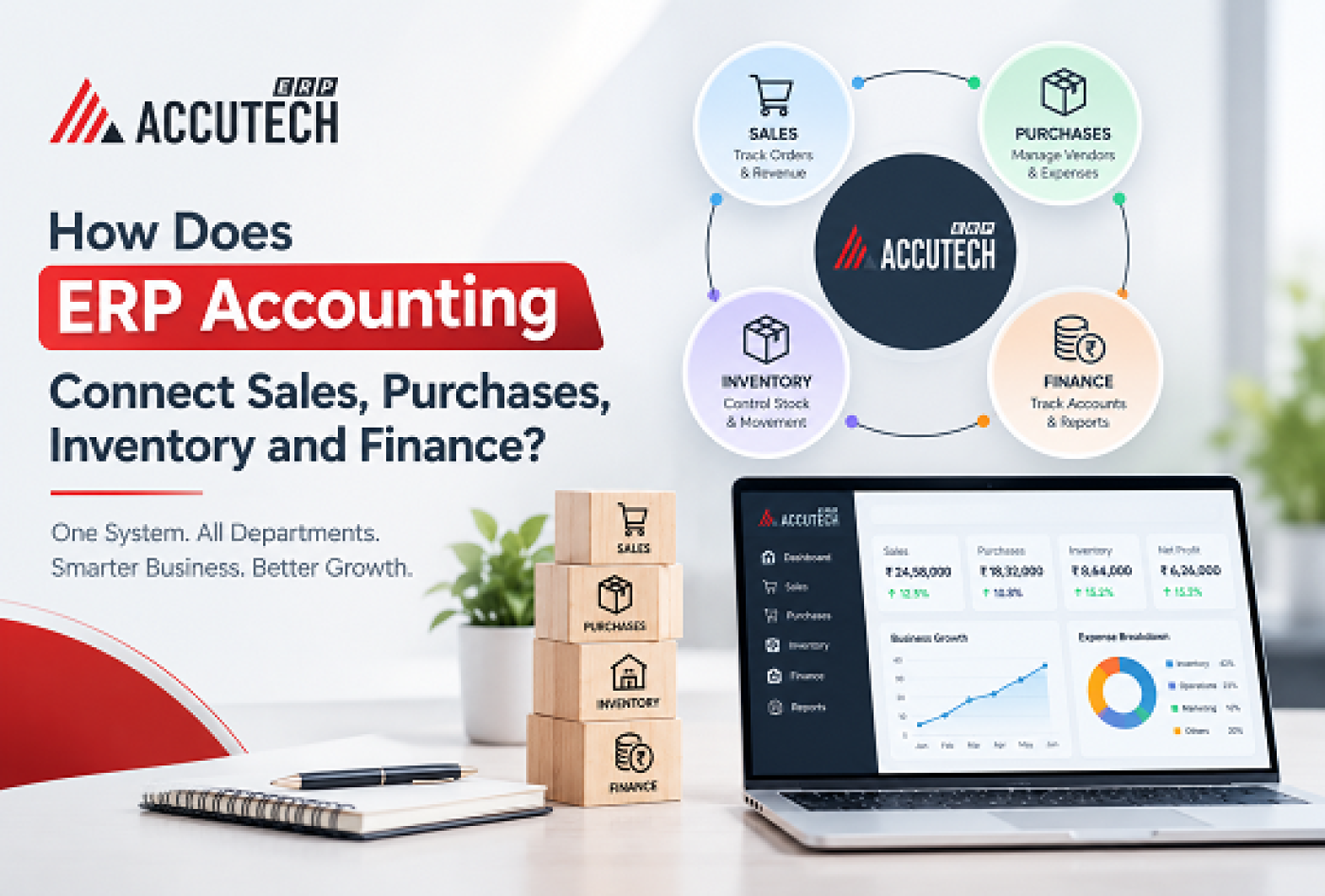
The core architecture of top accounting software India includes several interconnected modules:
Module | Primary Function |
Sales Module | Records every sale, manages customer data, tracks payment status, updates revenue accounts |
Purchase Module | Manages vendor orders, processes invoices, tracks expenses, records payables |
Inventory Module | Tracks stock levels, manages warehouse locations, records stock movements |
Finance Module | Consolidates all financial data, generates reports, manages ledgers and accounts |
What makes the best advance accounting ERP software unique is how these modules communicate. Rather than existing as separate systems, they share real-time data. When a sales invoice is created, the system simultaneously updates accounts receivable, inventory stock levels, and revenue figures without requiring manual intervention.
How Sales Module Connects to Accounting & Inventory
The sales module is where most customer transactions begin. When your sales team creates an invoice, multiple things happen instantly in an integrated ERP accounting software in India:
- General Ledger Entry: The accounting system automatically creates corresponding entries in accounts receivable and revenue accounts
- Inventory Update: Stock levels for sold items decrease automatically, preventing overselling
- GST Recording: The system tags the transaction with applicable tax rates and logs it for GST compliance
- Customer Ledger: Individual customer account balances update, showing outstanding dues instantly
- Financial Dashboards: Real-time revenue dashboards reflect the new sale immediately
Consider this practical scenario: A pharmaceutical distributor using best advance accounting ERP software processes 500 daily sales orders. Traditionally, this would require a warehouse team member to manually update inventory, an accounts person to record the sale in the general ledger, and a compliance officer to tag GST details. With an integrated system, all three updates happen simultaneously when the order is confirmed.
The result? Zero inventory discrepancies, zero manual data entry errors, and GST compliance built into every transaction.
Purchase Management Integration: From Orders to Financial Records
Purchase management in top accounting software India works as a mirror process to sales. When your purchasing department creates a purchase order, the advanced accounting system initiates a chain of integrated processes:
First, the system records the order in accounts payable while simultaneously flagging the amount in the inventory module as 'on order.' When the goods arrive and the vendor invoice is recorded, three critical updates occur: the inventory module receives the goods and updates stock quantities; the accounting system records the expense in the appropriate ledger accounts; and the GST module captures the input tax credit for future reconciliation.
This seamless integration has profound implications for businesses. A manufacturing company using advanced accounting system can instantly answer critical questions like: What's the total value of pending purchase orders? How much inventory is in transit? What's our current accounts payable position? What input tax credits are available for this month's GST filing?
Without integrated accounting software, these answers require manually pulling data from three different systems a process that's error-prone and time-consuming.
Inventory Tracking and Real-Time Stock Synchronization
Inventory is the bridge between sales and accounting. In the best advance accounting ERP software, inventory management isn't a standalone function it's deeply integrated with both financial and operational data.
Here's how it works: Every stock movement (sale, purchase, internal transfer, waste, or damage) generates a corresponding financial transaction. When you sell 100 units at ₹500 each, the system doesn't just reduce inventory by 100 units it simultaneously records the transaction at cost price in the inventory account, at selling price in revenue, and logs the GST component separately.
This real-time synchronization prevents a common problem in traditional systems: inventory and accounting records drifting out of sync. A business might show 500 units in the warehouse system but only 450 in accounting records. With integratedERP accounting software in India, this discrepancy is impossible because a single transaction updates both systems simultaneously.
Multi-location businesses benefit even more from this integration. A retail chain with 50 locations can see consolidated inventory across all stores in real-time, while each location maintains its own books. The head office finance team gets accurate consolidated financial statements every day.
Financial Reports: Unified Data Visibility
The ultimate benefit of integrated accounting emerges in financial reporting. With top accounting software India using a unified database, every report reflects accurate, up-to-date information from all departments.
Key reports generated from integrated data include:
- Profit & Loss Statement: Shows accurate revenue from sales module and expenses from purchase module, giving true business profitability
- Balance Sheet: Reflects accurate inventory valuations, accounts receivable aging, and accounts payable positions
- Cash Flow Statement: Combines payment information from sales and purchase modules for accurate cash position analysis
- Inventory Valuation Report: Shows stock levels with cost values, critical for understanding working capital requirements
- Outstanding Analysis: Lists customer receivables and vendor payables with aging, enabling better working capital management
Traditional systems require finance teams to manually consolidate data from multiple sources an error-prone process that typically takes 5-7 days. With best advance accounting ERP software, these reports generate in minutes, with 100% accuracy.
GST Compliance Automation in Integrated Accounting
GST compliance is perhaps where integrated ERP accounting software in India delivers the most dramatic value. The challenge with GST is that compliance isn't a monthly afterthought it's embedded in every transaction, and errors compound quickly.
With advanced accounting system technology, GST compliance happens automatically throughout the year:
When a sale is recorded, the system automatically applies the correct GST rate based on product category and customer location. When a purchase is recorded, it captures the vendor's GST details for ITC (Input Tax Credit) eligibility. Every month, when GSTR-1 (outward supplies) and GSTR-2 (inward supplies) are due, the system generates these returns with a few clicks.
The system also handles complex scenarios: reverse charge mechanisms, inter-state supplies, deemed exports, and composition scheme transitions. What might take an accountant 20+ hours of manual work monthly is now accomplished in 2-3 hours.
Additionally, reconciliation becomes painless. The system automatically matches your GSTR-2A data (what you received from vendors) with your recorded purchases, flagging discrepancies for resolution before filing GSTR-3B.
Key Benefits of Connected ERP Accounting Systems
The benefits of implementing the best advance accounting ERP software extend far beyond simple convenience. They fundamentally transform how businesses operate.
1. Elimination of Manual Data Entry
Every transaction flows through the system once, automatically updating all relevant modules. A business processing 1,000 transactions monthly can save 40+ hours of manual data entry, reducing errors and freeing staff for strategic work.
2. Real-Time Decision Making
Finance leaders get instant visibility into business performance. Instead of waiting for month-end reports, they can view current revenue, costs, profitability, and cash position anytime. This enables faster business decisions.
3. Improved Audit Trail and Compliance
Every transaction is recorded with complete details: who created it, when, what was changed, and why. Auditors appreciate this transparency, and regulatory compliance becomes significantly easier.
4. Better Working Capital Management
Integrated inventory and accounting data helps businesses optimize working capital. They know exactly how much capital is tied up in inventory and receivables, enabling better cash flow forecasting.
5. Scalability and Growth Support
As businesses grow, so do transaction volumes. An integrated top accounting software India can handle this growth without proportional increases in manual effort, supporting business expansion.
Implementing the Best Accounting ERP Software in India
Selecting and implementing best advance accounting ERP software is a significant decision that requires careful planning. Here's a structured approach:
Step 1: Define Your Requirements
Before evaluating any system, clearly document what you need. Consider industry-specific requirements (pharma, retail, manufacturing each have unique needs), transaction volume, number of branches/locations, GST complexity, and reporting requirements.
Step 2: Evaluate Key Features
Look for systems that offer seamless integration between sales, purchase, inventory, and finance modules. Ensure GST compliance automation is robust. Check if the system generates all reports you require instantly.
Step 3: Consider Implementation Support
The quality of implementation support is critical. Choose vendors who provide data migration support, staff training, and post-implementation support. Good implementation partners understand your industry and can configure the system for your specific needs.
Step 4: Plan Data Migration
Moving from old systems to new ERP accounting software in India requires careful data validation. Ensure opening balances are accurate, historical data is preserved, and you have a clear go-live plan.
Common Mistakes to Avoid
Many businesses make preventable mistakes when implementing advanced accounting system technology:
Mistake 1: Choosing Based Only on Price
The cheapest software isn't always the best value. Consider total cost of ownership including implementation, training, and support. An affordable system with poor support can cost far more in lost productivity.
Mistake 2: Insufficient Data Preparation
Many implementations fail because of poor data quality in legacy systems. Before migrating to best advance accounting ERP software, clean and validate all existing data thoroughly.
Mistake 3: Inadequate Staff Training
The best accounting software is only effective if users know how to use it properly. Invest in comprehensive training for all staff members who will use the system.
Mistake 4: Unrealistic Go-Live Timelines
Rushing implementation introduces errors and staff frustration. Allow adequate time for configuration, testing, and staff training before going live.
Mistake 5: Not Customizing for Your Business
ERP accounting software in India should be configured to match your specific business processes, not force you to change your business to match the software. Good vendors work with you to customize configurations appropriately.
Frequently Asked Questions
Q1: How does ERP accounting software eliminate inventory discrepancies?
ERP accounting software ensures every inventory movement is simultaneously recorded in the accounting system. When inventory is sold, purchased, transferred, or written off, the same transaction updates stock records and financial accounts. This synchronization, combined with regular audit trails, makes discrepancies visible immediately.
Q2: Can small businesses benefit from an advanced accounting ERP system?
Absolutely. While large enterprises pioneered ERP adoption, modern advanced accounting system solutions are designed for businesses of all sizes. Cloud-based deployment has made implementation faster and more affordable. Even small businesses with 10-20 employees managing multiple locations benefit from integrated accounting.
Q3: How much time does GST compliance take with integrated accounting?
With best advance accounting ERP software, monthly GST compliance that traditionally takes 20+ hours is reduced to 2-3 hours. The system generates GSTR-1, GSTR-2, and GSTR-3B automatically with data reconciliation. Your team focuses on verifying accuracy rather than data compilation.
Q4: What's the typical implementation timeline?
Implementation timelines vary based on business complexity. For a single location business with basic requirements, 2-3 months is typical. Multi-location businesses with complex requirements might need 4-6 months. The timeline includes discovery, configuration, data migration, testing, training, and go-live.
Q5: How does real-time inventory visibility improve sales?
When your sales team has real-time inventory visibility through top accounting software India, they never promise what isn't in stock. They can answer customer questions about availability instantly. This accuracy improves customer satisfaction, reduces order cancellations, and enables better forecasting.
Q6: Can ERP accounting software integrate with existing systems?
Most modern advanced accounting system solutions offer APIs and integration capabilities. They can connect with e-commerce platforms, CRM systems, banking platforms, and other business systems. This integration capability is important if you have existing systems you want to retain.
Q7: What security features should I look for in ERP accounting software?
Critical security features include role-based access controls, data encryption in transit and at rest, multi-factor authentication, complete audit trails, and regular automated backups. The system should comply with data protection regulations applicable in India.
Q8: How do I measure ROI from implementing ERP accounting software?
Common ROI metrics include: hours saved on manual data entry, reduction in accounting errors, time saved on GST compliance, faster month-end closing, improved cash flow from better receivables management, and reduced inventory carrying costs. Most businesses achieve positive ROI within 12-18 months.
Q9: Is cloud-based or on-premise deployment better for accounting ERP?
Cloud deployment is increasingly preferred for accounting ERP because it offers automatic updates, built-in security, remote access for distributed teams, lower IT infrastructure costs, and easier scalability. Choose based on your security requirements, IT capabilities, and budget. Most businesses find cloud deployment more practical.
Q10: How does multi-entity support work in advanced accounting ERP software?
Advanced accounting system software can manage multiple business entities (branches, subsidiaries, or divisions) within one system. Each entity maintains separate books and GST registrations while sharing the same database. The system generates individual entity reports and consolidated group reports, streamlining management of business groups.
Conclusion:
The integration of sales, purchases, inventory, and finance through best advance accounting ERP software isn't a luxury it's increasingly a business necessity. The complexity of modern business, combined with strict GST compliance requirements, makes manual accounting systems impractical.
Businesses that invest in top accounting software India like Accutech ERP gain multiple competitive advantages: faster decision-making, improved compliance, reduced operational costs, better cash flow management, and the ability to scale without proportional increases in administrative overhead.
The question isn't whether to implement an advanced accounting system, but when. The longer you delay, the more manual work consumes your team's time, and the more compliance risk you accumulate.
If you're ready to explore how integrated ERP accounting software can transform your business operations, we recommend taking the first step: understand your specific requirements, request a demonstration of leading solutions, and evaluate how each system addresses your business challenges.
The businesses that gain the most from ERP implementation are those that view it not as a software purchase but as a business transformation initiative. When you align your processes, staff, and technology around integrated accounting, the results compound over time.