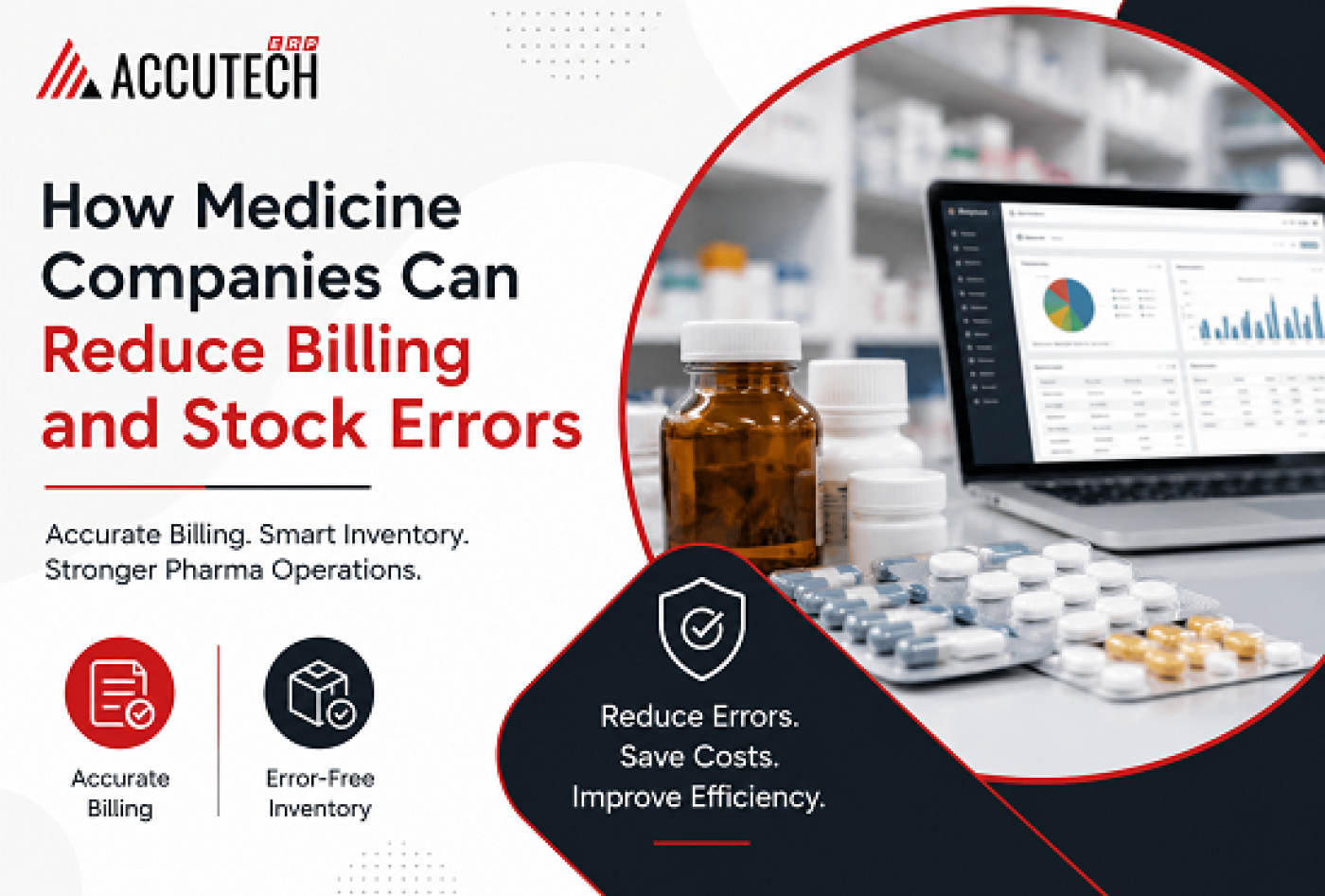
The pharmaceutical industry operates under intense pressure, strict regulatory compliance, rising operational costs, and the critical need to ensure patient safety. Yet beneath these challenges lies a persistent problem that costs medicine manufacturers millions annually: billing inaccuracies and inventory discrepancies.
Industry research reveals that up to 80% of healthcare-related invoices contain errors. For pharmaceutical companies, distributors, and retail pharmacies, these mistakes translate into lost revenue, delayed payments, damaged customer relationships, and potential regulatory penalties. Meanwhile, inventory discrepancies from counting mistakes to expired medication mishandling create additional financial strain and compromise patient safety.
The solution lies in implementing modern business management solutions that automate these critical processes. This comprehensive guide explores how medicine manufacturers can eliminate billing errors, prevent stock discrepancies, and optimize operational efficiency. Whether you're a startup pharmacy or an established distributor, this article provides actionable insights to transform your operations.
Understanding Billing Errors in Medicine Manufacturing
What Makes Pharmaceutical Billing Unique?
Pharmaceutical billing is inherently complex. Unlike standard retail transactions, medicine invoicing must account for:
- Multiple pricing tiers (wholesale, retail, institutional)
- Batch and serial number tracking for traceability
- Tax compliance (GST, excise duties, state levies)
- Insurance reimbursement codes and claim management
- Controlled substance documentation requirements
- Return and recall processing
Common Types of Pharmaceutical Billing Errors
1. Duplicate Billing
The same invoice is processed multiple times, resulting in overcharges. This frequently occurs when manual entry is involved or when system integration is weak. For medicine companies managing high-volume transactions, duplicate billing can lead to significant revenue leakage and customer disputes.
2. Quantity Mismatches
Invoiced quantities don't match shipped quantities. This happens when warehouse teams, billing departments, and inventory systems aren't synchronized. A single mismatch per transaction can compound into thousands across monthly operations.
3. Price Discrepancies
Outdated or incorrect price lists are used, especially problematic during promotional periods or when bulk discounts apply. Pharmaceutical pricing is dynamic; manual management is error-prone.
4. Tax Calculation Errors
With GST, excise duties, and state-specific taxes, even small mistakes compound. Manual calculations invite errors that can trigger regulatory audits.
The Financial Impact
Consider a mid-sized distributor processing 500 invoices monthly. If just 5% contain errors (25 invoices), and each error costs an average of Rs.2,000 in rework and dispute resolution, that's Rs.50,000 monthly losses Rs.600,000 annually. For larger operations, this impact multiplies significantly.
Beyond direct costs, billing errors damage reputation. Customers receiving incorrect invoices lose confidence and may switch to competitors. Regulatory bodies may impose penalties if errors result in tax non-compliance. This is why forward-thinking companies invest in modern software solutions to eliminate these errors at their source.
The Impact of Inventory Discrepancies on Pharma Operations
Stock Discrepancies: More Than Just Numbers
In pharmaceutical operations, inventory errors have serious consequences. A stock discrepancy isn't merely a financial loss; it can mean:
- Customers unable to fulfill prescriptions (patient safety compromise)
- Overstocking of slow-moving items (capital tied up, expiration risk)
- Understocking of critical medications (lost sales, reputation damage)
- Regulatory audit failures (fines, license suspension)
- Controlled substance documentation gaps (DEA violations)
Root Causes of Pharmaceutical Inventory Errors
Manual Counting Processes
Paper-based or spreadsheet-driven inventory management is inherently error-prone. Human fatigue, transcription mistakes, and lack of real-time visibility create compounding discrepancies. Pharmacies relying on manual counts often discover significant differences only during regulatory audits—too late to prevent penalties.
Expiration Date Management Failures
Expired medications represent both compliance violations and financial losses. Without systematic tracking, medicines expire on shelves, medications that must be destroyed or returned to manufacturers. For medicine companies, this is a preventable cost drain.
Return and Recall Processing
When medicines are returned or recalled, manual handling creates tracking gaps. If a batch recall occurs and inventory systems aren't updated immediately, pharmacies might unknowingly continue dispensing affected products, a nightmare scenario for patient safety and legal liability.
Visibility Across Multiple Locations
For pharmaceutical distributors with multiple warehouses or retail locations, maintaining accurate inventory across all points is nearly impossible with manual systems. Discrepancies grow exponentially with each additional location. Pharma company software with multi-location inventory management provides real-time visibility ensuring stock accuracy across the entire network.
How Modern ERP Systems Prevent Common Errors
Automation: The First Line of Defense
Modern business management systems eliminate manual intervention at every critical step:
- Automated Billing Generation: Invoices are created automatically from order data, reducing manual entry errors. Tax calculations are embedded, ensuring compliance every time.
- Real-Time Inventory Updates: Every transaction receipt, sale, return, or waste automatically updates stock levels. No end-of-day counting discrepancies.
- Duplicate Prevention: System rules prevent the same invoice from being processed twice, eliminating a major source of overbilling.
- Price Synchronization: Dynamic pricing rules ensure current prices are always applied, preventing undercharging or applying outdated discounts.
Data Integration and Accuracy
ERP for the pharmaceutical industry integrates all business processes purchasing, warehouse management, billing, and accounting into a single system of record. When your warehouse team receives stock, that data flows directly to inventory and becomes available to billing instantly. No gaps, no delays, no confusion about what quantity is actually available.
This integration ensures:
- Order quantities on invoices always match warehouse stock movements
- Pricing reflects current agreements and promotions
- Tax calculations match regulatory requirements
- Controlled substances are tracked with audit trails
Batch and Serial Number Traceability
Modern systems automatically capture and track batch and serial numbers at every point: receiving, storage, dispensing, and sale. This traceability is essential for:
- Recall Management: If a batch must be recalled, the system instantly identifies all locations where it's stocked and all customers who received it.
- Quality Assurance: Expired or compromised batches are flagged automatically, preventing sale or dispensing.
- Regulatory Compliance: Detailed audit trails satisfy FDA, DEA, and other agencies during inspections.
Alert Systems and Predictive Analytics
Smart systems don't just record transactions, they analyze them. Automated alerts notify you of:
- Medications approaching expiration (FEFO compliance)
- Stock levels falling below minimums (auto-trigger reorders)
- Unusual price variances (potential billing errors)
- Inventory discrepancies between physical counts and system records (investigate immediately)
These proactive systems transform medicine companies from reactive firefighting to proactive management, preventing errors before they cost money.
Key Features of ERP Solutions for Pharmaceutical Industry
Must-Have Features in Pharma Company Software
When evaluating modern business management systems, ensure they include these critical capabilities:
Feature | Why It Matters for Pharma |
GST & Tax Compliance | Auto-calculates GST, excise duties, and state taxes; generates compliant invoices |
Real-Time Inventory | Live stock levels updated instantly from warehouse and POS systems |
Batch Tracking | Captures batch/serial numbers for recall management and compliance |
Multi-Location Management | Unified control of multiple stores/warehouses from single dashboard |
Expiry Management | Alerts for near-expiry stock; FEFO enforcement; reverse distribution tracking |
Barcode/QR Scanning | Eliminates manual entry errors in receiving, stocking, and dispensing |
Pricing Rules | Dynamic pricing by customer type, volume, promotion; prevents billing errors |
Mobile Access | Sales teams, field staff can access inventory and place orders on-site |
Compliance and Regulatory Features
Pharmaceutical businesses face rigorous oversight. Your software must support:
- DSCSA Compliance: Track and trace medicines using serialization standards
- Controlled Substance Tracking: Detailed records for Schedule drugs with DEA-compliant audit trails
- GMP Documentation: Batch records, quality parameters, and manufacturing history
- Audit Trails: Complete history of every transaction for regulatory inspection
- Return and Recall Management: Automated processes for handling returns and product recalls
Reporting and Analytics
Top-performing medicine companies use data to drive decisions. ERP for pharmaceutical industry provides:
- Sales & Purchase Reports: Identify trends, top-selling medications, and slow movers
- Profitability Analysis: Margin tracking by product, customer, and location
- Error Tracking: Monitor billing errors, inventory discrepancies, and root causes
- Cash Flow Forecasting: Predict working capital needs and optimize payment terms
Implementation Considerations
When selecting a solution, prioritize:
- Cloud-Based Deployment: Accessible from any location, automatic updates, no server maintenance
- Easy Onboarding: Minimal IT expertise required; staff trained quickly
- Data Security: Encrypted storage, role-based access, HIPAA/data protection compliance
- Scalability: Grows with your business from small pharmacy to large distributor
Real-world Case Studies: Success Stories in Error Reduction
Case Study 1: Mid-Sized Pharmacy Chain – Eliminating 95% of Billing Errors
Challenge:
A 12-location pharmacy chain was experiencing 50-60 billing disputes monthly, primarily due to duplicate invoices and quantity mismatches. Their billing department spent 30+ hours weekly resolving errors. Revenue leakage was estimated at Rs. 40,000/month.
Solution:
They implemented a cloud-based ERP for the pharmaceutical industry with automated billing from point-of-sale data, real-time inventory sync across all locations, and duplicate prevention rules.
Results:
Within 6 months: Billing disputes dropped to 2-3 monthly (95% reduction). Billing department workload decreased to 5-10 hours/week. Revenue recovered: Rs. 80,000 annually. Customer satisfaction improved significantly.
Case Study 2: Pharmaceutical Distributor – Controlling Inventory Across 8 Warehouses
Challenge:
A regional pharma distributor managed 8 warehouses across multiple states. Inventory discrepancies were discovered during quarterly audits, with stock differences ranging 5-12% between physical counts and system records. Expired medications were frequently discovered only during recalls.
Solution:
They deployed a comprehensive business solution with real-time visibility, automated expiry tracking (FEFO enforcement), barcode scanning at every touch point, and centralized batch management.
Results:
Inventory accuracy improved to 98%+ across all locations. Expired medication losses decreased by 70%. Manual counting time reduced from 15 days/quarter to 2 days/quarter. Regulatory audits passed without findings.
Implementation Best Practices for Pharma Company Software
Step 1: Assess Your Current Challenges
Before implementing any pharmaceutical software, identify your specific pain points:
- Document current error rates (billing disputes, inventory discrepancies)
- Calculate financial impact (revenue lost, time spent resolving issues)
- Interview staff about bottlenecks (manual processes, system limitations)
- Map current workflows and identify gaps
This assessment becomes your ROI baseline; you'll measure success against these metrics.
Step 2: Select the Right Solution
Compare options based on:
- Industry-Specific Features: Does it support pharmaceutical-specific requirements (batch tracking, compliance)?
- Ease of Use: Can your team learn it quickly without extensive training?
- Integration Capabilities: Does it connect with your POS, accounting, and existing systems?
- Support & Training: Is vendor support responsive? Do they offer implementation assistance?
- Cost Structure: Transparent pricing with no hidden fees?
Always request a free trial or demo before committing. Accutech ERP, for example, offers a free 30-day trial so you can test the system with your real data.
Step 3: Plan Your Implementation
Create a detailed implementation plan:
- Phase 1 (Weeks 1-2): Data Migration & Setup
Migrate historical data (products, customers, transactions)
Configure master data (pricing rules, tax settings, user roles)
- Phase 2 (Weeks 3-4): Team Training
Conduct hands-on training for all users
Identify and empower power users to support peers
- Phase 3 (Weeks 5-8): Pilot Testing
Run transactions in the new system in parallel with your old system
Validate that results match (billing, inventory, reports)
- Phase 4 (Week 9+): Full Rollout
Cutover to live system with full team
Monitor closely for issues; have support team available 24/7
Step 4: Monitor Performance & Optimize
After going live, track these metrics monthly:
- Billing Error Rate: % of invoices with discrepancies
- Inventory Accuracy: % of system records matching physical counts
- Processing Time: Hours spent on manual tasks (reduced should indicate success)
- Customer Satisfaction: Dispute rates, payment delays
- Revenue Impact: Recovered revenue from eliminated errors
Use this data to refine processes and continuously improve. Many organizations find that the first 90 days post-implementation are critical to establish good habits early.
Measuring ROI and Success Metrics
Direct Financial Returns
Revenue Recovery from Eliminated Billing Errors
Calculate your baseline error rate and associated revenue loss. If you processed 10,000 invoices annually with a 5% error rate (500 errors) costing Rs. 2,000 each to resolve, that's 1M in annual losses. Reducing this to 0.5% errors saves Rs. 900,000 annually.
Inventory Cost Optimization
Accurate inventory reduces overstock (tied-up capital) and prevents stockouts (lost sales). Many companies recover 10-15% of inventory value within the first year.
Expired Medication Waste Reduction
Proactive expiry management prevents medicines from expiring on shelves. Many distributors report 40-60% reduction in expiration losses.
Indirect Financial Benefits
Labor Cost Reduction
Time spent on manual billing, inventory counts, and error resolution is eliminated. If your billing team spends 40 hours/week on error handling at a fully-loaded cost of 50/hour, that's Rs. 104,000 annually recovered.
Improved Cash Flow
Faster, error-free invoicing means faster payment. Customers aren't delaying payment to dispute invoices. Even a 5-day acceleration in receivables can improve working capital significantly.
Regulatory Compliance & Risk Mitigation
Passing regulatory audits without findings avoids fines and license suspension. The cost of a single audit failure (legal fees, fines, business disruption) often exceeds annual software costs.
Calculating Your ROI
ROI % = (Total Benefits - Software Cost) / Software Cost × 100
Example: A distributor with 1M in annual error losses + Rs.150,000 in labor inefficiency implementing software costing Rs.50,000 annually would see:
- Benefits: Rs. 900,000 (error recovery) + Rs.120,000 (labor) = Rs. 1,020,000
- ROI = (Rs. 1,020,000 - Rs. 50,000) / Rs. 50,000 × 100 = 1,940%
- Payback Period: Less than 3 weeks
Most medicine companies see positive ROI within 3-6 months, making pharmaceutical software one of the highest-ROI business investments available.
Frequently Asked Questions (FAQs)
Q1: What's the difference between a pharmacy management system and a full ERP?
A pharmacy management system focuses narrowly on inventory and dispensing. A complete ERP for the pharmaceutical industry integrates accounting, billing, inventory, and sales into one unified platform. For medicine companies, the unified approach eliminates data silos and ensures consistency across all operations. You get billing error prevention at the system level, not just inventory management.
Q2: How long does implementation typically take?
Implementation time varies by business size and complexity. A small pharmacy (1-5 locations) typically goes live in 4-6 weeks. A mid-sized distributor (8-20 locations) may take 8-12 weeks. Large enterprises could take 3-6 months. Most of this time is spent on training and data migration, not software configuration. Cloud-based pharmaceutical software solutions are typically faster to implement than on-premise alternatives.
Q3: Is my existing data at risk during migration?
Professional implementation includes comprehensive data backup and validation. Before going live, you'll run transactions in parallel with your old system to validate accuracy. Data is typically backed up at multiple points. Reputable vendors carry insurance for data protection. Always verify backup and recovery procedures with your vendor.
Q4: Can I integrate the new system with my existing tools?
Most modern pharma company software offers integrations with popular accounting systems, e-commerce platforms, and banking software. Many support API connections for custom integrations. Before selecting a solution, verify that it can integrate with your specific tools.
Q5: What kind of training is required?
Most vendors provide video guides, documentation, and live training sessions. Key staff (billing, warehouse, managers) need hands-on training (typically 4-8 hours). General users might only need 2-3 hours. Once your power users are trained, they can support colleagues. The best systems are intuitive enough that basic operations require minimal training.
Q6: How does pharmaceutical software handle compliance with regulations like DSCSA?
Specialized solutions include built-in compliance features: automatic batch/serial number capture, track-and-trace capabilities, and audit trail generation. These features are configured at setup and work automatically; your staff doesn't need to manage compliance manually. Regular software updates keep you aligned with changing regulations.
Q7: What happens if the system goes down? Is my data safe?
Cloud-based solutions operate on redundant servers with automatic failover. Downtime is extremely rare (industry standard is 99.9% uptime). In the unlikely event of an outage, your data remains safe in encrypted cloud storage. Many vendors offer disaster recovery capabilities and regular backups. Always ask about their SLA (Service Level Agreement) and recovery procedures.
Q8: Can I scale the system as my business grows?
Cloud-based solutions are inherently scalable. Adding new locations, users, or transaction volume requires no hardware upgrades, just a plan adjustment. You start with the features you need and add more as you grow. This makes it ideal for growing organizations.
Q9: How do I choose between cloud and on-premise solutions?
Cloud: Lower upfront costs, automatic updates, accessible anywhere, vendor manages security and backups. Ideal for most medicine companies.
On-Premise: Full control, higher upfront costs, you manage updates and security, limited remote access. Rarely chosen for new implementations in modern pharmaceutical operations.
For most pharmaceutical companies today, cloud-based pharmaceutical software is the optimal choice.
Q10: How does implementation support work? Will the vendor support my team?
Professional vendors provide implementation project managers, training specialists, and technical support during the implementation process. After go-live, you receive ongoing support (typically included or available for a fee). Support channels often include email, phone, and live chat. Check the vendor's support availability 24/7 support is ideal for operations where downtime is costly.
Conclusion:
Billing errors and inventory discrepancies aren't inevitable parts of pharmaceutical operations. They're symptoms of outdated, manual processes. Modern business solutions eliminate these errors automatically, recover lost revenue, reduce operational costs, and ensure regulatory compliance.
The companies that are thriving today have made this transition. They've implemented modern solutions that:
- Automate billing with real-time accuracy
- Maintain perfect inventory visibility across all locations
- Track batch and serial numbers for compliance
- Prevent expired medicines from reaching customers
- Provide data insights for better decision-making
The ROI is compelling: most companies recover their investment within weeks and see hundreds of thousands in annual savings. More importantly, they gain peace of mind knowing their operations are accurate, compliant, and optimized.