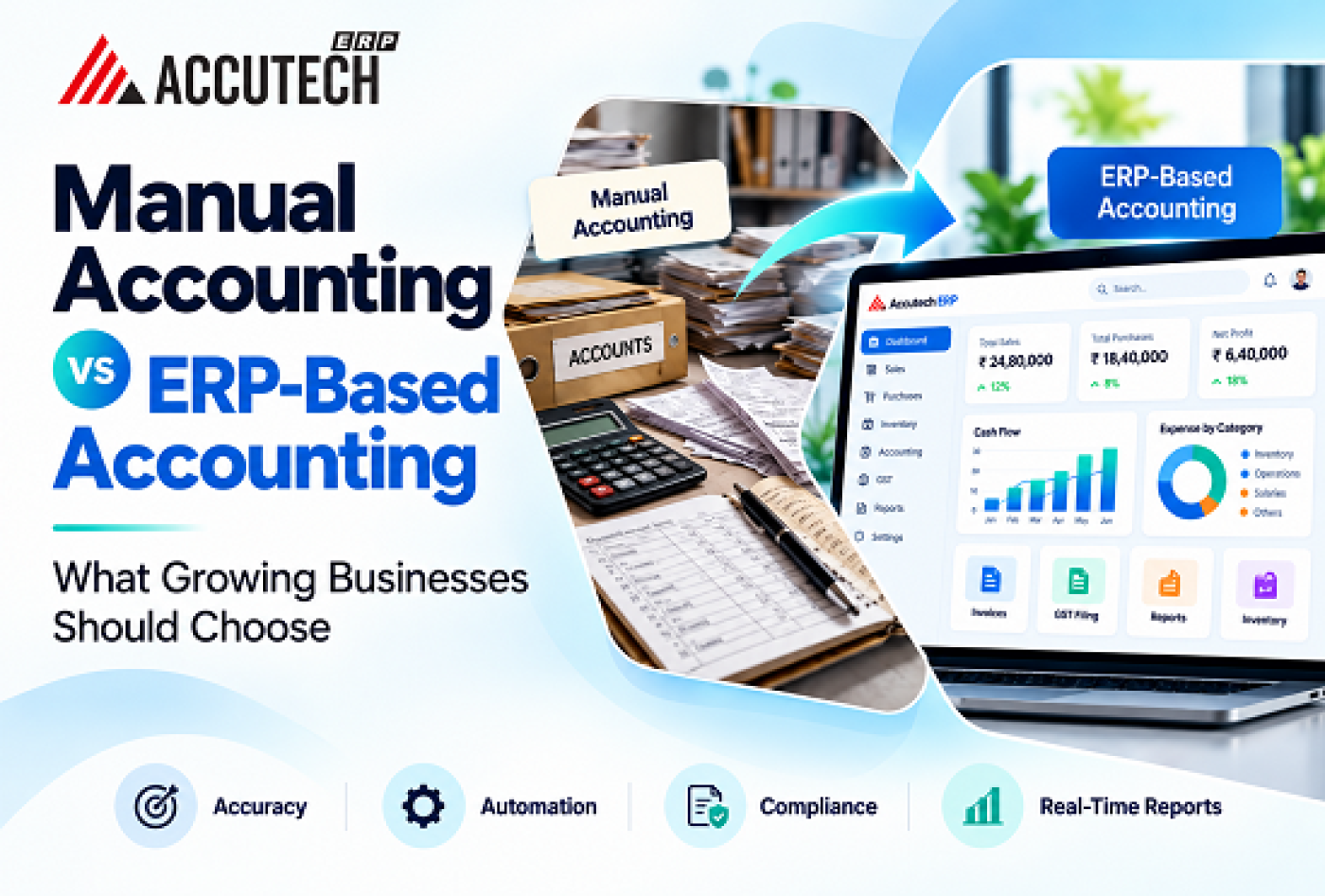
Manual Accounting vs ERP-Based Accounting: What Growing Businesses Should Choose
As your pharmaceutical business grows, one of the most critical decisions you'll face is how to manage your accounting operations. The choice between manual accounting and ERP-based accounting isn't just a matter of preference; it directly impacts your profitability, compliance, and operational efficiency. In the highly regulated pharmaceutical manufacturing industry, this decision becomes even more crucial.
For decades, many growing businesses relied on manual accounting methods, spreadsheets, paper records, and traditional bookkeeping practices. However, as your pharmaceutical business expands, the limitations of manual processes become increasingly apparent. Pharma PCD ERP Software has emerged as a powerful solution for pharmaceutical manufacturing enterprises seeking to streamline operations, ensure regulatory compliance, and scale their business efficiently.
This comprehensive guide will walk you through the critical differences between manual accounting and ERP-based accounting, explore why pharmaceutical manufacturing software is essential for modern businesses, and help you understand how implementing an erp for the pharma manufacturing industry can transform your financial operations.
What is Manual Accounting?
Manual accounting represents the traditional approach to financial record-keeping where accountants and bookkeepers rely on physical documents, spreadsheets, and manual data entry to track business transactions. For pharmaceutical manufacturing businesses, manual accounting involves recording invoices, receipts, and financial transactions by hand or through basic software like Excel.
Key Characteristics of Manual Accounting:
- Paper-based record keeping and filing systems
- Excel spreadsheets for data organization and calculations
- Manual data entry from receipts and invoices
- Human-dependent reconciliation and verification
- Limited real-time financial visibility
- Time-consuming reporting and month-end closures
For many years, manual accounting was the standard across the pharmaceutical manufacturing industry. Small to medium-sized pharmaceutical businesses could manage their finances with a dedicated accountant and basic bookkeeping systems. However, as businesses grow and regulatory requirements become more stringent, the limitations of manual accounting become increasingly problematic. The pharmaceutical manufacturing industry is particularly affected because regulatory compliance, batch tracking, and financial accuracy are not just important, they're legally mandated.
Understanding ERP-Based Accounting
ERP (Enterprise Resource Planning) based accounting represents a revolutionary shift in how businesses manage their financial operations. An ERP system integrates all business processes including accounting, inventory management, manufacturing, compliance, and supply chain management into a single, unified platform. For the pharmaceutical manufacturing industry, ERP-based accounting offers unprecedented control, visibility, and compliance capabilities.
Pharma PCD ERP Software specifically addresses the unique needs of pharmaceutical businesses by combining comprehensive financial management with industry-specific compliance features. These systems automatically capture transactions, update records in real-time, and provide instant financial insights across your entire organization.
Core Features of ERP-Based Accounting:
- Automated transaction recording and reconciliation
- Real-time financial dashboards and reporting
- Integration with manufacturing and inventory systems
- Automated compliance tracking and regulatory reporting
- Multi-user access with role-based permissions
- Advanced audit trails and data security
Key Differences: Manual vs ERP Accounting
Understanding the specific differences between manual accounting and ERP-based accounting is essential for making an informed decision for your pharmaceutical business. Let's examine the critical distinctions:
Aspect | Manual Accounting | ERP-Based Accounting |
Data Entry | Manual, time-consuming | Automated, real-time |
Data Accuracy | High error risk | 99.9% accuracy |
Financial Reporting | Delayed, monthly | Real-time insights |
Scalability | Limited growth capacity | Highly scalable |
Compliance | Manual tracking | Automated compliance |
Cost per Transaction | Higher labor costs | Lower cost per unit |
Why This Matters for Pharmaceutical Manufacturing:
For pharmaceutical manufacturing businesses, these differences are not merely operational; they directly impact regulatory compliance, financial accuracy, and competitive advantage. When you're manufacturing pharmaceuticals subject to strict regulatory oversight, the compliance capabilities of a dedicated ERP system become absolutely essential. An erp for pharma manufacturing industry can be configured to handle complex requirements such as batch tracking, expiration date management, regulatory documentation, and audit trail requirements.
Why Pharma PCD ERP Software is Essential for Your Business
As your pharmaceutical manufacturing business grows, implementing specialized Pharma PCD ERP Software transitions from being a 'nice-to-have' to an absolute necessity. Here's why:
Regulatory Compliance Excellence
The pharmaceutical industry operates under stringent regulatory frameworks including FDA compliance, WHO guidelines, and regional pharmaceutical regulations. A specialized pharma ERP solution can include built-in compliance modules that automatically track regulatory requirements, maintain audit trails, and generate required documentation. Manual accounting systems cannot reliably meet these compliance demands, putting your business at significant risk.
Batch and Serial Number Tracking
Pharmaceutical manufacturing requires meticulous tracking of every batch, including manufacturing dates, expiration dates, and quality control parameters. A dedicated pharma management platform automatically manages this information, ensuring that batch tracking is seamlessly integrated with your accounting and inventory systems. This level of integration is impossible with manual accounting methods.
Real-Time Visibility Across Operations
When managing a pharmaceutical manufacturing operation, you need instant visibility into financial performance, inventory status, production capacity, and supply chain status. ERP-based accounting provides this visibility through comprehensive dashboards and real-time reporting. With manual accounting, you're always looking backward reviewing historical data rather than managing current operations.
Benefits of Pharmaceutical Manufacturing Software
Implementing pharmaceutical manufacturing software, particularly a comprehensive ERP system, delivers transformative benefits that extend far beyond accounting operations:
Improved Operational Efficiency
A modern pharmaceutical ERP platform automates repetitive accounting tasks, reducing the time your accounting team spends on data entry and reconciliation. On average, businesses implementing ERP systems report a 40-60% reduction in accounting cycle time. Your team can focus on strategic financial analysis rather than clerical work.
Enhanced Financial Accuracy
Manual accounting is inherently prone to human error. Pharmaceutical manufacturing software eliminates redundant data entry, automatically validates transactions, and maintains real-time reconciliation. This results in dramatically improved financial accuracy critical when regulatory audits examine your financial records.
Superior Cost Control
An integrated pharma business management system provides granular visibility into costs at every stage of production. You can track raw material costs, manufacturing overhead, packaging expenses, and labor costs with precision. This cost visibility enables better pricing decisions, improved profit margin management, and identification of cost reduction opportunities.
Regulatory Compliance and Risk Mitigation
For pharmaceutical businesses, regulatory risk is an existential threat. An erp for pharma manufacturing industry includes capabilities designed to support pharmaceutical compliance requirements. Automated audit trails, documented procedures, and regulatory reporting capabilities significantly reduce compliance risk and simplify regulatory audits.
Scalability for Business Growth
As your pharmaceutical manufacturing business grows, manual accounting systems become increasingly unmanageable. Pharma PCD ERP Software scales seamlessly adding new manufacturing locations, product lines, or distribution channels requires minimal additional system configuration.
Cost Analysis: Manual Accounting vs ERP Implementation
One of the most common objections to implementing a pharma-specific ERP solution is the upfront cost. However, a comprehensive cost analysis reveals that ERP systems typically deliver ROI within 18-36 months:
Manual Accounting Costs (Annual):
- Accounting staff salaries: ₹80,000-1,20,000 per person
- Additional administrative staff: ₹40,000-60,000
- Error correction and audit issues: ₹5,000-15,000
- Compliance violations and penalties: ₹10,000-50,000+
- Lost productivity from inefficient processes: ₹20,000-40,000
- Total Annual Cost: ₹1,55,000-2,85,000
ERP-Based Accounting Costs (Annual):
- Software licensing (Pharma ERP): ₹30,000-80,000
- Implementation and training: ₹20,000-40,000 (one-time, amortized)
- Reduced accounting staff (1-2 positions): ₹80,000-1,20,000
- Support and maintenance: ₹10,000-20,000
- Total Annual Cost: ₹1,40,000-2,60,000
Key Financial Benefits:
- Labor cost reduction: 30-40%
- Improved cash flow through faster billing: ₹50,000-1,00,000 annually
- Reduced inventory carrying costs: 15-25%
- Compliance audit savings: 50-70%
- Improved decision-making leading to revenue growth: 5-15%
Common Mistakes to Avoid When Choosing an Accounting System
Choosing between manual accounting and ERP-based accounting is too important to get wrong. Here are critical mistakes pharmaceutical businesses make:
Mistake 1: Delaying Implementation Until It's Too Late
Many businesses wait to implement Pharma PCD ERP Software until they've reached crisis point when compliance issues emerge or accounting errors threaten the business. Implementing ERP systems is significantly more difficult when your business is in chaos. The best time to implement is when you're growing steadily but before you're overwhelmed by manual processes.
Mistake 2: Choosing a Generic ERP Over Pharmaceutical Manufacturing Software
Not all ERP systems are created equal. A generic ERP system designed for retail or general manufacturing may lack the specialized features required for pharmaceutical operations. Pharmaceutical manufacturing software can include batch tracking, expiration management, regulatory compliance features, and audit trail capabilities essential for pharma businesses. Choosing a generic solution may force you to manually handle pharmaceutical-specific requirements.
Mistake 3: Underestimating Implementation Complexity
ERP implementation is not simply a software installation it requires business process evaluation, data migration, staff training, and ongoing optimization. Underestimating this complexity leads to failed implementations, wasted resources, and frustrated teams. Select a vendor with proven expertise in pharmaceutical manufacturing industry implementations.
Mistake 4: Ignoring Data Migration Challenges
Moving from manual accounting systems to ERP-based accounting requires careful data migration. Historical data must be cleaned, validated, and imported correctly. Poor data migration can result in inaccurate financial statements and regulatory compliance issues. Budget adequate time and resources for data migration planning.
Frequently Asked Questions (FAQ)
Q1: How long does it typically take to implement Pharma PCD ERP Software?
Implementation timeline depends on your business complexity, current system sophistication, and number of locations. Most pharmaceutical manufacturing businesses complete implementation in 6-12 months. This includes planning (1-2 months), configuration (2-3 months), data migration (1-2 months), user training (1 month), and go-live (1-2 months). Smaller businesses may implement faster, while complex operations with multiple locations may require longer timelines.
Q2: Can we keep some manual processes alongside our ERP system?
While technically possible, maintaining parallel manual processes defeats the purpose of ERP implementation. The value of an integrated pharmaceutical business system lies in creating a unified, connected environment. Manual processes create data inconsistencies, increase error risk, and prevent you from achieving the full benefits of ERP. We recommend full commitment to the ERP system while maintaining documented procedures as backups during transition.
Q3: What's the difference between cloud-based and on-premise Pharma PCD ERP Software?
Cloud-based Pharma PCD ERP Software offers accessibility from anywhere, automatic updates, reduced IT infrastructure costs, and lower upfront investment. On-premise solutions provide greater control, potential customization flexibility, and may offer better compliance for organizations with strict data residency requirements. Cloud solutions are increasingly popular because they provide enterprise-grade security, redundancy, and automatic system updates important for pharmaceutical businesses.
Q4: How does ERP-based accounting improve regulatory compliance?
An erp for pharma manufacturing industry can include automated compliance features that track regulatory requirements, maintain comprehensive audit trails, and generate required regulatory documentation. ERP systems enforce standardized procedures, prevent unauthorized changes, and provide complete transaction history for regulatory review. Manual accounting systems can make it more difficult to demonstrate compliance, creating additional audit risk. A structured ERP environment helps reduce these risks through better compliance management.
Q5: What happens to our current accounting data when we migrate to ERP?
Your current accounting data undergoes careful preparation before migration. This includes data cleaning (removing duplicates and correcting errors), validation (ensuring data accuracy and completeness), and transformation (converting data to ERP system format). Most businesses migrate 2-3 years of detailed transaction history and summarize older data for reference. A professional implementation partner will handle this process systematically to ensure data integrity throughout the migration.
Q6: Can pharmaceutical manufacturing software handle multiple locations and currencies?
Yes, modern pharmaceutical manufacturing software can be designed to handle multi-location operations with different currencies, tax systems, and regulatory requirements. This multi-location capability is one of the key advantages of ERP systems over manual accounting. The system can maintain separate books for each location while providing consolidated reporting across the entire organization. This scalability enables efficient growth into new markets and regions.
Q7: How does pharmaceutical manufacturing software support batch and expiration tracking?
Pharmaceutical manufacturing software integrates batch tracking directly into inventory and financial management. When raw materials arrive, they're assigned batch numbers and expiration dates in the system. As materials are used in manufacturing, the system tracks which batches were used in each product. The system can flag expired inventory, restrict the use of expired materials, and maintain complete batch history for regulatory documentation. This level of integration is difficult to achieve with manual accounting systems.
Q8: What training is required for our team to use ERP-based accounting effectively?
Comprehensive training is essential for successful ERP implementation. Most implementations include role-specific training for accounting staff, managers, and supervisors (typically 40-80 hours per person). Training covers system navigation, standard procedures, compliance requirements, and reporting capabilities. Ongoing training is recommended as the system is used and your team gains expertise. Additionally, documentation and job aids should be created specifically for your pharmaceutical manufacturing processes to support long-term system success.
Q9: How much does Pharma PCD ERP Software cost compared to continuing with manual accounting?
While Pharma PCD ERP Software requires an upfront investment, with software licensing potentially ranging from ₹30,000-80,000 annually depending on users, modules, customization, and business requirements, the total cost of ownership can be lower than manual accounting when you factor in labor costs, error correction, compliance risks, and lost productivity. The financial analysis should consider both implementation costs and long-term operational savings.
Q10: How do we ensure our existing data is secure during ERP migration?
Data security during migration is critical, especially in the pharmaceutical industry where data sensitivity is high. Professional implementations include data encryption during transfer, secure temporary storage, access controls limiting who can view data during migration, and comprehensive testing to ensure data integrity. Additionally, comprehensive backups of your existing system are maintained throughout the process. Your implementation partner should provide detailed security documentation demonstrating how your data is protected during every stage of migration.
Best Practices for Successful ERP Implementation
To maximize the value of your pharmaceutical ERP investment, follow these proven best practices:
1. Secure Executive Sponsorship
ERP implementation requires visible, committed leadership. Executive sponsors must champion the project, allocate necessary resources, and maintain focus on implementation objectives. Organizations with strong executive sponsorship have significantly higher success rates.
2. Form a Strong Implementation Team
Dedicate experienced, respected employees to the implementation team. Include representatives from accounting, manufacturing, quality, supply chain, and IT. This team should work closely with your implementation partner to configure the system and ensure adoption across the organization.
3. Clearly Define Success Metrics
Before implementation begins, define measurable success criteria: reduced accounting cycle time, improved financial accuracy, compliance audit success, reduced inventory carrying costs, and improved cash flow visibility. Regularly track these metrics throughout and after implementation to demonstrate value.
4. Plan for Phased Implementation
Consider phased implementation rather than immediate full replacement of all systems. Start with core accounting and inventory modules, then progressively add manufacturing, compliance, and other modules. This phased approach reduces risk and allows your team to adapt to changes gradually.
5. Invest in Comprehensive Training
Allocate 15-20% of your implementation budget to training and change management. Well-trained users adopt the system faster, make fewer errors, and achieve better results. Training should continue after go-live as users gain proficiency and refinements are made.
Conclusion:
The decision between manual accounting and ERP-based accounting is fundamentally a decision about the future of your pharmaceutical business. Manual accounting systems may have served your business adequately in earlier growth stages, but as you scale, the limitations become increasingly apparent and costly.
An erp for pharma manufacturing industry represents a modern approach for pharmaceutical manufacturing businesses looking for greater control, visibility, and scalability. Beyond improved accounting efficiency, a dedicated pharma management system provides the regulatory support, operational visibility, and scalability essential for competing in today's pharmaceutical industry. The financial investment in ERP implementation can deliver substantial ROI through reduced labor costs, fewer errors, faster financial processes, and improved decision-making.
For growing pharmaceutical businesses, the question isn't whether to implement ERP-based accounting, but when. Early implementation provides competitive advantages through improved efficiency and compliance while avoiding crisis-driven implementations that become necessary when manual systems fail.
Ready to transform your pharmaceutical accounting operations? Explore how Accutech ERP's Pharma PCD ERP Software can streamline your financial processes, improve regulatory management, and support your continued growth. Our specialized team understands the unique requirements of pharmaceutical manufacturing and is committed to your implementation success.
Contact us today for a personalized demonstration and discover why pharmaceutical businesses choose Accutech ERP for their ERP needs.