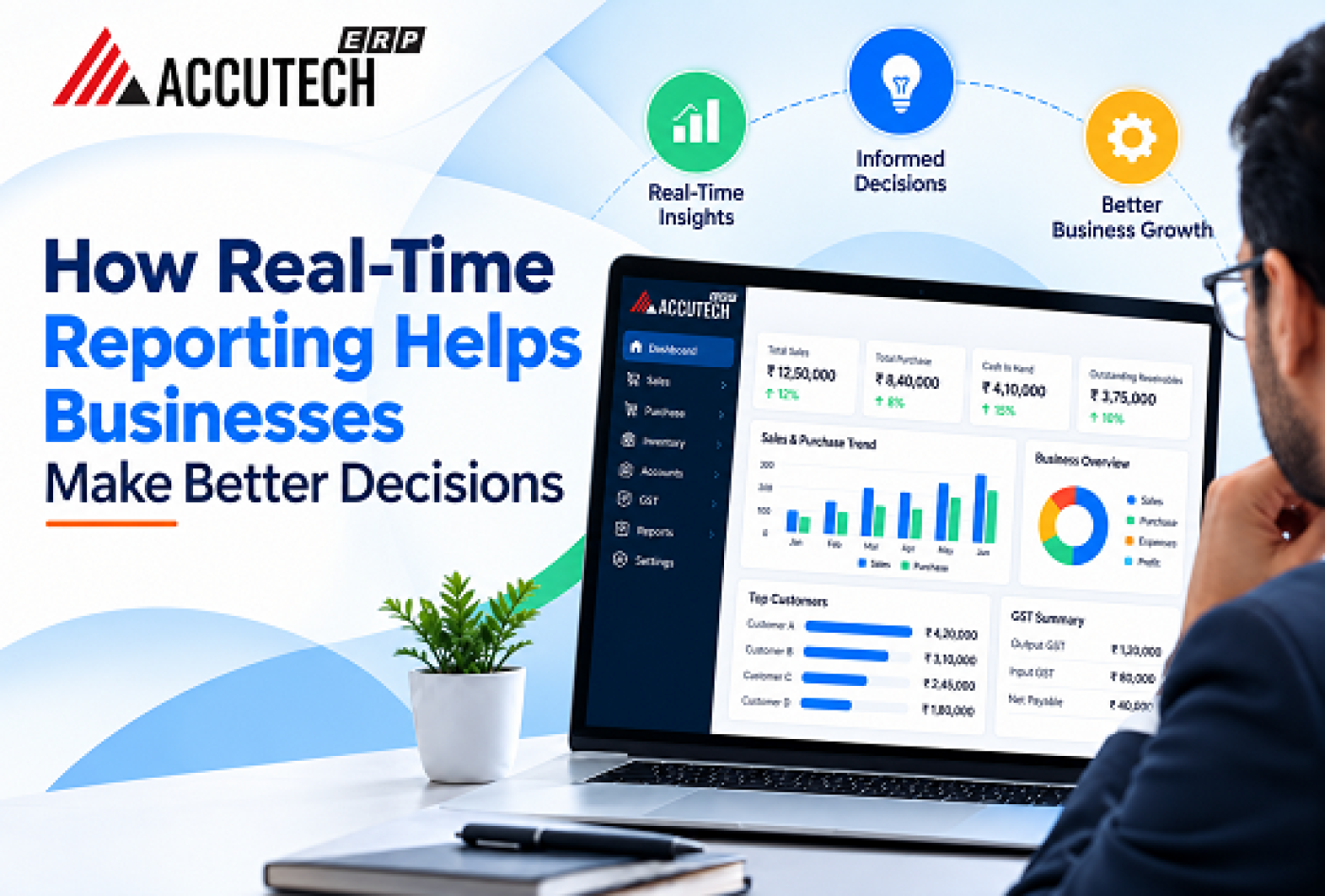
How Real-Time Reporting Helps Businesses Make Better Decisions
In today's rapidly evolving business landscape, making informed decisions quickly can be the difference between growth and stagnation. Yet, many businesses still rely on outdated accounting practices that provide delayed, fragmented financial information. This is where the best advance accounting ERP software transforms the way companies operate.
Real-time reporting has become essential for modern enterprises. Whether you're managing cash flow, analyzing customer profitability, tracking inventory costs, or ensuring GST compliance in India, having instant access to accurate financial data empowers business leaders to make data-driven decisions. According to recent industry research, businesses using real-time reporting systems experience 30% faster decision-making cycles and achieve 25% better financial accuracy compared to those using traditional methods.
This comprehensive guide explores how real-time reporting through an advanced accounting ERP solution helps businesses especially small and medium enterprises in India make better decisions. We'll cover the technology, benefits, implementation strategies, and practical examples that demonstrate the transformative power of real-time financial visibility.
The Evolution of Business Reporting: From Manual to Real-Time Intelligence
Understanding the journey from traditional accounting to modern real-time systems helps contextualize why this shift matters.
The Traditional Accounting Era (Pre-2010)
Decades ago, businesses maintained handwritten ledgers and paper-based accounting records. Financial reports were compiled monthly or quarterly, taking weeks to prepare. Decision-makers waited days or weeks for critical financial information, and errors were common but difficult to identify quickly. Audit trails were sparse, and compliance verification was labor-intensive and error-prone.
The ERP Era (2010-2020)
Enterprise Resource Planning (ERP) systems revolutionized accounting by centralizing data and automating transaction processing. However, even advanced ERP implementations typically provided reports on a batch schedule daily, weekly, or monthly. Decision-makers still experienced reporting delays, and the costs of implementing traditional ERP systems were prohibitive for small and medium businesses.
The Real-Time Intelligence Era (2020-Present)
Today's cloud-based accounting ERP platforms provide instantaneous visibility into business operations. Modern financial management systems in India now offer real-time dashboards, automated reconciliation, instant compliance alerts, and decision-support analytics. This shift has democratized advanced accounting capabilities, making them accessible to businesses of all sizes. The modern era emphasizes speed, accuracy, and actionable intelligence.
What is Best Advance Accounting ERP Software? A Complete Overview
Before diving deeper into real-time reporting benefits, it's essential to understand what the best advance accounting ERP software is and how it differs from basic accounting platforms.
Core Components of Advanced ERP Systems
- Real-Time Transaction Processing: Instant recording and processing of sales, purchases, and financial transactions
- Automated GST Compliance: Seamless handling of tax calculations, return generation, and audit trail maintenance
- Multi-Entity Management: Support for multiple businesses, branches, and legal entities with consolidated reporting
- Comprehensive Financial Reporting: Access to income statements, balance sheets, and cash flow reports instantly
- Inventory and Product Integration: Real-time stock tracking and product-wise profitability analysis
- Audit Trail and Compliance: Complete system-generated documentation of every transaction and user action
Why Advanced Accounting ERP Matters for Indian Businesses
India's complex tax environment, with GST regulations and multi-state operations, demands sophisticated accounting solutions. India's best accounting software should be designed to navigate these complexities while providing real-time visibility into business performance. This makes a modern ERP platform invaluable for decision-makers who need accurate, compliant financial information instantly.
7 Key Benefits of Real-Time Reporting for Business Decision-Making
The business case for real-time reporting through a modern accounting ERP platform is compelling and multifaceted. Let's explore seven transformative benefits:
1. Faster and More Accurate Decision-Making
Real-time reporting eliminates the lag between when transactions occur and when financial information becomes available. Business leaders can view current cash positions, customer payment status, supplier obligations, and inventory levels instantaneously.
This immediacy enables faster strategic decisions. The best advance accounting ERP software provides decision-makers with current, accurate information rather than historical approximations.
2. Enhanced Cash Flow Management and Financial Planning
Cash flow is the lifeblood of every business. With real-time reporting from an integrated financial management system, business owners can see exactly how much cash is available at any moment.
They can track outstanding customer invoices, monitor upcoming supplier payments, and forecast cash needs accurately. This visibility prevents surprises and helps optimize working capital.
Many businesses successfully reduce their cash conversion cycles by 15-20% by using real-time accounting data for proactive working capital management.
3. Profitability Analysis at the Customer, Product, and Department Level
Understanding which customers, products, or departments are most profitable is crucial for strategic focus. Real-time reporting capabilities in an advanced ERP accounting system enable detailed profitability analysis.
You can instantly identify your top-performing segments and those that are underperforming. This intelligence allows businesses to redirect resources toward high-margin opportunities, renegotiate terms with unprofitable customers, or discontinue non-performing product lines.
Businesses using such analytics report improving overall profitability by 10-18%.
4. Proactive Compliance and Risk Management
For Indian businesses, GST compliance is non-negotiable. A modern accounting ERP system automates compliance processes and provides real-time alerts for tax-related issues.
Real-time reporting shows tax liability, input credit status, and regulatory compliance gaps before they become problems. This proactive approach reduces audit risk, avoids penalties, and ensures businesses remain compliant with evolving regulations.
The system maintains complete audit trails automatically, eliminating manual compliance documentation.
5. Operational Efficiency and Reduced Manual Work
Manual reconciliation, journal entry creation, and report compilation are time-consuming and error-prone. Advanced accounting software automates these processes, freeing your accounting team to focus on analysis and strategy rather than data entry.
Businesses typically reduce accounting operational costs by 30-40% by implementing comprehensive ERP solutions. Real-time automation means reports that previously took days to compile are now available instantly.
6. Multi-Location and Multi-Entity Visibility
For growing businesses with multiple branches or entities, consolidated visibility is essential. A scalable accounting ERP platform supports multi-entity consolidation, allowing you to view both individual location performance and company-wide metrics in real-time.
This capability is invaluable for multi-location businesses because it enables quick identification of branch-specific issues and opportunities while maintaining an overall business perspective.
7. Data-Driven Culture and Strategic Planning
When real-time financial data is accessible to all decision-makers, it creates a culture of data-driven decision-making.
Strategic planning becomes based on actual performance metrics rather than assumptions. Businesses can set realistic targets, track progress continuously, and adjust strategies based on real-time performance.
India's best accounting software can become the central source of truth for business performance, enabling confident strategic planning and execution.
How Real-Time Financial Visibility Drives Strategic Decisions
Let's examine specific scenarios where real-time reporting through a modern accounting ERP solution directly influences business strategy:
Scenario 1: Credit Limit and Collection Strategy
A distributor using real-time reporting discovers that Customer A, despite generating high revenue, is consistently paying 45 days late.
Real-time visibility shows that this customer represents 12% of revenue but ties up 25% of working capital due to extended payment terms.
The business can immediately adjust credit policies reducing order limits, requiring prepayment, or renegotiating terms.
Without real-time reporting, this cost would continue unaddressed. An advanced financial ERP system makes such insights much easier to identify.
Scenario 2: Product Mix Optimization
A manufacturer discovers through real-time profitability reporting that Product X, which generates 15% of revenue, consumes 40% of production capacity and delivers only 3% profit margin.
Product Y, generating 8% of revenue, delivers 22% margin and requires minimal resources.
Armed with this intelligence, the company can shift manufacturing focus, marketing investment, and sales focus toward Product Y.
Real-time reporting from the best advance accounting ERP software enables this strategic pivot with confidence.
Scenario 3: Supplier Negotiation and Procurement Strategy
Real-time inventory and cost tracking reveals that Supplier A charges 12% more than Supplier B for identical materials.
This insight drives supplier consolidation, volume negotiations, or alternative sourcing. An integrated accounting and inventory ERP can quantify the impact showing that switching suppliers could improve gross margin by 2-3%.
This intelligence justifies changing suppliers and targets the savings opportunity precisely.
Scenario 4: Expansion and Investment Decisions
Before opening a new branch, management needs confidence that the business can support it.
Real-time cash flow projections and working capital analysis powered by actual historical data from an advanced accounting ERP system provide the foundation for expansion decisions.
Instead of guessing, businesses can model scenarios based on real performance data and make confident investment decisions.
Implementing Advanced Accounting ERP Software: Step-by-Step Guide
Successful implementation of a modern accounting ERP solution requires planning and careful execution. Here's a practical roadmap:
Step 1: Assess Your Current Environment
Document existing accounting processes, identify pain points, define team size, and clarify functional requirements.
Understand your tax obligations, multi-location needs, and industry-specific requirements. This assessment ensures the selected accounting platform aligns with actual business needs.
For SMEs evaluating the best accounting software for small business in India, this step is particularly important because unnecessary features can add complexity without creating value.
Step 2: Define Success Metrics
Establish measurable goals: reduction in reporting time, improved financial accuracy, faster close cycles, compliance automation, or user adoption targets.
These metrics help evaluate whether your accounting ERP investment is delivering expected value.
Step 3: Configure Chart of Accounts and Reporting Structure
Set up your account hierarchy that supports both operational needs and regulatory requirements.
Configure segment codes for branches, departments, or cost centers to enable detailed analysis. Proper configuration of the financial management system at this stage determines reporting flexibility later.
Step 4: Establish Data Migration and Initial Load
Migrate existing accounting data accurately from legacy systems.
This is critical for continuity and auditor confidence. A reliable ERP accounting solution should support clean migrations with validation checkpoints.
Step 5: Configure Tax and Compliance Rules
For Indian businesses, configure GST rules, HSN mappings, and compliance workflows.
India's best accounting software should have built-in GST compliance capabilities that require minimal configuration while supporting accurate tax reporting.
Step 6: Train Users and Establish Process Documentation
Comprehensive training ensures users understand how to leverage the accounting ERP system effectively.
Document standard operating procedures for transaction entry, month-end close, and reporting.
Step 7: Go Live and Continuous Optimization
Launch with a phased approach if possible. Monitor early usage, address issues quickly, and gradually expand functionality.
A modern accounting platform becomes more valuable over time as users become proficient and discover new analytical capabilities.
Real-World Success Stories: How Businesses Transformed with Real-Time Reporting
Case Study 1: Manufacturing Company Improves Margin by 8%
A mid-sized manufacturer implemented an advanced accounting ERP solution and gained real-time visibility into production costs.
Within three months, the cost accounting team identified that the manufacturing process for a specific product category was using 18% more materials than standard due to production inefficiencies.
Real-time reporting enabled rapid process improvement. The company improved gross margins from 34% to 42% within 12 months, entirely due to insights generated from real-time financial data.
Case Study 2: Distribution Business Reduces Cash Cycle by 22 Days
A distributor using real-time reporting discovered that average customer payment time was 68 days while average supplier payment terms were 35 days, creating a significant working capital gap.
Using real-time reporting dashboards from an integrated financial ERP platform, the company implemented targeted collection processes.
They incentivized early payment, tightened credit policies, and improved collection procedures. Payment cycles improved to 46 days, reducing working capital requirements by significant amounts.
Case Study 3: Service Company Identifies Unprofitable Customers
A service company with 200+ customers implemented real-time profitability reporting using an advanced accounting management system.
Analysis revealed that 8% of customers, mainly small accounts, were consuming 35% of service delivery resources while generating only 2% of revenue.
By consolidating small accounts, reducing service levels for low-margin customers, and focusing sales on high-value prospects, the company improved overall profitability by 18% within six months.
Common Mistakes When Selecting Accounting Software and How to Avoid Them
Mistake 1: Choosing Based on Price Alone
The cheapest software is rarely the best. Prioritize value over price.
A comprehensive financial ERP platform may cost more initially but can save substantially through automation, error reduction, and improved decision-making.
Mistake 2: Ignoring GST Compliance Capabilities
For Indian businesses, GST compliance is non-negotiable.
Ensure your accounting ERP has robust, regularly updated GST compliance features. This is not an optional feature but essential functionality.
Businesses searching for India's best accounting software should therefore evaluate GST capabilities carefully before finalizing a solution.
Mistake 3: Not Considering Multi-Location Needs Early
If growth is anticipated, select software that scales. Migrating later to more robust systems is expensive.
The best accounting software for small business in India should support future expansion to multiple locations, branches, or business entities.
Mistake 4: Underestimating Implementation Effort
Implementation requires time, resources, and expertise.
Budget adequately and allocate experienced team members. Implementing an advanced accounting ERP should be treated as a business initiative, not just an IT project.
Mistake 5: Selecting Software Without Testing
Always request demonstrations and free trials.
Test the system with actual data scenarios. Evaluating a solution before implementation prevents costly investments in software that does not match business requirements.
Frequently Asked Questions (FAQs)
Q1: How quickly can we implement advanced accounting ERP software?
Implementation timelines vary based on business complexity, data volume, and customization needs.
Simple implementations may take 4-8 weeks, while complex multi-location setups might require 3-6 months.
Cloud-based solutions typically implement faster than on-premise systems. A well-designed financial ERP platform uses industry best practices to minimize implementation duration.
Q2: Can modern accounting ERP software handle our existing data?
Yes, modern ERP systems are designed to migrate data from legacy platforms.
Advanced accounting solutions include data migration tools and verification processes. Historical data is preserved for audit purposes and year-on-year comparisons.
Professional migration services ensure accuracy and minimize business disruption.
Q3: What makes advanced ERP software different from basic accounting software?
Advanced ERP systems integrate accounting with operations inventory, sales, procurement, HR, and more.
They provide real-time visibility across the entire business, support complex organizational structures, handle compliance automation, and enable detailed analytics.
Basic software focuses on transaction recording; advanced systems provide business intelligence and decision support.
This wider functionality is one reason businesses increasingly look for the best advance accounting ERP software rather than standalone bookkeeping tools.
Q4: How does real-time reporting improve GST compliance?
An integrated accounting ERP automates tax calculations, maintains complete audit trails, and generates compliance reports instantly.
Real-time tax tracking identifies issues before filing deadlines. Automated reconciliation between your records and GST authority data prevents costly errors.
Most systems provide pre-filed return formats, reducing manual compilation work by 80-90%.
Q5: Is advanced accounting ERP software suitable for small businesses?
Absolutely. Modern cloud-based solutions make advanced accounting capabilities accessible to businesses of all sizes.
The best accounting software for small business in India is now accessible through cloud models with minimal upfront investment.
Small businesses benefit tremendously from automation, compliance features, and real-time visibility that were previously available only to large enterprises.
Q6: How secure is our financial data in cloud-based ERP systems?
Cloud-based solutions provide enterprise-grade security.
Modern accounting platforms use encryption, multi-factor authentication, role-based access controls, and automated backups.
Security is often superior to on-premise systems because providers maintain dedicated security infrastructure.
Regular security audits and compliance certifications such as ISO and SOC 2 can further strengthen data protection. Your financial data can therefore be more secure in a properly managed cloud environment than on local servers.
Q7: Can advanced accounting ERP software integrate with other business systems?
Yes, modern ERP systems include APIs and integration capabilities.
They can integrate with CRM systems, payment gateways, banking platforms, and e-commerce applications.
These integrations reduce manual data entry, improve accuracy, and provide comprehensive business visibility.
Businesses evaluating India's best accounting software should consider integration capabilities alongside accounting and compliance features.
Q8: What ongoing support is provided after implementation?
Quality ERP providers offer comprehensive post-implementation support including user assistance, system maintenance, regulatory updates especially important for GST changes in India and feature enhancements.
Reliable ERP providers maintain active support teams and regular update schedules.
Ensure support terms are clearly defined during vendor selection, particularly when comparing options for the best accounting software for small business in India.
Conclusion:
The competitive advantage in modern business belongs to organizations that make faster, better-informed decisions.
Real-time reporting through the best advance accounting ERP software has transformed how businesses operate from month-long accounting cycles to instant financial visibility. Accutech ERP helps businesses access real-time financial insights and make faster, more informed decisions.
Advanced financial management software is no longer a luxury for large enterprises but an essential tool for businesses of all sizes seeking to remain competitive.
Whether you're managing cash flow, optimizing profitability, ensuring compliance, or planning growth, a modern ERP accounting system like Accutech ERP provides the intelligence needed for confident decision-making.
For businesses searching for India's best accounting software, real-time reporting should be one of the most important capabilities to evaluate. Accutech ERP supports businesses with integrated reporting, financial visibility, and operational control.
Real-time reporting transforms accounting from a historical record-keeping function to a strategic business tool.
The journey from traditional accounting to real-time intelligence isn't just about technology, it's about fundamentally changing how your business operates.
Organizations that embrace this transformation gain:
- Speed: Real-time decisions instead of waiting for monthly reports
- Insight: Deep visibility into profitability, cash flow, and operational performance
- Compliance: Automated tax and regulatory requirements with minimal manual effort
- Efficiency: Reduced manual accounting work and improved operational efficiency
- Strategy: Data-driven planning with confidence in numbers
If you're still using manual accounting methods or basic accounting software, the time to upgrade is now.
A comprehensive ERP accounting solution such as Accutech ERP can help deliver measurable value through improved efficiency, reduced errors, better cash management, and most importantly, better business decisions.
Take the next step today. Request a demonstration of Accutech ERP if you're evaluating the best accounting software for small business in India and see firsthand how real-time reporting can transform your financial management and decision-making capabilities.
Your business deserves accounting intelligence that keeps pace with modern business demands. Make the shift to real-time reporting with Accutech ERP today.