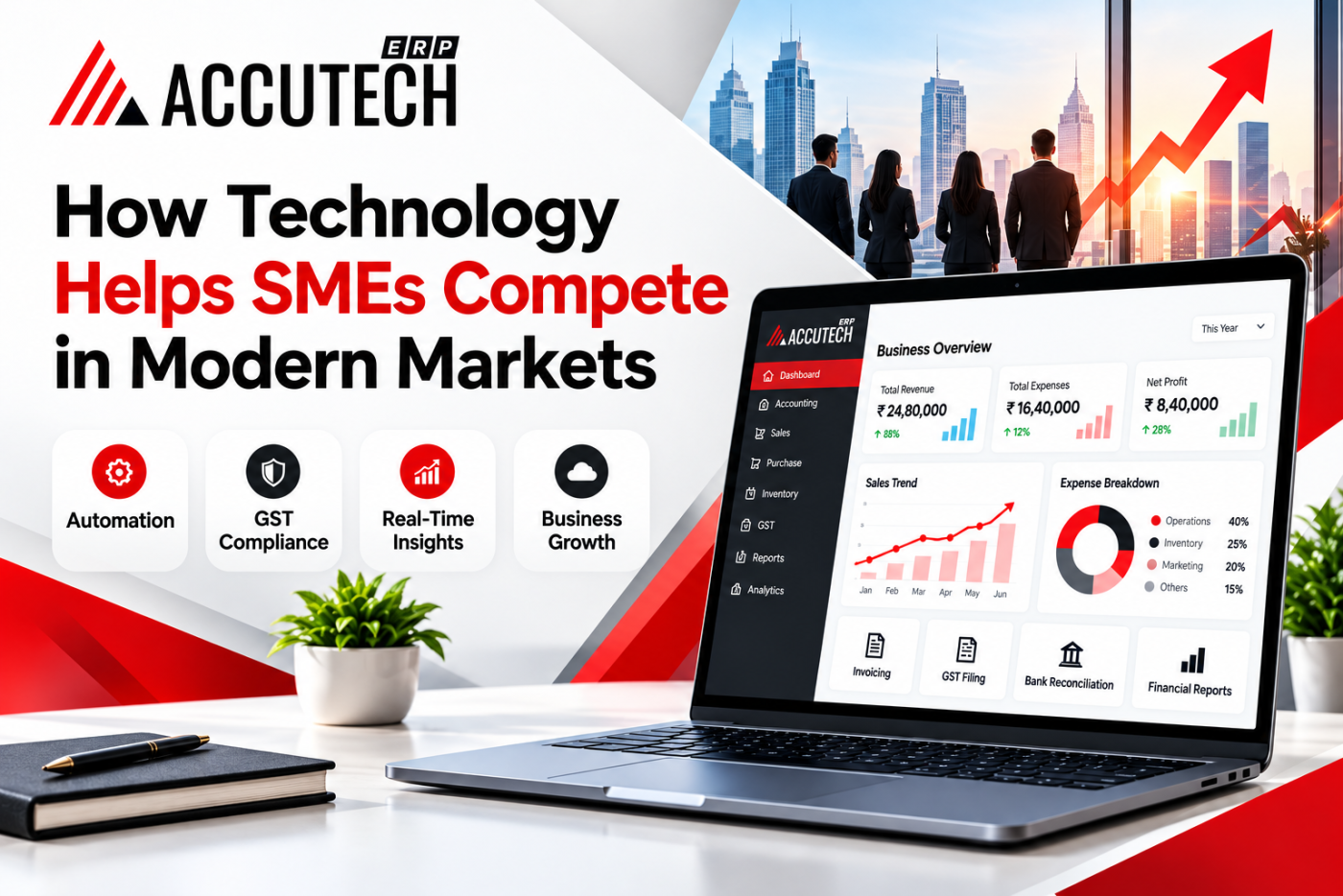
How Technology Helps SMEs Compete in Modern Markets
The modern business landscape is unforgiving for small and medium enterprises (SMEs). Competition is fiercer than ever, margins are tighter, and customer expectations have skyrocketed. Yet here's the surprising truth: technology has leveled the playing field in ways that were unimaginable just a decade ago.
Gone are the days when SMEs had to choose between staying lean and staying compliant. Today, the best advance accounting ERP software enables businesses of all sizes to operate with the financial precision and compliance readiness of enterprises. But not all businesses have yet discovered this competitive advantage.
According to recent industry research, SMEs that implement digital financial management solutions experience 35% faster financial closing, 40% reduction in manual errors, and 50% improvement in decision-making speed. That's the difference between surviving and thriving in competitive markets.
This comprehensive guide explores how technology specifically advanced accounting ERP solutions transforms SME operations, improves compliance, and creates sustainable competitive advantages. Whether you're struggling with manual accounting processes, facing GST compliance challenges, or trying to scale without losing financial control, this guide provides actionable insights and practical solutions.
The SME Competitive Challenge in 2026
SMEs operate in a paradox. They have the agility and customer intimacy that larger corporations envy, yet they often lack the operational efficiency and financial insights that drive sustainable growth. The stakes have never been higher.
Key Challenges Facing Modern SMEs:
- Limited Financial Visibility: Many SMEs still rely on spreadsheets, emails, and disconnected systems. Getting a real-time view of cash flow, profitability, or tax liability requires manual compilation and takes days.
- Compliance Complexity: GST compliance, income tax, payroll taxes, and regulatory filings have become increasingly complex. Non-compliance risks include penalties, interest, and reputational damage.
- Operational Inefficiency: Manual data entry, duplicate records across systems, and lack of automation create bottlenecks that consume resources and introduce errors.
- Scaling Challenges: As SMEs grow, managing multiple locations, entities, or product lines becomes increasingly difficult with disconnected systems.
- Decision-Making Delays: Without real-time data, SME leaders make decisions based on outdated information, missing market opportunities or failing to address problems early.
Understanding ERP Technology and Its Role
An ERP (Enterprise Resource Planning) system is an integrated software platform that connects all aspects of a business finance, accounting, inventory, sales, and compliance into a single, unified database.
Think of it as the nervous system of your business. When properly implemented, an ERP system ensures that every department has access to the same accurate, up-to-date information. A sale in the morning automatically updates inventory, triggers accounting entries, and updates financial projections all in real time.
How ERP Systems Deliver Competitive Advantage:
- Data Integration: Single source of truth across all business functions
- Automation: Eliminates manual, repetitive tasks
- Real-Time Visibility: Access to financial and operational data instantly
- Compliance Management: Built-in controls and audit trails
- Scalability: Grows with your business without needing system replacement
Why Cloud ERP Accounting is Game-Changing for SMEs
Cloud ERP accounting has fundamentally transformed how SMEs manage finances. Unlike traditional on-premise systems that require expensive IT infrastructure and maintenance, modern cloud-based financial platforms offer flexibility, affordability, and accessibility.
Comparison: On-Premise vs. Cloud ERP Accounting
Initial Cost: On-Premise = ₹5-15 Lakh+ | Cloud ERP = ₹500-5,000/month
IT Infrastructure: On-Premise = Heavy IT investment required | Cloud ERP = Zero infrastructure needed
Accessibility: On-Premise = On-site only | Cloud ERP = Anywhere, anytime, any device
Updates & Maintenance: On-Premise = Costly and time-consuming | Cloud ERP = Automatic, included in subscription
Why Cloud ERP Accounting Matters for SMEs:
Cloud-based solutions like the best advance accounting ERP software eliminate the capital expenditure barrier, allowing SMEs to access enterprise-grade technology without massive upfront investment. This democratization of technology is transforming how SMEs compete.
Key advantages include automatic software updates that keep you compliant with the latest tax laws (crucial in India's dynamic GST environment), seamless scalability as your business grows, and the ability to access financial data from anywhere essential for modern distributed teams.
Key Features of Best Advance Accounting ERP Software
Not all accounting software is created equal. Advanced accounting ERP platforms designed for SMEs combine powerful functionality with user-friendly interfaces, eliminating the need for extensive IT training.
Essential Features to Look For:
- Real-Time Financial Dashboards: View your complete financial position instantly. Multi-dimensional reporting lets you analyze by customer, product, location, or any dimension relevant to your business.
- Automated GST Compliance: Advanced accounting software automates GST calculations, generates GSTR files, tracks ITC (Input Tax Credit), and maintains audit trails. This is critical GST non-compliance penalties can be severe.
- Intelligent Reconciliation: Automatic matching of bank statements, supplier invoices, and customer payments saves hundreds of hours annually.
- Multi-Entity Management: Manage multiple branches, subsidiaries, or business entities within a single platform. Consolidated reporting with the ability to drill down to individual entity details.
- Customizable Charts of Accounts: Configure your accounting structure to match your business model, not the software's limitations.
- Comprehensive Audit Trail: Every transaction is tracked with who made it, when, and what changed. Critical for compliance and internal control.
- Integration Capabilities: The best accounting software in India connects with your existing business systems banking platforms, e-commerce stores, inventory management, payroll eliminating manual data entry.
- Role-Based Access Control: Restrict sensitive financial information to appropriate team members while giving others the data they need.
How Advance Accounting Software Solves Real SME Problems
Understanding features is important, but seeing how they translate to solving real business problems is transformative. Here's how advance accounting software addresses the most pressing challenges SMEs face:
Problem 1: Financial Closing Takes Weeks
Traditional Situation: Your accounting team manually collects data from sales, purchases, inventory, and payroll. They reconcile accounts, investigate discrepancies, prepare adjusting entries, and compile reports. The entire process takes 15-25 days.
How Advance Accounting Software Helps: With the best advance accounting ERP software, transactions flow directly into the system in real time. Account reconciliation happens automatically. Month-end closing tasks that took days now take hours. Some companies achieve same-week financial close.
Business Impact: Faster decision-making, better cash flow visibility, improved banker and investor relationships.
Problem 2: GST Compliance is Overwhelming
Traditional Situation: Your finance team manually tracks GST across invoices, reconciles GSTR-2A (supplier invoices) with your records, ensures ITC eligibility, and files monthly returns. Mistakes are costly penalties range from 10-25% of the tax amount.
How Advance Accounting Software Helps: Advanced accounting software built specifically for Indian businesses automates the entire GST workflow. Every invoice is categorized for GST treatment automatically. The system tracks which invoices have matching GSTR-2A entries and flags discrepancies. Return preparation is just a few clicks.
Business Impact: Reduced compliance risk, elimination of filing errors, confidence in tax positions, reduced professional fees.
Problem 3: Multi-Location Operations Are Chaotic
Traditional Situation: Each location maintains its own books. Consolidating them requires manual compilation, formula-based spreadsheets prone to errors, and weeks of work.
How Advance Accounting Software Helps: A modern advanced ERP accounting system supports unlimited entities and branches. Each location operates with its own ledgers, but the system maintains complete integration. At any moment, you can view consolidated financial statements, drill down to individual location details, or compare performance across locations.
Business Impact: Instant consolidated visibility, location-level accountability, ability to identify top and underperforming locations quickly.
GST Compliance and Real-Time Reporting Benefits
GST compliance represents one of the most significant operational and compliance challenges for Indian SMEs. Let's explore how modern advance accounting software is changing the game.
The GST Challenge:
- Requires tracking of multiple tax rates based on product type and customer location
- Demands monthly return filing with no margin for error
- Requires reconciliation with supplier invoices (GSTR-2A)
- Involves complex ITC (Input Tax Credit) eligibility rules
- Includes reverse charge mechanisms for certain transactions
How Best Advance Accounting ERP Software Ensures Compliance:
- Tax Rate Configuration: Maintains an updated database of GST rates for all products and services. When you create an invoice, the correct rate is applied automatically.
- Automatic GSTR-2A Matching: Downloads GSTR-2A data and automatically matches them against your purchase records. Discrepancies are flagged for investigation.
- ITC Tracking and Reconciliation: The system tracks which invoices qualify for ITC, monitors blocked credits, and ensures you're not claiming ineligible amounts.
- Return Preparation: GSTR-1, GSTR-2, GSTR-3B, and GSTR-9 are prepared automatically with 95%+ accuracy.
- Amendment Management: If you discover mistakes after filing, the system helps you prepare amendment returns easily.
Real-Time Reporting Benefits:
- Instant Access to Financial Data: Instead of waiting for monthly reports, get real-time visibility into sales, expenses, profitability, and cash flow.
- Proactive Problem Identification: When a customer's account goes delinquent or inventory levels drop below thresholds, immediate alerts notify relevant team members.
- Better Strategic Decisions: Analyze sales trends, customer profitability, product margins, and operational efficiency metrics in real time.
- Improved Cash Management: Know exactly what cash is coming in, what's going out, and when. Critical for SMEs with tight working capital.
Implementation Best Practices and ROI Metrics
Implementing the best advance accounting ERP software is not a simple software installation. It's a business transformation project that requires planning, change management, and realistic expectations.
Best Practices for Successful Implementation:
- Start with Clear Objectives: Define what success looks like. Reduce financial closing time from 15 days to 5 days? Reduce GST compliance time from 20 hours to 5 hours? Make these goals measurable and specific.
- Secure Executive Support: Successful ERP implementations require visible commitment from the top. Leadership needs to communicate the importance, remove obstacles, and allocate necessary resources.
- Invest in Training: Users won't adopt advance accounting software if they don't understand it. Plan for comprehensive training both initial and ongoing.
- Start with Core Modules: Begin with the accounting and financial management modules. Once stable, gradually expand to other modules like inventory management or payroll integration.
- Validate Data Quality: Migrate only clean data from your old system. Invest time in cleaning and validating. Bad data migrated = bad data in new system = bad decisions.
- Plan for Ongoing Support: Implementation doesn't end on day one. Budget for 2-3 months of post-implementation support to address issues and optimize processes.
Key ROI Metrics for Advance Accounting Software:
Financial Closing Time: From 15-20 days → 3-5 days (75% reduction)
GST Compliance Time: From 20-25 hours → 2-4 hours (90% reduction)
Accounting Errors: 40-60% reduction through automation
Decision-Making Speed: 3-5x faster with real-time data
Comparing Solutions: What Makes Best Accounting Software in India Stand Out
The market for accounting software in India has become increasingly crowded. International solutions, homegrown startups, and traditional ERP vendors all claim to offer the best accounting software in India. How do you choose?
Key Differentiators for Indian-Specific Solutions:
- Deep GST Understanding: GST is uniquely complex in India. Advanced accounting software built for the Indian market deeply understands GST mechanics reverse charges, HSN classifications, state-wise regulations, and recent amendments.
- Local Regulatory Compliance: Beyond GST, Indian businesses must comply with TDS rules, income tax provisions, e-invoicing requirements, and e-way bills. Indian-specific solutions have these baked in.
- Integration with Indian Payment Systems: Leading accounting platforms seamlessly integrate with NEFT, RTGS, UPI, and other Indian payment systems for automatic reconciliation.
- Support in Regional Languages: For SMEs in non-English speaking regions, interface and support in Hindi or regional languages matter significantly.
- Vendor Ecosystem Knowledge: Indian businesses work with local vendors, payment terms vary significantly, and credit management is different. Software built for India understands these nuances.
Red Flags in Software Selection:
- Limited or No GST Support: If a solution doesn't have comprehensive GST management, avoid it. This is non-negotiable for Indian businesses.
- No Multi-Currency or Multi-Language Support: India has businesses operating across multiple currencies and languages. Lack of this support is limiting.
- Poor Local Support: Software vendors who offer only email support or support based in countries without understanding of Indian business practices are problematic.
- Lack of Integration Capabilities: If the software doesn't integrate with banking systems, e-commerce platforms, or other business software you're using, data entry becomes manual and error-prone.
Common Implementation Mistakes and How to Avoid Them
While the best advance accounting ERP software has tremendous potential, implementations often fail due to common, avoidable mistakes. Learning from others' experiences can save you significant time and money.
Mistake #1: Trying to Customize Everything
The Problem: SME leaders often want the new system to work exactly like their old processes. They request extensive customizations to fit the old workflow.
The Solution: Focus on configuring, not customizing. A well-designed advanced accounting system is built with best practices embedded. Often, the right approach is to improve your processes to match the software's design, not the other way around.
Mistake #2: Inadequate Training
The Problem: Companies treat software training as a one-time event. Users attend a session, don't remember, and then revert to old processes.
The Solution: Plan ongoing training. Start with comprehensive initial training, follow with hands-on practice, then provide ongoing support. Create user guides tailored to different roles.
Mistake #3: Poor Data Migration
The Problem: Migrating old, uncleaned data into the new system. This perpetuates errors and creates immediate distrust in the system.
The Solution: Treat data migration as a distinct project. Clean historical data before migration. Validate balances. Perform reconciliation between old and new systems.
Mistake #4: Ignoring Change Management
The Problem: Implementing new software without addressing the human side of change. Users resist, continue old workarounds, and the system doesn't deliver its potential.
The Solution: Invest in change management. Involve key users early in selection and implementation. Communicate benefits clearly. Address concerns. Celebrate quick wins.
Mistake #5: Unrealistic Expectations
The Problem: Expecting the system to solve all problems immediately. If challenges arise during implementation, frustration sets in.
The Solution: Plan for a 3-6 month stabilization period. Expect some issues. Budget for post-implementation support. View implementation as the beginning of a journey with your financial management software.
The Future of ERP Technology for SME Growth
The ERP landscape is rapidly evolving. Understanding emerging trends helps you make software decisions that won't become obsolete in a few years.
AI and Machine Learning Integration:
Next-generation accounting ERP platforms are incorporating AI to identify patterns, predict cash flow, flag unusual transactions, and suggest optimizations. Machine learning algorithms learn from your business and become smarter over time.
Mobile-First and Remote Accessibility:
The pandemic accelerated remote work adoption. Modern advanced ERP solutions today have full mobile apps, not just web access. CFOs need to review balance sheets and approve transactions from their phones.
Enhanced Integrations and API-First Architecture:
Modern software uses APIs (Application Programming Interfaces) to connect seamlessly with other business applications. A single source of truth isn't about one massive system anymore; it's about systems that work together perfectly.
Frequently Asked Questions
Q1: What is the Best Advance Accounting ERP Software for my SME?
The best advance accounting ERP software depends on your specific business needs, budget, and complexity. Look for solutions that specifically support Indian GST regulations, offer cloud-based access, provide real-time financial reporting, and have excellent customer support. Evaluate at least 3-4 options, request demos, and check references from similar-sized businesses.
Q2: How Long Does It Take to Implement Advance Accounting Software?
Typical implementation timelines for an advanced accounting ERP system range from 3-6 months. The exact timeline depends on data volume, complexity of your current processes, system integrations needed, and the implementation methodology. Smaller implementations with fewer integrations might complete in 6-8 weeks, while complex multi-location setups might take 6-9 months.
Q3: Can Advance Accounting Software Integrate with My Existing Systems?
Yes, most cloud ERP accounting solutions offer integrations with banking systems, e-commerce platforms, inventory management software, and payroll systems. However, integration capabilities vary. Before purchasing, verify that the advance accounting software can integrate with all your critical business systems. API-based integrations are generally more reliable.
Q4: What's the Cost of Best Accounting Software in India?
The best accounting software in India can vary significantly in cost depending on features, number of users, and transaction volume. Cloud-based advance accounting software typically costs ₹500-5,000 per month. Some solutions charge per-user, others have tiered pricing. Implementation services might cost ₹50,000-5,00,000 depending on complexity. The ROI typically justifies the investment within 6-12 months.
Q5: How Does Advance Accounting Software Handle Multiple Locations?
Advanced accounting ERP platforms allow unlimited branches and locations, each with its own books and ledgers. You maintain location-level profit and loss statements, individual GST registrations if needed, and consolidated reporting across all locations.
Q6: Is Cloud ERP Accounting Secure?
Yes, reputable cloud ERP accounting providers invest heavily in security. Look for solutions with: data encryption in transit and at rest, multi-level authentication, regular security audits, compliance with international security standards, and automated backups. Cloud solutions often have better security than on-premise systems because vendors specialize in security infrastructure.
Q7: Can I Migrate Data from My Existing Accounting System?
Yes, most advance accounting software vendors offer data migration services. However, the quality of migration depends heavily on data preparation. Plan to spend 20-30% of implementation time on data cleaning and validation. Verify all balances match between old and new systems before going live.
Q8: How Often Are Updates and New Features Released?
Cloud-based financial management software typically releases updates monthly or quarterly. These updates include compliance updates (critical for GST changes), security patches, and new features. Updates are deployed automatically without disrupting your operations.
Q9: What Support and Training Is Provided?
Support and training vary by vendor. Look for: comprehensive initial training (both online and on-site), role-based training, user documentation and video tutorials, ongoing support (email, phone, chat), and dedicated account management. Choose based on your needs and response time requirements.
Q10: Can SMEs with Limited IT Skills Manage the Software?
Absolutely. Modern advance accounting software is designed for end users, not IT specialists. Intuitive interfaces, guided workflows, and comprehensive training make adoption achievable. Many SMEs successfully implement and manage advanced accounting systems with just one part-time administrator.
Conclusion:
The competitive landscape for SMEs has fundamentally changed. Technology is no longer a luxury for large corporations it's a necessity for all businesses that want to survive and grow.
The best advance accounting ERP software represents more than just a digital tool. It's a strategic investment in your business's financial foundation. It's about moving from reactive accounting (figuring out what happened last month) to proactive financial management (knowing what's happening in real time and making forward-looking decisions).
Consider the impact: Financial closing compressed from 15 days to 3 days. GST compliance reduced from 20+ hours to 3 hours. Real-time visibility into profitability by product, customer, and location. Multi-location operations managed as a unified entity. Audit readiness 24/7.
These aren't just operational improvements they're competitive advantages. They translate to faster response to market opportunities, better pricing decisions based on real cost data, improved cash management, reduced compliance risk, and easier access to finance.
If you're currently managing finances with spreadsheets, navigating GST manually, or struggling with multi-location consolidation, the time to act is now. Modern accounting ERP solutions available today are more affordable, more user-friendly, and more powerful than ever before.
Your competitors are adopting these solutions. Your most talented employees expect modern tools. Your customers and investors expect financial transparency. Cloud ERP accounting is no longer a future consideration it's a present necessity.
Take the first step today. Request a demo. Speak with vendors. Learn how advance accounting software can transform your business. The competitive advantage awaits.