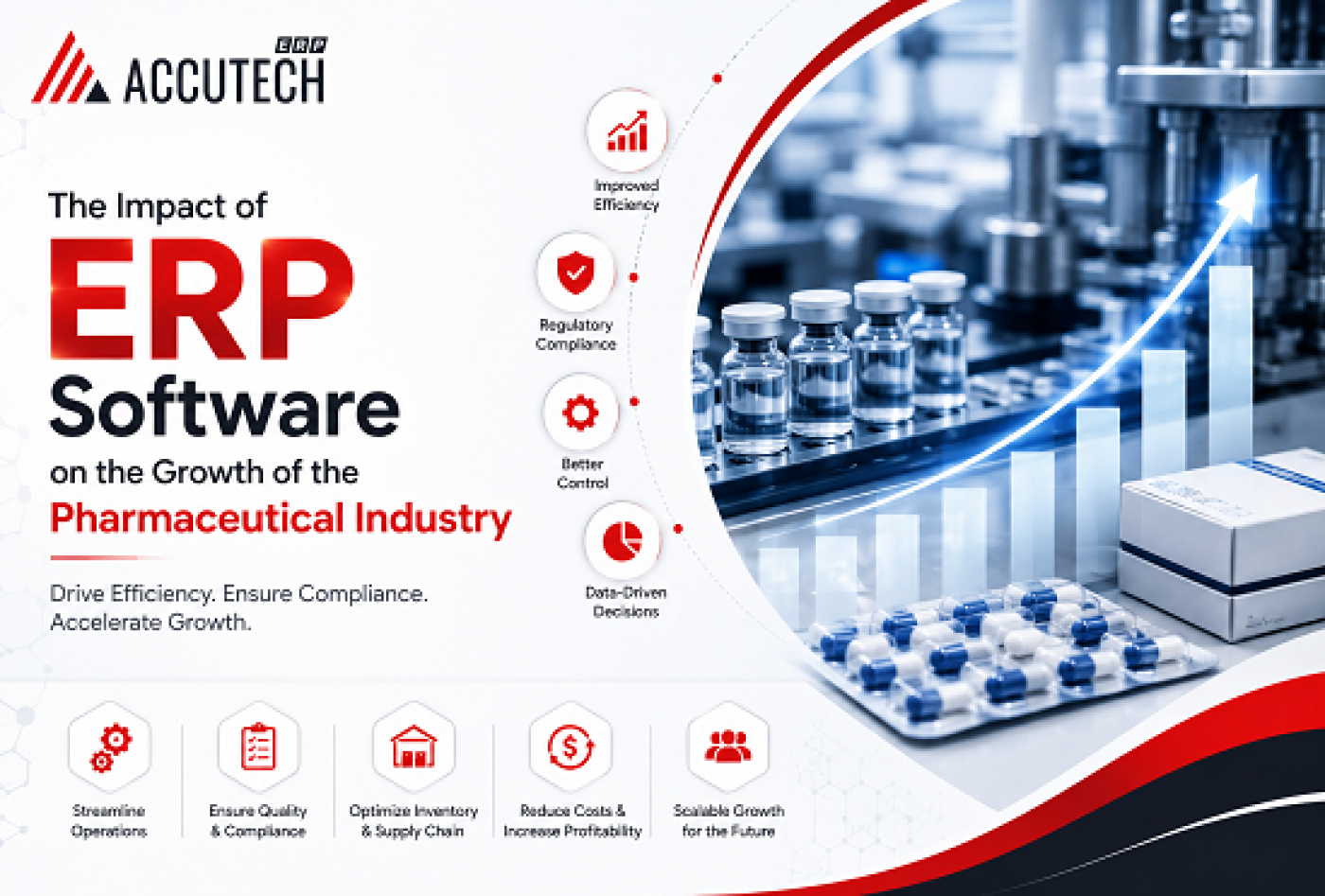
The pharmaceutical industry stands at a critical crossroads. With regulatory compliance becoming more stringent, supply chain complexity increasing, and competition intensifying, pharmaceutical companies face unprecedented operational challenges. Yet within these challenges lies a transformative opportunity.
Enterprise Resource Planning (ERP) software has emerged as a game-changer for pharmaceutical organizations worldwide. Unlike generic business management solutions, pharmaceutical manufacturing ERP software is specifically engineered to address the unique needs of drug manufacturers, distributors, and franchise businesses. This specialized approach delivers measurable growth benefits that extend far beyond simple cost reduction.
According to industry research, pharmaceutical companies implementing ERP solutions report efficiency improvements of 25-40%, error reduction rates of 60-75%, and ROI achievements within 18-24 months. More importantly, these systems enable companies to scale operations, enter new markets, and respond to regulatory changes with unprecedented agility.
In this comprehensive guide, we explore how ERP software directly impacts pharmaceutical industry growth, examining real-world benefits, implementation strategies, and best practices that leading companies are using to gain competitive advantage.
How ERP Software Transforms Pharmaceutical Operations
Understanding the Transformation
The pharmaceutical industry has traditionally relied on fragmented systems separate software for inventory, billing, accounts, and quality control. This siloed approach creates data inconsistencies, delays decision-making, and increases operational risk.
ERP software fundamentally changes this landscape by creating a unified platform where all business processes communicate seamlessly. Every transaction whether it's a purchase order, sales invoice, inventory movement, or financial entry flows through a single, integrated system.
From manufacturing and distribution to accounts management and GST compliance, erp systems for pharmaceutical manufacturing provide comprehensive visibility across the entire organization. This integration is not merely a technical improvement, it's a strategic advantage that directly translates to growth.
Real-World Impact Example
Consider a mid-sized pharma company managing 50 distributors across multiple regions. Without ERP:
- Order processing takes 3-4 days with manual data entry
- Inventory visibility is delayed by 24-48 hours
- Stock-outs and overstocking occur due to poor forecasting
- Billing errors average 5-8% of transactions
- Financial reporting requires 5-10 days of manual consolidation
With ERP implementation:
- Order processing reduces to same-day fulfillment
- Real-time inventory visibility across all locations
- Predictive analytics prevent stock issues
- Billing accuracy improves to 99%+
- Financial reporting is automated within 24 hours
This transformation enables the company to handle 2-3x more volume without proportional increase in operational overhead, a direct path to growth.
Key Benefits of Implementing Pharmaceutical ERP Systems
The benefits of implementing ERP software extend across every dimension of pharmaceutical business operations. Modern ERP systems for pharmaceutical manufacturing connect departments, standardize workflows, and provide the control required for sustainable expansion:
Immediate Benefits
- Process Automation: Eliminates 60-70% of manual data entry and administrative tasks
- Error Reduction: Decreases billing, inventory, and accounting errors by 70-80%
- Time Savings: Reduces month-end closing from weeks to days
- Cost Control: Identifies and eliminates process inefficiencies worth 8-12% of operating costs
Strategic Benefits
- Scalability: Support 5-10x volume growth without system overhaul
- Regulatory Readiness: Built-in compliance with GST, FDA guidelines, and industry standards
- Data-Driven Decisions: Access to comprehensive business analytics and real-time dashboards
- Customer Satisfaction: Faster order processing and order accuracy build customer loyalty
Operational Efficiency and Cost Optimization
Streamlining Daily Operations
Operational efficiency is where ERP delivers its most tangible, immediate returns. In pharmaceutical businesses managing multiple distributors, franchisees, and regional warehouses, operational complexity multiplies quickly.
A modern erp for pharmaceuticals automates routine tasks across several critical areas:
Stock and Inventory Management
- Automatic stock level tracking across multiple warehouses
- Expiry date monitoring to prevent wastage
- Batch-wise stock management for pharmaceutical products
- Automatic reorder point calculation and purchase order generation
Order Processing and Fulfillment
- Automated order creation from distributors and customers
- Instant invoice generation with accurate pricing
- Real-time order status visibility for customers
- Automatic billing and payment reconciliation
Cost Optimization Benefits
Beyond efficiency, ERP directly optimizes costs:
- Reduced Inventory Holding Costs: Better forecasting and stock management reduce excess inventory by 20-30%
- Lower Transaction Costs: Automated billing and payment processing reduce processing costs by 40-50%
- Decreased Administrative Overhead: Fewer manual processes mean lower labor costs
- Improved Cash Flow: Faster billing and collection cycles improve working capital by 15-25%
- Reduced Waste: Better expiry tracking and product management reduce pharmaceutical waste by 30-40%
Regulatory Compliance and Quality Assurance
In the pharmaceutical industry, regulatory compliance isn't optional, it's fundamental to business survival. Non-compliance can result in penalties, licensing suspension, or complete business closure.
Compliance Challenges in Pharma
Pharmaceutical businesses must manage multiple, overlapping regulatory requirements:
- GST (Goods and Services Tax) compliance with GSTR1, GSTR2A, and GSTR3B filings
- FDA regulations for manufacturing, quality, and documentation
- Batch tracking and expiry management requirements
- Traceability standards for pharmaceutical products
- TDS (Tax Deducted at Source) calculations and reporting
How ERP Ensures Compliance
Pharmaceutical manufacturing software with built-in compliance features eliminates manual compliance management:
- Automatic GST Calculation: Real-time GST computation on all transactions, with automatic GSTR generation
- Batch-Wise Tracking: Every product is tracked by batch number with automatic expiry alerts
- Audit Trails: Complete transaction history for regulatory audits and inspections
- Document Management: Centralized repository for all compliance documentation
- Quality Checks: Built-in validation rules prevent non-compliant transactions
Quality Assurance Integration
Modern ERP systems for pharma companies integrate quality assurance directly into operations:
- Quality Certificates: Automatic linking of supplier quality certificates to inventory
- Stock Validation: Prevents use of products failing quality checks
- Temperature Monitoring: Tracks storage conditions for temperature-sensitive products
- Recall Management: Rapid identification and management of recalled batches
Supply Chain Management and Inventory Control
Supply Chain Visibility
The pharmaceutical supply chain is inherently complex. Products must move from manufacturers through distributors, franchisees, and retailers to end customers while maintaining quality, preventing counterfeits, and ensuring traceability.
A reliable ERP for pharmaceuticals connects procurement, inventory, sales, and distribution data on one platform. ERP systems provide end-to-end visibility:
- Real-Time Stock Levels: Know inventory position across all locations instantly
- Supply-Demand Matching: Align inventory with actual demand to prevent stockouts
- Distributor Portal: Give distributors self-service visibility into available stock and order status
- Supplier Integration: Direct connection with suppliers for streamlined procurement
Inventory Optimization
- Automated Reorder Points: Calculates optimal stock levels for each product based on historical demand
- First Expiry First Out (FEFO): Prioritizes sale of products nearing expiry dates
- Multi-Warehouse Optimization: Balances inventory across locations to minimize holding costs
- Demand Forecasting: AI-powered predictions of future demand patterns
Distributor and Franchise Management
For pharmaceutical companies operating through distributors and franchisees, ERP provides:
- Automated Distributor Ordering: Simplified order entry for franchisees
- Credit Management: Automatic credit limit enforcement and payment tracking
- Performance Analytics: Track sales, returns, and profitability by distributor
- Incentive Calculation: Automatic commission and bonus calculations
Data Analytics and Business Intelligence
From Data Overload to Strategic Insights
Pharmaceutical businesses generate enormous amounts of data transaction data, inventory data, quality data, financial data. Without an integrated system, this data remains trapped in silos, unable to provide strategic insight.
Modern ERP platforms transform raw data into actionable business intelligence:
Key Analytics Capabilities
- Sales Analytics: Track sales by product, distributor, region, and time period to identify growth opportunities
- Profitability Analysis: Identify which products, customers, and channels are most profitable
- Cash Flow Forecasting: Predict future cash positions to manage working capital
- Inventory Health: Analyze stock turnover, aging inventory, and optimal stock levels
- Distributor Performance: Comprehensive metrics on distributor sales, returns, and profitability
- Outstanding Analysis: Age analysis of receivables and payables for better working capital management
Dashboard and Reporting
- Executive Dashboards: Real-time KPIs for quick decision-making
- Custom Reports: Flexible report builder for specific analysis needs
- Automated Reporting: Scheduled reports delivered automatically to stakeholders
- Comparative Analysis: Period-over-period and year-over-year comparisons
Integration with Pharmaceutical Workflows
Why Generic ERP Falls Short
Generic ERP systems designed for general manufacturing fail to address pharmaceutical-specific requirements. Pharmaceutical businesses have unique needs:
- Strict batch tracking and expiry management
- Complex HSN classification for GST purposes
- Temperature and storage condition monitoring
- Multi-level distribution through franchisees
- Packing and re-packing workflows
- Returns and recall management
Specialized Pharmaceutical ERP Features
Purpose-built pharmaceutical ERP software includes:
- Batch Management: Track each batch from manufacture through to end customer, with automatic expiry tracking and alerts
- HSN and GST Classification: Pre-configured HSN codes for pharmaceutical products with automatic tax calculation
- Packing Options: Support for multiple package sizes, with automatic packing cost allocation
- Return Management: Streamlined handling of product returns with reason coding and reverse logistics
- Distributor-Specific Features: Credit management, incentive calculations, and distributor portal
- Compliance Ready: Built-in compliance with pharma-specific regulations and standards
Implementation Best Practices and Strategies
Planning and Preparation
Successful ERP implementation requires thorough planning:
- Executive Sponsorship: Secure commitment from leadership for resource allocation and timeline
- Needs Assessment: Conduct detailed analysis of current processes and pain points
- Team Selection: Assemble cross-functional implementation team with representatives from all departments
- Timeline Development: Create realistic, phased implementation roadmap
- Budget Planning: Allocate budget for software, implementation services, training, and contingency
Implementation Approach
Step 1: System Configuration (Weeks 1-4)
- Configure account heads and financial structure
- Set up product master with HSN codes and tax classifications
- Create distributor and customer master data
- Define storage locations and warehouse structure
Step 2: Process Documentation (Weeks 3-6)
- Document current processes for each department
- Identify process improvements during migration
- Create standard operating procedures for new system
- Map legacy data to new system format
Step 3: Data Migration (Weeks 5-8)
- Extract historical data from legacy systems
- Clean and validate data for accuracy
- Load opening balances and master data
- Perform reconciliation and validation
Step 4: Training and Testing (Weeks 7-10)
- Conduct end-user training for all departments
- Execute parallel testing with legacy and new systems
- Identify and resolve discrepancies
- Prepare cutover checklist
Step 5: Go-Live and Stabilization (Week 11+)
- Execute cutover on predetermined date
- Monitor system during first transactions
- Provide immediate support to resolve issues
- Conduct post-implementation review
Common Challenges and Solutions
Challenge 1: Resistance to Change
Issue: Employees accustomed to legacy systems resist new processes and interfaces.
Solution:
- Involve employees in implementation process from beginning
- Highlight benefits specific to their roles
- Provide comprehensive training and ongoing support
- Create power-users who become peer mentors
Challenge 2: Data Quality Issues
Issue: Legacy data contains inconsistencies, duplicates, and inaccuracies.
Solution:
- Conduct thorough data audit before migration
- Implement data cleansing procedures
- Validate data integrity post-migration
- Establish data governance procedures for future
Challenge 3: Integration Complexity
Issue: ERP needs to integrate with multiple legacy systems and external platforms.
Solution:
- Use standardized integration APIs and middleware
- Implement integrations in phases, prioritizing critical systems
- Conduct thorough testing before production
- Maintain detailed integration documentation
Challenge 4: Timeline and Budget Overruns
Issue: Implementation takes longer and costs more than initially planned.
Solution:
- Build contingency into timeline (typically 20-30% buffer)
- Use phased implementation to spread costs
- Define scope clearly to prevent feature creep
- Establish change management procedures
Future Trends in Pharmaceutical ERP Technology
AI and Machine Learning Integration
Next-generation ERP systems are incorporating artificial intelligence for:
- Demand Forecasting: AI models predict future demand with 85-95% accuracy
- Anomaly Detection: Automatically identifies unusual transactions or patterns
- Intelligent Automation: RPA-powered bots handle routine data entry and transaction processing
- Prescriptive Analytics: AI recommends optimal actions based on business scenarios
Cloud-Native Architecture
Modern pharmaceutical companies are adopting cloud-based ERP systems for:
- Scalability: Scale infrastructure up or down based on demand
- Security: Enterprise-grade security and compliance
- Accessibility: Access from anywhere, anytime
- Cost Efficiency: Pay-as-you-go pricing model
Blockchain for Supply Chain
Blockchain technology is being integrated for:
- Counterfeit Prevention: Immutable product records prevent counterfeiting
- Traceability: Complete supply chain visibility from manufacturer to patient
- Regulatory Compliance: Automatic compliance documentation and audit trails
Frequently Asked Questions
Q1: What is the difference between pharmaceutical manufacturing software and generic ERP?
Pharmaceutical manufacturing software is purpose-built for the unique requirements of drug manufacturers and distributors. It includes specialized features like batch tracking, expiry management, HSN classification for pharmaceutical products, and compliance with pharmacy-specific regulations. Generic ERP systems lack these specialized capabilities and require significant customization to be suitable for pharmaceutical businesses.
Q2: How long does it typically take to implement an ERP system?
Implementation timeline depends on company size and complexity. Small companies (under 50 employees) may complete implementation in 8-12 weeks. Mid-sized companies (50-200 employees) typically require 12-16 weeks. Large enterprises may need 6-12 months. The timeline includes planning, configuration, data migration, training, and go-live.
Q3: What is the typical ROI for ERP implementation?
Pharmaceutical companies typically achieve 15-25% ROI within the first year of implementation. Cumulative benefits over 3-5 years often result in 50-80% ROI. Benefits include reduced operational costs (25-40% improvement), improved cash flow (15-25% improvement), and increased sales capacity (20-40% volume growth with same overhead).
Q4: Is cloud-based ERP secure enough for pharmaceutical data?
Yes, modern cloud-based ERP systems employ enterprise-grade security comparable to or exceeding on-premise systems. Cloud providers offer features like encryption, multi-factor authentication, automated backups, disaster recovery, and compliance certifications (ISO 27001, SOC 2, etc.). Many pharmaceutical companies prefer cloud-based solutions for their superior security and compliance capabilities.
Q5: Can we integrate ERP with our existing distributor management system?
Yes, modern ERP systems provide API-based integrations with various third-party systems. A good implementation partner can create custom integrations to connect your ERP with distributor portals, inventory systems, or CRM platforms. The integration approach depends on the specific systems and data flow requirements.
Q6: What training is required for successful ERP adoption?
Comprehensive training is critical for success. This includes: role-specific training for each department (4-8 hours per employee), super-user training for team leads (16-24 hours), and management training on analytics and decision-making (8-12 hours). Many companies implement train-the-trainer programs where internal power users become ongoing support resources.
Q7: How does ERP help with GST compliance?
Modern pharmaceutical ERP systems automate GST compliance through: real-time GST calculation on transactions, automatic GSTR1 and GSTR3B generation, HSN classification management, ITC (Input Tax Credit) tracking, and TDS calculation. This automation reduces compliance errors and filing time from 15-20 hours per month to just 2-3 hours.
Q8: Can we implement ERP without disrupting daily operations?
Yes, using a phased or parallel implementation approach minimizes disruption. A phased approach rolls out modules one at a time, allowing teams to stabilize before moving to the next module. A parallel approach runs old and new systems simultaneously during a testing period. Most companies choose phased implementation for pharmaceutical ERP to ensure business continuity.
Q9: How often should we update or upgrade our ERP system?
Cloud-based systems receive continuous updates with new features and security patches rolled out automatically. On-premise systems should be upgraded annually or bi-annually to maintain security and access new features. Most pharmaceutical companies plan for a 2-3 day upgrade process with minimal business disruption.
Q10: What support options are available post-implementation?
Most ERP vendors provide multiple support options: 24/7 technical support hotline, email support with SLA commitments, online knowledge base, community forums, and dedicated account managers. Premium support packages include proactive system monitoring, quarterly reviews, and strategic consulting. Choose support levels based on system criticality to your business.
Conclusion
The pharmaceutical industry is rapidly adopting ERP software to improve operational efficiency, maintain regulatory compliance, reduce errors, and support sustainable business growth. A pharma-specific ERP system connects production, inventory, batch and expiry tracking, quality control, GST management, sales, and reporting on one centralized platform.
Accutech ERP helps pharmaceutical manufacturers and distributors gain better control, real-time visibility, and accurate data for faster decision-making. Choosing ERP systems for pharmaceutical manufacturing allows businesses to standardize processes and manage expansion without losing operational control. A modern ERP for pharmaceuticals also simplifies routine work, reduces costs, and helps companies scale with greater confidence.