Picture this: It is a sweltering Tuesday morning in June. Rajan Mehta, a third-generation distributor running one of the largest FMCG distribution businesses in his city, arrives at his warehouse at 7 a.m. to find absolute chaos. Three of his biggest retail clients are calling simultaneously. One says they never received the soap consignment placed five days ago. Another is furious because two SKUs of packaged biscuits were invoiced at the wrong price. And the third is threatening to switch suppliers because delivery schedules have been completely erratic for the past month.
Rajan's team is scrambling through spreadsheets, paper registers, and WhatsApp messages trying to piece together what went wrong. His accountant cannot reconcile last month's ledger. His sales reps on the field have no real-time visibility into stock levels, so they are taking orders for products that are already out of stock. His warehouse manager is guessing expiry dates from memory.
This is not a dramatic hypothetical. This is the lived reality for thousands of FMCG distributors across India and Southeast Asia who are still running their operations on outdated tools. And this is precisely why the conversation around the best software for FMCG distributors has never been more urgent or more relevant than it is in 2026.
In this comprehensive guide, we are going to walk you through everything you need to know about selecting the right FMCG distribution software what it does, why it matters, how it compares to basic tools, what features to look for, and how to make a decision that genuinely transforms your business. Whether you are a first-generation entrepreneur just starting out or a seasoned distributor looking to scale, this blog is written for you.
1. Understanding the FMCG Distribution Landscape in 2026
Why FMCG Distribution Is Different from Other Industries
Fast-Moving Consumer Goods everything from packaged food and beverages to personal care products and household cleaners move at a pace that most other industries simply cannot match. A distributor in the FMCG space is handling hundreds or even thousands of SKUs simultaneously, managing multiple brands and principals, coordinating deliveries to dozens or hundreds of retail outlets daily, and doing all of this under tight margins where even small errors translate into significant losses.
The distribution layer between manufacturers and retailers is one of the most complex, high-velocity, and margin-sensitive segments of any supply chain. And yet, for the longest time, it has also been one of the most underserved when it comes to purpose-built technology.
The Scale Problem
Consider a mid-sized FMCG distributor. On any given day, they might be processing 200 to 500 secondary sales orders from retailers. Each order could contain 20 to 50 line items. Each line item has its own pricing structure, applicable scheme, batch number, and expiry date. The distributor is simultaneously tracking inward stock from 10 to 15 manufacturers, managing a fleet of 8 to 15 delivery vehicles, coordinating with 5 to 10 field sales representatives, and reconciling claims with multiple principals at the end of the month.
Without a robust distribution ERP software, this level of complexity is humanly impossible to manage accurately and efficiently. Something will always fall through the cracks. The only question is: how big will the crack be?
The 2026 Shift: Why Now Is the Tipping Point
The FMCG distribution landscape has changed significantly over the past three years. Here is what has shifted:
- Retailer expectations have skyrocketed. Modern kirana stores and modern trade outlets expect real-time order confirmation, accurate ETAs, and digital invoices.
- Principal accountability has tightened. Manufacturers are now demanding scheme compliance reports, secondary sales data, and outlet-level coverage analytics from their distributors.
- Competition has intensified. Quick-commerce platforms and direct-to-retail models have put traditional distributors under pressure to demonstrate superior service and lower error rates.
- Compliance requirements have grown. GST reconciliation, e-invoicing mandates, and tightening audit requirements mean that manual processes are no longer viable.
In this environment, adopting the right ERP for FMCG distribution is not a luxury. It is a fundamental business necessity.
2. What Exactly Is FMCG Distribution ERP Software?
Let us start with the basics, because there is a lot of confusion in the market about what FMCG distribution software actually is and what separates it from a generic ERP or accounting tool.
ERP vs. Accounting Software vs. Distributor Management System
Many distributors start their digital journey with basic accounting software. Tools like Tally are excellent for financial bookkeeping, but they were never built to manage the operational complexity of FMCG distribution. Here is a simple way to think about the difference:
|
Feature |
Basic Accounting Tool |
Generic ERP |
FMCG Distribution ERP |
|
Order Management |
Manual entry only |
Basic module |
Full automation with scheme capture |
|
Inventory Tracking |
Stock ledger only |
Batch-level tracking |
Batch + expiry + FIFO/FEFO |
|
Scheme & Discount Mgmt |
Not available |
Limited |
Full principal scheme mapping |
|
Van Sales / Beat Planning |
Not available |
Not available |
Built-in route & beat planning |
|
Principal Claim Management |
Manual |
Manual |
Auto-calculation & submission |
|
GST & e-Invoice |
Basic |
Module available |
Integrated & automated |
|
Mobile Sales Rep App |
Not available |
Limited |
Real-time field sales app |
|
Reports & Analytics |
Basic financial |
Standard reports |
Distributor-specific KPI dashboards |
A proper distribution ERP software designed specifically for the FMCG sector closes every one of those gaps. It understands the language of your business terms like beat planning, secondary sales, primary orders, scheme slabs, claim reconciliation, and outlet universe and it builds workflows around them.
The Core Architecture of a Good FMCG ERP
At its heart, a well-built ERP for FMCG distributors is structured around five interconnected modules:
- Order-to-Cash (O2C): From order entry in the field to delivery, invoicing, and payment collection
- Inventory & Warehouse Management: Stock receipt, storage, FIFO/FEFO dispatch, and shortage tracking
- Scheme & Pricing Engine: Automated application of principal schemes, discounts, and free goods
- Financial & Compliance Layer: GST, e-invoicing, credit notes, and ledger management
- Analytics & Reporting: Secondary sales MIS, outlet coverage, stock aging, and principal reports
3. The Real Cost of Not Having the Right Software
Before we dive into features and comparisons, let us talk about something distributors rarely calculate: the hidden cost of running on manual or inadequate systems.
Story: Two Distributors, Same City, Same Products
Meet Amit and Suresh. Both are distributors for the same FMCG brand in the same city, handling roughly the same volume. Amit runs his operation on spreadsheets and Tally. Suresh invested in a purpose-built FMCG distribution ERP two years ago.
|
Amit's Monthly Hidden Costs (Spreadsheet-Based) ✓ Pricing errors on 1.5% of invoices average loss: Rs 18,000/month ✓ Scheme under-claiming from principals due to missed documentation: Rs 35,000/month ✓ Expired stock written off due to poor FEFO tracking: Rs 22,000/month ✓ Overstocking of slow-moving SKUs due to poor demand visibility: Rs 15,000/month ✓ Extra staff time spent on manual data reconciliation: Rs 28,000/month ✓ Total estimated monthly loss: Rs 1,18,000+ |
|
Suresh's Results After 18 Months with FMCG Distribution ERP ✓ Invoice pricing errors reduced to near-zero with scheme engine automation ✓ Principal claim capture increased by 94% additional recovery: Rs 32,000/month ✓ Expired stock write-offs reduced by 78% through FEFO automation ✓ Inventory carrying costs reduced by 19% through demand-linked reordering ✓ Staff time on reconciliation reduced by 60% one full position reallocated ✓ Net ROI on software investment: achieved in 4.5 months |
The numbers do not lie. For most mid-sized FMCG distributors, the right FMCG distribution software pays for itself within the first six months through cost avoidance alone, before you even factor in revenue growth from better service and coverage.
4. Essential Features to Look for in FMCG Distribution Software
Not all ERP solutions are built equal. When evaluating the best software for your FMCG distribution business, here are the non-negotiable features you should look for:
4.1 Order Management with Scheme Capture
The most critical operational feature in any FMCG distribution software is the ability to automatically apply the correct pricing, discounts, and free goods schemes at the time of order entry. Principals run complex schemes value-based discounts, slab-based free goods, early payment incentives, and retailer-specific promotions and manually tracking these is both time-consuming and error-prone.
Good software will have a scheme master that maps each SKU to applicable schemes by date range, retailer category, and order value, and auto-apply them during invoice generation. This alone can eliminate thousands of rupees in daily pricing discrepancies.
4.2 Batch-Level Inventory with FEFO Management
In FMCG, expiry dates are not just a regulatory concern they are a financial one. A distribution ERP software that tracks inventory at the batch and expiry level, and enforces First Expiry First Out (FEFO) during dispatch, can dramatically reduce write-offs and the customer complaints that come from near-expiry products reaching retail shelves.
4.3 Beat Planning and Van Sales Management
For distributors with a field sales team, the ability to plan route-based visits, create delivery sequences, and enable real-time order-taking by sales reps through a mobile app is transformative. This ensures complete outlet coverage, eliminates missed visits, and gives you live secondary sales data as it happens rather than at end-of-day.
4.4 Principal-Wise Claims and Reconciliation
Every FMCG distributor earns a significant portion of their margin through scheme claims, credit notes, and promotional reimbursements from their principals. Yet, in many businesses, 10 to 20 percent of claimable amounts go uncollected simply because the documentation was not properly captured. A good ERP for FMCG distribution auto-generates claim summaries by principal, with supporting transaction data, so you never leave money on the table.
4.5 GST Compliance and e-Invoicing
With the Indian government's rolling mandate for e-invoicing now covering businesses across multiple turnover thresholds, and with GST return reconciliation being a monthly compliance obligation, your software must handle these seamlessly. Look for built-in IRN generation, e-way bill creation, GSTR-1 and GSTR-2A reconciliation, and automated credit note workflows.
4.6 Multi-Godown and Multi-Company Support
Growing distributors often operate across multiple warehouse locations or manage distribution for multiple companies under a group structure. Your software should support this without requiring separate installations or complex workarounds.
4.7 Mobile-First Field Sales App
In 2026, a field sales app is not a nice-to-have it is a core requirement. Sales representatives should be able to take orders on mobile devices with real-time stock availability checks, view outstanding balances for each retailer, capture attendance and visit notes, and share digital invoices on the spot. This is what separates modern FMCG distribution software from legacy systems.
4.8 Analytics and MIS Dashboards
Business owners and managers should have instant visibility into secondary sales by SKU, brand, and territory; stock aging reports; beat-wise coverage summaries; distributor-wise collection efficiency; and outstanding claim status. Without this, decision-making is reactive rather than proactive.
5. Common Myths About FMCG Distribution ERP
Myth 1: 'ERP is only for large businesses'
This is perhaps the most damaging myth in the FMCG distribution world. The reality is that distribution ERP software today comes in scalable versions designed for businesses of all sizes from distributors handling 50 orders a day to those handling 5,000. Modern cloud-based ERP solutions have made this technology accessible and affordable even for smaller operations.
Myth 2: 'My team will not adapt to new software'
Change management is real, but it is manageable. The best FMCG distribution platforms are designed with usability as a priority, offering intuitive interfaces, mobile apps that look and feel like consumer applications, and onboarding support that brings your team up to speed quickly. The question is not whether your team can adapt it is whether the vendor will support the transition effectively.
Myth 3: 'We already use Tally, so we do not need anything else'
Tally is an excellent financial accounting tool, and we are not suggesting you abandon it. However, Tally is not designed to manage the operational layer of FMCG distribution beat planning, field sales, scheme management, and inventory operations. The best software for FMCG distributors complements your accounting tool by handling everything that happens before a transaction is posted to the ledger.
Myth 4: 'Cloud ERP is not secure enough for business data'
Modern cloud ERP platforms use enterprise-grade encryption, role-based access controls, regular automated backups, and multi-factor authentication. In most cases, cloud storage is significantly more secure than local servers maintained by small businesses with limited IT infrastructure.
Myth 5: 'Implementation takes too long and disrupts operations'
A decade ago, ERP implementations could take 12 to 18 months. Today, purpose-built FMCG distribution platforms with pre-configured industry templates can be deployed in 4 to 8 weeks with minimal disruption, because the business logic is already built in.
6. How to Evaluate and Compare FMCG Distribution Software Options
The Indian market has several options for FMCG distribution technology. Here is a practical framework for evaluating them:
Step 1: Define Your Core Requirements
Before you speak to any vendor, write down a list of your top 10 operational pain points. Is it scheme errors? Expiry tracking? Field sales visibility? Principal claims? Your software evaluation should be anchored in these real-world needs, not in feature brochures.
Step 2: Prioritize Industry Specificity
General-purpose ERP tools can handle many functions, but they will always require heavy customization to fit the FMCG distribution context. A purpose-built FMCG distribution software comes with the right vocabulary, workflows, and business logic pre-configured, significantly reducing implementation time and risk.
Step 3: Evaluate Scalability and Integration
Your business will grow. Ensure the platform you choose can scale with you more users, more godowns, more product lines, more principals without requiring a system migration in two years. Also check for integration capabilities with your existing tools (Tally, e-invoicing portals, logistics providers).
Step 4: Assess Vendor Support and Track Record
Software is only as good as the support behind it. Look for vendors with a strong track record in the FMCG distribution segment specifically, with references from businesses of similar size and complexity. Ask about response time commitments, implementation methodology, and post-go-live support models.
Step 5: Request a Live Demo with Real Data
Never evaluate software based on slide decks or pre-recorded demos. Insist on a live walkthrough using your own business scenarios your SKUs, your scheme structures, your operational workflows. This is the only reliable way to assess whether the platform will genuinely work for you.
7. Spotlight: Accutech ERP for FMCG Distribution
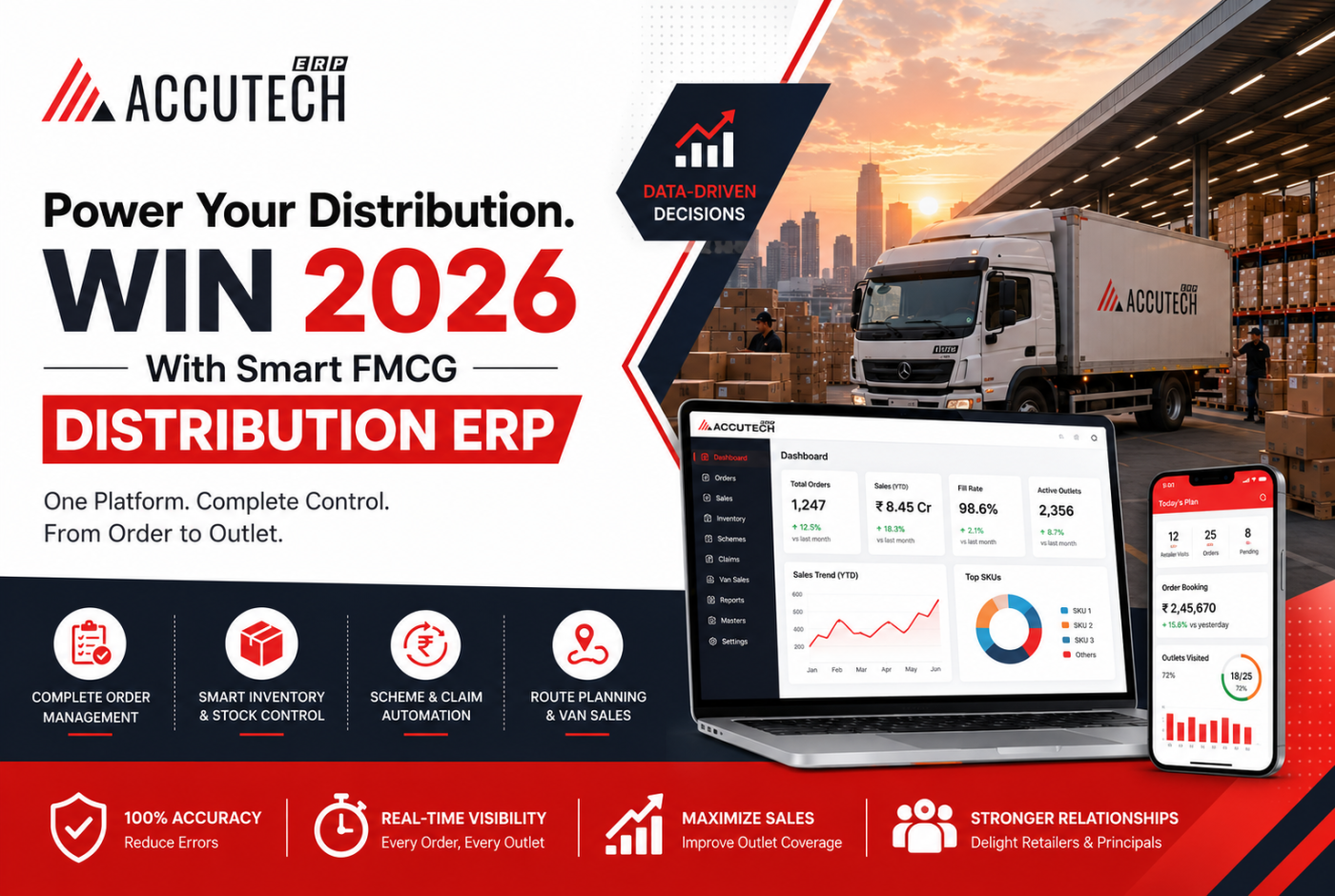
Among the purpose-built platforms available for Indian FMCG distributors in 2026, Accutech ERP has built a strong reputation for combining operational depth with ease of use. Designed specifically for the FMCG distribution segment, Accutech's ERP for FMCG distribution covers the full spectrum of distributor operations in a single integrated platform.
What Accutech Brings to the Table
Accutech's FMCG distribution module is built around the practical realities of how distributors actually operate. Rather than trying to be everything to everyone, it focuses on being exceptionally good at the things that matter most in FMCG distribution:
- End-to-end order management with automatic scheme application and real-time stock checks
- Batch and expiry tracking with enforced FEFO dispatch logic to minimize write-offs
- Beat planning and field sales app for complete secondary sales visibility and field force management
- Principal-wise claim management with automated claim generation and reconciliation workflows
- Fully integrated GST and e-invoicing to eliminate compliance headaches
- Multi-company and multi-godown support for growing distribution groups
- Rich analytics dashboards with customizable MIS reports for distributor and principal reporting
The Accutech Approach to Implementation
One of the differentiating factors of Accutech's distribution ERP software is its structured onboarding methodology. Rather than handing you a manual and wishing you luck, Accutech works with your team through a phased implementation starting with core order and inventory operations, then progressively rolling out advanced modules like field sales, scheme management, and analytics as your team builds confidence.
If you want to explore how Accutech's ERP for FMCG distribution can be configured for your specific business.
8. Implementation Guide: Transitioning to FMCG Distribution ERP
Making the switch to a new ERP platform is one of the most significant technology decisions a distributor will make. Here is a practical, step-by-step guide to doing it right:
Phase 1: Preparation (Weeks 1–2)
This is the most overlooked phase, and also the most critical. Good preparation determines whether your go-live will be smooth or chaotic.
- Conduct a full audit of your current master data: product master, customer master, supplier master, pricing master, and opening stock
- Cleanse your data eliminate duplicates, update pricing, verify current stock counts
- Map your existing workflows: how orders are currently taken, processed, invoiced, and dispatched
- Identify your power users the team members who will be trained first and will support their colleagues
Phase 2: Configuration and Training (Weeks 3–5)
- Work with your vendor to configure the software to match your specific workflows, pricing structures, and scheme templates
- Run parallel operations continue old processes while testing new ones to validate accuracy
- Train your team in role-based sessions: warehouse staff, sales reps, billing team, and management separately
- Set up integrations with your accounting software and any other existing tools
Phase 3: Go-Live and Stabilization (Weeks 6–8)
- Switch fully to the new system for a defined cut-over date typically the start of a new month or financial quarter
- Have your implementation team on-site or on-call for the first two weeks post go-live
- Monitor key error indicators: pricing discrepancies, stock mismatches, and invoicing errors
- Collect feedback from all user groups and address issues within 24 to 48 hours
Phase 4: Optimization (Month 3 Onwards)
- Begin using advanced analytics to identify operational improvements
- Activate advanced modules (van sales, principal claims, demand forecasting) once core operations are stable
- Establish regular MIS review cadence with management using live dashboards
9. Industry Trends Shaping FMCG Distribution Technology in 2026
To choose a platform that will serve you not just today but for the next five years, it helps to understand where FMCG distribution technology is heading.
AI-Powered Demand Forecasting
The next frontier for FMCG distribution software is predictive intelligence. Leading platforms are beginning to integrate machine learning models that analyze historical sales patterns, seasonal trends, promotional cycles, and external signals (weather, events, holidays) to predict demand at the SKU and outlet level. This enables distributors to optimize their procurement and inventory holding, reducing both stockouts and overstock.
Integration with E-Commerce and Quick Commerce
As quick-commerce platforms expand their reach, traditional FMCG distributors are increasingly being asked to integrate with digital ordering platforms. Modern distribution ERP systems are building API-based connectors that allow orders from digital channels to flow seamlessly into the same fulfillment workflow as traditional field sales orders.
Real-Time Retailer Connectivity
The dream of a fully connected supply chain where retailers can track their orders, access product availability, and communicate directly with distributors through digital channels — is becoming a reality. Platforms that offer a retailer portal or app create a new level of transparency and stickiness in the distributor-retailer relationship.
Sustainability and Traceability
With increasing regulatory and consumer pressure on supply chain transparency, FMCG distributors are being asked to demonstrate product traceability from manufacturer to retailer. Batch-level tracking in your ERP is the foundation of this capability.
Voice and Conversational Interfaces
In 2026, voice-enabled ordering and WhatsApp-based order workflows are emerging as mainstream features in FMCG distribution software. Field sales reps and even retailers can place or confirm orders through conversational interfaces, dramatically reducing the time and friction involved in the ordering process.
10. ROI Calculation: What Is the Real Return on Investment?
One of the most common questions distributors ask when evaluating software is: "How long will it take to pay for itself?" Here is a simple framework for calculating your potential ROI.
Five Key Value Drivers
|
Value Driver |
How the Software Helps |
Typical Monthly Value |
|
Scheme recovery |
Auto-capture of all principal schemes and claims |
Rs 20,000 – Rs 80,000 |
|
Expiry write-off reduction |
FEFO enforcement reduces near-expiry dispatches |
Rs 10,000 – Rs 40,000 |
|
Pricing error elimination |
Scheme engine removes manual pricing mistakes |
Rs 8,000 – Rs 35,000 |
|
Staff productivity gains |
Automation reduces manual reconciliation hours |
Rs 15,000 – Rs 50,000 |
|
Inventory optimization |
Better demand visibility reduces overstocking |
Rs 12,000 – Rs 45,000 |
For a mid-sized FMCG distributor, the combined monthly value from these five drivers alone typically ranges from Rs 65,000 to Rs 2,50,000. Most purpose-built distribution ERP software solutions in the market are priced significantly below this range on a monthly basis, making the financial case for adoption straightforward.
11. Myths vs. Facts: Quick Reference
|
Common Myth |
The Fact |
|
ERP is too expensive for small distributors |
Modern cloud ERP is accessible at all business sizes |
|
My existing team cannot learn new software |
Role-specific training and intuitive UI make adoption manageable |
|
Generic accounting software is sufficient |
It covers finance only; operational management needs a purpose-built tool |
|
Implementation will disrupt my operations |
Phased rollouts and parallel running minimize disruption |
|
Cloud data is not secure |
Cloud platforms offer superior security vs. local servers in most SMB contexts |
|
All FMCG ERPs are basically the same |
Industry-specific depth varies enormously between platforms |
12. Practical Tips for Maximizing Your FMCG ERP Investment
Buying the software is only the beginning. Here is how to get the maximum value from your investment:
- Invest in proper data cleansing before go-live. Garbage in means garbage out. Spend the time needed to ensure your master data products, customers, pricing is accurate before you migrate.
- Train your team, not just your IT person. Every user should understand how their role connects to the broader system. A warehouse staff member who does not understand FEFO will undo all the software's work.
- Use the analytics. The dashboards and reports in your FMCG distribution software are only valuable if you review them regularly and make decisions based on them. Designate a weekly MIS review as a fixed management meeting.
- Engage with your vendor's product updates. The best platforms release regular feature updates based on customer feedback. Stay engaged with the user community and submit feedback on features that would help your specific business.
- Start measuring KPIs from day one. Establish baseline metrics before go-live (order accuracy rate, claim recovery rate, stock write-off percentage) so you can quantify your ROI over time.
- Extend the system to your retailers. If your platform offers a retailer portal or WhatsApp ordering integration, use it. The more of your supply chain is connected to the system, the more value it generates.
13. Choosing the Right FMCG Distribution Software: Key Decision Criteria
To help you structure your final evaluation, here is a decision checklist across the dimensions that matter most:
|
Evaluation Criterion |
Questions to Ask Your Vendor |
|
Industry Specificity |
Is the platform built specifically for FMCG distribution, or is it a generic ERP? |
|
Scheme Management |
Can it handle slab-based, value-based, and time-bound schemes simultaneously? |
|
Mobile Capability |
Is there a native mobile app for field sales reps with offline capability? |
|
Principal Reporting |
Can it generate secondary sales and scheme reports per principal format? |
|
Compliance |
Does it support e-invoicing, e-way bill, and GSTR reconciliation natively? |
|
Scalability |
Can it scale to multiple companies, godowns, and users without re-platforming? |
|
Integration |
How does it integrate with Tally or other existing financial tools? |
|
Implementation |
What is the typical go-live timeline and what support is provided? |
|
References |
Can you speak to existing customers in the FMCG distribution segment? |
Conclusion: The Best Investment You Can Make in Your Distribution Business
Let us go back to Rajan Mehta for a moment. Six months after that chaotic Tuesday morning, Rajan had implemented a purpose-built FMCG distribution ERP. His team was running beat planning from mobile apps. His scheme recovery had jumped by 31 percent. His last audit showed zero pricing discrepancies across 1,200 invoices. His three largest retail clients the ones who had been threatening to leave were now his three most loyal, because they received digital invoices on delivery and could track their orders in real time.
Rajan did not change his business model, his product portfolio, or his pricing strategy. He changed one thing: the way his business was managed. And the right FMCG distribution software made that possible.
In 2026, the question is no longer whether FMCG distributors need a proper distribution ERP software. The question is which one is the right fit for your business, and how quickly you can make the transition. Every month you delay is a month of avoidable losses, missed claims, and dissatisfied customers.
If you are ready to explore what the best software for FMCG distributors looks like in practice, we encourage you to take the next step. Talk to a specialist, request a demo, and see firsthand how a purpose-built ERP for FMCG distribution can transform the way you operate.