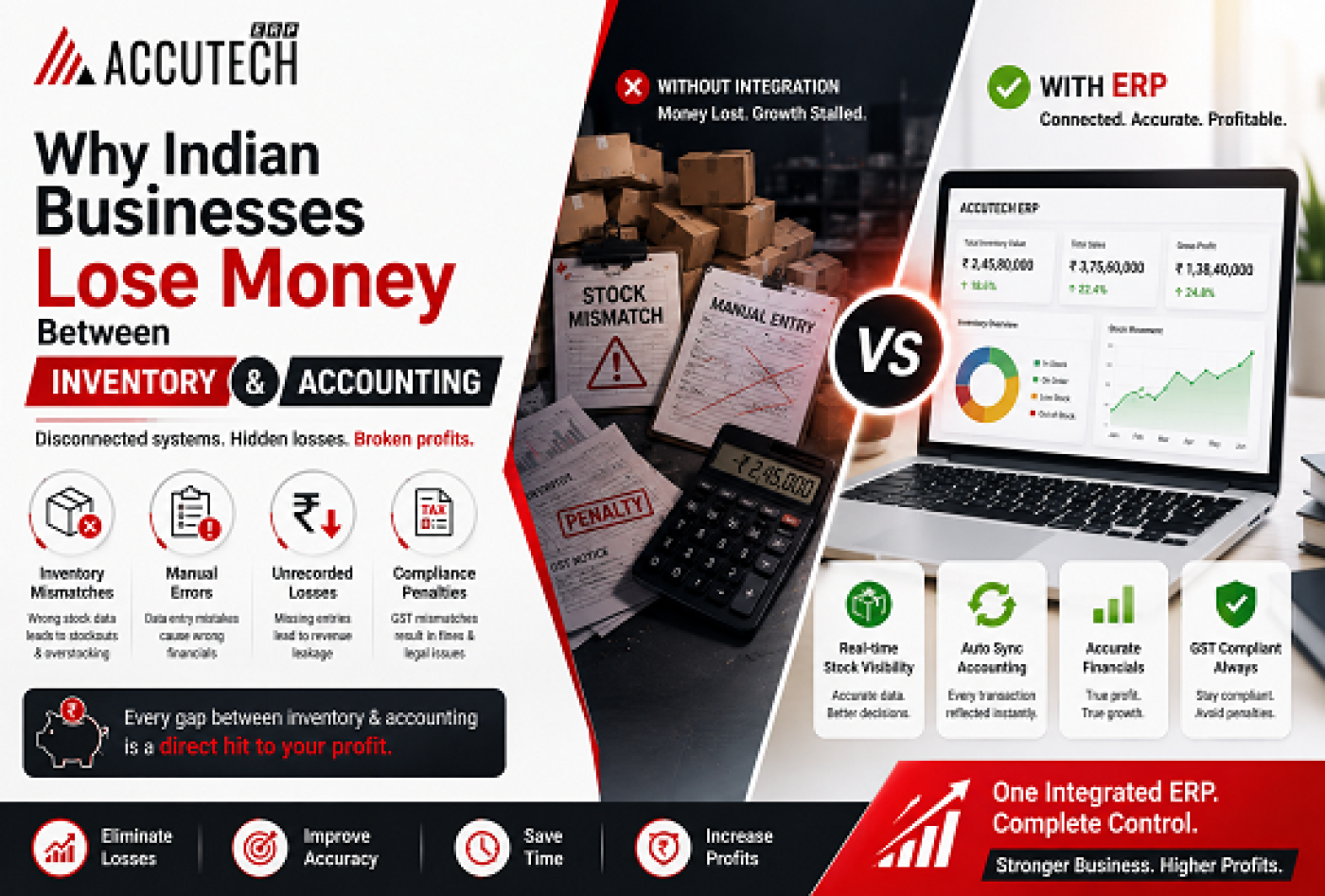
Every day, Indian businesses struggle with a silent financial drain that goes unnoticed until it is too late. The disconnect between inventory management and accounting systems causes companies to lose thousands, sometimes lakhs in unreported losses, inventory shrinkage, and compliance penalties. This critical issue affects businesses across all industries, from trading to manufacturing, and directly impacts the bottom line.
According to industry reports, approximately 35–40% of small and medium enterprises (SMEs) in India face significant financial discrepancies due to inventory-accounting misalignment. The best advance accounting ERP software can eliminate these costly gaps, but many businesses still operate with fragmented systems. The problem is not just about missing stock; it is about broken data flow, manual reconciliation errors, and regulatory non-compliance that compounds over time.
This comprehensive guide explores why this happens, what it costs your business, and, most importantly, how advance accounting software solutions can fix these issues permanently. Whether you are managing a small trading business or a multi-location enterprise, the best accounting software in India can transform your financial operations. Understanding the problem is the first step toward implementing an integrated system that delivers measurable results.
By investing in a unified ERP solution today, you can eliminate manual reconciliation, reduce compliance penalties, and gain real-time visibility into your financial position. An integrated accounting ERP is not a luxury, it is a necessity for sustainable growth and accurate financial reporting.
The Invisible Money Leak: Why Inventory-Accounting Gaps Exist
Understanding the Root Cause of System Disconnects
The fundamental problem stems from operating inventory and accounting systems independently. Most Indian businesses use separate tools, physical stock management systems, legacy spreadsheets, or standalone software that do not communicate with each other. This fragmented approach prevents the seamless data flow that an integrated accounting platform provides.
When you sell a product, three critical actions must happen simultaneously. The stock quantity must be reduced in the inventory system, revenue must be recorded in the accounting ledger, and the cost of goods sold (COGS) must be calculated automatically. Without a unified ERP connecting these functions, each transaction occurs independently.
In disconnected systems, these actions happen at different times or sometimes not at all. This lag creates an “invisible money leak” where accounting records do not match actual inventory. The best accounting software in india solves this by ensuring that all three actions occur simultaneously within one unified system.
Why This Happens in Indian Businesses Specifically
Indian SMEs and mid-market businesses face unique challenges that amplify this problem. Many businesses grew organically without proper digital infrastructure, adding accounting software and inventory management tools separately without ensuring that the systems could communicate. The transition to an integrated ERP system is critical but is often delayed.
Additionally, locally compliant accounting systems especially those designed around GST regulations are a relatively recent development. Many businesses implemented their systems before these solutions existed and have not yet migrated. Upgrading to advance accounting software that manages GST-ready transactions and automatic reconciliation becomes essential as a business scales.
Real-World Impact: How Much Money Are You Actually Losing?
Quantifying the Financial Damage of Disconnected Systems
Let us quantify the actual impact using realistic numbers for an Indian trading business with ₹1 crore in annual revenue. Without implementing the Best Advance Accounting ERP Software, these are the typical annual costs:
Loss Category | Annual Impact | Impact of Advance Accounting Software |
Inventory Shrinkage | ₹3-5 Lakhs | Reduced by 80% with real-time tracking |
Manual Entry Errors | ₹2-3 Lakhs | Eliminated with automated data entry |
GST Compliance Penalties | ₹5-7 Lakhs | Avoided with automatic reconciliation |
Accounting Adjustments | ₹1-2 Lakhs | Reduced 90% with best accounting software in india |
Management Overhead | ₹2-4 Lakhs | Freed up for strategic work |
That is a total potential annual loss of ₹13–21 lakhs due to disconnected processes. For many businesses, implementing an integrated accounting ERP can deliver a return on investment within 8–12 months through these savings alone.
The Hidden Costs Beyond Direct Financial Loss
Beyond direct financial losses, inventory-accounting gaps create hidden costs that many businesses overlook. Finance teams can spend 30–40 hours every month on manual reconciliation instead of strategic analysis. Tax professionals may charge additional fees because the records require extra scrutiny. Banking relationships can suffer when compliance issues arise, while working capital remains trapped in inventory write-offs that could have been prevented.
Investing in the best accounting software in India can eliminate these hidden costs while improving decision-making. With a unified accounting platform, the finance team can access real-time reports showing exact inventory positions, profit margins, and cash-flow status. This visibility supports better pricing decisions and faster working-capital management.
Common Mistakes That Cost Indian Businesses Millions
Why Spreadsheets and Manual Systems Fail
Mistake #1: Manual Inventory-to-Accounting Reconciliation
The practice of manually matching inventory spreadsheets with accounting records is error-prone and time-consuming. A typical accountant may spend three to five days every month reconciling these datasets. An integrated ERP eliminates this work through automated matching.
Mistake #2: Delayed Transaction Recording
Many Indian businesses record transactions in batches at the end of the week or month rather than in real time. This creates periods during which inventory reflects sales but accounting records do not. A unified accounting system records connected transactions immediately.
Mistake #3: Inadequate Stock Valuation Methods
The inconsistent application of FIFO, LIFO, or weighted-average costing creates accounting anomalies. An integrated system enforces consistent valuation policies across transactions, eliminating this source of error.
Mistake #4: Missing Goods-in-Transit Reconciliation
Indian businesses frequently manage goods moving between warehouses or arriving from suppliers. Without proper tracking, these goods may appear in neither inventory nor accounting records. ERP systems automatically track and account for goods in transit.
Mistake #5: Ignoring Intercompany Transactions
Businesses with multiple entities often struggle to track stock movements between companies. These transactions must be recorded differently from third-party purchases. A properly configured ERP handles these complexities automatically using appropriate intercompany accounting rules.
GST Compliance: The Hidden Risk Factor
Why Inventory-Accounting Gaps Trigger GST Audit Flags
India’s Goods and Services Tax system demands proper alignment between inventory and accounting records. When the records do not match, GSTR filings can become inaccurate. The GST system cross-checks sales declarations and purchase-related information, making reliable transaction records essential for businesses.
If inventory records show that 100 units were sold but accounting records contain revenue for only 90 units, the business has a discrepancy that an integrated system should identify. Such inconsistencies may result in scrutiny, reconciliation issues, or input tax credit disputes.
Repeatedly adjusted or mismatched figures can create red flags during compliance reviews. A unified accounting ERP maintains complete audit trails showing transaction dates, quantities, values, users, and GST treatment. This documentation protects the business during audits while making return preparation simpler and more efficient.
How the Best Advance Accounting ERP Software Bridges the Gap
The Integrated Solution Your Business Needs
The best advance accounting ERP software eliminates inventory-accounting mismatches by creating a single source of truth. When inventory decreases, the related accounting records are updated simultaneously. There is no unnecessary delay, duplicate manual entry, or avoidable opportunity for error.
The best accounting software in india automatically calculates the cost of goods sold according to the configured valuation method, such as FIFO or weighted average. Every sales and purchase transaction can be tagged with the appropriate GST code and tax treatment. The system can also track inventory across warehouses, branches, and business entities while creating the necessary accounting entries for stock transfers.
Key Features of an Integrated Accounting ERP
- Account Head Management: Create detailed account hierarchies with balance-sheet mapping for complex organisational structures.
- Product-to-Accounting Linkage: Connect every product with the appropriate accounting category, HSN code, ledger, and tax treatment.
- Transaction Accuracy: Process transactions through unified workflows supported by complete audit trails.
- Real-Time Financial Reports: Access profit and loss statements, balance sheets, cash-flow reports, and ledgers without waiting for month-end closing.
- Automated Reconciliation: Automatically match accounting, inventory, and applicable GST-related records to identify discrepancies.
Why Advance Accounting Software Beats Spreadsheet Solutions
Spreadsheets are flexible but unreliable. A single incorrect formula can corrupt an entire reconciliation process. In comparison, advance accounting software enforces data integrity at every stage. Inventory cannot be entered without the required coding, invoices remain linked with stock movements, and validation controls reduce the risk of incomplete transactions.
An integrated system provides version control and prevents the “multiple versions of the same file” problem that damages data integrity. Audit trails show changes, user actions, and adjustments. This documentation is valuable during internal reviews and tax audits. Modern systems can also be updated when compliance requirements change, helping businesses remain aligned with applicable regulations.
Step-by-Step Implementation Strategy
Phase 1: Assessment and Planning (2–3 Weeks)
- Define your current gaps: Map the points at which inventory and accounting records diverge before choosing an ERP system.
- Set clear objectives: Decide what you expect from the best advance accounting ERP software, such as inventory synchronisation, GST support, multi-location management, or all three.
- Choose your ERP carefully: Research accounting ERP solutions designed for Indian compliance and ensure that the selected system includes inventory-accounting integration.
Phase 2: Data Preparation (3–4 Weeks)
- Clean your historical data: Audit existing inventory and accounting records and resolve discrepancies before migrating them.
- Configure account heads: Design the accounting structure in the new system while considering GST mapping and reporting requirements.
- Set opening balances: Ensure that inventory opening balances align correctly with accounting balances before using the new advance accounting software.
Phase 3: System Configuration (2–3 Weeks)
- Configure products: Link every product to the correct inventory category, accounting ledger, HSN code, and tax structure.
- Set up GST rules: Configure the applicable tax treatment for different product and service categories.
- Define workflows: Establish how sales, purchases, returns, transfers, and stock adjustments will flow through the ERP.
Phase 4: Pilot and Testing (2–3 Weeks)
- Run parallel processing: Process selected transactions in both the existing system and the new ERP to validate accuracy.
- Test reconciliation: Perform inventory and accounting reconciliation to confirm that the previous gaps have been eliminated.
- Validate GST output: Ensure that reports generated through the best accounting software in india match the verified source transactions and expected calculations.
Phase 5: Full Implementation (1–2 Weeks)
- Switch over: Move all transactions to the new ERP from a predetermined cutover date.
- Archive old systems: Preserve historical records for reference and audit purposes.
- Monitor metrics: Track reconciliation differences, processing time, user errors, and reporting accuracy for at least three months.
Frequently Asked Questions
Q1: How Does the Best Advance Accounting ERP Software Prevent Inventory Shrinkage?
The best advance accounting ERP software helps prevent shrinkage through real-time inventory tracking and transaction controls. Every inventory movement is recorded with a supporting audit trail. Physical stock counts can be reconciled with system quantities, allowing discrepancies to be identified and investigated quickly.
Instead of treating shrinkage as an unexplained loss, management can track when and where differences occurred and which transactions or users were involved.
Q2: Can the System Handle Multiple Entities With Different GST Treatments?
Yes. A suitable integrated ERP can manage multi-entity operations. Each entity can maintain separate accounting books while authorised users access consolidated reports. The system can track GST information separately for each GSTIN and manage inter-entity transactions using the required accounting entries.
Q3: What Is the Typical ERP Implementation Timeframe?
Implementation commonly takes 8–12 weeks, depending on the complexity of the business. A simple implementation may take six to eight weeks, while a complex project involving multiple locations, entities, integrations, and approval workflows may require 12–16 weeks.
Implementation success depends heavily on data preparation, process clarity, employee training, and stakeholder alignment. Businesses should choose a vendor that offers a structured implementation methodology and dependable support.
Q4: How Does Automated Reconciliation Work in the Best Accounting Software in India?
The best accounting software in india compares information across connected data sources. It can match sales entries with invoices, purchase records with supplier-related information, and stock movements with corresponding accounting entries.
Instead of spending several days manually comparing records, users can review a system-generated discrepancy report. The software highlights unmatched or inconsistent transactions so the responsible team can investigate them.
Q5: Is Cloud-Based Accounting ERP Better Than an On-Premise Solution?
Cloud-based advance accounting software offers several potential advantages, including remote accessibility, automatic backups, reduced infrastructure costs, and faster deployment. It is particularly helpful for businesses operating across multiple branches, warehouses, or locations.
The right choice depends on internet reliability, data-security policies, integration requirements, business size, and internal IT capabilities. Some vendors also provide hybrid deployment models.
Q6: Can Existing Business Tools Be Integrated With an Accounting ERP?
Modern accounting ERP systems generally support API-based integrations with third-party tools. Businesses may connect e-commerce platforms, CRM systems, banking solutions, payment gateways, or other operational applications.
Before selecting a solution, check whether it provides pre-built connectors or properly documented APIs. Poor integration can recreate data silos at a different level and defeat the purpose of implementing a unified system.
Q7: What Is the Expected ROI From Implementing an Integrated ERP?
Many businesses can achieve a positive return on investment within 12–18 months. Savings may come from reduced reconciliation time, lower inventory shrinkage, fewer manual errors, better compliance management, and improved working-capital utilisation.
For a business generating approximately ₹1 crore in annual revenue, the potential savings can be substantial. However, actual ROI will depend on existing inefficiencies, implementation cost, transaction volume, employee adoption, and operational complexity.
Q8: How Does Accounting ERP Ensure Data Security?
Enterprise-grade systems use multiple security layers, including data encryption, role-based access, two-factor authentication, audit trails, regular backups, and security monitoring.
Businesses should assess the vendor’s security policies, hosting arrangements, backup procedures, data portability, user-access controls, and relevant certifications before making a final decision.
Q9: What Happens if the ERP Vendor Closes?
The service agreement should include clear data-ownership and portability clauses. Business data should remain exportable in standard, usable formats. A reliable vendor should maintain regular backups and provide appropriate business-continuity measures.
Never implement a business-critical system without understanding how your data can be retrieved, transferred, or restored if the service is discontinued.
Q10: How Does the System Handle Seasonal Business Fluctuations?
Modern ERP platforms provide inventory-planning features that can support seasonal demand. Businesses can set reorder levels, analyse historical sales patterns, plan purchasing, and configure production schedules before peak seasons.
Real-time reporting provides visibility into available stock, pending orders, receivables, payables, and expected cash requirements. This information helps businesses prepare for seasonal peaks and manage cash flow during slower periods.
Conclusion:
The disconnect between inventory and accounting is costing businesses real money every day. For a mid-sized Indian enterprise, the annual impact can exceed ₹15–20 lakhs. However, this is not a problem without a solution. Integrated ERP platforms have evolved to address the accounting, inventory, and compliance requirements of Indian businesses.
The Best Advance Accounting ERP Software is no longer limited to large enterprises. It is increasingly essential for businesses that need financial accuracy, inventory control, operational visibility, and reliable compliance records. The best accounting software in India provides real-time integration, automated reconciliation, and connected transactions that eliminate the costly gaps created by fragmented systems.
The path forward is clear. Identify the areas where inventory and accounting records diverge most significantly. Select advance accounting software that matches the complexity and budget of your organisation. Plan the implementation carefully, prepare the data properly, train users, and monitor the results.
Accutech ERP provides an integrated platform for businesses seeking better control over inventory, accounting, GST compliance, and real-time financial reporting. By bringing essential operations together in one connected system, Accutech ERP helps reduce financial leakage, minimise manual errors, improve productivity, and support faster decision-making.
The right ERP investment can pay for itself through improved efficiency, lower compliance risks, and stronger financial control. Businesses using connected systems are already gaining a competitive advantage. With Accutech ERP, the question is not merely whether you should upgrade, it is whether your business can afford to wait.