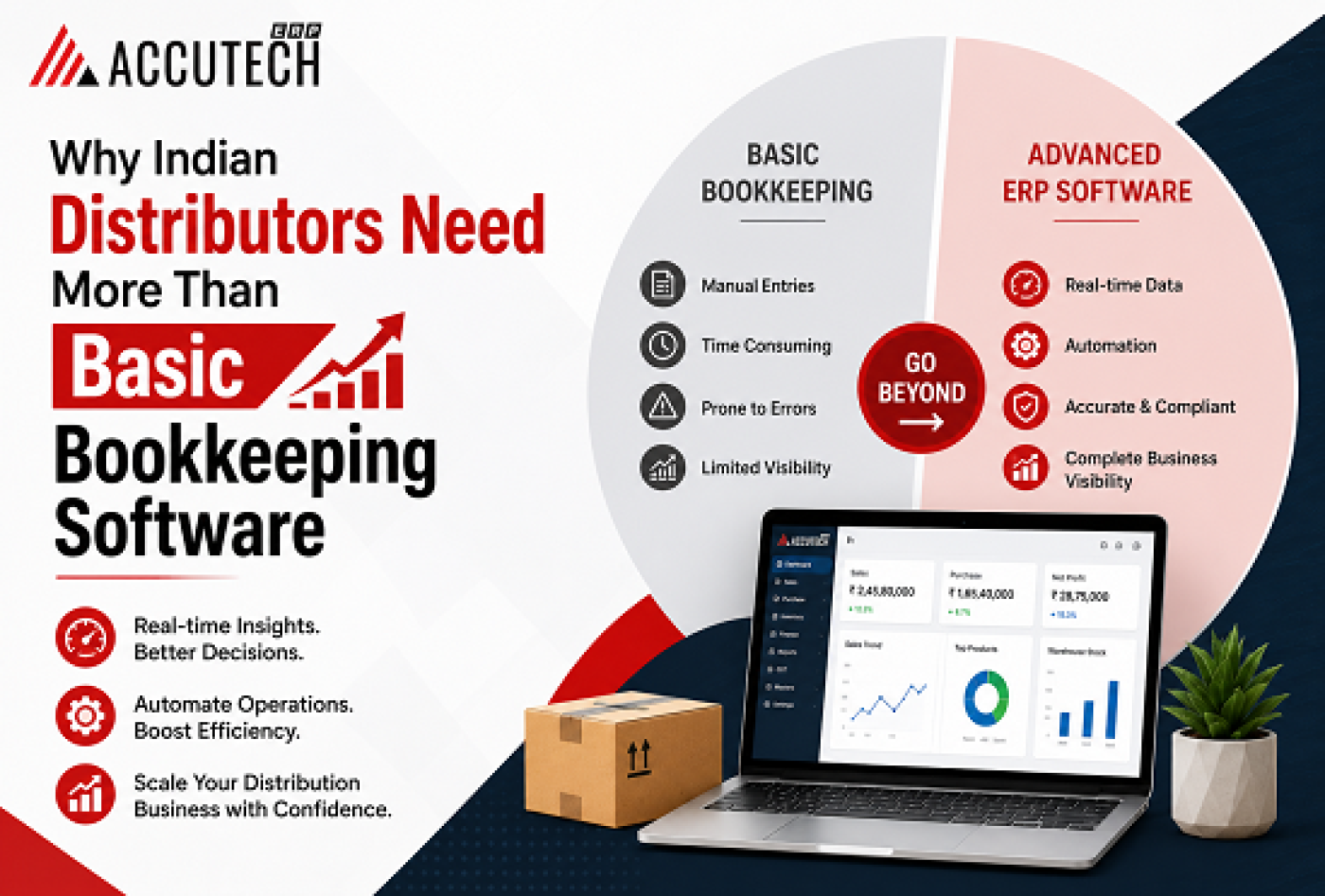
The distribution business in India has undergone a dramatic transformation over the past decade. Today's Indian distributors face unprecedented challenges: managing multiple SKUs, handling complex supply chains, ensuring GST compliance, tracking inventory across warehouses, and maintaining relationships with hundreds of retailers and suppliers. Yet many still rely on basic bookkeeping software that was designed for simple, manual record-keeping.
Understanding why Indian distributors need more than basic bookkeeping software is critical for business success. The gap between what basic bookkeeping software can do and what Indian distributors actually need has never been wider. Manual processes, delayed reporting, and inability to handle multi-location operations are creating bottlenecks that hold businesses back from growth.
For growing distribution businesses, selecting the best accounting software in India becomes important when basic bookkeeping tools can no longer manage increasing operational and financial complexity.
Consider this: A mid-sized distributor managing 5,000+ products across 15 warehouses can spend 40+ hours monthly on manual data entry, reconciliation, and reporting. That's productivity lost. That's cash flow visibility delayed. That's decision-making based on outdated information. This is precisely why Indian distributors need more than basic bookkeeping software; they need intelligent, automated solutions that can keep pace with modern business demands.
This comprehensive guide explores the core reasons why Indian distributors need more than basic bookkeeping software and how advanced financial management solutions can transform their operations, improve profitability, and enable sustainable growth.
Understanding Current Challenges in Indian Distribution Businesses
Indian distributors operate in one of the world's most complex business environments. Understanding these challenges is crucial to recognizing why Indian distributors need more than basic bookkeeping software. The operational complexities of distribution require sophisticated financial management tools.
Modern accounting software in India must therefore support the operational, compliance, inventory, and financial requirements that distributors deal with every day.
Multi-Tier Supply Chain Complexity
Unlike simple businesses, Indian distributors must manage relationships and transactions across multiple tiers:
- Manufacturers and wholesalers at the top tier
- Sub-distributors and regional partners in the middle
- Direct retail customers, wholesale markets, and institutional buyers
Inventory Management Across Multiple Locations
Managing stock across multiple warehouses and distribution centers requires real-time visibility. Most Indian distributors operate 3-20 separate locations, making inventory tracking a nightmare with basic bookkeeping software. Products move constantly between locations, and inaccurate records lead to stockouts or overstock situations that cost money.
An Advance Accounting ERP Software can help connect inventory movements with accounting records, giving distributors better control over financial and operational information.
GST Compliance and Tax Complexity
India's Goods and Services Tax (GST) system introduced unprecedented complexity. Distributors must track multiple GST rates (5%, 12%, 18%, 28%) depending on product categories, manage input tax credit (ITC) calculations accurately, file monthly/quarterly GSTR returns with precision, and handle inter-state transactions with appropriate documentation. This is another critical reason why Indian distributors need more than basic bookkeeping software compliance tools must be built-in and automated.
Distributors comparing the best accounting software in India should therefore consider GST automation and compliance capabilities alongside traditional accounting functions.
Seasonal Demand Fluctuations
Indian distribution is highly seasonal. Peak seasons (festivals, monsoons, winters) create cash flow challenges. Basic bookkeeping software cannot forecast or plan for these fluctuations, leaving distributors vulnerable to cash crunches during low-demand periods.
Limitations of Basic Bookkeeping Software: Why It Falls Short
Basic bookkeeping software was designed for simple accounting needs: recording invoices, maintaining a general ledger, and generating basic financial statements. Modern Indian distributors have moved far beyond these basic needs. Recognizing the limitations is essential to understanding why Indian distributors need more than basic bookkeeping software. Let's examine the specific gaps:
Moving towards an Advance Accounting ERP Softwareallows distributors to manage functions that traditional bookkeeping systems were never designed to handle.
Limitation 1: No Real-Time Inventory Tracking
Basic bookkeeping software treats inventory as a line item in the balance sheet. It doesn't provide SKU-level tracking across multiple warehouses, real-time stock quantity and valuation updates, automated alerts for low stock or overstock situations, or integration with point-of-sale systems or e-commerce platforms.
Limitation 2: Inadequate Multi-Location Support
Most basic bookkeeping software is built for single-location businesses. Managing multiple warehouses, distribution centers, and retail points becomes cumbersome because the software cannot track costs and profitability by location, manage inter-location transfers efficiently, or generate location-specific financial and operational reports.
This makes choosing capable accounting software in India especially important for distributors operating warehouses, branches, or sales networks across different locations.
Limitation 3: Poor GST and Tax Compliance Tools
Basic bookkeeping software often has inadequate GST features. This creates significant risks: it cannot accurately calculate GST liability across different product categories, doesn't automatically track Input Tax Credit (ITC) eligibility, cannot generate GSTR-1, GSTR-3B, and other return formats automatically, and has limited audit trail and documentation capabilities.
Limitation 4: Lack of Advanced Analytics and Reporting
In today's data-driven environment, basic bookkeeping software cannot provide profitability analysis by product, customer, or region, cash flow forecasting and what-if analysis, key performance indicator (KPI) dashboards, or actionable insights for strategic decision-making.
Limitation 5: Manual Reconciliation and Data Entry
Basic bookkeeping software requires extensive manual work, which leads to human errors in data entry, time-consuming bank and customer reconciliation processes, outdated information and delayed decision-making. These limitations are fundamental reasons why Indian distributors need more than basic bookkeeping software; they need automation and intelligence.
Why Advanced Financial Software Matters for Indian Distributors
Advanced financial software solutions go far beyond what basic bookkeeping software can offer. For Indian distributors, this difference translates into tangible business benefits that directly impact the bottom line. Every distributor asking "why do I need advanced software" should consider these critical advantages that come with moving beyond basic bookkeeping:
An Advance Accounting ERP Software brings accounting, inventory, compliance, reporting, and business operations together, helping distributors work with more accurate and timely information.
1. Enhanced Operational Efficiency
Advanced solutions automate routine tasks like invoice generation, payment processing, and financial reconciliation. This reduces the time your accounting team spends on manual work from 40+ hours monthly to just 5-10 hours. Your finance team can focus on strategy rather than data entry.
Businesses searching for the best accounting software in india should prioritize this level of automation because reducing repetitive manual work can directly improve operational efficiency.
2. Real-Time Financial Visibility
Unlike basic bookkeeping software, advanced systems provide dashboards showing current cash position and expected cash flows, accounts receivable aging and collection status, profitability by product, customer, or region, and inventory valuation and movement.
3. Automated GST and Tax Compliance
Advanced accounting solutions automatically calculate GST liability, track ITC, and generate GST returns. This eliminates compliance risk and ensures your business stays audit-ready at all times. This is why Indian distributors need more than basic bookkeeping software compliance which cannot be manual or error-prone.
4. Better Credit and Collection Management
For Indian distributors extending credit to retailers, advanced software provides tools to set credit limits and monitor customer creditworthiness, automate payment reminders and dunning workflows, and analyze customer profitability after accounting for payment delays.
5. Scalability for Growth
Basic bookkeeping software becomes increasingly cumbersome as your business grows. Advanced solutions scale effortlessly, whether you add new product lines, expand to new regions, or increase transaction volume.
Key Features Every Indian Distributor Needs in Modern Software
Not all advanced software solutions are created equal. Here are the essential features that Indian distributors must look for when choosing accounting and financial management software that goes beyond basic bookkeeping. These features directly address why Indian distributors need more than basic bookkeeping software.
The right accounting software in india should combine these capabilities in one system instead of forcing businesses to manage separate tools and disconnected records.
Feature 1: Multi-Location Inventory Management
The software should provide:
- Real-time visibility of stock levels across all warehouses
- Barcode scanning and RFID integration capabilities
- Automated reorder point calculations
- Lot/batch and serial number tracking for regulatory compliance
Feature 2: Comprehensive GST Compliance Tools
Essential GST features include:
- Automatic GST rate application based on product category and customer location
- Real-time GST liability calculation
- Automated GSTR-1, GSTR-2A, and GSTR-3B generation
- Input Tax Credit (ITC) reconciliation and management
Feature 3: Customer and Supplier Management
The software must support:
- Detailed customer profiles with credit limit and payment history tracking
- Automated invoice generation and delivery
- Payment reconciliation with multiple payment methods
- Customer profitability analysis after all discounts and credits
Feature 4: Advanced Analytics and Business Intelligence
Modern Indian distributors need:
- Customizable dashboards and KPI tracking
- Profitability analysis by product, customer, region, and salesperson
- Cash flow forecasting and trend analysis
- Inventory turnover and carrying cost analysis
Feature 5: Mobile and Remote Access
In today's environment, distributors need:
- Mobile apps for sales representatives to process orders in the field
- Cloud-based access to financial information from anywhere
- Offline capabilities for areas with poor connectivity
Basic Bookkeeping vs. Advanced Financial Solutions - Feature Comparison
Feature | Basic Bookkeeping | Advanced Solutions |
Multi-Location Support | Limited | Full support |
Real-Time Inventory | Manual updates | Real-time sync |
GST Compliance | Manual calculation | Automated |
Analytics & Reports | Basic only | Advanced BI |
Mobile Access | None | Full mobile app |
Automation | Minimal | Extensive |
Scalability | Limited | Unlimited |
Real-World Impact: How Advanced Solutions Transform Distribution Businesses
Understanding why Indian distributors need more than basic bookkeeping software becomes crystal clear when you look at real-world examples. Actual case studies from distribution businesses show the dramatic improvements possible when upgrading from basic bookkeeping systems.
Case Study 1: Pharmaceutical Distributor - Compliance and Cash Flow
A mid-sized pharmaceutical distributor operating across 12 states was using basic bookkeeping software and faced serious challenges: GST compliance was a nightmare, with hundreds of products at different GST rates. The compliance officer was manually verifying calculations, and monthly GSTR filing took 20 hours. Additionally, without real-time visibility of accounts receivable aging, the company often didn't know how much credit was outstanding, leading to overdrafts and expensive short-term borrowing.
Solution: Implemented advanced financial software with automated GST compliance and real-time AR dashboard.
Results:
- GST filing time reduced from 20 hours to 2 hours monthly
- Accounts receivable aging visibility reduced DSO from 45 days to 35 days
- Eliminated GST compliance errors (saving potential penalties)
- Annual interest savings on short-term borrowing: ₹4,50,000
Case Study 2: FMCG Distributor - Profitability and Growth
A growing FMCG distributor wanted to expand but couldn't get clear profitability insights by customer or product using basic bookkeeping software. Basic bookkeeping software showed overall profit, but not which customers were actually profitable. After switching to advanced software with detailed profitability analytics, the distributor discovered that 30% of customers generated only 5% of profit (due to high service cost), and identified top-profit products for inventory optimization.
Results:
- Improved overall profit margin by 2.3% within 6 months
- Revenue increased 18% with better customer targeting
- Inventory investment optimized based on profitability data
Implementing Advanced Financial Software: Step-by-Step Guide
Recognizing why Indian distributors need more than basic bookkeeping software is one thing. Making the actual transition is another. The implementation process requires careful planning to ensure success and quick value realization. Here's how to do it effectively:
Step 1: Assessment and Planning (Week 1-2)
- Document current processes and pain points with basic bookkeeping software
- Identify key requirements from finance, sales, and operations teams
- Get executive buy-in and allocate budget
Step 2: Vendor Evaluation (Week 3-4)
- Test multiple solutions specific to distribution industry
- Verify GST compliance features thoroughly
- Check integration capabilities with existing systems
Step 3: Data Migration Planning (Week 5-6)
- Clean historical data from basic bookkeeping software
- Plan parallel running period (old and new systems)
- Set reconciliation checkpoints
Step 4: Implementation and Training (Week 7-12)
- Start with core modules (AP, AR, General Ledger)
- Train key users thoroughly - don't rush this
- Document all custom configurations
Step 5: Cutover and Optimization (Week 13+)
- Move fully to new system after validation
- Monitor performance closely in first month
- Continuously optimize based on user feedback
Cost-Benefit Analysis: Investment in Advanced Financial Software
Many Indian distributors hesitate because they see basic bookkeeping software as cheaper. A proper cost-benefit analysis tells a different story. The investment in advanced solutions typically pays for itself within 2-3 months through improved efficiency and reduced errors:
Annual Cost Breakdown:
- Software licensing: ₹2,00,000 - ₹5,00,000
- Implementation: ₹1,50,000 - ₹3,00,000 (one-time)
- Training: ₹50,000 - ₹1,00,000
- Support: ₹1,00,000 - ₹2,00,000
Total Annual Cost: ₹4,00,000 - ₹8,50,000
Annual Benefit Breakdown:
- Time savings: 40+ hours monthly = ₹5,00,000+ annually
- Improved cash flow: 5-7 days DSO reduction = ₹10,00,000 - ₹20,00,000
- Reduced inventory carrying costs: 2-3% = ₹3,00,000 - ₹5,00,000
- Compliance cost avoidance: ₹2,00,000 - ₹5,00,000
- Improved profitability: 1-2% margin = ₹10,00,000+
Total Annual Benefit: ₹25,00,000 - ₹45,00,000+
ROI: 300-500% in Year 1, with payback in 2-3 months
Common Mistakes Indian Distributors Make
When upgrading from basic bookkeeping software, many Indian distributors repeat common mistakes that undermine their investment and prevent them from realizing the benefits of modern financial systems:
Mistake 1: Insufficient Planning and Stakeholder Alignment
Many distributors jump into implementation without getting input from all departments. Finance, sales, warehouse, and operations teams all have different needs. Without alignment, the new software disappoints everyone.
Mistake 2: Poor Data Quality During Migration
Migrating dirty data from basic bookkeeping software is worse than having no data. Take time to clean and validate all data before migration. "Garbage in, garbage out" is real.
Mistake 3: Inadequate Training
Skipping on training costs money later. Users revert to old workarounds, miss new features, and remain unproductive. Budget for comprehensive training across all user levels.
Mistake 4: Trying to Replicate Old Processes
New software offers better ways to do things, but companies often try to recreate old processes. Use the implementation as an opportunity to redesign workflows and capitalize on new capabilities.
Mistake 5: Lack of Ongoing Optimization
After go-live, many companies think they're done. The system optimization journey is just beginning. Continuous improvement and feature adoption drive long-term value and maximize ROI.
Frequently Asked Questions
Q1: Why do Indian distributors specifically need more than basic bookkeeping software?
Indian distributors face unique challenges: complex GST compliance, multi-location operations, seasonal demand fluctuations, and tight working capital. Basic bookkeeping software cannot handle these complexities effectively. Advanced solutions designed for distribution provide the specific features and compliance capabilities Indian distributors need to thrive in today's competitive environment.
Q2: What makes advanced financial software better than basic bookkeeping for distributors?
Advanced solutions offer real-time inventory tracking, automated GST compliance, profitability analytics by customer/product, multi-location support, and mobile access. Basic bookkeeping is transaction-focused; advanced software is operation and decision-focused. This difference enables better decision-making and strategic growth.
Q3: How long does it take to implement advanced financial software?
For a typical mid-sized distributor, implementation takes 8-12 weeks from vendor selection to full go-live. Small distributors might take 4-8 weeks, while larger enterprises might take 12-20 weeks. The timeline depends on complexity, data volume, and customization needs. Proper planning is key to staying on schedule.
Q4: What's the average cost of implementing advanced financial software?
Total cost including licensing, implementation, and training typically ranges from ₹4,00,000 to ₹10,00,000 depending on company size and software choice. However, ROI is typically 300-500% in the first year through time savings, improved cash flow, and compliance cost avoidance.
Q5: Can we maintain both systems during transition?
Yes, a parallel run period of 4-6 weeks is recommended. This allows validation that the new system produces correct results before fully cutover. However, don't extend this too long as maintaining two systems creates confusion and additional workload.
Q6: How does advanced software handle GST compliance better?
Advanced software automatically applies correct GST rates based on product category and customer location, calculates GST liability, tracks Input Tax Credit, and generates GSTR returns automatically. This eliminates manual calculation errors and ensures audit-ready documentation at all times.
Q7: What about integration with existing systems like ERPs?
Most modern advanced financial software can integrate with ERPs via APIs or standard data formats. Confirm integration capabilities before selection. Good vendors provide pre-built connectors for popular systems, reducing implementation time and cost.
Q8: How often should we update or upgrade the software?
Cloud-based solutions receive automatic updates (usually monthly). On-premise solutions need annual major updates. Regulatory updates (like GST changes) should be applied within 30 days of announcement to ensure continued compliance.
Q9: What support should we expect from the vendor?
Good vendors provide 24/7 helpdesk support, regular training updates, user community forums, and quarterly business reviews. Verify support response times for critical issues (should be 2-4 hours maximum) before committing.
Q10: How do we measure ROI after implementation?
Track key metrics: hours spent on accounting tasks (should reduce 60%+), DSO (days sales outstanding - target 15-20% reduction), compliance audit findings (should go to zero), inventory turnover (should improve 10-15%), and overall profit margin (should improve 1-2%). Compare pre and post-implementation metrics quarterly to measure success.
Conclusion:
The question is no longer "Should Indian distributors upgrade from basic bookkeeping software?" The real question is "How quickly can they afford to upgrade?" In today's competitive environment, distributors who continue using basic bookkeeping software are systematically disadvantaged.
Modern Indian distributors operate in an environment of complexity that basic bookkeeping software simply cannot address. Multi-location operations, GST compliance, tight cash flow management, and the need for real-time business intelligence are not optional extras; they're survival requirements. Understanding why Indian distributors need more than basic bookkeeping software is the first step toward modernizing your operations.
For distributors planning long-term growth, Accutech ERPcan provide the integrated financial and operational foundation required to manage increasing business complexity. By connecting accounting, inventory, sales, purchasing, reporting, and compliance-related processes within a unified system, Accutech ERP helps distributors gain better visibility and control over their business.
If you're currently using basic bookkeeping software, this is your call to action: Start the assessment process today. Identify your pain points, evaluate solutions such as Accutech ERP, and plan your transition. The sooner you move beyond basic bookkeeping, the sooner you can focus on growing your distribution business instead of managing paperwork and disconnected processes.
Your competitors are already upgrading. The question is will you?