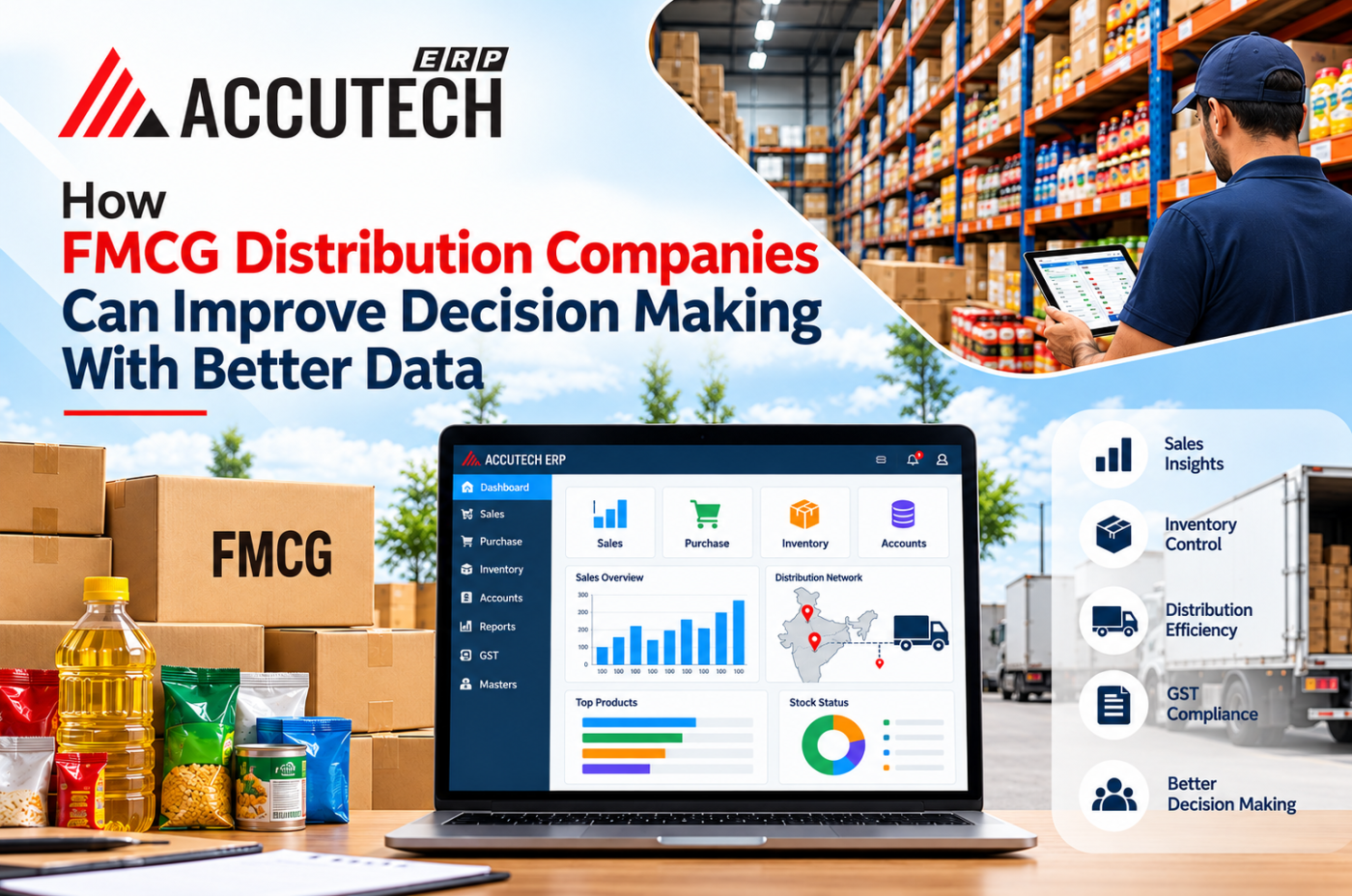
How FMCG Distribution Companies Can Improve Decision Making With Better Data
In today's hypercompetitive FMCG industry, making decisions based on gut feeling or outdated reports is a recipe for disaster. Companies managing fast-moving consumer goods distribution face unprecedented pressure to optimize every aspect of their supply chain, from procurement to delivery. Yet most FMCG distribution companies still operate with fragmented data sources, manual processes, and reporting delays that can cost thousands in lost revenue.
The reality is stark: 73% of FMCG distributors report difficulty in accessing real-time business data when making critical decisions. This data blindness leads to overstocking, stockouts, inefficient routes, and missed market opportunities. That's where FMCG Distribution ERP Software enters the picture.
Implementing a modern distribution management system transforms your entire operation by centralizing data, automating processes, and providing instant visibility into inventory, sales, finances, and customer behavior. Whether you're managing multiple warehouses, tracking thousands of SKUs, or ensuring GST compliance across locations, an integrated business platform provides the foundation for smarter decision-making.
In this comprehensive guide, we'll explore how advanced distribution technology revolutionizes business operations, why data-driven decisions matter more than ever, and exactly how to implement these solutions for maximum impact in 2026.
Current Challenges in FMCG Distribution Decision Making
1. Data Fragmentation and Silos
Traditional FMCG distribution companies operate with data scattered across multiple systems: inventory management in one tool, accounting in another, sales tracking in a third. This fragmentation makes it nearly impossible to get a complete view of your business. When sales data, stock levels, and financial information don't sync in real-time, leaders make decisions based on incomplete information.
2. Delayed Reporting and Insights
Most FMCG distribution companies generate reports manually, often at month-end or quarter-end. By the time insights reach decision-makers, the market has moved on. Manual accounting processes and spreadsheet-based reporting create bottlenecks that prevent agile decision-making. You need real-time visibility, not last month's numbers.
3. Inventory Inefficiency
Without accurate real-time data, distributors either over-order (tying up capital in excess stock) or under-order (missing sales opportunities). Dead stock depreciates value, expired inventory gets written off, and popular items run out. Modern FMCG distribution erp software solves this by providing precise inventory visibility across all locations and SKUs.
4. GST Compliance Complexity
GST compliance requires meticulous record-keeping, timely filing, and accurate tax calculations. Manual processes in distribution management environments lead to errors, penalties, and audits. An integrated FMCG accounting software solution automates compliance and keeps you audit-ready at all times.
How FMCG Distribution ERP Software Solves Data Problems
FMCG Distribution ERP Software is not just another software tool, it's a complete business transformation solution. By integrating all your business processes into one unified platform, the system eliminates data silos and creates a single source of truth for every decision.
Unified Data Ecosystem
Imagine having your entire FMCG distribution business in one place: sales orders, purchase invoices, stock levels, customer details, supplier information, and financial records all synchronized in real-time. This is what a modern distribution ERP platform delivers. Every department sales, operations, finance, logistics works with the same data, eliminating confusion and delays.
Real-Time Business Intelligence
Dashboard-driven analytics in FMCG software give you instant answers to critical questions: Which products are selling fastest? Which customers are most profitable? Where is inventory stagnating? Real-time reporting capabilities transform your accounting and distribution platform from a compliance tool into a strategic asset for decision-making.
Automated Compliance
A modern distribution management solution automates tax calculations, report generation, and compliance workflows. GST returns, TDS compliance, and financial statements are generated at the click of a button, reducing manual work and minimizing errors.
Real-Time Inventory Management and Visibility
Inventory is the lifeblood of FMCG distribution. Too much, and you lose money on storage and expiry. Too little, and you lose sales. An integrated distribution ERP platform provides granular visibility into every warehouse, branch, and depot.
Multi-Location Stock Tracking
Manage inventory across unlimited warehouses and distribution centers with real-time updates. When a customer orders from location A but stock is available at location B, the distribution system helps optimize fulfillment. This reduces delivery times and improves customer satisfaction.
Demand Forecasting
Advanced FMCG software analyzes historical sales trends, seasonality, and market patterns to forecast future demand. This capability helps you maintain optimal stock levels, reduce carrying costs, and avoid stockouts during peak seasons.
Expiry and Batch Management
A dedicated FMCG distribution system tracks batch numbers, expiry dates, and manufacturing dates automatically. FIFO (First-In-First-Out) prioritization is enforced throughout the supply chain, minimizing waste and ensuring compliance with food safety regulations.
Sales Analytics and Demand Forecasting
Sales data is the clearest signal of what customers actually want. A centralized ERP solution captures every order, return, and customer interaction, transforming raw sales data into actionable intelligence.
Customer-Level Insights
Understand which customers are your most profitable, which products they prefer, and when they typically order. FMCG accounting software combined with sales analytics helps you identify high-value accounts and optimize your sales strategy accordingly.
Product Performance Analysis
Which SKUs are generating profit, which are slow-movers, and which are losing money? A modern distribution management platform provides detailed product-level profitability analysis, helping you eliminate underperforming items and expand fast-sellers.
Route Optimization
Integrated route planning in distribution management systems reduces logistics costs by 15-25%. Smart algorithms consider order location, vehicle capacity, and delivery windows to create efficient routes, saving time and fuel.
Financial Reporting and Accounting System Benefits
Finance is where an integrated distribution ERP solution truly shines. Modern accounting automation handles everything from invoice generation to financial statement creation, ensuring accuracy and timeliness.
Automated Invoice Generation
Orders flow directly into invoice creation. Tax calculations are automatic, discounts are applied systematically, and invoices are generated instantly. FMCG software eliminates manual invoice errors that plague traditional systems.
Profitability Analysis by Customer, Product, and Region
A unified ERP platform breaks down profitability from multiple angles. See which customer segments, product categories, and geographic regions drive your highest margins. This intelligence guides strategic pricing and promotional decisions.
Cash Flow Management
Track outstanding receivables and payables with precision. Integrated accounting tools monitor payment terms, send automated reminders for overdue invoices, and help optimize working capital.
Multi-Currency and Multi-Entity Support
For FMCG companies operating across states or internationally, consolidated accounting is complex. A comprehensive distribution ERP system handles multi-entity consolidation, inter-company transactions, and currency conversions automatically.
GST Compliance and Risk Management
GST compliance is non-negotiable for FMCG distributors. Errors can result in penalties, interest, and reputation damage. A reliable ERP platform ensures you're always tax-compliant and audit-ready.
Automated GST Calculations
Tax rates vary by product category and destination. The system automatically applies correct tax rates based on item HSN code, customer location, and transaction type. This significantly reduces the risk of manual calculation errors.
GSTR-1, GSTR-2A, and GSTR-3B Ready
Monthly GST return filing requires precise data. Integrated accounting systems generate GSTR-1 (sales) and GSTR-2A (purchases) in seconds, with built-in validation. Reconciliation becomes a matter of minutes, not days.
ITC Tracking and Compliance
Input Tax Credit (ITC) is critical for FMCG distributors' profitability. A centralized business management solution tracks every eligible purchase, ensures documentation is complete, and prevents missed ITC opportunities.
Actionable Strategies for Better Decision Making
1. Establish KPIs and Monitor Daily
Define key performance indicators (KPIs) for your FMCG distribution business: inventory turnover, days sales outstanding, gross margin %, stock-out frequency, etc. A modern ERP dashboard lets you monitor these metrics in real-time. Daily reviews help catch issues before they become problems.
2. Use Data for Customer Segmentation
Integrated accounting and analytics tools help you segment customers by profitability, purchase frequency, and product preference. This enables targeted promotions, customized pricing, and personalized service for high-value accounts.
3. Implement Scenario Planning
What if you increased prices by 5%? What if demand drops by 20%? Modern distribution management platforms enable scenario modeling, letting you test decisions before implementing them. This reduces risk and improves strategic planning.
4. Automate Routine Decisions
Purchase order generation, reorder point triggers, and invoice approvals can all be automated through a distribution management system. This frees your team to focus on strategic decisions rather than firefighting daily operational issues.
Common Mistakes to Avoid
Mistake 1: Choosing Distribution Software Without Proper Implementation
Buying a distribution ERP solution without a solid implementation plan is like buying a Ferrari and never learning to drive. Proper onboarding, data migration, and team training are essential. Choose vendors who provide comprehensive implementation support.
Mistake 2: Neglecting Data Quality
Business management system outputs are only as good as the data going in. Garbage in, garbage out. Invest in data validation, regular audits, and user training to ensure information accuracy throughout the system.
Mistake 3: Ignoring User Adoption
Technology adoption fails when end-users aren't properly trained or convinced of its value. Engage stakeholders early, show them how the system makes their jobs easier, and provide ongoing support.
Mistake 4: Over-Customization
Customizing your distribution system extensively to match legacy processes defeats the purpose. Best practice is to adapt your processes to proven ERP workflows, not the other way around.
Frequently Asked Questions
Q1: What makes an FMCG distribution ERP different from general accounting software?
A specialized distribution ERP is purpose-built for the unique complexities of fast-moving consumer goods distribution. It handles multi-warehouse inventory, complex pricing hierarchies, distributor-specific workflows, and regulatory compliance specific to FMCG businesses. General accounting software lacks the inventory and supply chain capabilities essential for distributors.
Q2: How does an FMCG system improve decision-making speed?
Real-time data availability is the game-changer. Instead of waiting for month-end reports, an integrated ERP platform provides instant dashboards with current sales, inventory, and financial data. Leaders can make decisions within hours instead of days.
Q3: Is a distribution management system suitable for small distributors?
Absolutely. Cloud-based business management solutions are affordable and scalable for businesses of all sizes. Small distributors benefit from automated invoicing, inventory tracking, and compliance features without massive IT infrastructure investments.
Q4: How does an FMCG ERP system ensure data security?
Modern business platforms use bank-grade encryption, multi-factor authentication, regular backups, and role-based access controls. Choose cloud vendors with SOC 2 certification and comprehensive data protection policies.
Q5: What's the typical ROI timeline for an FMCG ERP implementation?
Most FMCG distributors see payback within 12-18 months. Benefits include reduced inventory carrying costs (10-20%), fewer GST compliance errors, faster invoice processing, and improved cash flow. Larger operations see returns within 6-9 months.
Q6: Can a distribution ERP integrate with existing systems?
Yes. Modern ERP platforms offer APIs and pre-built integrations with banking systems, payment gateways, shipping providers, and other software. This ensures seamless data flow across your technology ecosystem.
Q7: How does an ERP system handle multiple warehouse operations?
A distribution management platform provides unlimited warehouse locations with independent stock tracking, transfer orders between warehouses, and consolidated reporting across all locations. You get both granular control and enterprise visibility.
Q8: What training is required for ERP adoption?
Comprehensive training programs should cover accounts staff, warehouse operators, sales teams, and management. Most implementations include 2-4 weeks of training before go-live, with ongoing support during the first few months.
Q9: How often should we analyze business data?
Operational metrics (inventory, sales, orders) should be reviewed daily. Financial reports and strategic analysis should happen weekly or monthly. ERP automation makes this frequency feasible without overwhelming your team.
Q10: What's the difference between cloud-based and on-premise accounting systems?
Cloud-based business management platforms offer lower upfront costs, automatic updates, accessibility from anywhere, and vendor-managed security. On-premise software provides more customization control but requires IT infrastructure and maintenance overhead. Cloud is recommended for most modern FMCG distributors.
Conclusion:
The FMCG distribution landscape has fundamentally changed. Companies that rely on intuition and delayed reporting are losing to competitors who harness real-time data for faster, smarter decisions. An integrated distribution ERP isn't a luxury, it's a competitive necessity.
Whether you're struggling with inventory accuracy, missing GST deadlines, or losing visibility into profitability, the solution is clear: implement a modern business management platform that integrates all your processes into one intelligent system.
The journey from data-blind to data-driven doesn't happen overnight, but it's absolutely worth the investment. Modern ERP implementations typically show results within months: better inventory turns, fewer compliance errors, faster cash flow, and most importantly, smarter business decisions made with confidence.
Take the first step today. Request a demo of Accutech ERP's FMCG Distribution Software to see how real-time data and intelligent workflows can transform your business. Don't let another quarter pass with gut-feel decisions. Your competitors certainly won't.