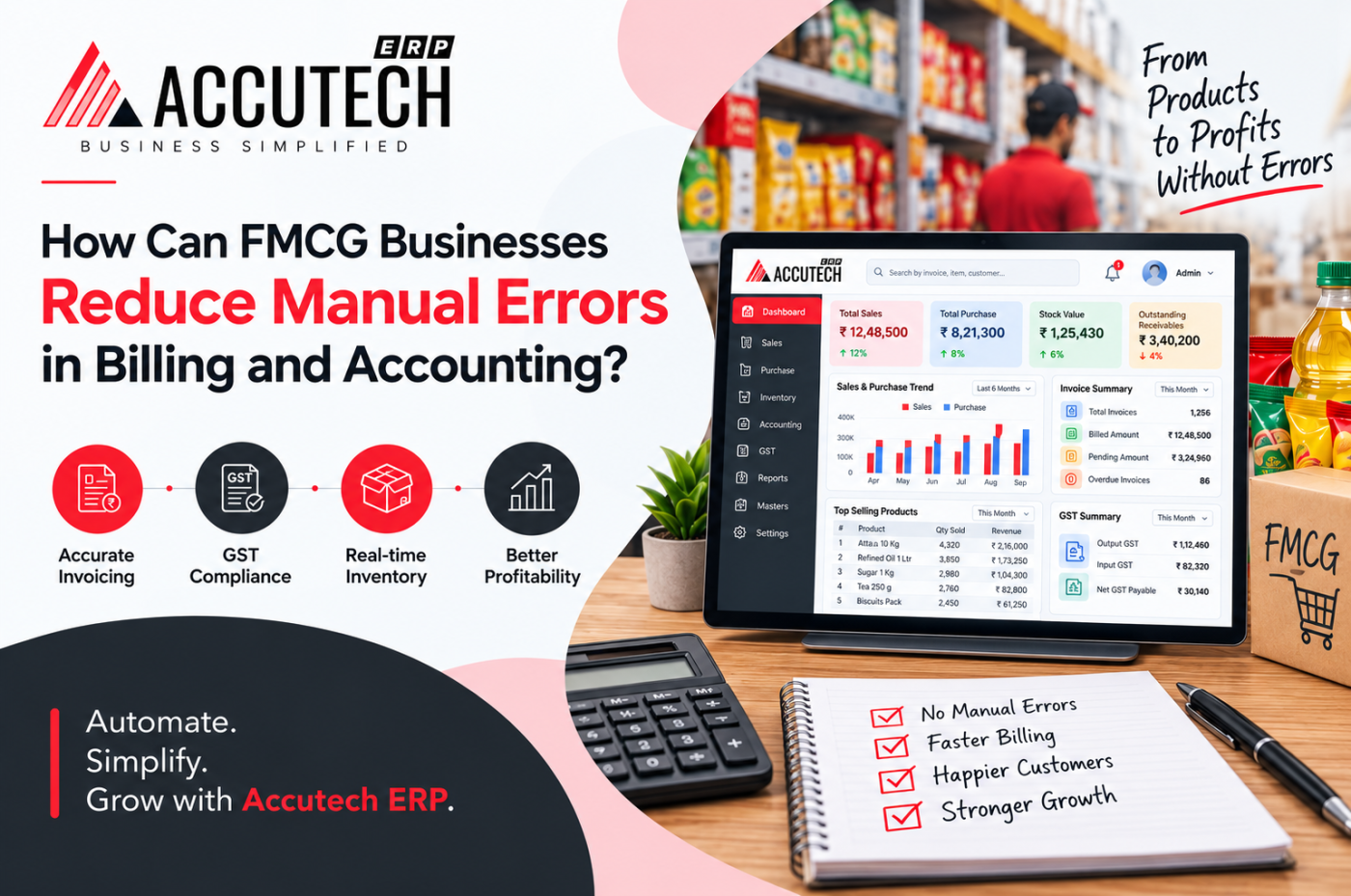
Manual billing and accounting errors cost FMCG businesses thousands of dollars annually. When distribution networks span multiple cities with hundreds of retailers, every transaction matters. A single miscalculation in invoice values, product quantities, or tax amounts can trigger audit complications, customer disputes, and compliance penalties that damage your bottom line.
The challenge intensifies dramatically when dealing with complex GST calculations, varied discount structures, and payment reconciliation across multiple channels and customer segments. Most traditional methods rely on manual data entry into spreadsheets, offline processes, and disconnected systems creating bottlenecks that slow down operations and invite costly mistakes that accumulate over time.
This is where FMCG Distribution ERP Software becomes transformative for your distribution business. Modern, cloud-based solutions designed specifically for FMCG operations automate billing, validate transactions in real-time, and maintain GST-ready compliance all while reducing human error by up to 95% and accelerating your financial operations.
In this comprehensive guide, we'll explore proven strategies, technologies, and best practices that help FMCG businesses eliminate manual errors and build a stronger financial foundation. Whether you're running a regional distribution network or managing operations across multiple states, understanding how modern ERP software works can revolutionize your accounting processes and customer relationships.
Understanding Manual Errors in FMCG Billing and Accounting
FMCG distribution operates at an entirely different scale compared to typical retail businesses. Product variety is extensive, customer networks are vast, and transaction volumes are enormous. In this high-velocity environment where speed and accuracy are critical, manual billing processes become increasingly vulnerable to errors and costly mistakes.
Common Sources of Manual Errors in FMCG Distribution:
Data Entry Mistakes: Warehouse staff manually entering product codes, quantities, and rates into invoicing systems frequently transpose digits or misremember pricing structures, leading to incorrect billing amounts. In a distribution network handling hundreds of orders daily, even small percentages of entry errors result in significant revenue loss.
Discount Calculation Errors: Different customer segments receive different discounts wholesale rates differ from retail rates, seasonal promotions come and go, and loyalty discounts apply selectively. Manual calculations create pricing inconsistencies, customer disputes, and lost margins that compound monthly.
GST Tax Miscalculations: Complex tax rules, input tax credits, and state-wise variations make manual GST calculations error-prone. One miscalculated invoice can cascade into compliance headaches during monthly GST reconciliation and audit processes.
Inventory-Invoice Mismatch: When billing systems and inventory records aren't synchronized in real-time, discrepancies arise immediately billing for items not in stock or missing items from invoices. This creates customer service nightmares and operational confusion.
Payment Reconciliation Delays: Manual payment tracking makes it difficult to match customer payments with outstanding invoices, leading to account confusion and cash flow visibility problems.
The Cost of Billing Inaccuracies in Distribution Networks
Beyond the obvious financial losses, billing errors damage customer relationships and operational efficiency. A distributor managing 500+ retail outlets could face dozens of billing disputes monthly when relying on manual processes, directly impacting customer satisfaction and retention.
Quantifiable Impacts of Manual Billing Errors:
Lost Revenue: Billing errors result in undercharging customers or payment delays, directly impacting cash flow and profitability. A business with ₹50 lakhs in monthly sales experiencing just 2% billing errors loses ₹10,000 monthly plus additional administrative costs.
Increased Administrative Costs: Staff spend 20-30% of their time correcting billing mistakes, issuing credit notes, and reconciling accounts. This resource drain diverts focus from strategic business activities and customer growth initiatives.
Customer Churn: Recurring billing disputes erode customer trust and loyalty. Retailers become frustrated with frequent corrections and may switch to competing distributors who offer error-free billing and reliable operations.
Audit and Compliance Risks: Manual records lack complete audit trails, creating vulnerabilities. When tax authorities or internal audits discover discrepancies, penalties and fines follow quickly, damaging compliance reputation.
How ERP for FMCG Distribution Automates Billing Processes
A robust ERP for FMCG Distribution connects inventory management, sales orders, pricing databases, and accounting ledgers into a unified, integrated system. When a sales representative enters an order, the system automatically validates stock availability, applies correct pricing and discounts, calculates taxes accurately, and generates a complete invoice all without manual intervention.
Key Automation Features in FMCG ERP Software:
Automated Invoice Generation: Orders automatically convert to invoices with pre-filled product details, rates, quantities, and customer information no manual entry required. The system applies applicable discounts and calculates final amounts without user input, ensuring consistency and accuracy.
Dynamic Price List Integration: When wholesale rates change, updates reflect across all modules simultaneously. FMCG distribution business software ensures new pricing appears in all future orders without manual updates or oversight.
Discount Engine: The system automatically applies customer-specific, product-specific, or volume-based discounts based on established rules. Complex discount hierarchies are managed through configuration rather than manual calculation, eliminating errors.
Validation Rules: Before finalizing invoices, FMCG ERP software validates data integrity automatically. It checks stock availability, verifies credit limits, and confirms customer payment status, preventing problematic orders from being invoiced.
Real-Time Inventory Tracking Prevents Billing Mismatches
A fundamental source of billing errors occurs when sales teams invoice for items that are out of stock or unavailable. Traditional systems lack real-time visibility into warehouse conditions, forcing teams to rely on outdated stock lists or manual counts that quickly become inaccurate.
FMCG distribution business software solves this challenge through live, integrated inventory tracking. When warehouse staff scan incoming goods or pick items for shipment, inventory levels update immediately across the entire system. Sales and billing teams see current stock positions in real-time, enabling accurate invoicing for every transaction.
Benefits of Real-Time Inventory Visibility:
Prevention of Over-Invoicing: Sales teams can only invoice items that currently exist in stock. The system prevents billing for unavailable products, maintaining customer trust and operational integrity.
Accurate Delivery Confirmations: When warehouse staff confirm shipments, inventory levels decrease automatically and instantly. Billing records exactly match what was physically delivered to customers.
Multi-Location Tracking: Distributors managing multiple warehouses across regions see consolidated stock across all locations, reducing duplicate orders, preventing shipping delays, and optimizing inventory allocation.
GST Compliance and Automated Tax Calculations
GST compliance represents perhaps the most complex aspect of FMCG billing and accounting. Different product categories have different tax rates (5%, 12%, 18%, or 28%). Inter-state transactions trigger IGST, while intra-state transactions use SGST and CGST. Input Tax Credits (ITC) add another layer of complexity. Manual tax calculations are prone to errors and compliance violations.
Modern FMCG Distribution ERP Software automates tax calculations entirely and accurately. The system stores HSN codes and tax classifications for every product. When billing an order, the system automatically applies the correct tax rate based on product type and destination state, ensuring full compliance.
GST Automation Capabilities:
State-Wise Tax Calculation: The system determines transaction location and applies SGST + CGST for intra-state transactions or IGST for inter-state shipments automatically, ensuring tax accuracy.
HSN Mapping: All products are tagged with HSN codes. The system applies corresponding tax rates automatically during invoicing, eliminating manual tax classification errors.
ITC Tracking: The system tracks eligible input taxes and maintains detailed records for reconciliation and audit purposes, supporting compliance initiatives.
Return Filing Support: GSTR-1 data is auto-generated from transaction records, reducing manual report preparation effort by hours and ensuring accuracy.
Multi-Entity Accounting for Distributed FMCG Operations
Large distributors often operate through multiple legal entities separate businesses for different regions, product categories, or business models. Managing accounting across these entities while maintaining consolidated reporting is complex and error-prone when using manual methods.
FMCG ERP software provides built-in multi-entity support and capabilities. Each legal entity maintains separate accounting records, but the system can consolidate reports instantly. Distributors operating three regional entities can generate combined financial statements with a single click while maintaining entity-wise profitability analysis.
Multi-Entity Benefits:
Separate Books: Each entity maintains independent ledgers, enabling accurate entity-wise profitability tracking and performance analysis.
Consolidated Reporting: Parent company leadership can view combined financial statements covering all entities.
Inter-Company Transactions: The system handles transfers between entities without creating consolidated duplications or accounting confusion.
Audit Trail and Financial Visibility
Manual accounting systems create audit nightmares. When errors surface during tax audits, companies struggle to trace transaction origins or justify accounting decisions. Digital ERP systems maintain complete audit trails automatically and securely.
FMCG distribution business software records every transaction change who entered it, when it was entered, what was changed, and why. This creates a tamper-proof record that satisfies auditors and regulators, protecting your business from compliance violations.
Audit Trail Components:
Transaction Logging: Every invoice, payment, and adjustment is logged with timestamp and user identification automatically.
User Access Controls: Different employees have different permission levels. The system tracks who accessed sensitive financial data and when.
Change Documentation: If someone modifies an invoice or accounting entry, the system records both original and modified versions for audit purposes.
Payment Reconciliation and Outstanding Tracking
Matching incoming payments to outstanding invoices is a perpetual pain point in billing operations. Customers sometimes pay partial amounts, make payments weeks after invoicing, or issue check payments with vague descriptions. Manual reconciliation is time-consuming and error-prone.
ERP systems automate payment reconciliation. When payments arrive, the system matches them against open invoices based on customer and amount automatically. If a customer pays for multiple invoices with a single check, the system intelligently allocates the payment.
Payment Reconciliation Features:
Automatic Matching: The system matches received payments to outstanding invoices by amount and customer automatically.
Partial Payment Tracking: When customers make partial payments, the system allocates amounts and tracks remaining balances accurately.
Aging Analysis: The system automatically categorizes outstanding receivables by age (30 days, 60 days, 90+ days), helping manage credit and collections.
Implementation Best Practices for FMCG ERP Software
Selecting the right software is crucial, but successful implementation determines actual business results. Here are proven best practices that ensure maximum value:
Step 1: Process Assessment and Mapping
Before implementing any ERP system, document your current billing and accounting processes thoroughly. Identify bottlenecks, error-prone steps, and manual touchpoints affecting operations. Map these processes to system capabilities. Understanding how the new system will change workflows helps manage adoption and resistance.
Step 2: Data Cleansing and Migration
Transfer historical data from legacy systems to your new software. This includes product master data, customer information, supplier records, and historical transactions. Validate data quality during migration incomplete or duplicate records will perpetuate errors.
Step 3: Configuration and Customization
Configure the system to match your business structure precisely. Set up accounting heads, product categories, customer types, and pricing structures. Define discount rules, GST classifications, and approval workflows. Most modern systems offer configuration rather than custom coding and leverage this for faster deployment.
Step 4: User Training and Change Management
Train all affected users thoroughly. Create role-specific training programs: billing staff learn invoicing, warehouse staff learn inventory functions, accountants learn reporting capabilities. Assign power users as internal champions who can support colleagues during transition.
Step 5: Pilot Testing and Gradual Rollout
Don't implement across the entire organization simultaneously. Start with a pilot in one region or product line. Test all critical billing and accounting scenarios. Verify that invoicing accuracy improves and manual errors reduce. Once the pilot succeeds, roll out to other regions gradually.
Frequently Asked Questions
1. What is FMCG Distribution ERP Software and how does it reduce billing errors?
FMCG Distribution ERP Software is a comprehensive business management system designed specifically for fast-moving consumer goods distributors. It integrates inventory management, sales, billing, accounting, and compliance functions seamlessly. The system reduces billing errors by automating invoice generation, applying correct pricing and tax calculations automatically, validating transactions before finalization, and maintaining real-time inventory synchronization. Instead of manual data entry creating mistakes, the software eliminates human touchpoints in critical billing processes.
2. How does ERP for FMCG Distribution handle GST compliance?
ERP for FMCG Distribution includes built-in GST automation throughout the system. The software stores HSN codes and applicable tax rates for each product. When generating invoices, it automatically applies correct tax rates based on product classification and transaction location (intra-state or inter-state). The system tracks eligible input tax credits, generates GSTR-1 returns from transaction records, and maintains complete audit trails for tax authorities.
3. Can FMCG distribution business software handle multi-branch operations effectively?
Yes, absolutely. FMCG distribution business software is specifically designed for distributed business models. It manages multiple branches, warehouses, and distribution centers from a single platform seamlessly. Each location maintains independent inventory, sales, and accounting records, but the system can generate consolidated reports across all locations. This prevents discrepancies between branch records and provides complete visibility.
4. How does real-time inventory tracking prevent billing mistakes?
When warehouse operations are integrated with billing, inventory levels update automatically as goods are received, picked, and shipped. Billing teams see current stock positions in real-time. They cannot invoice items that are out of stock. When delivery is confirmed in the warehouse, inventory decreases instantly. This real-time synchronization ensures invoiced quantities always match physically delivered quantities.
5. What kind of billing reports does FMCG ERP software provide?
Modern FMCG ERP software generates extensive billing and accounting reports including: invoicing summaries by period, customer, or product; aged receivables analysis; outstanding payment tracking; sales performance by distributor or territory; payment reconciliation reports; GST compliance reports; profit & loss statements; and complete audit trails. Most systems provide these reports in real-time dashboards with drill-down capabilities.
6. How long does implementation of FMCG ERP software typically take?
Implementation timelines vary based on organization complexity and data volume. A small distributor with single location might implement in 4-6 weeks. A large distributor with multiple branches, complex pricing structures, and substantial historical data typically requires 3-4 months. Phased implementations starting with core billing and accounting, then expanding to other modules are faster and lower-risk.
7. What is the ROI (Return on Investment) for FMCG ERP software?
FMCG businesses typically see strong ROI within 12-18 months through: reduced billing errors (saving 95% of error-related rework), lower administrative overhead (20-30% staff time savings), faster cash collection (2-3 day acceleration), reduced audit risks and penalties, and improved pricing accuracy (2-3% revenue improvement). Many organizations report paying back the investment within the first year.
8. Is comprehensive training required for ERP software adoption?
Yes, comprehensive training is essential for successful adoption. Vendors typically provide initial training during implementation. Organizations should conduct ongoing training for new employees and refresher training for existing staff. Designate power users in each department to support colleagues. Create role-specific training materials for billing staff, warehouse personnel, and accountants.
9. How does FMCG distribution business software improve customer relationships?
Accurate, timely invoicing improves customer satisfaction significantly. Billing disputes decrease dramatically when invoices are accurate and delivered promptly. Customers appreciate transparent pricing and tax calculations. When retailers can trust billing accuracy, they're more likely to expand purchases and remain loyal.
10. How does cloud-based FMCG distribution business software differ from on-premise solutions?
Cloud-based FMCG distribution business software offers greater accessibility users can access from anywhere with internet connection. Updates are automatic without requiring IT maintenance. Data is backed up automatically. Initial capital investment is lower as there's no need to purchase servers. For most distributors, cloud solutions offer better flexibility and lower total cost of ownership.
Conclusion:
Manual billing and accounting processes are no longer viable for modern FMCG businesses. The scale, complexity, and compliance requirements of today's operations demand sophisticated digital solutions. Continuing to rely on spreadsheets and manual data entry means accepting continuous errors, inefficiency, and compliance risks that compound.
FMCG Distribution ERP Software solves these challenges by automating billing, validating transactions, calculating taxes accurately, tracking inventory in real-time, and maintaining complete audit trails. The result is dramatic reduction in manual errors, faster financial close cycles, improved customer satisfaction, and stronger profitability.
Whether you’re a regional distributor managing 50 outlets or a national FMCG business working with hundreds of retail partners, Accutech ERP provides a scalable solution designed to simplify distribution, accounting, inventory, and compliance operations.
Modern ERP solutions have already proven their value across growing FMCG organizations. The question is no longer whether your business can afford to implement an ERP system, it's whether you can afford to delay adopting a smarter and more efficient solution like Accutech ERP.