The FMCG business is moving at lightning speed. Every second counts when you're managing hundreds of SKUs, multiple distribution points, complex billing, and thousands of customers. One wrong move a misplaced inventory figure, a billing error, or delayed order processing and your entire operation feels the impact.
I still remember the chaos. Before modern solutions, FMCG distributors operated like a well-oiled machine that was actually running on rust and good intentions. Spreadsheets governed everything. Phone calls were constant. Mistakes compounded daily. Customers got frustrated. Revenue opportunities disappeared.
Then everything changed with FMCG distribution software. Today, distributors who've implemented the right FMCG ERP software are operating with unprecedented clarity, speed, and profitability. This isn't just about managing inventory anymore it's about completely transforming how you run your distribution business.
In this comprehensive guide, I'm going to show you exactly how the best FMCG management software works, why it matters for your business and how to choose the solution that fits your specific needs. Whether you're a small distributor trying to scale or an established player wanting to optimize operations, this article is for you.
Understanding the FMCG Distribution Challenge: Why Software Matters
Let me paint a realistic picture of what FMCG distribution looks like without proper software.
Rakesh runs a regional FMCG distribution business in Gujarat. He handles products from three major companies everything from personal care to household items. He has 15 salespeople, 5 warehouse staff, and serves 400+ retail customers across three districts.
Without modern software, his days look like this: Manual stock counts at warehouse. Excel sheets being updated by different people at different times (sometimes creating conflicts). Sales people calling back to check if items are available. Invoices created manually or using basic templates. Payment reconciliation done by hand. Late nights calculating commissions and analyzing which products are selling. Constant fire fighting when customers complain about orders or billing errors.
The stress is immense. The inefficiency is staggering. The missed opportunities are costly.
This is exactly where FMCG distribution business software steps in to transform everything. It's not just a nice-to-have anymore it's essential for survival and growth in modern FMCG distribution.
What Is FMCG Distribution ERP Software? A Complete Breakdown
Before we dive into benefits, let's clarify what we're actually talking about.
Beyond Basic Accounting
FMCG ERP software is not just an accounting tool. Yes, it handles billing and basic invoicing, but that's like saying a car is just about wheels. The real power lies in how it orchestrates your entire operation.
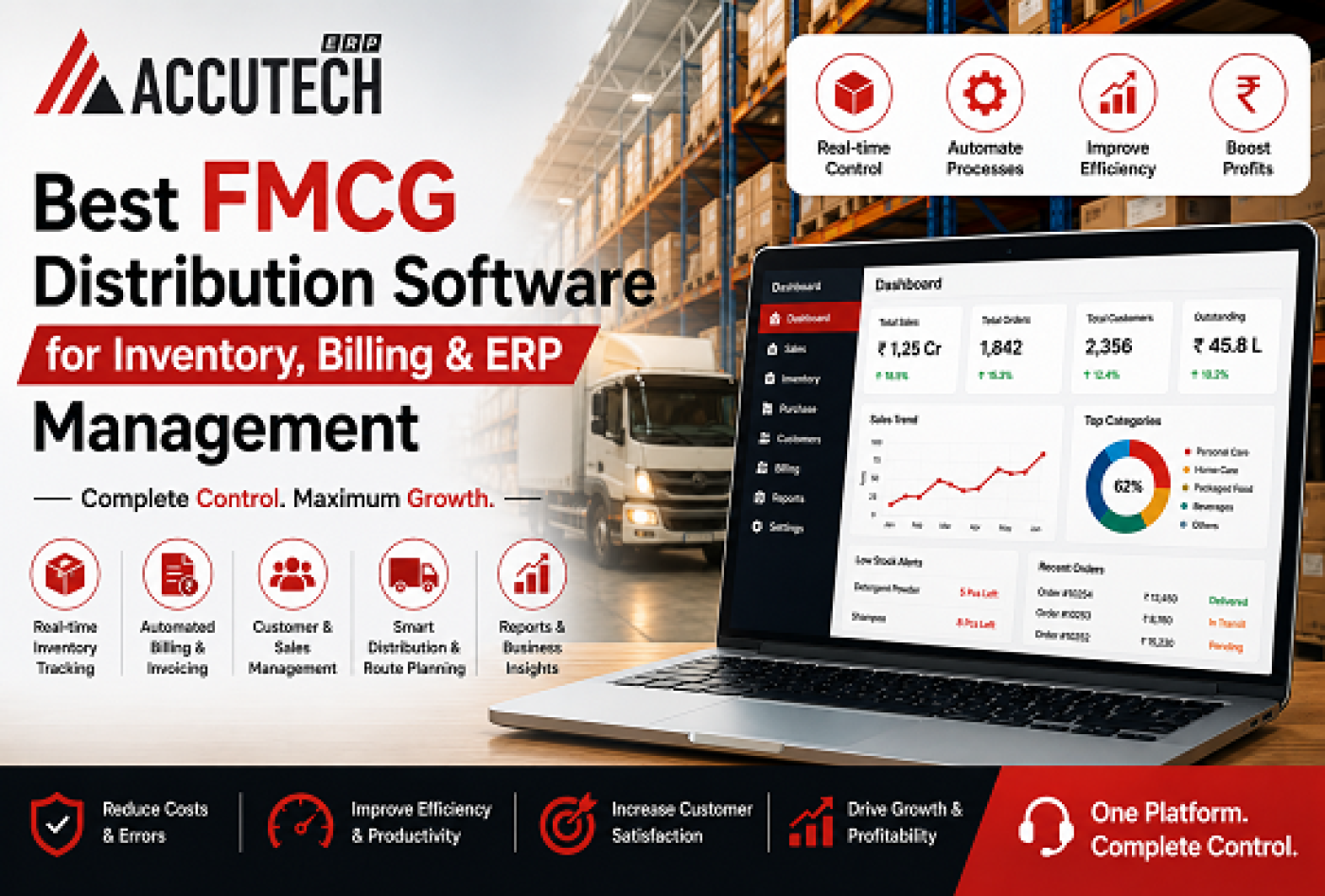
Proper FMCG management software includes:
- Real-time inventory tracking across all locations
- Automated order processing from customers
- Intelligent billing with automatic invoice generation
- Sales performance tracking and analytics
- Route optimization for deliveries
- Customer credit management and payment tracking
- Automated reporting and business intelligence
Think of it as a command center for your entire distribution operation. Everything flows through it, and you have complete visibility.
Benefit #1: Revolutionary Inventory Management That Actually Works
Inventory is the heartbeat of FMCG distribution. Stock out when you should have stock, and you lose sales. Overstock and your capital is stuck in dead inventory.
Real-Time Visibility Across All Locations
With the right FMCG distribution software, you see everything. Not tomorrow. Not in an hour. Right now.
Your warehouse manager scans items as they arrive. Your salesperson can check availability instantly from his phone. Your customer service team knows exactly what's in stock before making promises. This real-time data prevents the curse of every distributor: telling a customer yes when the answer is actually no.
Automatic Stock Alerts and Smart Reordering
No more guessing when to reorder. The system monitors your stock levels and alerts you when specific items are running low. For established distributors working with multiple brands, this automation is a game-changer. You'll never again face the embarrassment of a stockout for a fast-moving product.
Batch and Expiry Management
FMCG products have expiry dates. Managing multiple batches, tracking which products expire when, ensuring FIFO (first in, first out) stock rotation this is incredibly complex without software.
Quality FMCG ERP software handles all of this automatically. It tracks batch numbers, expiry dates, and prevents you from accidentally selling expired stock. This protects your reputation and keeps you compliant with regulations.
Benefit #2: Billing That's Fast, Accurate, and Automated
Billing in FMCG distribution is complex. You're dealing with multiple product categories, different GST rates, wholesaler versus retailer pricing, promotional discounts, credit notes, and more.
One-Click Invoice Generation
Imagine your salesperson completing an order at a customer's location. They press a button, and an invoice is generated instantly complete with all applicable taxes, discounts, and product information. This is standard with modern FMCG management software.
No manual calculations. No errors. Just instant, accurate billing.
GST Compliance Built Into Every Transaction
GST regulations are complex and constantly evolving. Your FMCG distribution business software should automatically handle GST calculations, track HSN codes, and generate GST reports. This keeps you compliant without dedicating resources to tax management.
Payment Tracking and Collections
You extend credit to customers. You need to track who owes what, when it's due, and when it's paid. Modern systems track this perfectly, send automatic payment reminders, and generate aging reports showing exactly which customers are behind on payments.
Benefit #3: Sales Team Productivity Explosion
Your salespeople are your revenue generators. Every moment they spend on paperwork or administrative tasks is time they're not selling.
Mobile Access to Everything
Field salespeople can access the entire system from their phones or tablets. Check inventory. Create orders. Generate invoices. All while standing at the customer's shop. This transforms the sales experience and drastically reduces order-to-fulfillment time.
Automated Sales Reporting
Forget asking salespeople to submit daily reports. Everything they do is automatically logged. You know who sold what, where, and when. You can identify top performers, spot struggling salespeople, and make data-driven decisions about your team.
Intelligent Commission Calculations
Commission structures in FMCG can be complex different rates for different products, bonuses for achieving targets, penalties for returns. Your FMCG ERP software calculates all of this automatically. No disputes. No manual reconciliation. Just accurate commissions on time.
Benefit #4: Data-Driven Decision Making
This might be the most underestimated benefit of FMCG management software. Suddenly, you have access to powerful business intelligence.
Sales Analytics That Reveal Patterns
Which products are your best sellers? Which customers generate the most profit? What's the seasonal trend in your sales? Which geographic area is underperforming? With real data, you can answer these questions and optimize your business.
Profit Margin Visibility
Many distributors don't truly know their profit margins by product or customer. They think they're making money on everything, but some products might actually be losing money when you factor in handling costs, returns, and logistics.
Your system shows you exactly which products are profitable and which are dragging down your bottom line.
Predictive Insights
Advanced FMCG distribution software can identify trends and predict future demand. This helps you stock smarter and capitalize on opportunities before competitors do.
Benefit #5: Operational Efficiency and Cost Reduction
Everything I've mentioned so far translates to concrete cost savings.
- Reduced manual labor: Your team spends less time on paperwork, more time on value-added activities
- Fewer billing errors: Less time fixing mistakes, more time managing operations
- Better inventory management: Less dead stock, fewer stockouts, optimized working capital
- Faster collections: Automated reminders mean faster payment cycles and better cash flow
- Reduced returns and disputes: Better documentation prevents disagreements with customers
One distributor I know saved ₹8 lakhs annually just from reducing billing errors and improving inventory management. That's money that went directly to their bottom line.
Myths vs. Facts: What People Get Wrong About FMCG Distribution Software
Myth #1: It's too expensive for small distributors
Fact: Modern cloud-based FMCG ERP software is often cheaper than maintaining multiple spreadsheets and spreadsheet errors. You pay a monthly subscription, not a huge upfront investment. ROI typically happens within 3-6 months.
Myth #2: Implementation takes months and disrupts operations
Fact: Modern solutions are designed for quick implementation. Many distributors are operational in 2-4 weeks. The key is choosing a vendor experienced with FMCG distribution specifically.
Myth #3: You need an IT person to run it
Fact: Quality FMCG management software is designed for people in distribution, not tech experts. If your team can use WhatsApp and email, they can use modern FMCG software.
Myth #4: It requires you to digitize everything overnight
Fact: Most systems allow gradual rollout. You can start with one warehouse, one product line, or one region, and then expand. You don't have to flip a switch and change everything at once.
Myth #5: It's only for large distributors
Fact: FMCG distribution business software scales from small solo distributors to large organizations. Many systems are specifically designed for small and mid-sized distributors.
Real Transformation: How Distributors Actually Benefit
Let me tell you what happened when Priya, a distributor in Bangalore, implemented proper FMCG distribution software.
Before: She had 8 salespeople, 3 warehouse staff, and served 250 retailers. Operations were chaotic inventory mismatches every month, billing disputes, salespeople waiting for warehouse to confirm stock, manual invoicing taking hours, and no clear idea of actual profitability by product.
After 6 months: Here's what changed:
- Inventory accuracy improved from 78% to 99%
- Salespeople now complete orders 60% faster
- Billing disputes dropped from 12% of invoices to less than 2%
- She discovered two product lines that were actually losing money and adjusted strategy
- Cash collections improved, increasing monthly cash flow by ₹4 lakhs
- One warehouse staff person was freed up for sales support
She scaled to 400 retailers without hiring additional management staff. The system was doing what would have required two additional people.
Key Features to Look for in FMCG Distribution Software
Non-negotiable Features
- Real-time inventory tracking: This is fundamental. If the system doesn't show you accurate stock instantly, it's not worth it
- Mobile accessibility: Your salespeople need to work from the field with mobile access
- Automated invoicing: This alone saves massive time and reduces errors
- GST compliance: Built-in automatic GST calculations and reporting
- Multi-warehouse support: If you're operating from multiple locations, you need to manage all of them centrally
- Sales analytics: Dashboard showing sales trends, top products, and performance by territory
- Customer credit management: Track credit limits, outstanding payments, and payment history
- Batch and expiry tracking: Non-negotiable for FMCG to avoid regulatory issues
Nice-to-Have Features
- Route optimization for deliveries
- Customer portal for order placement
- Predictive inventory management using AI
- Integration with popular accounting software
- Automated email/SMS notifications to customers
Common Questions:
Q1: How long does it take to implement FMCG distribution software?
Typically 2-4 weeks for a small distributor, 4-8 weeks for a larger operation. It depends on your complexity and data readiness. Most vendors provide implementation support to ensure a smooth transition.
Q2: What about data security and privacy?
Quality FMCG ERP software uses enterprise-grade security with encryption, regular backups, and compliance with data protection regulations. Your business data is safer in cloud systems than in local spreadsheets.
Q3: Can the system handle multiple product lines from different suppliers?
Yes, that's actually what most modern FMCG management software is designed for. You can manage unlimited products from multiple suppliers with different pricing structures and tax rates.
Q4: What about integration with my existing systems?
Modern solutions typically integrate with accounting software, banking systems, and other business tools via APIs. Ask potential vendors about integrations before choosing.
Q5: Is there training provided for my team?
All reputable vendors provide training. Most offer online training, documentation, and ongoing support. Since the software is user-friendly, your team becomes productive quickly.
Q6: What happens if I outgrow the system?
Choose an enterprise-grade system that scales. Cloud-based FMCG distribution software can handle growth from 100 customers to 10,000 without major upgrades.
Q7: Can I access reports anytime, anywhere?
Yes. Modern systems provide dashboards accessible from any device desktop, tablet, or mobile as long as you have internet. You can check your business status 24/7.
Q8: What's the typical ROI for FMCG distribution software?
Most distributors see ROI within 3-6 months through reduced errors, faster processing, better inventory management, and improved collections. Larger distributors often see ROI in 2-3 months.
Q9: What if my business has unique requirements?
Good vendors offer customization options. Choose one that understands FMCG distribution specifically, as they'll have features built for your industry rather than forcing you into a generic system.
Q10: How much does FMCG distribution software actually cost?
Cloud-based solutions typically range from ₹5,000-₹25,000+ per month depending on features, number of users, and warehouses. Some vendors offer usage-based pricing where you only pay for what you use.
FMCG Distribution Software vs. Generic ERP: Why Specialized Matters
You might be thinking: "Why not just use a generic ERP system?" That's a fair question. Let me explain why specialized FMCG distribution software is worth considering:
|
Feature |
Specialized FMCG |
Generic ERP |
|
Batch/Expiry Track |
Built-in, automatic |
Needs customization |
|
Field Sales |
Optimized mobile |
Basic mobile, not optimized |
|
FMCG Workflows |
Pre-configured |
Need configuration |
|
Implementation |
2-4 weeks |
4-6 months |
|
Cost |
Lower total cost |
Higher with customization |
How to Choose the Right FMCG Distribution Software for Your Business
With so many options available, how do you choose?
- Start with a needs assessment: List your specific requirements. What's your biggest pain point? Inventory? Billing? Sales tracking? Start with your top 3 needs.
- Get free trials: Never buy without trying. Most vendors offer 14-30 day free trials. Use them to test whether the system fits your workflow.
- Talk to current users: Ask the vendor for references from similar distributors. Call them and ask about their experience.
- Evaluate vendor support: The best software is only good if you get proper support. Test their support team with questions during trial.
- Check for FMCG-specific features: Ensure they understand batch tracking, expiry management, and FMCG-specific workflows.
- Understand pricing clearly: Ask about all costs licensing, setup, training, support. No surprise charges.
- Plan for scalability: Choose a system that can grow with you. Can it handle 10x your current volume?
The Bottom Line: FMCG Distribution Software is Your Competitive Advantage
Let me be direct: in 2026, FMCG distribution without proper FMCG management software is like trying to compete with one arm tied behind your back.
Your competitors who've implemented FMCG distribution business software are:
- Responding to customer orders faster than you
- Making billing errors at 1/10 your rate
- Never stock outs or overstocking like you do
- Collecting payments faster and maintaining better cash flow
- Understanding their profitability and making smarter business decisions
The question isn't whether you can afford to implement FMCG ERP software. The question is whether you can afford NOT to.