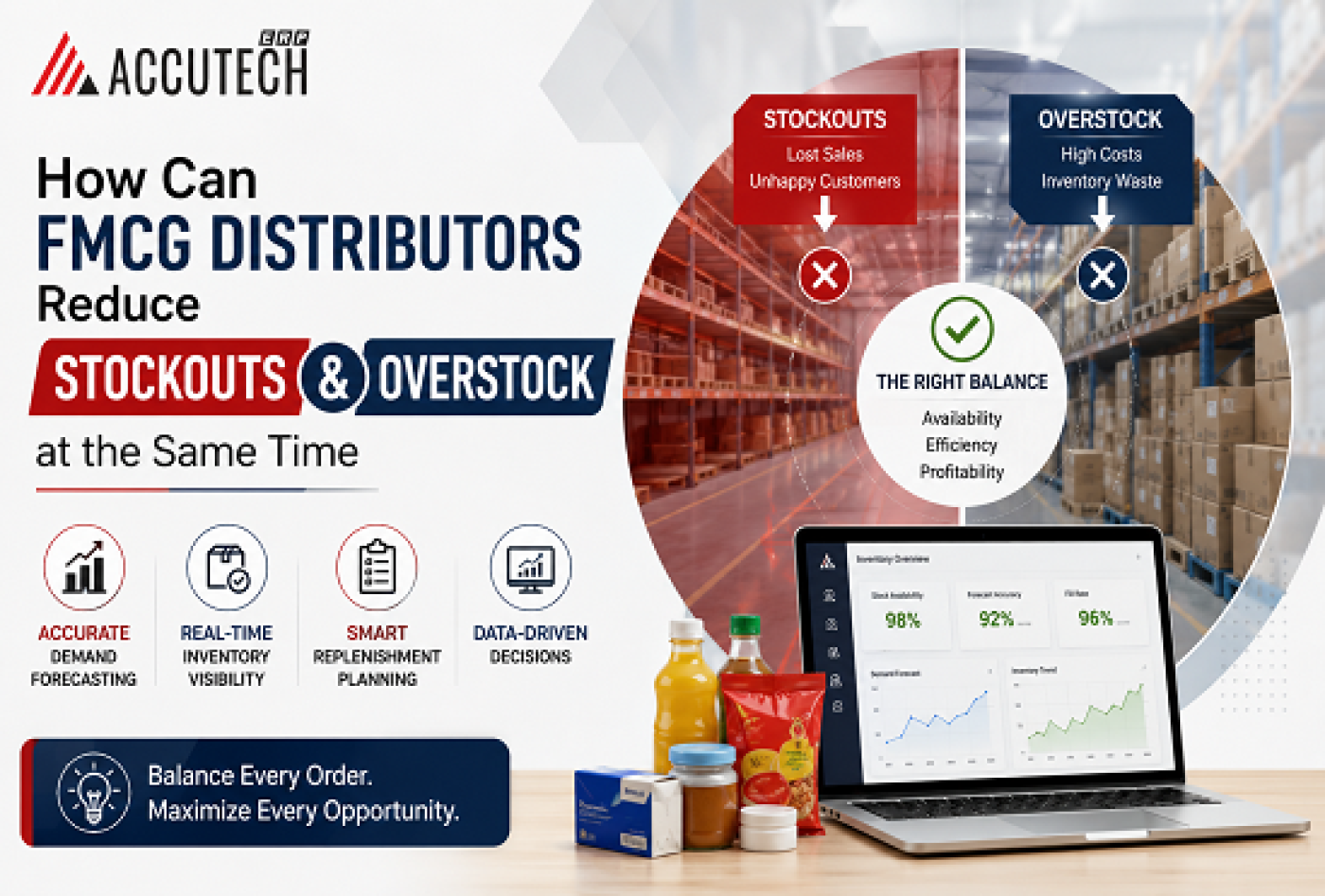
For FMCG distributors, inventory management sits at the crossroads of two seemingly opposing challenges: How do you prevent stockouts that disappoint customers and drain revenue, while simultaneously avoiding overstock situations that tie up capital and waste perishable products?
This paradox has long plagued the fast-moving consumer goods industry. In 2026, data shows that 43% of businesses cite inventory management as their most critical operational challenge, with 70% losing customers due to stockouts. Yet, paradoxically, overstocking costs businesses between 20% to 30% of their inventory value annually through storage expenses, waste, and capital lock-in.
The solution isn't choosing between prevention and mitigation, it's orchestrating them simultaneously. Modern distribution technology, powered by artificial intelligence and real-time data analytics, enables distributors to achieve an unprecedented balance. With tools like advanced demand forecasting, inventory optimization algorithms, and centralized visibility across supply chains, distributors can now reduce stockouts by up to 71% while simultaneously minimizing excess inventory.
This comprehensive guide explores how FMCG Distribution ERP Software transforms inventory challenges into competitive advantages, covering practical strategies, emerging technologies, and actionable best practices that leading distributors are implementing today.
Understanding the Stockout-Overstock Paradox
The fundamental challenge facing modern FMCG distributors is a delicate balancing act. On one hand, running out of stock means lost sales, disappointed customers, and potential permanent switches to competing brands. On the other hand, maintaining excessive inventory creates storage bottlenecks, accelerates product expiration, and wastes financial resources that could be deployed more productively.
What Causes Stockouts?
Stockouts occur when product availability cannot match customer demand. Common causes include:
- Inaccurate demand forecasting leading to underestimated orders
- Supply chain disruptions delaying product arrivals
- Unexpected surges in demand from promotions or seasonality
- Poor coordination between distributors, retailers, and suppliers
- Manual inventory tracking systems that lag behind real-world changes
- Inefficient reordering processes that create lead-time gaps
The business impact is severe. Studies indicate that 8% of FMCG products are out of stock at any given time globally, and 40% of affected customers immediately switch to competitor brands. This results in an estimated ₹93.9 lakh crore in lost retail sales annually.
What Causes Overstock?
Conversely, overstock situations develop when inventory levels exceed what the market demands. Key triggers include:
- Overly conservative ordering strategies designed to prevent stockouts
- Seasonal demand fluctuations not accurately captured in forecasts
- Failed promotional campaigns that didn't drive expected sales
- Long lead times encouraging bulk orders that exceed immediate needs
- Lack of real-time visibility causing duplicate orders across the supply chain
- Product obsolescence and shelf-life constraints for perishable goods
For FMCG businesses, overstocking is particularly costly. Perishable products spoil, promotions must be used to clear excess stock (eroding margins), and capital remains tied up in inventory that doesn't generate returns. Global supply chain waste from inefficient inventory management is projected to reach approximately ₹51.5 lakh crore in 2026.
Why These Problems Coexist
The paradox exists because traditional inventory management approaches rely on static safety stock levels and historical averages. When demand becomes volatile as it always does in FMCG these traditional methods fail in both directions. Distributors either hold excessive buffer stock (creating overstock) or set levels too conservatively (risking stockouts).
The solution requires moving beyond traditional methods to dynamic, data-driven approaches powered by modern inventory systems that can respond in real time to changing market conditions.
Why FMCG Distribution Faces Unique Inventory Challenges
FMCG distribution operates under constraints that most other industries don't face. Understanding these unique pressures is essential for developing effective solutions.
High SKU Complexity
Unlike industries managing a handful of products, FMCG distributors typically handle hundreds or thousands of stock-keeping units (SKUs). A single distribution center might manage 250+ different products across 50+ production lines, each with unique demand patterns, shelf lives, and profit margins. This complexity makes traditional inventory management nearly impossible without automated distribution technology.
Higher SKU counts directly correlate with inventory forecasting errors. Each additional product adds exponentially more variables that demand forecasting systems must consider, making manual or basic statistical methods increasingly unreliable.
Perishability and Shelf-Life Constraints
FMCG products are inherently time-limited. Beverages expire, dairy products spoil, and confectionery items lose freshness. This means every day inventory sits in a warehouse, it becomes less valuable. Unlike durable goods that can sit indefinitely, FMCG products have a finite window for sale.
This constraint creates a unique pressure: overstock isn't just wasteful it's actively destructive. Products that don't sell within their shelf-life window become complete losses. This makes FMCG distributors more vulnerable to overstock consequences than other industries.
Unpredictable Demand Volatility
FMCG demand can shift dramatically and unpredictably. Weather patterns (summer heat drives beverages), social media trends (a viral TikTok can spike confectionery sales), holidays, and promotional campaigns create sudden demand spikes. For seasonal categories, demand can swing 200–400% between peak and off-peak periods.
Traditional forecasting methods built on historical averages fail to capture these sudden shifts. By the time a demand surge appears in weekly reports, retail shelves are already empty and the sales opportunity has passed. Modern FMCG ERP technology addresses this through AI-powered demand sensing that detects signals 14–21 days before they fully materialize.
Multi-Location Complexity
Large FMCG distributors don't operate from single locations. They manage inventory across multiple plants, distribution centers, warehouses, and retail partnerships. One organization might have 11 plants, 4 distribution centers, partnerships with 200+ distributors, and direct delivery to 20,000+ customers.
Scattered stock data across these locations frequently creates a paradoxical situation: stockouts in one market while excess inventory remains stranded in another. Without centralized visibility through a centralized ERP platform, these imbalances go undetected until revenue damage is already done.
The Cost of Poor Inventory Management
Understanding the financial impact of poor inventory management creates urgency for modernization. The costs extend far beyond simple lost sales.
Financial Impact of Stockouts
- Immediate lost revenue from unavailable products
- Permanent customer switching (34% of consumers switch brands after just two stockout experiences)
- Brand reputation damage and decreased customer loyalty
- Increased promotional costs to recapture lost customers
- Supply chain inefficiencies from emergency restocking orders
Financial Impact of Overstock
- Excessive storage and warehouse space costs
- Product spoilage and waste (particularly damaging for perishables)
- Capital lock-in cash that could be deployed elsewhere sits in unsold inventory
- Markdown losses when excess inventory must be discounted to clear
- Obsolescence and write-offs for expired or damaged products
- Increased insurance and inventory carrying costs
Research from industry sources indicates that FMCG inventory shrinkage alone costs the industry ₹1.77 trillion annually, driven by stockouts, phantom inventory (discrepancies between system records and physical counts), expired products, and manual counting errors.
For a mid-size FMCG distribution center, implementing modern distribution technology can deliver approximately ₹7.6 crore–₹11.5 crore in annual savings through improved inventory accuracy alone, before accounting for labor reduction and overstock prevention.
Real-Time Visibility: The Foundation of Inventory Control
The first step toward solving the stockout-overstock paradox is establishing complete, real-time visibility across your entire inventory network. You cannot manage what you cannot see.
What Real-Time Visibility Means
Real-time inventory visibility means knowing, at any moment, exactly what products you have in stock, where they're located, and in what condition. This goes beyond simply knowing total quantities it includes tracking:
- Product locations across all warehouses, distribution centers, and retail partnerships
- Expiration dates and shelf-life remaining for each batch
- Quality status (damaged goods, recall holds, etc.)
- Reserved inventory (products allocated to specific orders)
- In-transit inventory between locations
- Historical movement patterns that enable predictive analytics
How FMCG Distribution ERP Software Delivers Real-Time Visibility
Modern FMCG Distribution ERP Software integrates data from multiple sources:
- Warehouse Management Systems (WMS) that track every receipt and shipment
- Point-of-Sale (POS) systems that record actual customer purchases
- IoT sensors that monitor environmental conditions (temperature for cold storage)
- RFID technology that tracks products through the supply chain
- Supplier systems that provide order status and delivery tracking
This unified data architecture transforms scattered information into actionable intelligence. When a retailer sells products, the POS data flows automatically into your distribution center's ERP platform. When your supplier ships goods, tracking updates flow in. When warehouse staff perform inventory counts, results update in real-time.
Benefits of Real-Time Visibility
- Immediate identification of stockout risks before they impact customers
- Detection of overstock situations that can be addressed through promotions or redistribution
- Accurate data for demand forecasting models (garbage in = garbage out; clean data enables accurate predictions)
- Ability to redistribute inventory geographically when imbalances develop
- Enhanced decision-making based on current rather than historical information
- Compliance readiness with expiration tracking and traceability requirements
Demand Forecasting: Predicting the Future with Accuracy
Real-time visibility tells you what's happening today. Demand forecasting predicts what will happen tomorrow, next week, and next month. Accurate forecasting is the linchpin that enables FMCG distributors to solve the stockout-overstock paradox.
Why Traditional Forecasting Methods Fail
Most FMCG organizations relied on spreadsheet-based forecasts or basic statistical methods like moving averages. While these work when demand is stable and predictable, they completely break down when facing FMCG's inherent volatility.
A simple moving average, for example, assumes the future will look like the recent past. But when a competitor launches a promotion that steals market share, or when seasonal demand suddenly spikes, the moving average lags weeks behind reality. By the time the forecast updates, damage is already done.
AI-Powered Demand Forecasting Advantage
A modern fmcg distribution software provider can incorporate machine learning and artificial intelligence into demand forecasting engines. These systems:
- Process 18+ months of historical sales data alongside external signals (weather, holidays, economic indicators, promotional calendars)
- Create SKU-specific forecasts accounting for individual product characteristics
- Predict demand 14–21 days in advance with 91% accuracy (versus 63–78% for manual methods)
- Continuously learn and improve as new data arrives
- Account for seasonal patterns that can shift 200–400% between peak and off-peak periods
- Identify demand anomalies and alert teams to unusual patterns
Companies implementing AI-driven demand forecasting report 20–30% improvements in forecast accuracy. In supply chain operations specifically, AI models have reduced forecast errors by 30–50% compared to spreadsheet-based methods.
Step-by-Step: Implementing Accurate Demand Forecasting
Establish clean data foundation: Consolidate historical sales data from all channels and locations, removing anomalies and errors.
Identify demand drivers: Map factors influencing each product category (seasonality, promotions, holidays, weather patterns).
Build baseline models: Start with statistical models that capture basic trends and seasonality.
Introduce AI/ML layers: Overlay machine learning models that capture complex, non-linear relationships.
Integrate external signals: Connect promotional calendars, holiday schedules, competitor intelligence, and weather data.
Establish forecast governance: Define how forecasts are created, reviewed, and adjusted across the organization.
Implement feedback loops: Compare forecast accuracy against actual results and continuously refine the models.
Inventory Optimization Algorithms: Smart Distribution
Once you have accurate demand forecasts, the next step is determining optimal inventory levels that minimize the combination of stockout risk and overstock cost. This is where inventory optimization algorithms prove invaluable.
The Science of Optimal Inventory Levels
Optimal inventory management is fundamentally a mathematical optimization problem. The goal is to minimize total costs, which include both stockout costs (lost sales, customer dissatisfaction) and holding costs (storage, spoilage, capital lock-in).
For each SKU at each location, optimization algorithms consider:
- Demand forecast (mean and variability/risk)
- Lead time from suppliers
- Holding costs (warehouse space, insurance, product spoilage)
- Stockout costs (lost margin plus customer lifetime value impact)
- Shelf-life constraints (products with short remaining life need priority for sales)
- Seasonal demand patterns and cyclical variations
Traditional methods set safety stock based on rules of thumb (like "2 weeks of demand"). This creates the paradox: it's too high for slow-moving items (overstock) and too low for volatile items (stockouts).
AI-optimized ERP software calculates unique optimal levels for each product-location combination, accounting for that specific product's demand volatility and characteristics.
How Optimization Algorithms Solve the Paradox
Instead of fighting between stockout prevention and overstock avoidance, optimization algorithms balance them dynamically:
- For high-velocity products with stable demand: Lower safety stock since demand is predictable, reducing overstock risk.
- For volatile products where demand fluctuates significantly: Maintain higher safety stock but optimize allocation across locations based on real demand patterns.
- For perishable products nearing expiration: Adjust target levels downward and trigger aggressive sales tactics.
- For new product launches: Use analogue clustering (identifying similar existing products) to estimate demand rather than relying on nonexistent history.
- For seasonal products: Dynamically adjust target levels based on the point in the seasonal cycle and remaining shelf-life.
Multi-Location Management: Centralizing Scattered Stock Data
Large FMCG distributors rarely operate from single locations. Managing inventory across multiple plants, distribution centers, warehouses, and retail partnerships creates complexity but also opportunities.
The Multi-Location Challenge
Without centralized systems, multi-location operations frequently create paradoxical situations: Product A is overstocked in Warehouse B while simultaneously out of stock in Warehouse C, even though both serve similar customer bases. Redistribution happens too slowly (if at all), preventing the natural rebalancing that would solve both problems.
FMCG Distribution ERP Software Benefits for Multi-Location Operations
- Centralized visibility: Single dashboard showing inventory position across all locations simultaneously.
- Automatic imbalance detection: Algorithms flag situations where products are oversupplied in some locations and undersupplied in others.
- Redistribution orchestration: System recommends transfers between locations to rebalance inventory geographically.
- Network optimization: Allocation logic considers freight costs and lead times to recommend most cost-effective distribution.
- Demand pattern mapping: Identifies which customer clusters prefer which locations, enabling smarter allocation.
Practical Example: Multi-Location Rebalancing
Consider a beverage distributor with three warehouses:
- Warehouse A (Urban Market): Stock of popular cola is depleted, demand forecasted to spike 22% next week due to an upcoming festival.
- Warehouse B (Suburban Market): Stock of the same cola is 40% above optimal levels; demand forecast shows decline.
- Warehouse C (Regional Distribution): Stock levels are normal; demand is stable.
Traditional systems would handle this reactively: When Warehouse A runs out, emergency orders get placed (at higher cost). When Warehouse B's overstock becomes obvious, clearance promotions are triggered (at margin loss).
The ERP system optimizes proactively: It identifies the imbalance three weeks early, recommends transferring 5,000 units from Warehouse B to Warehouse A, and executes the transfer before either situation becomes critical. Stockout is prevented, overstock is eliminated, and transportation cost remains minimal.
Automated Replenishment: Reordering Made Intelligent
Even with perfect visibility and forecasting, execution matters. Automated replenishment systems ensure that optimal inventory levels translate into actual purchasing decisions and orders.
From Manual Reordering to Intelligent Automation
Traditional approaches involve someone monitoring inventory levels, checking forecasts, and manually creating purchase orders. This process is slow, inconsistent, and prone to errors.
Automated replenishment systems transform this through:
- Continuous monitoring: Systems evaluate inventory levels continuously, not weekly or monthly.
- Algorithmic ordering: When inventory drops below optimal levels, the system automatically generates purchase orders.
- Supplier integration: Orders flow directly to suppliers, reducing order-to-shipment lead times.
- Demand-driven quantities: Order sizes reflect demand forecasts, not arbitrary minimum order quantities.
- Exception management: System flags unusual situations requiring human judgment (supplier issues, demand anomalies).
Just-in-Time Replenishment for FMCG
Just-in-time (JIT) replenishment ordering inventory exactly when needed offers particular benefits for FMCG:
- Reduces storage pressure and warehouse space requirements
- Keeps products fresher (less time sitting in warehouses)
- Minimizes holding costs and capital lock-in
- Reduces spoilage and expiration waste
However, JIT requires accurate demand forecasting and reliable suppliers. Without these prerequisites, JIT creates stockout risk. With FMCG Distribution ERP Software providing accurate forecasts and supplier integration, JIT becomes a practical and powerful strategy.
Best Practices for FMCG Distribution ERP Implementation
Successfully working with a fmcg distribution software provider and achieving the benefits described above requires more than just technology. Organizational alignment, change management, and proper methodology are equally critical.
Pre-Implementation Assessment
Audit current state: Document existing inventory management processes, systems, and data quality issues.
Define objectives: Establish specific goals (e.g., 'reduce stockouts from 8% to 2%', 'decrease overstock costs by approximately ₹4.8 crore annually').
Assess data readiness: Evaluate the quality of historical data and ability to integrate with existing systems.
Evaluate organizational readiness: Identify change management needs and potential resistance.
Benchmark against peers: Understand industry standards for performance metrics.
Implementation Approach
Start with pilot: Implement the ERP platform in one location or for one product category first, validating approach before full rollout.
Establish governance: Create clear processes for how forecasts are generated, reviewed, and adjusted.
Train cross-functionally: Supply chain, operations, finance, and sales teams must understand how to use new visibility and optimization capabilities.
Integrate data sources: Connect all relevant systems (POS, WMS, supplier systems, accounting) to the ERP platform.
Define KPIs and dashboards: Establish how success will be measured and ensure stakeholders have visibility into key metrics.
Plan for iteration: Use the first 3–6 months to calibrate forecasts and optimize settings based on real-world performance.
Change Management Essentials
Technology alone doesn't drive results. Organizations must address:
- Shifting from intuition-based to data-driven decision making
- Building trust in algorithmic recommendations
- Establishing new roles and responsibilities in an optimized supply chain
- Updating performance metrics to incentivize desired behaviors
- Providing training and support to help teams adapt
Measuring Success: Key Performance Indicators (KPIs)
To understand whether your FMCG ERP implementation is delivering results, you need comprehensive metrics that address both stockout and overstock challenges.
Stockout Metrics
- Stockout frequency: Percentage of SKUs that were out of stock during a period. Target: <2% for fast-moving items.
- Days out of stock: Total days specific products were unavailable. Target: minimize to <1% of operating days.
- Fill rate: Percentage of customer orders completely fulfilled without backorder. Target: >98%.
- Stockout cost impact: Revenue lost due to unavailable products. Target: reduce by 50%+ through implementation.
Overstock Metrics
- Excess inventory percentage: Portion of total inventory above optimal levels. Target: <15%.
- Inventory age: Average days inventory sits before sale. Target: reduce by 30%+.
- Shrinkage rate: Inventory loss due to spoilage, damage, or obsolescence. Target: reduce from typical 2-3% to <1%.
- Holding cost reduction: Decrease in storage, insurance, and carrying costs. Target: 20-30% reduction.
Operational Efficiency Metrics
- Inventory turnover: Number of times inventory is sold and replaced per year. Target: increase by 15-25%.
- Forecast accuracy: Percentage of forecasted demand that matches actual demand. Target: 85-95%.
- Inventory accuracy: Match between system records and physical counts. Target: 99.5%+.
- Order cycle time: Time from purchase order creation to delivery. Target: reduce by 20-40%.
Financial Metrics
- Working capital reduction: Decrease in capital tied up in inventory. Target: 15-30% reduction.
- Return on investment (ROI): Financial return from the ERP implementation. Typical payback: 11.3 months.
- Cost per unit managed: Reduction in supply chain cost per SKU. Target: 20-40% reduction.
Frequently Asked Questions (FAQs)
Q1: How can FMCG distributors truly reduce both stockouts and overstock simultaneously?
The key is implementing FMCG Distribution ERP Software that provides real-time visibility, accurate demand forecasting, and inventory optimization algorithms. Rather than using static safety stock levels that create the paradox, these systems calculate optimal inventory levels dynamically for each product-location combination. High-velocity products get lower safety stock to reduce overstock, while volatile products receive appropriately calibrated buffers to prevent stockouts. Continuous monitoring also enables rapid rebalancing across locations. Leading distributors have reduced stockouts by 71% while simultaneously cutting excess inventory by 40%.
Q2: What is fmcg distribution software and how does it differ from general ERP systems?
This type of software is specifically designed for the unique needs of fast-moving consumer goods businesses. Unlike generic ERP systems, specialized FMCG systems include modules for handling multiple SKUs with high volumes, managing perishable products with shelf-life constraints, tracking batch expiration dates, managing complex promotional pricing, and optimizing distribution across multiple locations. Accutech ERP's FMCG Distribution module exemplifies this specialization by offering inventory management, billing, sales and purchase tracking, GST compliance, and reporting dashboards tailored specifically for FMCG operations.
Q3: What features should a good fmcg distribution software provider include?
A good fmcg distribution software provider should offer real-time inventory visibility across multiple locations, AI-powered demand forecasting, inventory optimization capabilities, automated replenishment, supplier integration, multi-location and multi-entity support, shelf-life and expiration tracking, GST and tax compliance automation, and comprehensive reporting for sales, stock, and profitability. The software should also integrate with existing POS and warehouse systems and provide user-friendly dashboards that help managers make faster and more informed decisions.
Q4: How long does it take to see results from implementing an FMCG ERP system?
Most organizations see measurable improvements within 3–6 months of implementation. Early benefits usually include improved inventory accuracy, which can immediately reduce phantom inventory issues. Forecast accuracy improvements generally become more visible within 4–6 months as the system learns from historical and current data. Full financial benefits, including reduced stockout costs and lower overstock write-offs, can take 6–12 months to fully materialize. Average ROI payback is around 11.3 months, while some larger enterprises may recover their investment sooner.
Q5: What is the best FMCG ERP solution in India?
The best FMCG ERP solution in India depends on the specific size, processes, and operational requirements of the business. Distributors should evaluate solutions based on their track record with similar businesses, specialized FMCG features such as shelf-life tracking and multi-location management, demand forecasting capabilities, integration options, scalability, vendor support, implementation services, and GST compliance. Accutech ERP is a leading provider in India offering a comprehensive FMCG distribution solution designed to support inventory, billing, accounting, reporting, and distribution operations.
Q6: How does AI improve FMCG inventory management?
AI improves FMCG inventory management by analyzing large volumes of historical and current data to identify demand patterns, seasonal variations, anomalies, and future inventory requirements. AI-powered forecasting systems can combine sales history with external factors such as holidays, promotions, and weather to improve demand predictions. They can also calculate optimal stock levels for different product-location combinations, recognize seasonal demand swings, and continuously improve predictions as new data becomes available. This helps distributors reduce forecasting errors, maintain better stock availability, and avoid excessive inventory.
Q7: What is the cost of working with a fmcg distribution software provider?
Implementation costs can vary significantly depending on company size, operational complexity, number of users, locations, integrations, and the current technology environment. Costs may range from approximately ₹47.7 lakh for smaller implementations to ₹4.8 crore or more for large enterprise-level deployments. However, the return on investment can be substantial because improved inventory accuracy, reduced stockouts, lower excess inventory, better warehouse utilization, and higher operational efficiency can generate significant long-term savings. Most organizations aim to recover their implementation investment within 11–18 months.
Q8: Can FMCG ERP software handle seasonal demand variations?
Yes, a capable fmcg distribution software provider can offer systems specifically designed to manage seasonal demand variations. AI-powered forecasting systems analyze historical seasonal patterns and category-specific factors, such as higher beverage demand during summer or increased confectionery sales during festive periods. The system can adjust inventory targets based on seasonal cycles and recommend stock increases or reductions in advance. This helps distributors prepare for peak-demand periods while avoiding unnecessary inventory during slower seasons.
Q9: How does FMCG ERP software improve GST compliance?
FMCG ERP software improves GST compliance by automating many tax-related processes within the distribution workflow. The system can classify products using HSN codes, calculate GST on sales and purchases, generate GST-compliant invoices and credit notes, support e-way bill processes, and assist with GST return preparation. It can also help businesses track input tax credit, reconcile transactions, and generate compliance reports. This reduces manual work, minimizes errors, and makes GST reporting more efficient for FMCG distributors.
Q10: What is the relationship between inventory management and profitability in FMCG?
Inventory management has a direct impact on profitability in FMCG because stockouts lead to lost sales and can push customers toward competing brands, while overstock ties up working capital and increases storage, spoilage, handling, and insurance costs. Poor inventory planning can also create inefficiencies across purchasing, warehousing, and distribution. Since FMCG businesses often operate on relatively thin margins, even small improvements in inventory turnover, stock accuracy, and demand forecasting can contribute significantly to overall profitability.
Conclusion:
The challenge of reducing stockouts and overstock simultaneously has long felt irresolvable like trying to solve an equation with two unknowns. Traditional inventory management approaches force a choice: maintain high safety stock to prevent stockouts (accepting overstock consequences) or minimize inventory levels (accepting stockout risk).
However, modern FMCG Distribution ERP Software such as Accutech ERP eliminates this false choice. By combining real-time inventory visibility, AI-powered demand forecasting, and advanced optimization algorithms, leading distributors are now achieving historically unprecedented results: reducing stockouts by 71% while simultaneously cutting excess inventory by 40%. Working capital is freed up, spoilage is minimized, and customer satisfaction improves.
The implementation path is clear: Start with visibility (you cannot manage what you cannot see), establish accurate demand forecasting, implement inventory optimization, automate replenishment, and measure results relentlessly. With Accutech ERP, FMCG distributors can bring these processes together on a centralized platform and make more informed inventory decisions. Most organizations see measurable improvements within 3–6 months and full ROI within 11–18 months.
The competitive advantage belongs to distributors who solve this paradox first. They operate more efficiently, serve customers better, and maintain stronger financial positions. Accutech ERP helps FMCG businesses build better control over inventory and distribution operations. In a market where margins are thin and customers have options, these advantages compound into sustained competitive superiority.