There's a moment every successful FMCG distributor dreads. You have built something remarkable. Your distribution network is thriving. Sales are climbing month after month. Your team is energized. Everything is working smoothly.
Then reality hits: your accounting system cannot handle the volume. Your inventory software is sluggish with 5,000 SKUs. Your sales team's mobile app crashes when managing 50 orders simultaneously. Your data reporting takes three times longer. The very tools that got you here are now holding you back.
This is the scalability crisis. And it is exactly when business owners realize that most software, including many so-called FMCG solutions, was not built to grow with you.
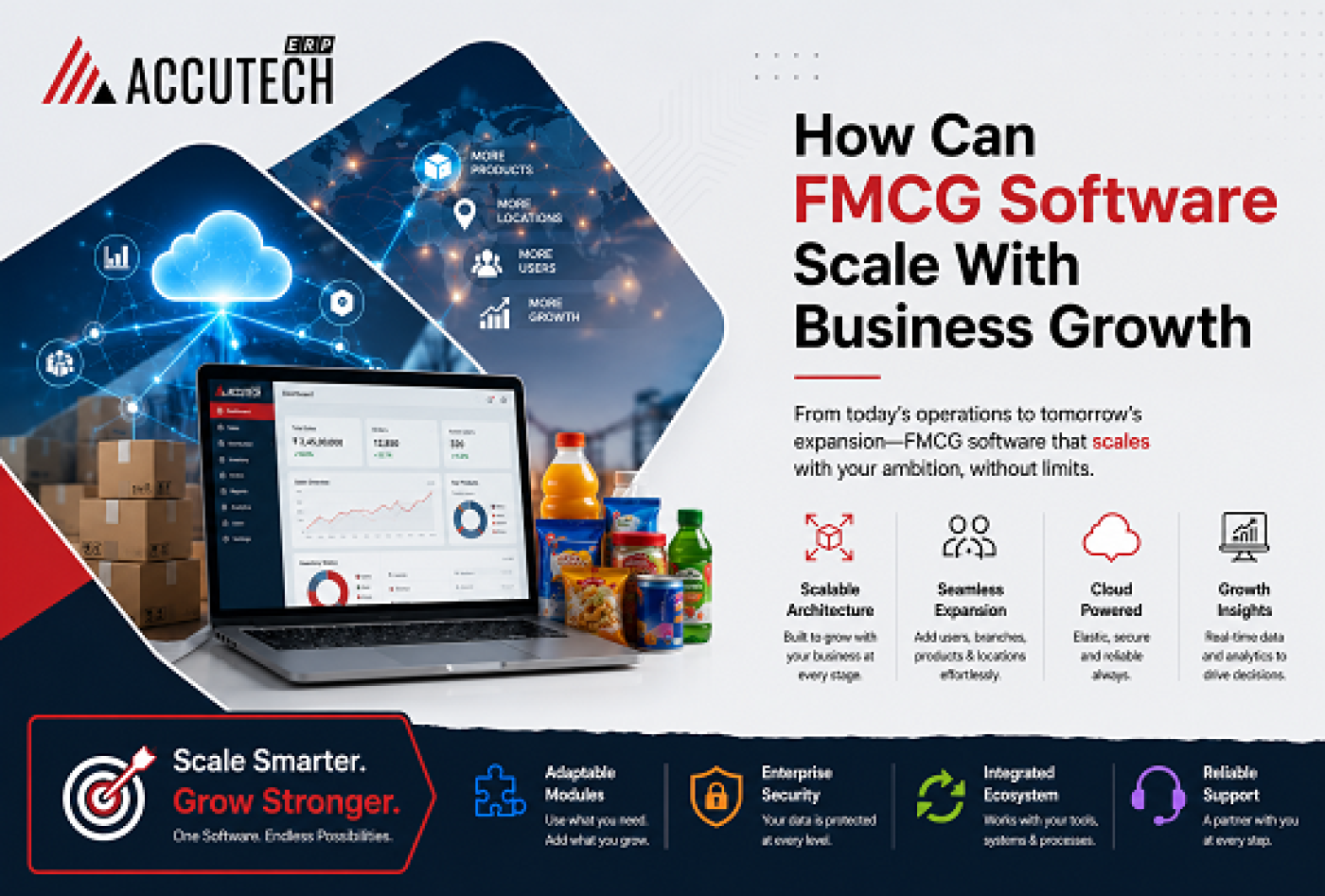
Here is what separates companies that scale successfully from those that hit ceilings: they chose FMCG management software built on scalable architecture from day one. In this comprehensive guide, I will explain exactly how FMCG ERP software enables smooth, sustainable business growth without requiring system replacements or disruption.
Understanding Scalability: Why It Matters for FMCG Distributors
Before we dive into how scaling works, let us clarify what scalability actually means in the context of FMCG software.
Scalability is not just about handling more data. It is about:
- Performance maintenance: Your system stays fast even with 10x more transactions
- User expansion: Adding 50 new salespeople does not require re-architecture
- Geographic expansion: Managing operations across 10 states is as easy as one state
- Product complexity: Handling 1,000 SKUs feels the same as handling 10,000
- Process sophistication: Adding complex workflows does not slow the system
- Integration capacity: Connecting 20 systems works as smoothly as connecting two
The Cost of Scalability Failure
When software does not scale, the costs are significant:
- System replacement: 15-25 lakhs for new software plus implementation
- Data migration risk: Lost data, corruption, or inconsistencies that take months to fix
- Operational disruption: 2-3 months of chaos when you can least afford it
- Productivity loss: Your team relearning systems during your growth phase
- Missed growth opportunities: Revenue loss while dealing with system problems
This is why choosing FMCG distribution software with scalability built in matters so much.
Scalability Factor #1: Cloud Architecture Enables Growth
The foundation of truly scalable FMCG software is cloud architecture.
What This Means
Cloud-based FMCG ERP software runs on distributed servers that automatically handle increasing demand. Unlike on-premise systems with fixed hardware, cloud systems grow elastically.
When you onboard 100 new salespeople:
- Traditional system: You need to buy more servers, install hardware, configure networks. This takes weeks and costs 10+ lakhs.
- Cloud system: The cloud automatically allocates more computing resources. It happens instantly, no capital expenditure.
Real-World Impact
A beverage distributor in Gujarat expanded from 3 to 12 regional teams within 18 months. With their previous on-premise system, they would have faced system crashes, slow performance, and a 20 lakh server upgrade. With cloud-based FMCG distribution business software, the expansion happened transparently. No disruption. No additional infrastructure investment.
Scalability Factor #2: Database Optimization for Growing Data
As your business grows, your database explodes with data: millions of transactions, inventory records, customer interactions, and historical information.
How Scalable Systems Handle Data Growth
Leading FMCG management software employs sophisticated database optimization:
- Indexing strategies: Smart indexing ensures queries remain fast even with billions of records
- Data partitioning: Large datasets are split across multiple databases, maintaining query speed
- Archive automation: Older data moves to archives without affecting current system performance
- Caching layers: Frequently accessed data is cached, reducing database load
- Replication: Data is replicated across servers ensuring no single point of failure
The result: Your system runs at the same speed whether you are managing 100 SKUs or 100,000 SKUs, whether you have 10 orders per day or 10,000.
Scalability Factor #3: Multi-Tenancy Architecture
This is a feature that separates truly scalable FMCG software from systems that merely claim to be scalable.
What Multi-Tenancy Means for Growth
Multi-tenancy means the software efficiently serves multiple users, warehouses, and even different companies from shared infrastructure without compromising isolation or security.
This enables you to:
- Add new warehouses instantly without re-deployment
- Support multiple subsidiaries or brands from one system
- Manage geographic expansion without technical complications
- Implement different business rules for different locations while maintaining data integrity
Practical Example
A snack manufacturer with brands sold through different distribution channels needed one system to handle: direct distribution, retail chains, e-commerce, and wholesale. Multi-tenant architecture let them manage all channels with different pricing, processes, and reporting from one platform. Growth from one channel did not impact others.
Frequently Asked Questions
Q1: At what point does my business outgrow FMCG management software?
With truly scalable FMCG ERP software, this rarely happens. Distributors operate at 100+ crore turnover with 10,000+ SKUs and 500+ salespeople on the same system. You will not outgrow it.
Q2: Does scaling slow down the system for existing users?
No. Proper cloud architecture ensures that adding new users, locations, or data does not impact existing users. Performance actually improves as the system distributes load across more servers.
Q3: Can FMCG distribution software handle merger or acquisition scenarios?
Yes. Multi-tenancy and data partitioning let you integrate another distributor's data into one system. This enables unified operations post-acquisition without building new infrastructure.
Q4: What happens if I need to migrate to a different system later?
Scalable FMCG distribution business software exports data in standard formats. APIs enable data extraction. You are never locked in, though migration is rarely needed.
Q5: Does scalability come with hidden costs?
With properly structured cloud systems, no. Fixed monthly subscription covers unlimited users, unlimited transactions, unlimited data growth. No surprise scaling costs.
Q6: How do I know if FMCG software is truly scalable?
Ask: Are they cloud-based? Do they use micro services? Do they have customers at 10x your size? Ask for performance benchmarks. Call existing customers. True scalability is verifiable.
Q7: Does my data remain secure as the system scales?
Scalable systems use enterprise-grade security: encryption, multi-factor authentication, regular audits, and compliance certifications. Scaling does not compromise security.
Q8: What about data backup and disaster recovery at scale?
Scalable cloud systems automatically backup across multiple geographic locations. Disaster recovery is built-in. You do not manage this.
The Bottom Line:
Your business is going to grow. The question is not if, it is how fast and when. The FMCG management software you choose today either enables that growth or constrains it.
Truly scalable FMCG ERP software built on cloud architecture, micro services design, and proven performance optimization grows with your business. You will not outgrow it. You will not face system replacements. You will not experience the disruption that plagues businesses that chose poorly.
The distributors winning in 2026 are not those with the best software at their current size. They are those with software that scales with their ambitions. Make that choice today.