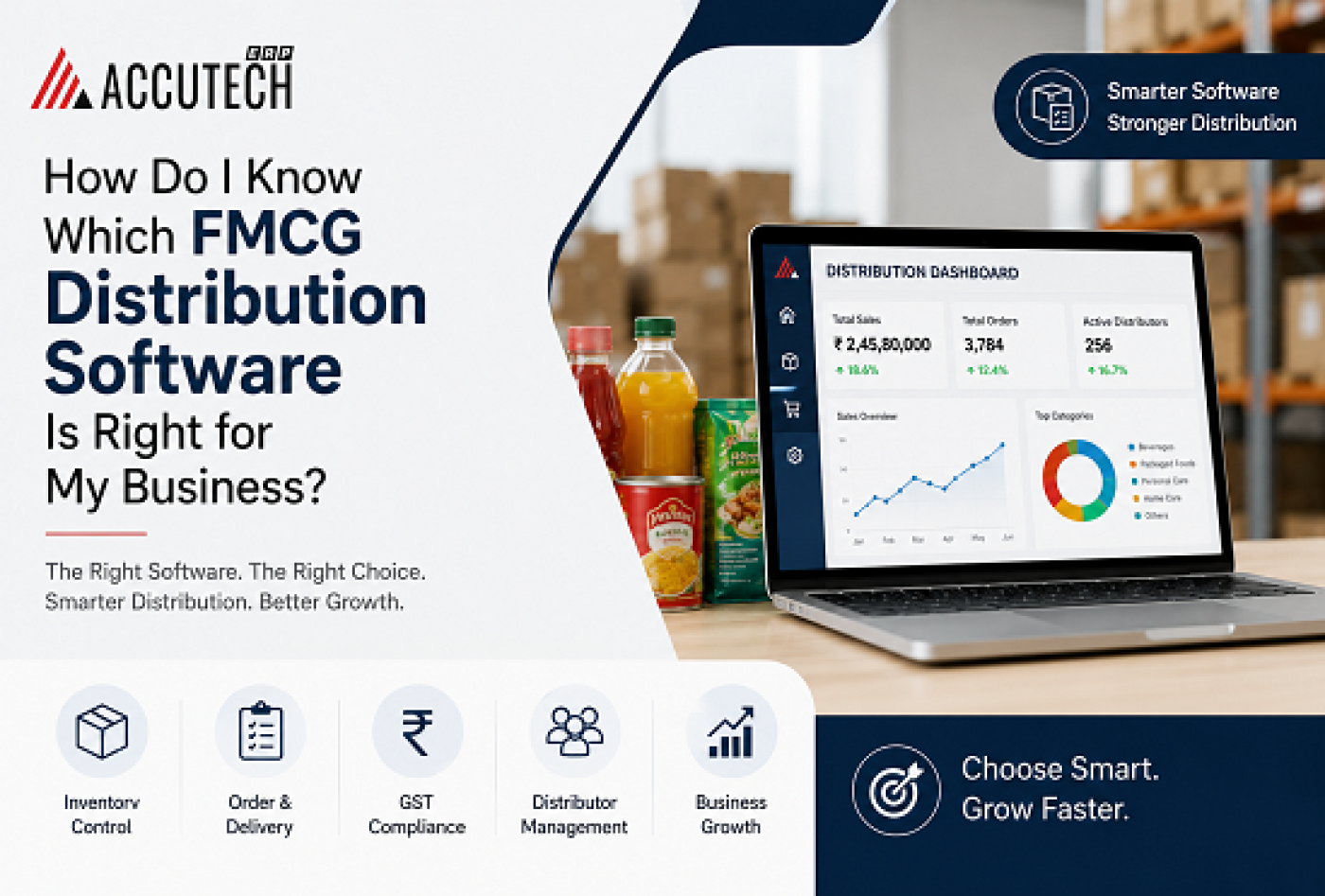
Fast-moving consumer goods distributors operate in one of the most competitive industries today. From managing high-volume inventory to coordinating multiple distribution channels, the challenges are immense. This is where FMCG Distribution ERP Software can play an important role in improving business efficiency.
A specialized distribution ERP is designed for businesses operating in the fast-moving consumer goods sector. Unlike generic systems, fmcg distribution business software is built around challenges such as rapid inventory turnover, multiple SKUs, complex pricing structures, GST compliance, distributor networks, and multi-location operations.
Implementing the right distributor management system for fmcg can transform daily operations by reducing manual work, improving stock visibility, simplifying order processing, and giving management better control over business performance.
Core Components of FMCG Distribution Software
- Inventory Management: Real-time stock tracking across warehouses, automated reorder levels, batch management, and expiry monitoring.
- Sales and Order Management: Faster order processing, invoicing, dispatch planning, and delivery tracking.
- Financial Accounting: Integrated receivables, payables, ledgers, reconciliation, and financial reporting.
- Compliance and Reporting: GST-ready invoicing, statutory reports, and compliance support.
- Distribution Management: Better control over distributors, routes, field sales teams, and last-mile operations.
Why Choosing the Right Software Matters for Your FMCG Business
Selecting the right solution should not be taken lightly. The software you choose can either simplify operations and support growth or create unnecessary complexity if it does not match your processes.
Operational Efficiency
A well-selected distribution platform automates repetitive activities such as billing, stock updates, order entry, payment tracking, and reporting. The right FMCG distribution erp software can reduce duplicate data entry and provide real-time visibility across departments.
This allows employees to spend less time on routine administrative work and more time on sales, customer service, collection follow-ups, and business development.
Cost Reduction
A properly implemented system can reduce operational waste by improving inventory planning, minimizing stock mismatches, reducing pilferage, and helping businesses control logistics and warehousing expenses.
With good fmcg distribution business software, management can identify unnecessary costs, slow-moving products, excess inventory, and inefficient processes more quickly.
Scalability and Growth
Your software should be able to grow with your business. A suitable distributor management system for fmcg should support additional branches, warehouses, users, distributors, product categories, and geographic markets without forcing you to replace the entire platform.
Scalability is especially important for distributors planning to expand into new cities, states, or distribution channels.
Data-Driven Decision Making
Modern distribution systems provide dashboards and reports that help management understand sales trends, customer behavior, inventory movement, outstanding payments, product profitability, and branch performance.
Access to accurate and timely information makes it easier to make faster and more informed business decisions.
Essential Features in FMCG Distribution Software
When evaluating software options, focus on the features that directly affect your business operations rather than choosing a platform only because it offers a long feature list.
Real-Time Inventory Management
Real-time stock visibility is essential for distributors dealing with hundreds or thousands of SKUs. Your system should track inventory across multiple warehouses and provide batch-wise, expiry-wise, and location-wise information.
The right FMCG Distribution ERP Software should also help with reorder planning, stock transfers, damaged goods, sales returns, purchase returns, and slow-moving inventory analysis.
Multi-Location Support
Growing distributors often operate from multiple branches, godowns, or distribution centers. The system should provide centralized control while allowing location-specific access and reporting.
A good platform should make it possible to view both branch-level and consolidated business performance.
GST Compliance Automation
The system should support GST-compliant billing, tax calculations, HSN-based taxation, e-invoicing, e-way bills where applicable, and relevant GST reports.
Reliable fmcg distribution business software can reduce manual compliance work and lower the risk of incorrect tax calculations or reporting errors.
Mobile Access and Field Operations
Sales representatives and field teams should be able to access customer information, stock availability, outstanding balances, product pricing, and order status while working outside the office.
Mobile access can also help improve order accuracy and reduce delays between order collection and processing.
Advanced Reporting and Analytics
Look for customizable reports covering sales, purchase, inventory, margins, outstanding payments, customer performance, salesperson performance, product movement, and cash flow.
A good reporting system should allow users to drill down from summary figures into transaction-level details.
Assessing Your Specific Business Requirements
Before comparing vendors, conduct a detailed internal assessment. No two FMCG distributors operate in exactly the same way, so your software selection should reflect your specific business model.
Step 1: Document Your Current Processes
Map your current processes from purchasing and inward stock to sales orders, billing, dispatch, collections, returns, and financial reporting.
Identify bottlenecks, duplicate work, manual Excel dependencies, stock mismatches, delayed reports, and areas where employees repeatedly enter the same information.
This document can become the foundation of your software requirement list.
Step 2: Define Your Business Objectives
Decide what you want the new system to achieve. Your goals may include:
- Reducing order processing time
- Improving stock accuracy
- Expanding into new markets
- Controlling outstanding payments
- Improving salesperson productivity
- Reducing manual accounting work
- Strengthening GST compliance
The best distributor management system for fmcg is not necessarily the one with the most features; it is the one that best supports your most important business objectives.
Step 3: Evaluate Your Organizational Capabilities
Consider your team's technical comfort, internal IT support, data quality, and willingness to adopt new workflows.
If your organization has limited technical resources, prioritize software with reliable implementation assistance, training, and ongoing support.
Financial Considerations: Cost and ROI Analysis
Cost is important, but the cheapest system is not always the most economical option. Evaluate the total cost of ownership rather than only the initial subscription or license amount.
Understanding Implementation Costs
Your budget may include:
- Software subscription or license fees
- Initial setup and configuration
- Data migration
- Integration with existing systems
- User training
- Custom reports or workflows
- Annual maintenance or support
- Additional users, branches, or modules
When evaluating FMCG Distribution ERP Software, ask vendors to clearly explain which services are included and which are charged separately.
Calculating Return on Investment
Measure expected benefits such as:
- Reduction in manual data entry
- Improved inventory turnover
- Lower stock carrying costs
- Faster billing and collections
- Reduced order errors
- Better control over discounts and margins
- Lower compliance workload
- Improved management reporting
Good fmcg distribution business software should create measurable improvements in productivity and control, not simply digitize existing inefficient processes.
Implementation and Vendor Support Considerations
Even strong software can fail if implementation, migration, training, or support is poor. Vendor capability is therefore as important as product functionality.
Implementation Methodology
Ask whether the vendor follows a structured implementation process that includes:
- Requirement study
- Process mapping
- Configuration
- Data migration
- User testing
- Training
- Go-live support
- Post-implementation review
A well-planned implementation reduces disruption and helps users adopt the system more confidently.
Vendor Support Structure
Evaluate response times, support channels, escalation procedures, availability during critical business hours, and whether the vendor provides dedicated implementation or account support.
A reliable distributor management system for fmcg should be backed by a support team that understands distribution workflows, not just technical troubleshooting.
Training and Knowledge Transfer
Training should cover day-to-day users as well as managers and administrators. Ask whether the vendor provides live training, recorded tutorials, documentation, refresher sessions, and support for new employees.
Strong training improves adoption and reduces dependency on vendor support for basic tasks.
Common Mistakes to Avoid When Choosing Fmcg Distribution Software
Mistake 1: Prioritizing Cost Over Functionality
Choosing software only because it is cheap can result in missing features, excessive manual work, poor reporting, weak support, and expensive custom development later.
Focus on overall business value rather than only the initial price.
Mistake 2: Ignoring Scalability Requirements
Do not select software only for your current business size. Consider your expected growth in branches, warehouses, users, customers, transactions, and product categories.
A scalable platform should support expansion without forcing a disruptive migration.
Mistake 3: Overlooking User Adoption
Even advanced software will fail if employees find it difficult to use. Evaluate the interface, speed, navigation, workflow simplicity, and training requirements before making a final decision.
Mistake 4: Insufficient Due Diligence
Do not rely only on sales presentations. Ask for demonstrations using your actual workflows and request references or case studies from similar businesses.
When comparing FMCG Distribution ERP Software, test practical scenarios such as sales returns, schemes, multi-pack products, stock transfers, rate management, outstanding collections, and GST reporting.
Mistake 5: Failing to Plan for Change Management
New systems often change existing responsibilities and workflows. Explain the benefits clearly to employees, involve key users during evaluation, and provide enough training before go-live.
This makes the transition smoother and reduces resistance.
Frequently Asked Questions
Q1: What is the typical implementation timeline?
Implementation time depends on business size, data volume, customization, number of branches, and integration requirements. Smaller businesses may go live relatively quickly, while complex multi-location organizations generally need a longer phased implementation.
Q2: Can the software integrate with my existing systems?
Most modern platforms offer APIs or integration options for accounting tools, e-commerce platforms, payment gateways, CRM systems, e-invoicing services, and other business applications.
Before purchasing, ask the vendor to confirm integration support for the exact applications you use.
Q3: How does the system handle multi-level distributor networks?
A capable distributor management system for fmcg can use branch structures, user permissions, customer hierarchies, territory mapping, and separate reporting to manage complex distribution networks.
It should also provide consolidated reporting for management while maintaining operational control at individual locations.
Q4: What are the key differences between cloud and on-premise solutions?
Cloud solutions generally offer easier access, faster deployment, lower infrastructure requirements, and automatic updates. On-premise systems may provide more direct infrastructure control but typically require greater internal IT management.
The right choice depends on your security policies, internet availability, customization needs, and internal technical resources.
Q5: How does GST compliance work?
Modern systems can automate tax calculation based on transaction type, product classification, customer location, and applicable GST rules.
They may also support GST-related reporting, reconciliation, e-invoicing, and e-way bill workflows depending on the solution.
Q6: Can I customize the software for my unique business processes?
Many platforms support configuration of workflows, reports, permissions, pricing rules, product structures, and approval processes.
However, excessive customization should be avoided where standard configuration can meet the requirement, because heavy customization can increase implementation cost and future upgrade complexity.
Q7: What training and support do vendors typically provide?
Support may include live training, online sessions, knowledge bases, video tutorials, documentation, ticketing systems, phone support, and implementation assistance.
When comparing fmcg distribution business software, check exactly what is included in the package and whether additional training is chargeable.
Q8: How do I measure success after implementation?
Define KPIs before go-live, such as:
- Inventory accuracy
- Order processing time
- Billing speed
- Sales return percentage
- Outstanding collection days
- Stock turnover
- User adoption
- Manual entries reduced
- Reporting turnaround time
Compare these metrics before and after implementation to measure improvement.
Q9: What security measures should the software have?
Look for role-based access control, secure authentication, encrypted data transmission, regular backups, activity logs, disaster recovery processes, and appropriate data protection measures.
Ask cloud vendors where data is hosted, how backups are managed, and what security practices are followed.
Q10: How frequently should the software receive updates?
Update frequency varies by vendor. Cloud platforms may receive regular feature improvements, tax updates, bug fixes, and security patches without requiring manual installation.
Ask vendors how updates are communicated, tested, and deployed.
Conclusion:
Choosing the right distribution software is a major business decision because it affects inventory, billing, accounting, sales, compliance, reporting, and management visibility.
A good evaluation process should consider functionality, scalability, usability, implementation capability, support quality, integration options, security, and total cost of ownership.
Keep these points in mind:
- Match the software to your actual business processes and growth plans.
- Compare functionality and long-term value, not only price.
- Involve key employees in demonstrations and testing.
- Prioritize scalable architecture and strong support.
- Define measurable KPIs before implementation.
- Test important business scenarios before signing the contract.
The right FMCG Distribution ERP Software can provide a single platform for inventory, sales, accounting, reporting, and distribution operations. A suitable distributor management system for fmcg can also improve visibility across branches and sales channels, while dependable fmcg distribution business software can simplify daily operations and support better management control.
Accutech ERP offers a comprehensive solution designed to help FMCG distributors streamline operations, improve inventory visibility, simplify accounting and compliance, and manage business growth from a centralized platform. By choosing Accutech ERP, distributors can gain better control over day-to-day operations and make faster, data-driven business decisions.