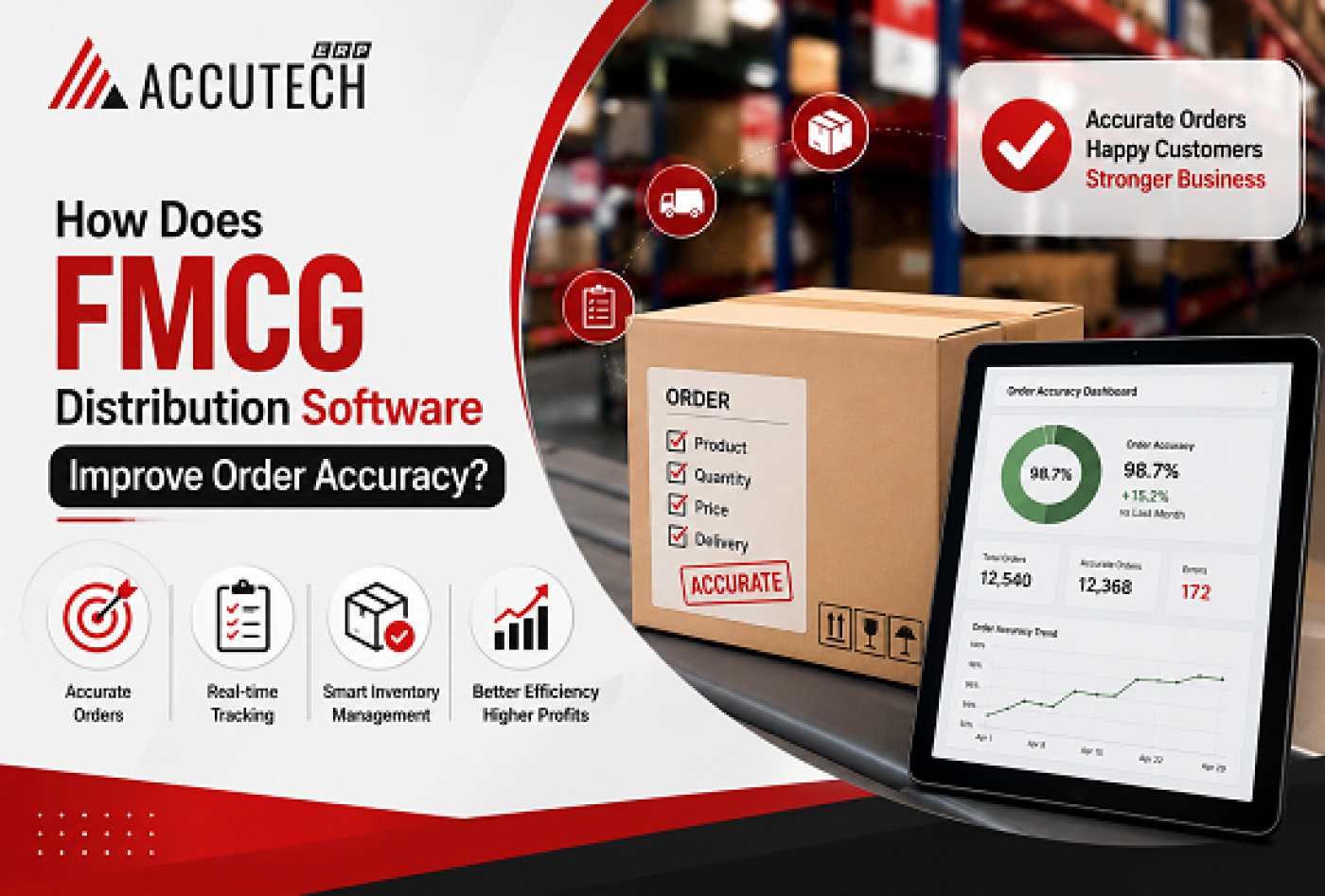
In the fast-paced world of Fast-Moving Consumer Goods (FMCG) distribution, a single order error can cascade into multiple problems. A wrong product shipped to a retailer doesn't just disappoint the customer it disrupts inventory levels, damages brand reputation, and erodes profit margins. For FMCG distribution companies managing thousands of orders daily across multiple branches, manual processes simply cannot keep up with accuracy demands.
Recent industry data shows that without proper systems, FMCG distribution networks experience order error rates between 3-7%. This might seem small, but when you're handling tens of thousands of orders monthly, even a 2% error rate translates into hundreds of mistakes each costing time, money, and customer trust.
This is where FMCG distribution software and enterprise resource planning (ERP) systems become game-changers. Modern FMCG distribution ERP software doesn't just streamline operations; it fundamentally transforms how businesses handle orders, reducing error rates to below 1% while simultaneously improving speed and efficiency.
In this comprehensive guide, we'll explore exactly how FMCG management software achieves this transformation, what features make the difference, and how your business can implement these solutions to achieve near-perfect order accuracy.
Understanding Order Accuracy in FMCG Distribution
Before diving into solutions, it's critical to understand what order accuracy truly means in the context of FMCG distribution.
Order accuracy encompasses several interconnected dimensions:
- Product Accuracy: Ensuring the correct product SKU is picked and shipped, not a similar or substitute item.
- Quantity Accuracy: Verifying that the exact ordered quantity matches what's packed and delivered.
- Delivery Accuracy: Confirming that orders reach the correct destination on schedule.
- Documentation Accuracy: Ensuring invoices, barcodes, and delivery notes match the shipment contents.
- Billing Accuracy: Verifying that customer invoices reflect exact products, quantities, and agreed pricing.
Why Traditional Manual Processes Fail
Consider a typical day in a distribution warehouse relying on manual processes:
- Orders arrive in various formats: phone calls, emails, handwritten notes, and verbal.
- Staff manually enter order details into spreadsheets, introducing transcription errors.
- Pickers navigate physical warehouse locations, relying on memory and paper lists.
- Quantities are verified by eye, not weight, enabling subtle quantity mismatches.
- Invoicing is done separately, often hours or days after shipment, creating reconciliation nightmares.
The Hidden Costs of Order Errors
Understanding the true impact of order inaccuracies helps justify the investment in proper FMCG distribution business software:
Direct Financial Impact
Each order error requires correction, restocking, reshipment, credit notes, and administrative overhead. A single error might cost ₹500-2,000 to resolve. With thousands of orders daily, these costs multiply rapidly.
Customer Relationship Damage
Retailers losing inventory visibility due to incorrect shipments cannot meet their own customer commitments. This erodes trust and can result in lost customers to competitors.
Operational Inefficiency
Staff spend hours resolving order disputes, tracking misshipments, and managing returns instead of processing new orders.
Compliance and Regulatory Issues
In India's FMCG sector, GST regulations require precise documentation. Order errors create compliance risks and potential penalties.
How FMCG Distribution Software Improves Order Accuracy
Modern FMCG distribution ERP software eliminates error points by automating the entire order lifecycle. Here's how:
1. Real-Time Order Capture and Validation
Orders enter the system through standardized digital channels, online portals, mobile apps, or integrated EDI connections. The moment an order is placed, the software instantly validates it against:
- Current stock levels reject orders for out-of-stock items before they reach the warehouse.
- Customer credit limits and payment status.
- Product-customer compatibility (preventing restricted goods from going to unauthorized retailers).
- Pricing agreements and applicable discounts.
Result: Invalid orders are caught before warehouse staff even see them, eliminating a massive source of errors.
2. Intelligent Inventory Management Integration
The software maintains real-time visibility of inventory across all warehouses and branches. When an order is received:
- The system automatically reserves stock items, preventing overselling.
- It tracks inventory at multiple levels by batch, expiry date, and location ensuring FIFO (First In, First Out) compliance.
- It flags slow-moving or near-expiry stock, preventing accidental shipment of obsolete products.
- For multi-location businesses, it automatically selects the optimal warehouse location for fulfillment based on proximity, stock levels, and capacity.
3. Automated Picking and Packing Workflows
This is where order accuracy transforms dramatically. Instead of pickers using paper lists and manual verification:
- Mobile barcode scanners guide each picker to exact warehouse locations, displaying what quantity to pick.
- Scanners verify each item before picking if a picker scans the wrong product, the device immediately alerts them.
- Packed items are weighed automatically, comparing actual weight to expected weight based on product specifications. Any variance triggers a recheck.
- Final quality checks scan all items again against the order requirements before sealing the package.
4. Integrated Billing and Documentation
One of the most common sources of confusion in FMCG distribution is discrepancies between physical shipments and documentation. Modern FMCG distribution software links everything together:
- Invoices are automatically generated the moment an order is confirmed, matching exactly what was ordered.
- Packing slips, barcode labels, and delivery notes all pull from the same order record, ensuring consistency.
- GST calculations are automatically applied based on product classifications and customer location.
- Delivery personnel have real-time access to complete shipment details on mobile devices, allowing instant verification at customer locations.
5. Proactive Exception Management
Quality FMCG management software doesn't just prevent obvious errors it catches subtle issues before they become problems:
- Alerts when an order quantity seems unusual compared to customer's historical ordering patterns.
- Notifications if products in an order are typically ordered together but one is missing.
- Warnings if multiple orders to the same customer have identical quantities and products (potential duplicate entry).
- Automated quality scoring for each order before shipment.
Key Features That Drive Order Accuracy
When evaluating FMCG distribution software or ERP systems, look for these critical features:
Advanced Inventory Tracking
The software should track inventory at multiple dimensions: by SKU, batch number, manufacturing date, expiry date, warehouse location, and shelf. This multi-dimensional tracking prevents critical errors like shipping expired products or confusing similar items.
Multi-Channel Order Integration
Whether orders arrive via phone, mobile app, EDI, or marketplace integrations, they should all flow into a single unified system. This eliminates the transcription errors that plague businesses managing multiple order channels separately.
Real-Time Analytics Dashboards
Managers need live visibility into order accuracy metrics. Dashboards should display order error rates by product, customer, warehouse, and shift. This enables quick identification and correction of emerging accuracy problems.
Automated Reconciliation
The system should continuously compare what was ordered, what was picked, what was packed, what was shipped, and what the customer received. Discrepancies are flagged automatically for investigation.
Mobile Field Operations
Delivery teams need mobile access to shipment details with the ability to verify contents with customers in real-time using barcode scanning. This catches errors before products leave the warehouse.
Real-World Benefits and Case Studies
The impact of implementing proper FMCG distribution ERP software is quantifiable and dramatic.
Order Accuracy Improvement: 85% → 99.2%
A beverage distributor managing operations across 15 warehouses implemented integrated FMCG distribution software. Within 90 days, order error rates dropped from 3.2% to 0.8%, a 75% reduction. This eliminated over 200 erroneous orders per month that previously required rework.
Processing Speed: 4 hours → 45 minutes
A snacks manufacturer previously required 4 hours from order receipt to shipment due to manual data entry and verification steps. After implementing FMCG management software with automated workflows, the same process now takes 45 minutes, enabling same-day delivery for most orders.
Cost Reduction: ₹12 lakhs → ₹2.5 lakhs annually
A FMCG distributor calculated that order errors cost approximately ₹12 lakhs annually in rework, customer credits, and administrative overhead. With proper software implementation, this dropped to ₹2.5 lakhs—a 79% reduction that paid for the software investment in under a year.
Best Practices for Maximizing Order Accuracy
Even the best FMCG distribution software requires proper implementation and ongoing discipline to achieve maximum accuracy.
1. Comprehensive Initial Data Setup
Before going live, invest time in establishing accurate master data:
- Product master data with accurate SKUs, descriptions, specifications, and variants.
- Customer data with correct delivery addresses, billing addresses, credit limits, and pricing agreements.
- Warehouse location mapping with accurate bin numbers and capacity limits.
- Initial inventory counts reconciled with physical warehouse verification.
2. Staff Training and Change Management
The best software requires skilled users. Ensure comprehensive training on:
- How to use barcode scanners correctly and troubleshoot issues.
- Understanding why verification checkpoints exist and how they prevent errors.
- Best practices for mobile device handling in warehouse environments.
3. Continuous Quality Monitoring
Even with automated systems, ongoing vigilance is essential:
- Review order accuracy reports weekly, identifying patterns in errors.
- Conduct random quality audits of packed orders before shipment.
- Track customer complaints and feedback, tracing them back to specific system or process issues.
4. Integration with Customer Feedback Loops
Connect customer feedback directly to the software system so that common issues are identified and addressed systematically rather than being addressed on a case-by-case basis.
Common Mistakes in Order Management
Even with modern FMCG distribution software, companies often make preventable mistakes:
Incomplete Master Data Setup
Rushing implementation without properly setting up product master data, customer records, or warehouse locations results in errors that persist throughout the system's life. Invest time in data quality upfront.
Ignoring Validation Rules
Some teams bypass system validations to 'speed up' processing. This defeats the entire purpose of the software. Validation rules exist to prevent errors.
Inadequate User Training
Even excellent FMCG management software fails if users don't understand how to use it correctly. Invest in ongoing training and support.
Failing to Reconcile Regularly
Discrepancies between ordered, picked, and received quantities must be investigated immediately. Letting them accumulate creates systemic inaccuracies.
Implementation Strategy
Successfully implementing FMCG distribution ERP software requires a structured approach:
Phase 1: Assessment and Planning (Weeks 1-4)
Map your current order processes, identify pain points, and establish baseline accuracy metrics. This provides a clear before/after benchmark.
Phase 2: Configuration and Data Setup (Weeks 5-12)
Configure the software for your business model, import master data, and validate accuracy. This is not the phase to cut corners.
Phase 3: Pilot Implementation (Weeks 13-16)
Launch with one warehouse or one customer segment. This allows you to identify issues without massive operational disruption.
Phase 4: Training and Rollout (Weeks 17-20)
Train all users intensively during the pilot phase, then expand to full deployment. Provide continuous support during this critical transition period.
Phase 5: Monitoring and Optimization (Ongoing)
Establish continuous monitoring with weekly accuracy reports, monthly process reviews, and quarterly optimization initiatives.
Frequently Asked Questions
Q1: What percentage of order errors can FMCG distribution software typically eliminate?
Quality FMCG distribution ERP software can reduce order errors by 90-95%. Most companies see error rates drop from 2-5% to under 1% within 90 days of proper implementation. The remaining errors are typically due to data entry issues or customer specification changes that occur after order placement.
Q2: How does barcode scanning improve order accuracy?
Barcode scanning creates multiple verification checkpoints throughout the order fulfillment process. When a picker scans a product, the system confirms it's the correct item for that order. When weight verification scans the final package, it ensures the quantity is correct. This systematic verification catches nearly all errors before shipment.
Q3: Can FMCG distribution software integrate with existing customer systems?
Yes, modern FMCG distribution software like Accutech ERP's system supports EDI integration, API connections, and multi-channel order intake. This means you can receive orders from customer ordering systems directly without manual data entry.
Q4: How does real-time inventory visibility prevent order errors?
Real-time inventory tracking prevents orders from being placed for products that are actually out of stock. It also automatically reserves stock when orders are confirmed, preventing the same inventory from being allocated to multiple orders. This ensures every order placed can be fulfilled exactly as promised.
Q5: What is the ROI timeline for implementing FMCG distribution software?
Most companies achieve ROI within 12-18 months through eliminated rework costs, reduced labor in order processing, and improved customer retention. Some achieve it faster (6-9 months) if they had very high error rates before implementation. The key is measuring both direct costs (rework, credits) and indirect costs (customer satisfaction, labor hours).
Q6: How does FMCG management software handle GST compliance in order accuracy?
The software automatically applies correct GST classifications based on product type and customer location, calculates taxes accurately, and generates compliant invoices and HSN reports. This eliminates the most common cause of GST audit issues incorrect tax treatment on invoices.
Q7: Can small FMCG distributors benefit from this technology?
Absolutely. While larger distributors benefit more from advanced features like multi-warehouse optimization, even small distributors with 500-1000 orders monthly see dramatic improvements. Cloud-based FMCG distribution software makes it affordable for businesses of all sizes.
Q8: What happens when a customer receives an incorrect order despite using the software?
Quality FMCG distribution ERP software captures full transaction history and exactly what was verified at each step. This creates a complete audit trail showing where the error occurred (order entry error, picking error, etc.) and enables root-cause analysis to prevent future recurrence.
Q9: How does automated order validation improve accuracy before warehouse processing?
As soon as an order is placed, the system validates it against product availability, customer credit status, pricing agreements, and business rules. Invalid orders are rejected automatically or flagged for review before reaching warehouse staff. This catches problems at the source rather than during fulfillment.
Q10: How should businesses measure order accuracy improvement after implementing FMCG distribution software?
Track metrics including:
1) Order accuracy rate (correct orders / total orders)
2) Error rate by type (picking errors, quantity errors, shipping errors)
3) Time from order receipt to shipment
4) Customer complaint rate related to order accuracy
5) Cost per error resolution.
These metrics should be monitored weekly and trended monthly to demonstrate improvement and identify emerging issues.
Conclusion:
In the competitive FMCG distribution landscape, order accuracy is no longer a nice-to-have; it's a competitive imperative. Customers expect accurate orders delivered on time, every time. Retailers facing their own inventory challenges cannot tolerate errors that disrupt their operations.
Modern FMCG distribution software and ERP systems have fundamentally changed what's achievable. By combining automated workflows, real-time visibility, intelligent validation, and comprehensive audit trails, these systems achieve order accuracy rates above 99% a level impossible with manual processes.
The implementation of proper FMCG distribution business software delivers benefits far beyond just accuracy improvements:
- Significantly faster order processing cycles (from days to hours)
- Lower operational costs through reduced rework and streamlined workflows
- Improved customer relationships built on reliable delivery
- Better financial control with accurate invoicing and GST compliance
- Enhanced management visibility through real-time dashboards
If you're still managing FMCG distribution with manual spreadsheets and paper processes, the opportunity to transform your operations is immense. The cost of inaction hidden in error rework, customer dissatisfaction, and operational inefficiency far exceeds the investment in proper software.
The future of successful FMCG distribution belongs to businesses that embrace technology to achieve near-perfect order accuracy while simultaneously improving speed and reducing costs.