Rajan had been running his FMCG distribution business for eleven years. He knew every nook of his warehouse, recognized every supplier’s handwriting on delivery slips, and could quote you his top-selling SKUs from memory. His team was loyal. His relationships were solid. And yet, every month, the same two problems followed him home like unwanted guests: stockouts that cost him clients, and overstocking that quietly drained his margins.
Then, in early 2025, a competitor two towns over quietly doubled their throughput. Same products. Same market. Half the team. The difference? They had adopted a modern FMCG distribution business software platform powered by artificial intelligence.
That story is playing out across India, Southeast Asia, and the entire global FMCG sector right now. And if you’re in distribution whether you manage 500 SKUs or 50,000 what’s happening in enterprise technology is directly relevant to your bottom line. This blog is your complete guide to understanding how AI is transforming inventory software for distributors, what the transition looks like on the ground, and what you need to ask before choosing a system.
Why FMCG Distribution Is Uniquely Difficult (And Always Has Been)
Before we talk about solutions, let’s talk honestly about the problem. FMCG distribution is arguably one of the most operationally complex businesses in existence. You’re dealing with perishable goods, razor-thin margins, high SKU counts, seasonal demand spikes, and a supply chain that stretches across dozens of vendors, vehicles, and retail points.
The Classic Pain Points That Never Go Away
- Demand forecasting errors: A missed prediction doesn’t just cost you a sale it costs you shelf space, customer trust, and sometimes the account entirely.
- Manual reconciliation nightmares: Distributors running on spreadsheets spend hours every week reconciling stock figures that should update automatically.
- Expiry and batch management: In FMCG, FEFO (First Expired, First Out) isn’t optional. It’s survival. Without software, enforcing it is nearly impossible at scale.
- Real-time visibility gaps: When your field team doesn’t know what’s in stock, they can’t promise accurate delivery timelines. Customer dissatisfaction follows.
- Returns and credit note chaos: Managing returns from retailers, coordinating credit notes, and updating ledgers in manual systems, this becomes a full-time job.
These aren’t problems that goodwill or hard work can solve. They require systems. And in 2026, those systems are increasingly powered by artificial intelligence.
What Exactly Is AI-Powered Distribution Software?
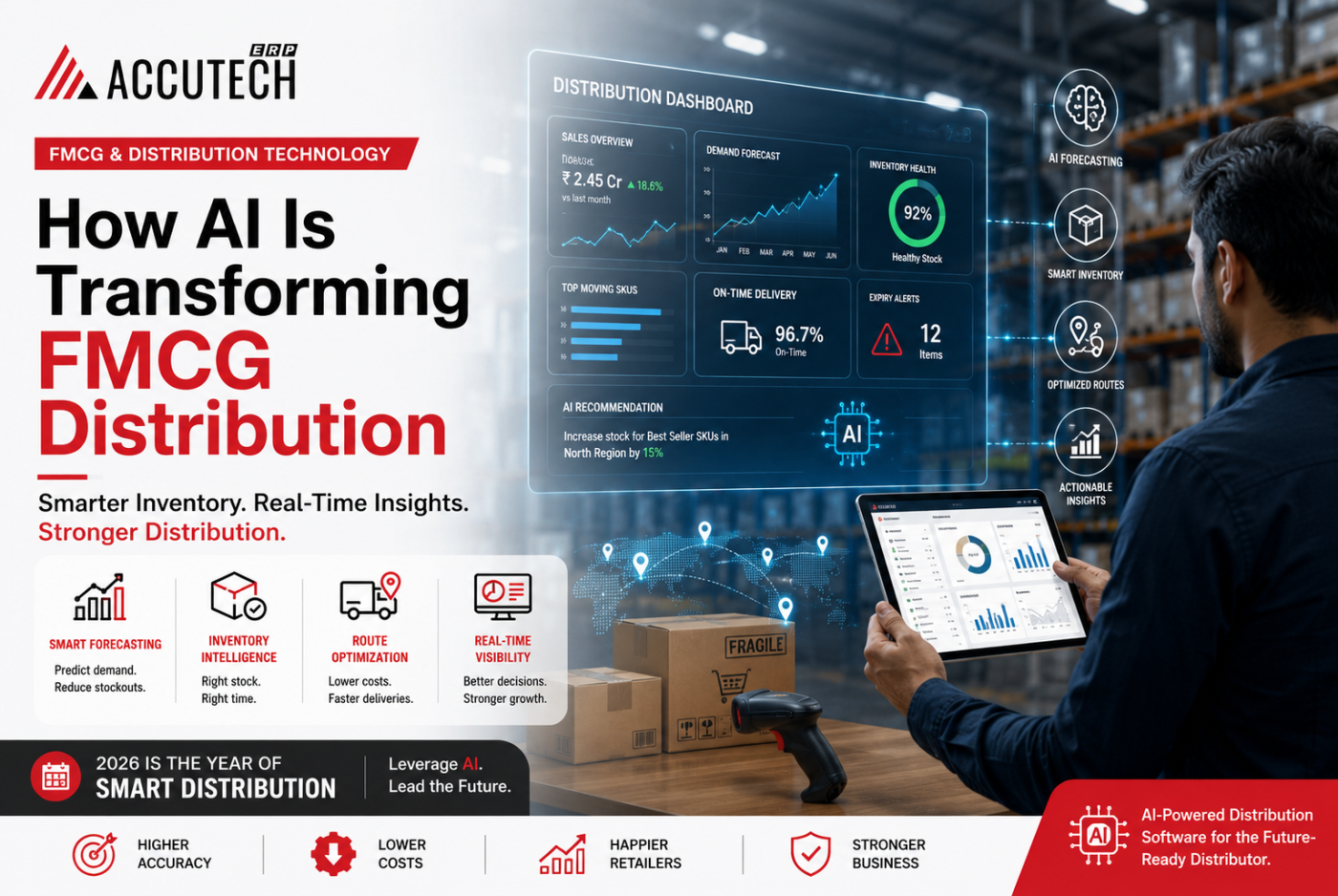
Let’s clear something up: AI in distribution ERP software doesn’t mean robots replacing your warehouse staff. It means intelligent algorithms running quietly in the background, learning from your business data, identifying patterns, and helping your team make better decisions faster.
Think of it this way: your traditional ERP records what happened. Your AI-powered distribution ERP software tells you what’s likely to happen next and recommends what to do about it.
Core AI Capabilities in Modern Distribution ERP
- Predictive Demand Forecasting: Machine learning models analyze historical sales, seasonality, market trends, and even weather patterns to generate accurate demand predictions.
- Intelligent Reorder Triggers: Instead of fixed reorder points, AI calculates dynamic reorder quantities based on real-time stock velocity.
- Automated Route Optimization: AI selects the most efficient delivery routes, reducing fuel costs and improving on-time delivery rates.
- Anomaly Detection: The system flags unusual stock movements, potential pilferage, or supplier inconsistencies before they become expensive problems.
- Smart Purchase Recommendations: Based on current inventory, pending orders, and predicted demand, the system recommends exactly what to order and when.
- Customer Behavior Analysis: AI identifies your most profitable accounts, flags at-risk relationships, and helps prioritize sales efforts.
The result is a distribution operation that doesn’t just react it anticipates. And in a market where your competitors are moving faster every quarter, that anticipation is worth more than almost any other business investment.
The State of AI in FMCG Distribution in 2026
If you’ve been skeptical about AI adoption in your industry, 2026 is the year to revisit that skepticism. According to multiple industry reports, more than 62% of mid-to-large FMCG distributors in Asia have adopted or are actively evaluating AI-integrated inventory software for distributors this year alone.
The shift has been accelerated by three major forces:
Force 1: Post-Pandemic Supply Chain Reckoning
The COVID-19 supply chain disruptions of the early 2020s exposed every weakness in manual distribution systems. Businesses that had relied on historical patterns found those patterns completely useless overnight. AI-powered systems, by contrast, were able to recalibrate forecasts much faster because they were built to learn from new data, not just old patterns.
Force 2: The Talent Crunch
Finding and retaining skilled distribution managers, logistics coordinators, and inventory specialists has become increasingly difficult. AI systems don’t replace people they make the people you have dramatically more effective, allowing smaller teams to manage larger operations.
Force 3: Margin Compression
FMCG margins have been under pressure for years. Rising logistics costs, retailer negotiation power, and competitive pricing have squeezed distributors from all sides. AI-powered optimization has become not a luxury but a survival tool, helping businesses identify and eliminate inefficiencies that were previously invisible.
AI Inventory Management: A Closer Look at How It Works
Let’s get practical. When we talk about AI inventory management in an FMCG context, what does the day-to-day experience actually look like?
Morning: Starting the Day with Intelligent Insights
In a traditional distribution setup, your warehouse manager begins the day by physically checking stock levels, reviewing yesterday’s dispatch notes, and making calls to suppliers. In an AI-powered system, they open a single dashboard that has already analyzed overnight data — flagging which SKUs are running low, which orders have priority status, and which delivery routes need re-sequencing.
This isn’t futuristic. This is what modern FMCG distribution business software looks like in practice today. The system does the legwork. Your team focuses on judgment calls.
Afternoon: Real-Time Adjustments
Halfway through the day, a large retail account places an unexpected bulk order. In a manual system, your team would scramble checking stock, calculating available inventory, adjusting pending orders. In an AI system, the software immediately checks available inventory, reserved stock, pending inbound shipments, and suggests whether to fulfill partially or delay pending a next-day restock. The decision still sits with your team. But the information they need arrives in seconds, not hours.
End of Day: Learning and Adapting
Perhaps the most powerful aspect of AI inventory management is what happens after closing. The system processes the day’s transactions, updates its demand models, refines its forecasts, and generates recommendations for tomorrow. Every single day, it gets marginally smarter about your specific business. After six months, you have a system that knows your distribution patterns better than any individual employee can.
Key Benefits of AI-Integrated Distribution ERP Software
Let’s talk numbers. Because at the end of the day, business decisions are driven by ROI and AI-powered distribution ERP software delivers measurable returns across multiple dimensions.
Benefit 1: Reduction in Inventory Carrying Costs
Overstocking is one of the most expensive silent drains in distribution. AI-driven demand forecasting consistently reduces excess inventory by 20–35% in documented case studies. When you’re carrying less stock, you’re freeing up working capital, reducing warehouse space requirements, and minimizing expiry losses all simultaneously.
Benefit 2: Improved Order Fulfillment Rates
Stockouts don’t just mean lost sales. They mean damaged relationships with retailers who are counting on you. AI-powered inventory software for distributors maintains optimal stock levels intelligently, dramatically reducing the incidence of stockouts. Businesses report fulfillment rate improvements of 15–25% after AI adoption.
Benefit 3: Faster Accounts Receivable Cycles
Modern FMCG distribution business software integrates billing, collections, and credit management. AI helps identify slow-paying accounts, automates payment reminders, and flags credit limit breaches in real time compressing your AR cycle and improving cash flow without requiring additional finance staff.
Benefit 4: Data-Driven Sales Decision Making
AI analytics reveal which products are growing, which are declining, which accounts are most profitable, and which territories are underperforming. This turns your sales strategy from gut-feel guesses into evidence-based decisions.
Benefit 5: Regulatory and Compliance Readiness
In regulated FMCG categories food, beverages, pharmaceuticals traceability is non-negotiable. AI-powered distribution ERP software maintains complete batch tracking, expiry monitoring, and audit trails automatically. Compliance stops being a burden and becomes a byproduct of normal operations.
Myths vs. Facts: Clearing the Air on AI in FMCG Distribution
Despite the clear benefits, many distribution business owners still hesitate. Usually, that hesitation is built on misconceptions. Let’s address them directly.
Myth 1: AI Is Only for Large Enterprises
Fact: Modern SaaS-based distribution ERP software is scalable and accessible to mid-size and even small distributors. Many platforms offer modular pricing, meaning you pay for the features you use. A distributor managing 500 SKUs can benefit from AI demand forecasting just as much as one managing 50,000.
Myth 2: Implementation Takes Years and Disrupts Operations
Fact: Cloud-based FMCG distribution platforms typically deploy in 4–12 weeks. Modern implementations use phased rollouts, meaning your business continues operating normally while the new system comes online gradually.
Myth 3: My Staff Will Struggle to Use It
Fact: Today’s AI inventory management platforms are designed with non-technical users in mind. Interfaces are increasingly conversational and intuitive not the complex green-screen systems of the past. Most teams adapt within 2–4 weeks with proper training.
Myth 4: Our Data Is Too Messy to Use AI
Fact: AI systems are specifically designed to handle imperfect, inconsistent data. In fact, they often help clean and standardize data as part of the onboarding process. The longer you wait, the more data you’re not collecting.
Myth 5: We’ll Lose Control of Our Business Decisions
Fact: AI in distribution ERP is a decision-support tool, not a decision-making replacement. Every recommendation can be reviewed, overridden, and adjusted by your team. You gain intelligence without giving up authority.
How to Evaluate FMCG Distribution Business Software in 2026
Not all distribution software is created equal. As AI features become a standard marketing claim, it’s important to ask the right questions before committing to a platform.
The 8-Point Checklist for Evaluating Distribution ERP Software
- Does the platform offer genuine AI-powered demand forecasting, or just static reorder-point alerts?
- Is the software cloud-based with mobile access for field sales and warehouse teams?
- Does the inventory software for distributors handle FEFO/FIFO batch tracking automatically?
- Is there a unified ledger that connects billing, inventory, and collections in real time?
- How does the platform handle multi-location warehousing?
- What integrations are available with GST billing, Tally, and third-party logistics?
- Does the vendor offer onboarding support and ongoing training?
- Is there a demo or trial period available to evaluate fit?
These questions protect you from platforms that label themselves AI-powered but simply have a slightly smarter reporting module. Genuine AI inventory management makes a qualitative difference to daily operations and you should be able to see that in any honest product demonstration.
Real-World Applications: What AI Looks Like in FMCG Distribution
Let’s move beyond theory and look at specific, real-world application areas where AI is already delivering measurable value for FMCG distributors in 2026.
Application 1: Seasonal Demand Planning
Festivals, school seasons, harvest periods FMCG demand is cyclical, but the cycles are never perfectly predictable. AI models that incorporate historical sales, regional event calendars, and social media trend data can now produce demand forecasts that are 40–60% more accurate than traditional methods. For a distributor managing cold beverages or confectionery, that accuracy translates directly to profit.
Application 2: Expiry Management at Scale
One of the most painful costs in FMCG distribution is product expiry. A smart FMCG distribution business software platform monitors every batch, calculates velocity, and proactively recommends promotional pricing or priority routing for near-expiry goods before they become write-offs.
Application 3: Salesman Productivity Optimization
AI systems can analyze salesperson performance by territory, product mix, visit frequency, and order conversion rates. This allows distribution managers to identify coaching opportunities, optimize territory allocation, and reward performance with precision rather than relying on anecdotal observations.
Application 4: Credit Risk Management
Offering credit to retailers is essential in FMCG distribution but managing that credit risk manually is a constant headache. AI can analyze retailer payment behavior, flag accounts approaching credit limits, and predict which accounts are likely to default, allowing your finance team to intervene proactively.
Application 5: Supplier Performance Tracking
Not all suppliers are equal. AI-powered distribution ERP software tracks on-time delivery rates, quality consistency, price changes, and fill rates across your entire supplier base surfacing this data in a way that makes procurement decisions objective rather than relationship-based.
The Human Side of the AI Transition
We’d be doing you a disservice if we talked only about technology without acknowledging the human dimension of this transition. Implementing new software especially AI-powered systems changes how people work. And change is hard, even when it’s clearly beneficial.
Managing Your Team Through the Transition
The most common source of resistance isn’t technical it’s psychological. Team members who’ve developed their value through years of manual expertise worry that AI makes them redundant. The best way to address this is to frame the technology shift accurately: AI handles the tedious, error-prone work so that your experienced people can focus on judgment, relationships, and strategy.
A warehouse manager who used to spend three hours reconciling stock figures can now spend those hours improving supplier relationships, coaching junior staff, or analyzing market opportunities. That’s not a demotion it’s a promotion.
Training Is Not Optional
Even the most intuitive inventory software for distributors requires proper training. Businesses that invest in structured onboarding role-specific training, practice scenarios, dedicated support contacts see adoption rates dramatically higher than those that simply install the software and expect teams to figure it out.
When evaluating vendors, always ask specifically about their onboarding and training methodology. It’s as important as the software itself.
Distribution ERP Software vs. Traditional Software: A Practical Comparison
|
Feature |
Traditional Software |
AI-Powered Distribution ERP |
|
Demand Forecasting |
Manual / Historical Average |
AI-driven, real-time, adaptive |
|
Inventory Alerts |
Fixed reorder points |
Dynamic, context-aware triggers |
|
Route Planning |
Manual or basic optimization |
AI-optimized, real-time adjustment |
|
Expiry Management |
Manual batch checks |
Automated FEFO with proactive alerts |
|
Sales Analytics |
Periodic reports |
Live dashboards with predictive insights |
|
Credit Management |
Manual review |
AI risk scoring & auto-alerts |
|
Data Entry |
High manual effort |
Automated with exception handling |
|
Scalability |
Limited, needs rework |
Cloud-native, infinitely scalable |
Wellness Parallels: Why Managing Your Business Health Is Like Managing Personal Health
Here’s an analogy that might resonate. Think about how people approach personal health. For years, we managed it reactively we went to the doctor when something went wrong. Then came preventive care: annual checkups, health monitoring, lifestyle adjustments based on data. Today, we have wearables that track heart rate, sleep, and blood pressure in real time flagging concerns before they become crises.
Business health follows the same evolution. Traditional software is the annual checkup it tells you what happened. AI inventory management is the continuous monitoring system it watches, learns, and alerts. The businesses that embrace this transition will be the ones still running strong ten years from now.
Your distribution business deserves the same proactive intelligence you’d want for your own body. The tools now exist. The question is whether you’re ready to use them.
Frequently Asked Questions
Q1: What is the best inventory software for distributors in India in 2026?
The best inventory software for distributors in 2026 combines real-time stock management, AI-driven demand forecasting, GST-compliant billing, multi-warehouse support, and mobile accessibility. Look for platforms built specifically for FMCG distribution workflows rather than generic ERP systems adapted for distribution. Platforms like Accutech ERP offer industry-specific features built for the Indian distribution market.
Q2: How does AI help in FMCG inventory management?
AI inventory management helps FMCG businesses by predicting demand with higher accuracy, automating reorder triggers, identifying slow-moving stock, flagging near-expiry batches, optimizing delivery routes, and analyzing salesperson and territory performance all in real time, continuously improving as more data accumulates.
Q3: What should I look for in distribution ERP software?
When evaluating distribution ERP software, prioritize: cloud deployment for remote access, AI-powered forecasting, batch and expiry tracking, GST integration, multi-location inventory management, real-time sales analytics, credit and collections management, and robust onboarding support.
Q4: Is FMCG distribution software expensive to implement?
Modern cloud-based FMCG distribution business software typically operates on a subscription model, making it accessible to businesses of various sizes. ROI is typically achieved within 6–12 months through inventory savings, improved order fulfillment, and reduced manual labor costs.
Q5: How long does it take to implement distribution ERP software?
Most mid-size distribution businesses complete a cloud-based ERP implementation in 4–10 weeks. Enterprise deployments with complex integrations may take 3–6 months. A phased implementation approach starting with core inventory and billing before adding AI modules typically delivers the fastest time to value.
Q6: Can small distributors use AI inventory management tools?
Absolutely. Many modern AI inventory management platforms offer modular pricing that scales with your business size. A distributor with 300 SKUs and a single warehouse can benefit from AI demand forecasting just as meaningfully as a large multi-location operation.
Practical Tips for a Successful FMCG Software Transition
Tip 1: Start With a Data Audit
Before selecting any platform, audit your existing data. How many SKUs do you carry? How is your current stock data recorded? What transaction history do you have? Clean, well-structured historical data makes AI adoption smoother and generates better insights faster.
Tip 2: Involve Your Team Early
Don’t make software decisions behind closed doors and then announce them to your team. Involve your warehouse manager, sales team, and finance staff in the evaluation process. Their buy-in dramatically improves adoption rates and they often identify requirements that decision-makers miss.
Tip 3: Define Success Metrics Upfront
Before going live, agree on what success looks like. Is it a 15% reduction in stockouts? Faster invoice processing? Improved collection days? Defined metrics allow you to track ROI objectively and motivate your team with tangible targets.
Tip 4: Don’t Rush the Parallel Run
Most experienced implementers recommend a parallel run operating your old and new systems simultaneously for 2–4 weeks. Yes, it’s extra work. But it catches discrepancies before they become crises and builds team confidence in the new system.
Tip 5: Commit to Continuous Learning
AI systems improve with use. The more consistently your team uses the platform entering data accurately, following recommended workflows, reviewing AI insights the smarter and more valuable the system becomes. Treat it as an ongoing investment, not a one-time purchase.
The Future of AI in FMCG Distribution: What’s Coming Next
If 2024 and 2025 were about AI entering FMCG distribution, 2026 and beyond are about AI becoming the operational backbone. Here’s what’s on the horizon:
- Conversational ERP Interfaces: Instead of navigating menus, distribution managers will query their ERP in plain language and receive instant, AI-generated answers.
- Autonomous Purchase Orders: AI systems that not only recommend purchase quantities but automatically generate and send POs to pre-approved suppliers when stock triggers are met.
- Predictive Logistics Partnerships: Integration between distribution ERP and logistics providers’ AI systems, enabling real-time capacity planning and dynamic route adjustment.
- Retailer Demand Signals: As more retailers share POS data, distributor AI systems will receive upstream demand signals, enabling even more precise restocking.
- Carbon-Aware Distribution Planning: Sustainability is becoming a business KPI. AI will increasingly factor carbon footprint into route optimization and supplier selection decisions.
The trajectory is clear. Distribution ERP software will not look the same in three years as it does today. The businesses that embrace this evolution now will be best positioned to lead their markets.
Why AccutechERP Is Built for This Moment
If everything in this article resonates if you recognize your own business in the challenges described and want the kind of intelligent control we’ve outlined then it’s worth looking at what purpose-built FMCG distribution business software actually looks like.
Accutech ERP’s FMCG Distribution platform has been built from the ground up for Indian distribution businesses. It combines the operational depth of traditional distribution ERP software with modern AI capabilities in a system that your team can actually use, not just demo.
Key Highlights of Accutech ERP for FMCG Distribution
- Real-time multi-location inventory software for distributors with batch and expiry tracking
- AI inventory management with predictive demand forecasting and dynamic reorder intelligence
- Fully GST-compliant billing and integrated Tally sync
- Mobile-first design for field sales teams and warehouse staff
- Customer credit management with AI-powered risk alerts
- Route optimization and delivery tracking
- Comprehensive analytics dashboards for management decision-making
- Dedicated onboarding support and training for Indian distribution teams
|
Ready to see what AI-powered FMCG distribution software looks like in practice? Visit accutecherp.com/services/fmcg-distribution to book a personalized demo for your business. No pressure. No commitment. Just a clear look at what’s possible. |
Conclusion: The Smartest Move You Can Make for Your Distribution Business
Let’s come back to Rajan for a moment. After six months on an AI-powered FMCG distribution business software platform, his stockouts dropped by 28%. His carrying costs fell by 22%. His sales team closed 18% more orders because they had real-time inventory visibility on their phones. And perhaps most valuably, he stopped lying awake wondering if the stock figures were accurate.
His business didn’t change overnight. But it changed steadily, measurably, and in the right direction. That’s what thoughtful adoption of AI inventory management actually looks like not a dramatic transformation, but a consistent, compounding improvement that builds a more resilient, profitable, and manageable business.
The technology is ready. The ROI is proven. The real question isn’t whether AI will transform FMCG distribution it’s already doing that. The question is whether your business will be part of that transformation, or watching it from the sidelines.
You’ve already taken the first step by reading this far. The next one is easier than you think.