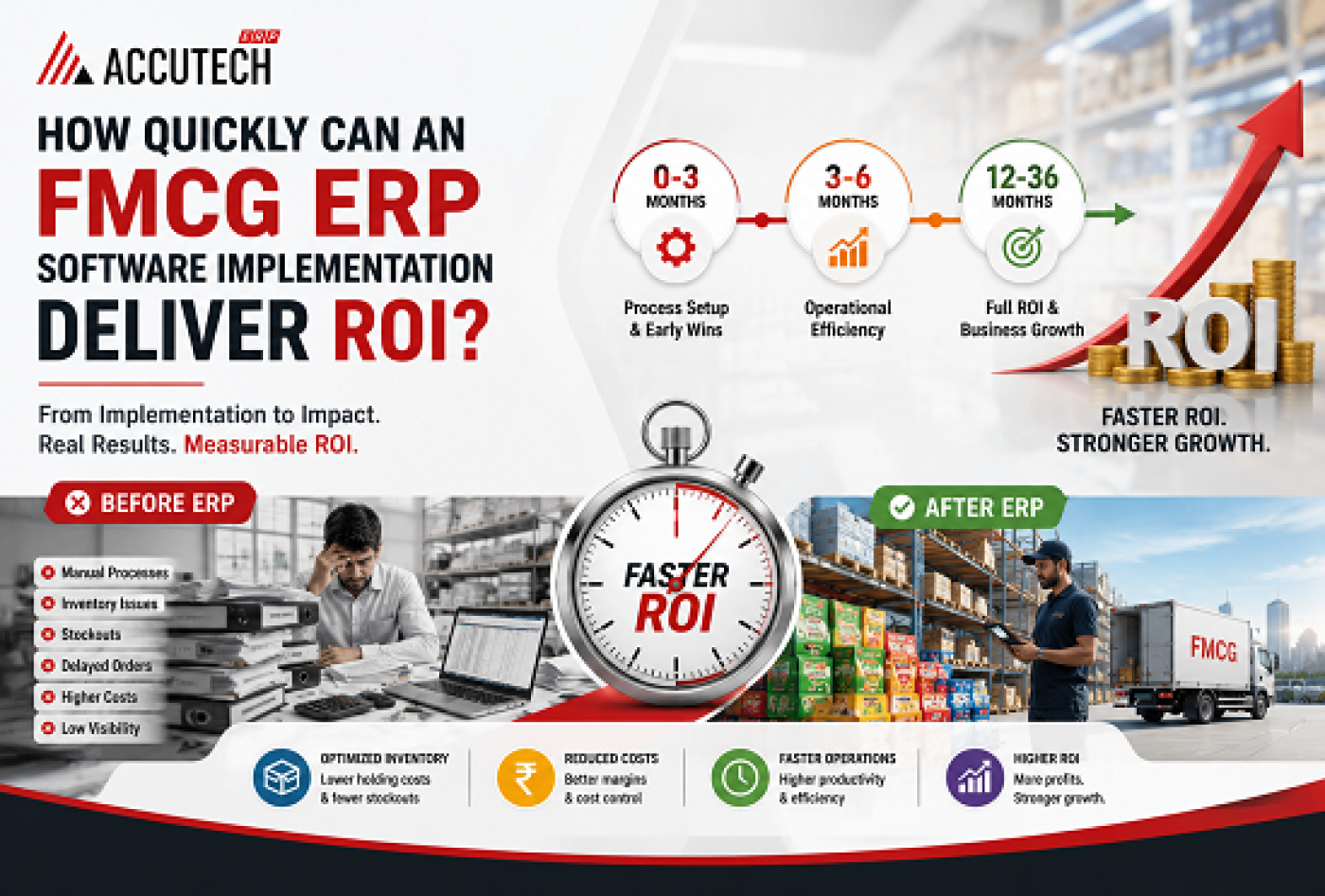
Every FMCG distributor asks the same question before signing off on new software: "How long until this pays for itself?" It's a fair question. Between licensing, training, data migration, and the inevitable adjustment period, an ERP rollout feels like a leap of faith.
The good news is that this isn't a leap of faith anymore there's enough real-world data from distributors, manufacturers, and ERP implementation partners to give you a grounded answer. In this guide, we'll walk through exactly when FMCG businesses typically start seeing returns from FMCG Distribution Software, what drives that timeline faster or slower, and how to structure your own rollout so ROI shows up sooner rather than later.
Why FMCG Businesses Are Asking This Question Now
FMCG distribution runs on thin margins and high transaction volumes. A single distributor might process hundreds of invoices, dozens of promotional schemes, and multiple GST filings every week often across several warehouses or branches. When that's managed through spreadsheets, WhatsApp updates, and disconnected billing tools, small inefficiencies compound quickly into real money: expired stock, missed reorders, duplicate scheme claims, and delayed collections.
fmcg erp software exists to close those gaps. But because it touches inventory, accounting, sales, and compliance all at once, business owners naturally want to know how soon that investment turns into savings not just in theory, but on their own balance sheet.
What "ROI" Actually Means for an FMCG Distributor
Before estimating a timeline, it helps to separate ROI into two categories:
Hard ROI - measurable savings you can put a number on: reduced inventory carrying costs, fewer stock outs, lower manual labor hours, faster GST filing, and reduced scheme leakage.
Soft ROI - harder to quantify but still valuable: better decision-making from real-time dashboards, improved audit readiness, stronger customer and supplier relationships due to fewer billing errors.
Most fmcg distribution business software implementations deliver soft ROI almost immediately teams simply stop wasting time reconciling numbers across systems. Hard ROI, the kind that shows up in your P&L, takes a little longer to materialize because it depends on process adoption, not just software installation.
The Real Timeline: From Go-Live to Measurable Returns
There's no single universal number, but patterns across the FMCG and broader ERP industry are consistent enough to map out a realistic timeline.
|
Stage |
Typical Duration |
What Happens |
|
Planning & requirement mapping |
2–4 weeks |
Process audit, data cleanup planning, module selection |
|
Implementation & data migration |
4–12 weeks |
Product/customer/vendor master setup, GST and HSN mapping, configuration |
|
Go-live & user adoption |
1–3 months |
Staff training, parallel runs, early workflow fixes |
|
Early operational ROI |
3–6 months |
Reduced manual errors, faster billing, better stock visibility |
|
Full financial ROI (payback period) |
12–36 months |
Inventory cost reduction, working capital release, compliance savings compound |
Mid-market FMCG distributors typically see their fmcg erp software system fully "settle in" within 3 to 6 months of go-live, with measurable financial payback generally landing somewhere in the 18-to-36-month range. Businesses using cloud-based, industry-specific ERP platforms — rather than heavily customized generic ERP tend to land on the faster end of that range, since implementation and training cycles are shorter.
Featured snippet answer: Most FMCG distributors begin seeing operational benefits from ERP software within 3–6 months of go-live, with full financial ROI typically achieved within 18–36 months, depending on business size and implementation quality.
Quick Wins vs. Long-Term Gains: What to Expect at Each Stage
It helps to think of ROI in three waves rather than one single moment.
Wave 1: Operational Relief (Month 1–3)
- Fewer billing errors and disputes
- Faster invoice generation and order processing
- One shared view of stock across teams (no more "let me check and call you back")
Wave 2: Process Efficiency (Month 3–9)
- Reduced time spent on GST return preparation
- Lower instances of stockouts and overstocking
- Cleaner outstanding/receivables tracking, improving collections
Wave 3: Financial Payback (Month 9–36)
- Working capital released from optimized inventory
- Reduced wastage and expiry-related losses
- Measurable reduction in scheme leakage and duplicate claims
- Lower cost of manual reconciliation and audit prep
This staged view matters because many businesses expect Wave 3 results in Wave 1 and get discouraged when they don't see it. ROI is cumulative, not instant.
What Actually Speeds Up (or Slows Down) ROI
Not every FMCG business gets the same payback timeline, even using identical software. A few variables consistently make the difference:
Factors that accelerate ROI:
- Clean, pre-migration data (accurate product masters, HSN codes, customer/vendor lists)
- Choosing fmcg distribution software built specifically for the industry rather than a generalized system requiring heavy customization
- Strong internal change management and early staff buy-in
- Phased rollout (starting with core inventory and billing before layering in advanced reporting)
- Cloud deployment, which shortens setup and infrastructure costs
Factors that delay ROI:
- Messy or duplicated master data (a very common and very underestimated hurdle)
- Resistance from field sales or warehouse staff who default back to manual habits
- Overcustomizing the system before understanding standard workflows
- Treating go-live as the finish line instead of the starting point for optimization
A Simple ROI Example You Can Adapt
Here's a simplified illustration to make the numbers concrete (adjust based on your own scale):
A distributor carries ₹5 crore in inventory and invests ₹40–50 lakh in a fmcg management software rollout, including setup and first-year licensing.
If better demand forecasting and stock visibility reduce excess inventory by even 15%, that releases roughly ₹75 lakh in working capital. At a modest 10% annual cost of capital, that's a saving of ₹7.5 lakh a year before accounting for reduced wastage, faster billing cycles, and lower manual labor costs.
Scale this to your own inventory value, staff costs, and current error rates, and the payback period becomes much easier to estimate honestly rather than guess at.
FMCG Distribution ERP Software vs. Generic ERP: Why the Difference Matters
One of the biggest ROI accelerators is choosing software built around how FMCG distribution actually works GST compliance, HSN-based tax mapping, scheme and claims tracking, multi-branch stock movement instead of adapting a generic ERP built for a different industry.
|
Feature |
Generic ERP |
Purpose-Built FMCG ERP |
|
GST & HSN compliance |
Requires custom setup |
Built-in, ready to configure |
|
Product & scheme management |
Limited or add-on |
Native support for FMCG-specific workflows |
|
Implementation time |
Longer, more customization needed |
Shorter, pre-configured for distribution |
|
Multi-branch/entity support |
Often requires extra modules |
Typically included |
|
Reporting for distributors |
Generic dashboards |
Sale/purchase pendency, party-wise, HSN summary reports |
This is exactly the gap that a solution like Accutech ERP's FMCG Distribution module is built to close combining inventory, GST-ready accounting, and distribution-specific reporting in one system, which shortens the runway to ROI considerably compared to retrofitting a generalized ERP.
Common Mistakes That Delay ROI
- Skipping the data cleanup phase. Duplicate SKUs and inconsistent product codes are one of the most common (and most underestimated) causes of delayed timelines.
- Rolling out everything at once. Trying to activate every module accounting, sales, GST, reporting simultaneously overwhelms teams and slows adoption.
- Under-investing in training. ROI depends on people actually using the system correctly, not just the software existing.
- No defined success metrics. Without baseline numbers (current inventory turnover, error rates, filing time), it's impossible to measure improvement later.
- Treating go-live as "done." The biggest financial gains usually come from post-go-live optimization, not the initial rollout.
Best Practices to Accelerate Your ERP Payback Period
- Clean your data before migration, not after. This single step prevents the most common source of delay.
- Start with core modules inventory, billing, and GST compliance before adding advanced analytics.
- Set baseline KPIs before go-live so improvements are measurable, not anecdotal.
- Train field and warehouse staff early, not just office-based accounting teams.
- Review reports monthly in the first two quarters to catch adoption gaps early.
- Choose a distribution-specific platform to reduce customization time and compliance risk.
- Treat the first 90 days as calibration, not failure, if numbers don't move immediately.
Frequently Asked Questions
- How long does it take to implement FMCG ERP software?
For a mid-sized FMCG distributor, implementation to go-live typically takes 6–12 weeks, depending on data complexity and the number of branches or entities involved.
- When do businesses typically start seeing ROI from FMCG ERP software?
Operational benefits fewer errors, faster billing, better stock visibility usually appear within 3–6 months. Full financial payback generally falls between 18 and 36 months.
- What's the difference between operational ROI and financial ROI?
Operational ROI refers to time and error savings that show up quickly, like faster invoicing. Financial ROI refers to measurable cost reductions and revenue impact, such as reduced inventory carrying costs, which take longer to compound.
- Does cloud-based FMCG ERP deliver ROI faster than on-premise systems?
Generally, yes. Cloud deployments have lower upfront infrastructure costs and shorter setup timelines, which tends to shorten the overall payback period compared to on-premise installations.
- What features should I look for in FMCG distribution business software to maximize ROI?
Look for GST and HSN compliance tools, real-time inventory visibility, scheme and claims tracking, multi-branch support, and built-in sale/purchase reporting features specifically designed for distribution rather than generic operations.
- Can poor data quality really delay ROI that much?
Yes inconsistent product codes, duplicate customer records, and inaccurate opening balances are among the most common reasons implementations take longer than planned. Data cleanup should never be rushed.
- Is FMCG ERP software worth it for smaller distributors?
Yes. Smaller distributors often see proportionally faster ROI because manual processes represent a larger share of their operating costs relative to revenue, so automation has an outsized impact.
- How is ERP ROI typically calculated?
A common formula is (Net Benefits ÷ Total Investment) × 100, where net benefits include cost savings, released working capital, and productivity gains, measured against total implementation and licensing costs.
- What's the biggest factor that determines how fast ROI shows up?
User adoption. Even the best-configured system won't deliver returns if sales, warehouse, and accounting teams don't consistently use it in daily operations.
- Should I expect the same ROI timeline as competitors in my industry?
Not necessarily. Timelines vary based on business size, current process maturity, data quality, and how phased the implementation is treat industry benchmarks as a guide, not a guarantee.
Final Thoughts
There's no single date on the calendar when ROI suddenly "arrives." It builds in layers starting with fewer daily headaches, moving into measurable process efficiency, and eventually showing up as real, bankable savings in inventory, compliance, and working capital. What determines how fast you get there isn't luck it's data readiness, phased rollout, and choosing software actually built for FMCG distribution rather than adapted from something else.
If you're evaluating how a purpose-built system could fit your own distribution business, take a look at Accutech ERP's FMCG Distribution ERP Software it's designed around the inventory, GST compliance, and reporting needs distributors deal with every day, which is exactly the kind of fit that shortens the road to ROI.