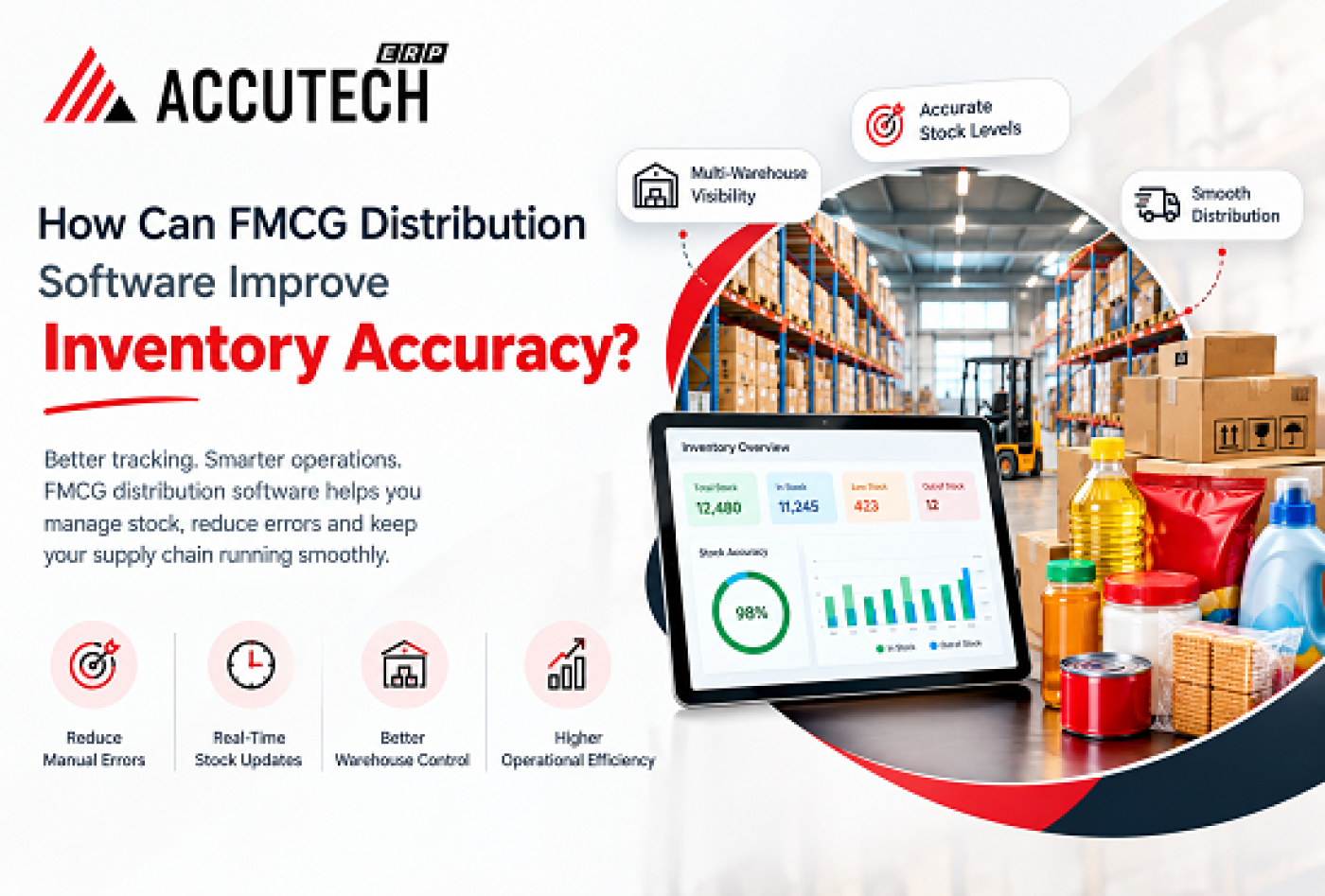
How Can FMCG Distribution Software Improve Inventory Accuracy?
Inventory accuracy is the backbone of any successful FMCG (Fast-Moving Consumer Goods) distribution business. When stock counts don't match your records, you face stockouts, overstock situations, cash flow problems, and unhappy customers. According to industry research, businesses lose approximately 1-2% of revenue annually due to inventory inaccuracies, a significant figure that directly impacts profitability.
The challenge becomes exponentially more complex when managing multiple warehouses, distribution centers, and retail locations across diverse geographical areas. This is where FMCG Distribution ERP Software becomes invaluable. Modern ERP solutions designed specifically for FMCG distribution businesses leverage automation, real-time data processing, and intelligent algorithms to ensure inventory accuracy at every stage of the supply chain.
In this comprehensive guide, we'll explore how fmcg distribution business software transforms inventory management, eliminates discrepancies, and creates a competitive advantage for distribution companies. We'll also examine why investing in a robust fmcg distribution management software solution is essential for modern businesses competing in today's fast-paced market.
Understanding FMCG Distribution Challenges
Before diving into solutions, it's crucial to understand the unique challenges faced by FMCG distributors:
High Volume, Low Margin Operations
FMCG businesses deal with massive quantities of products moving through distribution networks daily. With thin profit margins, even small percentage losses due to shrinkage or tracking errors translate into substantial financial impacts. Manual inventory management systems simply cannot handle the velocity and volume of FMCG operations.
Complex Supply Chain Networks
FMCG distributors typically manage inventory across multiple locations including central warehouses, regional distribution centers, and local storage facilities. Coordinating stock levels across this complex network without automated systems leads to inconsistencies, duplicate records, and inability to locate products quickly.
Human Error and Manual Processes
Paper-based or spreadsheet-based inventory systems are prone to data entry errors, transcription mistakes, and inconsistencies between different departments. When inventory counts are done manually, the margin for error increases dramatically, especially in fast-paced distribution environments.
Expiry Date Management
FMCG products have limited shelf lives. Without proper tracking, expired goods sit in warehouses, leading to write-offs and environmental waste. Accurate expiry tracking requires systematic monitoring that manual processes simply cannot provide reliably.
How FMCG Distribution ERP Software Works
FMCG Distribution ERP Software is an integrated system that connects all aspects of your distribution operations in a single, unified platform. Here's how it functions:
Centralized Data Repository
All inventory information from product master data to stock levels across locations is stored in a single database. This eliminates data silos and ensures everyone in the organization works with the same, current information. Whether it's your warehouse manager, sales team, or finance department, all departments access real-time, accurate data.
Automated Transaction Processing
When inventory moves whether it's received from suppliers, transferred between locations, sold to customers, or removed for damage the fmcg distribution management software automatically records these transactions. This real-time updating eliminates the lag between physical movements and system records.
Integration with Warehouse Operations
Modern fmcg distribution business software integrates with barcode scanning systems, RFID technology, and warehouse management systems (WMS). This creates an automated flow of information from the moment goods arrive at the warehouse until they're delivered to customers.
Key Features That Improve Inventory Accuracy
Several specific features within FMCG Distribution ERP Software directly contribute to improved inventory accuracy:
Feature | How It Improves Accuracy |
Barcode Scanning | Eliminates manual data entry errors; ensures every product movement is recorded accurately. |
Batch Tracking | Maintains complete traceability of product batches; critical for recall management and expiry tracking. |
Multi-Location Sync | Synchronizes inventory across all warehouses in real-time; prevents double-selling and stock duplications. |
Automated Cycle Counts | Performs continuous inventory verification without disrupting operations; catches discrepancies early. |
Stock Reconciliation | Automatically identifies and flags variances; generates reports for investigation and correction. |
Real-Time Stock Visibility and Tracking
One of the most transformative benefits of FMCG Distribution ERP Software is providing real-time visibility into stock levels. Unlike traditional systems where inventory data might be hours or days old, modern ERP solutions update information instantly.
This real-time visibility enables:
- Immediate detection of stock discrepancies between physical and system inventory
- Quick response to out-of-stock situations before sales are lost
- Accurate demand forecasting based on actual current inventory levels
- Better customer service through accurate availability information
- Informed decision-making by management based on current data, not historical snapshots
For an integrated distribution platform to provide this real-time visibility, it must be connected to your warehouse operations, including point-of-sale systems, receiving stations, and picking areas. This integration is what separates basic inventory management from a true ERP platform for FMCG distribution.
Automation in Warehouse Operations
Automation is at the heart of inventory accuracy improvement. Fmcg distribution business software leverages automation in several ways:
Automated Receiving Processes
When goods arrive at the warehouse, barcode scanning automatically matches received products against purchase orders. The system verifies quantities and quality instantly, reducing the likelihood of errors. If discrepancies are detected, the system flags them immediately for action.
Picking and Packing Optimization
Fmcg distribution management software uses intelligent algorithms to optimize picking routes and validate orders. Barcode scanning during picking ensures the correct items are selected. Before packing, the system double-checks that the order contents match what was supposed to be picked, minimizing shipping errors.
Automatic Stock Adjustments
Instead of manual stock adjustments at month-end, FMCG Distribution ERP Software continuously updates inventory records. When items are damaged, expire, or are lost, the system automatically adjusts stock levels, reducing the manual work and human error associated with period-end reconciliations.
Multi-Location Inventory Synchronization
One of the biggest challenges in FMCG distribution is managing inventory across multiple locations. A distributor might have a central warehouse, several regional distribution centers, and numerous local pickup points. Synchronizing inventory without a unified system is nearly impossible.
Fmcg distribution business software solves this through:
- Centralized master database that's accessible from all locations simultaneously
- Automated inter-location transfer processes that update inventory instantly
- Visibility into stock levels at each location without requesting manual reports
- Prevention of overselling by showing available inventory across all warehouses
- Optimized distribution of stock based on demand patterns at each location
This synchronization capability is critical because it prevents duplicate orders, lost sales due to inventory visibility issues, and unnecessary stock transfers that waste time and money.
Reducing Stock Discrepancies and Shrinkage
Stock discrepancies between system inventory and physical inventory are a major challenge in FMCG distribution. These arise from theft, damage, miscounting, misplacement, and data entry errors. Industry data shows that typical shrinkage rates in distribution operations range from 0.5% to 2% of inventory value.
The ERP system reduces shrinkage through:
Continuous Cycle Counting
Instead of doing one massive physical inventory once a year, fmcg distribution management software enables cycle counting where a small portion of inventory is counted continuously. This approach identifies discrepancies quickly while allowing the warehouse to remain operational.
Audit Trails and Accountability
Every inventory transaction is logged with timestamps and user identification. This creates a complete audit trail showing who moved what, when, and why. This visibility serves as both a theft deterrent and a tool for identifying process breakdowns.
Variance Investigation
When physical counts don't match system records, fmcg distribution business software helps investigate the cause. It can show all transactions affecting that inventory, identify when the discrepancy likely occurred, and help determine the root cause.
Data Analytics and Predictive Inventory Management
Beyond immediate accuracy, modern fmcg distribution management software includes analytics capabilities that help prevent future inventory problems. These platforms analyze historical data to identify patterns and trends.
Demand Forecasting
By analyzing past sales data, seasonal trends, and market factors, the ERP platform can predict future demand with reasonable accuracy. This helps optimize stock levels not too much and not too little.
Inventory Optimization
The system recommends optimal stock levels for each product at each location. These recommendations consider factors like lead times, local demand patterns, storage capacity, and carrying costs considerations that are impossible to manage manually.
Performance Dashboards
Fmcg distribution business software provides executive dashboards showing key metrics: inventory turnover rates, shrinkage percentages, accuracy levels by location, and days of inventory on hand. These metrics help management identify problem areas and track improvement over time.
Best Practices for Implementing FMCG Distribution Management Software
Selecting the right FMCG Distribution ERP Software is only half the battle. Implementation and adoption are critical. Here are best practices:
1. Data Cleanup Before Implementation
Before migrating to a new system, audit and clean your existing data. Remove duplicate records, standardize product codes and names, and reconcile discrepancies. If you transfer bad data to your new system, you'll have the same problems you started with.
2. Comprehensive Staff Training
Your fmcg distribution management software is only as good as your team's ability to use it effectively. Invest in comprehensive training for warehouse staff, supervisors, managers, and accounting personnel. Ensure they understand not just how to use the software, but why accurate inventory management matters.
3. Phased Rollout
Rather than implementing across all locations simultaneously, consider a phased approach. Start with one distribution center or region, work out bugs and processes, then expand. This reduces risk and allows for knowledge transfer.
4. Integration with Existing Systems
Ensure your new fmcg distribution business software integrates seamlessly with your existing accounting software, CRM, e-commerce platform, and other systems. Integration eliminates data silos and ensures consistency across your operations.
5. Continuous Optimization
After implementation, regularly review reports and metrics to identify areas for improvement. The ERP platform provides the data needed to continuously optimize processes and improve inventory accuracy.
ROI and Business Benefits
The investment in fmcg distribution management software delivers measurable returns:
- Reduced Inventory Carrying Costs: By optimizing stock levels, you reduce the capital tied up in inventory
- Lower Shrinkage and Write-offs: Better tracking reduces losses from damage, expiry, and theft
- Improved Customer Service: Accurate inventory means fewer stockouts and better order fulfillment
- Faster Decision-Making: Real-time data enables quick responses to market changes
- Reduced Labor Costs: Automation reduces manual, repetitive work
- Better Compliance: Accurate records make audits easier and reduce risk of regulatory issues
- Scalability: Systems designed for FMCG distribution can grow with your business
Most companies see payback on their ERP investment within 12-24 months, with ongoing benefits that accumulate over time.
Frequently Asked Questions
Q1: What's the difference between basic inventory software and FMCG Distribution ERP Software?
Basic inventory software typically tracks stock levels but operates in isolation. A full ERP platform integrates inventory with accounting, sales, purchasing, and reporting into a unified system. It's designed specifically for the complexities of FMCG distribution including multi-location management, high-volume transactions, and real-time synchronization.
Q2: How quickly can we expect to see improvements in inventory accuracy after implementing fmcg distribution business software?
Many organizations see immediate improvements in data consistency once the system is live. Within 30-60 days, as staff becomes proficient and processes stabilize, inventory accuracy typically improves noticeably. Achieving optimal accuracy (95%+) usually takes 3-6 months as all processes become standardized.
Q3: Can FMCG distribution management software work with our existing barcode and RFID systems?
Yes, modern ERP solutions are designed to integrate with most standard barcode and RFID systems. During implementation, your provider should verify compatibility and configure the integration. This connectivity is crucial for the real-time accuracy benefits.
Q4: How does fmcg distribution business software handle seasonal demand fluctuations?
The analytics capabilities in fmcg distribution management software analyze historical seasonal patterns to forecast demand during peak periods. This allows you to adjust stock levels proactively, ensuring adequate inventory during busy seasons without excessive stock during slow periods.
Q5: What security features protect our inventory data in an ERP system?
Enterprise-grade distribution software includes multiple security layers: user authentication with role-based access controls, data encryption in transit and at rest, regular security audits, backup and disaster recovery protocols, and compliance with standards like ISO 27001.
Q6: How does the system handle inventory write-offs for expired or damaged goods?
The distribution platform tracks expiry dates and allows you to mark items as damaged or expired. The system automatically adjusts inventory and can generate write-off documents for accounting purposes. This maintains both accurate physical counts and proper financial records.
Q7: Can multiple users work in the distribution software simultaneously?
Yes, the software is designed for concurrent multi-user access. The system uses database locking mechanisms and transaction controls to prevent conflicts. When multiple people interact with the same inventory, the system maintains data integrity and ensures all transactions are properly recorded.
Q8: How often should we perform physical inventory counts?
With continuous cycle counting capabilities, you might perform full physical counts quarterly or semi-annually instead of annually. Some organizations with very high accuracy levels only do annual verification counts. The frequency depends on your accuracy targets and regulatory requirements.
Q9: What kind of reports can we get from distribution software?
A comprehensive ERP platform provides hundreds of standard reports including: inventory summaries by location and product, expiry tracking reports, variance analysis, shrinkage reports, sales and purchase analysis, stock movement trends, financial reports, and custom reports tailored to your business requirements.
Q10: How much does FMCG distribution software typically cost?
Costs vary based on company size, number of users, locations, and features required. Small businesses might invest ₹2-5 lakhs annually, mid-market companies ₹5-20 lakhs, and enterprise solutions ₹20+ lakhs. Most providers offer flexible pricing models including subscription-based (SaaS) or perpetual licenses.
Conclusion:
Inventory accuracy isn't a "nice-to-have" feature for FMCG distributors it's a competitive necessity. In an industry characterized by high volumes, thin margins, and complex supply chains, even small improvements in accuracy translate to significant financial gains. FMCG Distribution ERP Software provides the integrated, automated platform that modern distribution operations require.
By implementing a robust fmcg distribution management software solution, you gain:
- Real-time visibility into inventory across all locations
- Automated processes that reduce human error and increase efficiency
- Comprehensive analytics to optimize stock levels and predict demand
- Better financial control and compliance capabilities
- Scalable infrastructure to support business growth
The question isn't whether your business can afford to invest in this kind of ERP system it's whether you can afford not to. As your competitors modernize their operations, those still relying on manual processes will find themselves at an increasingly significant disadvantage.
Ready to transform your FMCG distribution operations? Explore how Accutech ERP's comprehensive fmcg distribution business software can improve your inventory accuracy, streamline operations, and drive profitability. With proven features in real-time tracking, automated processes, multi-location synchronization, and advanced analytics, Accutech ERP is designed specifically for modern FMCG distributors.
Request a demo today to see how the software can transform your business. Discover why thousands of FMCG distributors trust Accutech ERP to manage their most critical operations and drive inventory accuracy excellence.