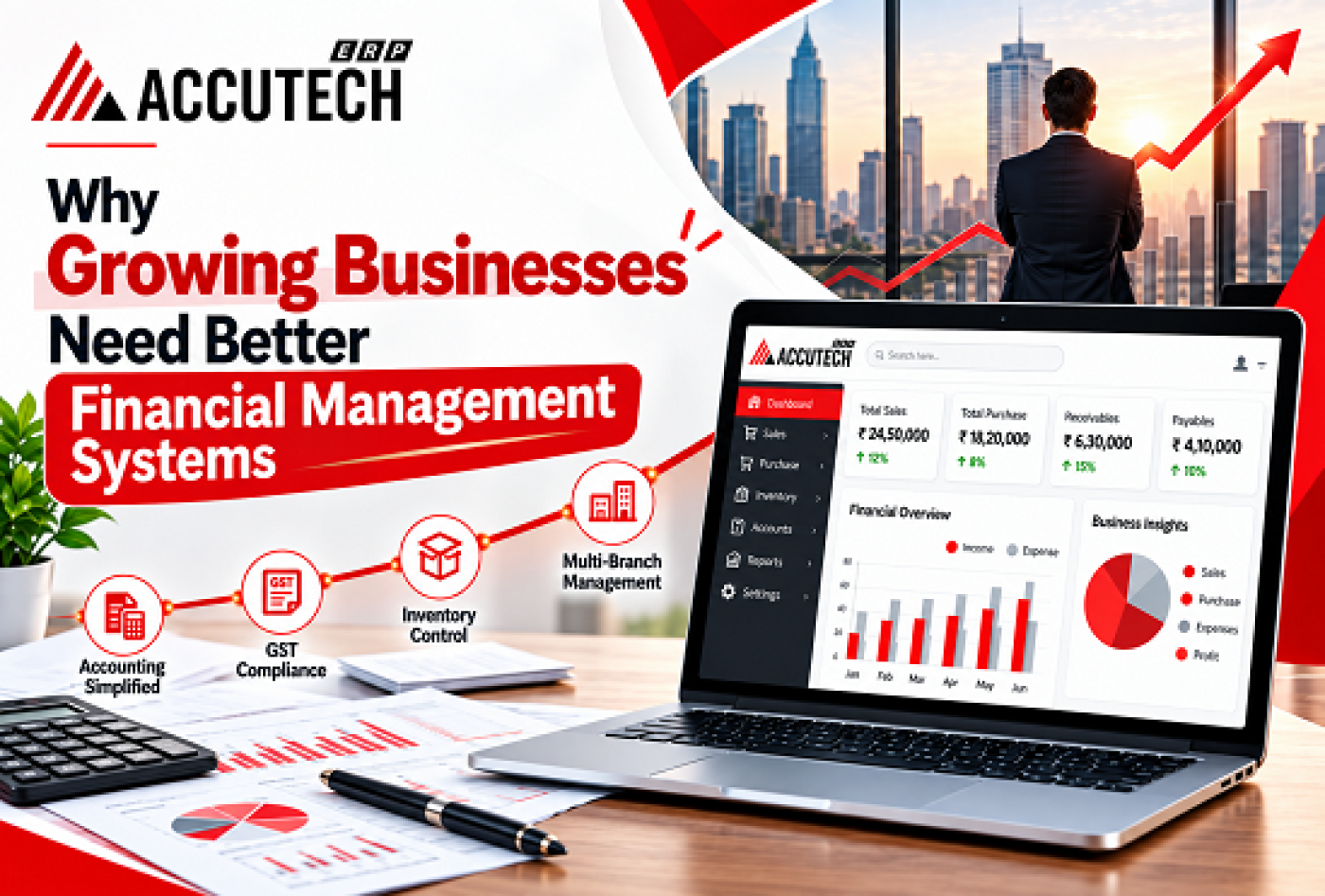
Why Growing Businesses Need Better Financial Management Systems
Every growing business reaches a moment when the books stop keeping pace with the business. Orders are climbing, a second branch is opening, the GST deadline is three days away, and someone in accounts is still hunting for a missing invoice inside a shared spreadsheet. Sales look healthy, yet nobody can say with confidence how much cash is really available, who owes what, or whether the stock on the shelf matches the stock in the software.
That gap between growth and financial clarity is the reason better financial management systems matter. In this guide you will learn what changes as a company scales, what a modern accounting platform should actually do, how cloud and manufacturing needs shape the decision, and how to shortlist the best advance accounting erp software for your own situation without drowning in feature lists.
Whether you run a trading firm, a distribution network or a factory floor, you will find a practical checklist, comparison tables, an implementation roadmap and straight talk about the mistakes businesses keep repeating.
The Growth Trap: When Spreadsheets Stop Scaling
In year one, almost any setup works. A founder, an accountant and a simple billing tool can manage a few dozen invoices a week. The trouble creeps in quietly. More customers mean more ledgers. More products mean more HSN codes and rate lists. A second godown means two versions of stock. Each addition feels small, but together they build a system that nobody fully understands.
Warning signs your finance setup has been outgrown
- Month-end closing takes days instead of hours because data sits in several files.
- Receivables ageing is guesswork, so collections slip and cash gets tight.
- Stock in the software and stock in the warehouse never match.
- GST returns need heavy manual cleanup, and input tax credit mismatches show up late.
- Owners wait for the accountant to "pull a report" before making simple decisions.
- Auditors ask for supporting documents that take days to trace.
What patchwork finance really costs
Illustrative scenario: a distributor with two branches and around 600 active products keeps sales in one tool, purchases in another and ledgers in a third. Every month, an accountant re-types numbers to reconcile them. One wrong HSN code slips into a return, the tax credit is delayed, and the owner hears about it weeks later. Nothing dramatic went wrong. The system simply had no way to catch the error early.
That is the hidden price of patchwork finance. It is rarely one big failure; it is a steady drip of late collections, blocked credits, overstocked items and delayed decisions, plus finance staff who spend their days fixing data instead of analysing it.
What a Financial Management System Actually Does
A financial management system is software that records, organises and reports every financial transaction of a business (sales, purchases, payments, stock movements and taxes) in one connected place. An advanced accounting ERP goes a step further by linking those records to inventory, compliance and multi-branch operations.
In practice, a good system should do five jobs well:
- Record once: every sale, purchase, return and voucher is entered one time and posts to the right ledgers automatically.
- Report live: ledgers, stock, outstanding balances, profit and loss and the balance sheet are available without a month-end rebuild.
- Control access: you decide who can create, edit or view each type of record.
- Support compliance: tax calculations, HSN mapping and return-ready summaries are built in, not bolted on.
- Scale smoothly: more users, products and branches do not break the structure.
Basic tools vs an advanced accounting ERP
Area | Spreadsheets / basic billing | Advanced accounting ERP |
|---|---|---|
Data entry | Repeated across files | Entered once, flows to ledgers, stock and tax |
Reporting | Manual, usually after month-end | Live ledgers, stock and outstanding reports |
GST | Manual compilation and cross-checking | Invoice-level tax and monthly summaries |
Multi-branch | Separate files per location | Branch-wise and consolidated views |
Audit trail | Limited or missing | Traceable voucher history |
Scalability | Slows down as volume grows | Built for higher volume and more entities |
The difference is not cosmetic. In a connected system, one sales invoice updates the customer ledger, stock position, tax summary and day book together. In a disconnected setup, the same invoice gets typed three or four times, and every retyping is another chance for an error.
Five Business Outcomes Better Systems Deliver
- Faster, better decisions. When sales, purchase and stock reports are live, owners stop guessing. You can see which customers and products actually drive margin and act this week, not next month.
- Real control over cash. Customers outstanding with ageing and supplier payables in one view show where cash is stuck and which payments can wait.
- Fewer errors. Masters such as account heads, products and HSN codes are set once and reused, so a typo does not multiply across documents.
- Audit readiness. Under the Companies (Accounts) Rules, companies using accounting software have needed an audit trail (edit log) feature that cannot be switched off since 1 April 2023. Even if you are not a company, a visible change history makes reviews calmer. You can read more on the Ministry of Corporate Affairs website.
- Room to grow. New branches, entities and product lines slot into the existing structure instead of forcing a rebuild.
Why Manufacturers Feel the Pain First
Manufacturing adds layers that traders never see: raw materials, packing material, finished goods, dealer or distributor sales and tax at every step. That is why ERP for manufacturing India is never just a production topic. Accounting is the spine. Production data without accurate ledgers and costing tells you what you made, not whether you made money.
Take packing material alone. Cartons, labels and bottles are bought in bulk, consumed unevenly and often tracked in a side spreadsheet. When that sheet drifts from reality, stock valuation drifts with it, and so does reported profit.
What manufacturers should expect from the accounting layer
- A detailed product master with type, group, specification and manufacturer links.
- Separate tracking for packing material and stock summaries.
- Purchase order to purchase invoice to return flows that post straight to ledgers.
- HSN-wise tax summaries and invoice-level HSN details.
- Party-wise and item-wise sales and purchase analysis to spot profitable customers.
- Controlled opening stock balances at the start of a financial year.
Search results for ERP for manufacturing India are crowded with heavy platforms built around shop-floor planning. If your biggest pain is financial control, tax accuracy and stock integrity, an advanced accounting ERP with strong product and transaction modules may serve you better than an oversized suite you will use at twenty percent of its capacity.
Cloud vs On-Premise: What Works for Indian Businesses
A decade ago, accounting software meant a server in the corner and an IT person who understood it. Today, buyers of cloud accounting software in India can log in from the office, a godown or a client site and see the same live numbers.
For businesses with branches, that single shared view is the biggest advantage. Branch teams enter data locally, the owner sees consolidated results the same day, and the accountant stops chasing files over email.
Factor | Cloud | On-premise |
|---|---|---|
Access | Anywhere with internet | Mostly office network |
Updates | Vendor rolls out tax and feature updates | Manual installation |
Backups | Automated and off-site | Depends on your own discipline |
Upfront cost | Lower, usually subscription based | Higher hardware and licence cost |
Connectivity | Needs a reliable connection | Works on a local network |
Scaling | Add users and branches easily | Needs more infrastructure |
Cloud is not automatically better, though. Ask three questions before committing: where is my data hosted, how often is it backed up, and can I export everything in a standard format if I leave? Also test how the product behaves on a weak connection, which matters in many Tier-2 and Tier-3 cities.
When comparing cloud accounting software in India options, give extra weight to how quickly the vendor ships GST-related updates. Tax rules change often, and software that lags quietly becomes a compliance risk.
GST Compliance: Where Better Systems Pay for Themselves
For Indian businesses, GST is the most visible reason to upgrade. Regular taxpayers file GSTR-1 and GSTR-3B every month (eligible small taxpayers may use the quarterly QRMP scheme), and input tax credit depends heavily on what your suppliers have reported, which appears in GSTR-2B on the official GST portal.
That makes clean data non-negotiable. A wrong HSN code, a missing invoice or a mismatched supplier GSTIN does not stay a small error. It can delay credit or invite a notice.
What good GST handling looks like inside accounting software
- Tax calculated automatically on every transaction using HSN mapping on the product.
- Invoice-level tax visibility for quick checking.
- Sale, purchase and HSN summaries by month and year.
- Support for credit and debit notes, including rate difference adjustments.
- Easy comparison of your purchase records with supplier-reported data.
E-invoicing adds another layer for larger taxpayers. Thresholds have changed over time, so verify the current limit on the official portal instead of relying on older articles.
Must-Have Features of an Advanced Accounting ERP
Feature lists can overwhelm, so anchor your evaluation on the modules that touch money every day. The table maps each area to what a capable system should offer, with examples from the Accutech ERP advance accounting module for reference.
Area | What to look for | Example in AccuTech ERP |
|---|---|---|
Accounts management | Flexible heads, balance sheet mapping | Unlimited hierarchy levels, BS head mapping |
Product management | HSN, rate lists, opening stock, packing | Product, HSN, Rate List, Opening Balance, Packing |
Transactions | Orders, invoices, returns, notes, vouchers | Sale and Purchase Order, Invoice, Return, Proforma, Reorder PO, CR/DR Note, HSN Voucher |
Sale and purchase reports | Party-wise and item-wise analysis | Sale and Purchase Summary, Party Item Wise, HSN Summary |
Financial reports | Ledgers, stock, outstanding | Account Ledger, Product Ledger, Stock Summary, Party Outstanding |
GST | Return-ready tax summaries | GST workflow support, month and year tax summary |
Account books | Statutory books and statements | Cash, Bank, Sale, Purchase, Day Book, Trial Balance, P&L, Balance Sheet |
Multi-entity | Branch-wise and consolidated views | Multi-branch and multi-entity support |
Notice how much of this is about structure rather than flash. Strong master data (accounts, products, HSN) is what makes every downstream report trustworthy. Security and access control matter just as much, so ask any vendor about role-based permissions, backups and audit trails, particularly if you are evaluating cloud accounting software in India providers.
How to Choose the Best Advance Accounting ERP Software
There is no universal winner. The best advance accounting erp softwarefor a pharma manufacturer will differ from the right choice for a garment trader. What you want is the best fit for your workflows, volume and growth plans, backed by a vendor who answers the phone.
Criterion | Why it matters | Ask the vendor |
|---|---|---|
Industry fit | Trading, pharma, FMCG and factories work differently | Can you demo my actual flow, not a generic one? |
Compliance depth | GST rules keep changing | How quickly do you ship tax updates? |
Reporting | Decisions need live data | Can I drill from a summary down to the voucher? |
Multi-branch | Growth means more locations | Separate books with consolidated reporting? |
Security | Financial data is sensitive | Role-based access, audit trail, backups? |
Ease of use | Adoption decides your return | How long until my team is productive? |
Support | Problems appear at month-end | What are response times and languages? |
Total cost | Licence is only one part | What do users, branches, upgrades and training cost? |
Insist on a demo with your own data. A polished generic demo proves little; a messy real invoice with a return and a rate difference proves a lot. If you are shortlisting ERP for manufacturing India vendors, also ask how packing material, product groups and stock opening balances are handled.
Step-by-Step: Moving to a Better System Without Chaos
- Map your current process. Write down how a sale, purchase, return and payment flow today, and where delays occur.
- Rank your needs. Separate must-haves (GST, stock accuracy, branches) from nice-to-haves.
- Shortlist two or three vendors and request demos using real scenarios.
- Clean your data first. Merge duplicate parties, fix HSN codes and verify opening balances. Bad data in means bad reports out.
- Set up masters carefully. Build account heads, balance sheet mapping, products and rate lists before entering transactions.
- Run in parallel for one cycle. Compare trial balances from the old and new systems.
- Train by role and set permissions so people see only what they need.
- Go live at the start of a month or period and review weekly for the first quarter.
For a mid-sized business, expect setup to take weeks rather than days, mostly because of data cleanup. Manufacturers planning an ERP for manufacturing India rollout should budget extra time for product, packing and opening stock masters.
Common Mistakes to Avoid
- Buying on price alone. The cheapest option often costs more later in workarounds and manual fixes.
- Skipping data cleanup. Migrating messy data simply moves the mess into a new system.
- Ignoring training. Software nobody understands gets bypassed with spreadsheets again.
- Over-customising early. Start with standard workflows and customize only what truly hurts.
- Forgetting access controls. Everyone having full edit rights is an audit risk.
- Planning only for today. A tool that fits ten users may struggle with next year's branches.
- Treating the demo as the finish line. Check references, support quality and the upgrade path too.
One more trap deserves a mention: hunting for a magic label. The best advance accounting erp software is rarely the cheapest or the flashiest. It is the one your team will actually use every single day.
Expert Tips for Getting More From Your System
- Close the books on a fixed rhythm (weekly checks, monthly closing) so surprises stay small.
- Review receivables ageing every week and assign follow-ups by name.
- Reconcile bank and cash books regularly instead of at year end.
- Use party-wise and item-wise reports to find your top and bottom performers.
- Limit edit rights and review the audit trail occasionally.
- If you choose cloud accounting software in India vendors, schedule a restore test so you know backups really work.
Where Accutech ERP Fits In
Accutech ERP's advance accounting module is built around the areas covered above: account heads with unlimited hierarchy, balance sheet mapping, a detailed product master, transaction processing, sale and purchase analysis, financial reports, GST visibility and statutory books. It supports multi-branch and multi-entity structures, and the company also offers industry-focused solutions for pharma manufacturing, bulk drug trading and FMCG distribution.
If you are building a shortlist of cloud accounting software in India choices or ERP for manufacturing India solutions, you can explore the module in detail and request a demo on the Accutech ERP advance accounting page. Bring one real invoice, one return and one GST scenario, and judge the software on those.
Frequently Asked Questions (FAQs)
What is a financial management system in simple words?
It is software that records and organises every money-related activity of your business (sales, purchases, payments, stock movements and taxes) in one connected place, then turns that data into ledgers, reports and statements you can trust.
Why do growing businesses need an accounting ERP instead of spreadsheets?
Spreadsheets rely on manual entry and personal discipline. As volume grows, errors multiply, versions conflict and reports arrive late. An accounting ERP records each transaction once, links it to ledgers, stock and tax, and gives live reports, so decisions stay timely and audits stay manageable.
How is an advanced accounting ERP different from basic billing software?
Basic billing software mainly creates invoices. An advanced accounting ERP also manages account hierarchies, balance sheet mapping, product masters, returns, vouchers, party-wise analysis, statutory books and multi-branch reporting, so billing, accounting, stock and tax stay in sync.
Is cloud-based accounting safe for Indian businesses?
It can be, provided the vendor offers encryption, role-based access, automated backups and an audit trail. Ask where your data is hosted, how restores work and whether you can export records in standard formats. Safety also depends on strong passwords and sensible user permissions on your side.
How does accounting software help with GST compliance?
It applies tax automatically using product HSN mapping, keeps invoice-level tax details and produces monthly and yearly tax summaries that speed up return preparation. It also helps you compare purchase records with supplier-reported data so mismatches can be fixed before filing.
Can one system handle multiple branches and GSTINs?
Yes, if it supports multi-entity structures. Look for separate books per branch or entity, location-wise stock and consolidated reporting. During a demo, confirm how each GST registration is handled and how inter-branch transfers are recorded.
When is the right time to upgrade my accounting system?
Upgrade when month-end closing drags on, stock and book figures disagree, GST preparation eats up days, or you are adding branches, products or users. Moving before the pain becomes severe is far easier than migrating in the middle of a crisis or an audit.
What should manufacturers look for in an accounting system?
Check for a detailed product master, HSN and tax mapping, packing-material tracking, opening stock control, a clean purchase-to-payment flow, party-wise analysis and dependable stock and ledger reports. Also ask whether the vendor has experience in your industry, such as pharma or FMCG.
How long does implementation usually take?
It depends on data quality, the number of branches and users, and how much customisation you want. Many small and mid-sized businesses need a few weeks for master setup, a parallel run and training. Clean data and a clear process map speed things up; heavy customisation slows them down.
Conclusion
Growth rewards businesses that can see clearly. Better financial management systems give you that clarity through live reports, GST-ready records, branch-wise control and an audit trail you can trust. Choosing the best advance accounting erp software is less about chasing features and more about gaining control.
Whether you compare cloud accounting software in India vendors or evaluate ERP for manufacturing India platforms, start with your own workflows, test with real data and insist on strong support. Do that, and your finance function stops being a bottleneck and becomes a growth engine.