Let me take you back to a moment many business owners have experienced. It's midnight, and Rajesh, a manufacturing business owner in Bangalore, is sitting at his desk surrounded by invoices, receipts, and scattered papers. His accountant hasn't submitted the quarterly reports, his tax deadlines are approaching, and he has absolutely no idea how much profit he's actually made this quarter. Sound familiar?
This is the reality for millions of businesses across India. Traditional accounting methods, manual spreadsheets, paper records, and delayed financial reporting have become a burden that slows growth and creates unnecessary stress. In 2026, with the rapid digital transformation of India's business landscape, continuing to manage finances the old-fashioned way isn't just inconvenient; it's genuinely risky.
The good news? Cloud accounting software India has revolutionized how businesses manage their financial health. These intelligent solutions have transformed the lives of thousands of entrepreneurs, enabling them to make real-time financial decisions, reduce accounting costs by up to 40%, and spend less time worrying about compliance.
Understanding the Evolution: Why Cloud Accounting Software India Became Essential
The Indian business ecosystem has transformed dramatically over the past decade. We've moved from a nation where most businesses relied on traditional ledgers and local accountants to a thriving digital economy where companies of all sizes demand instant access to financial data.
Think about what happened during the pandemic. Businesses that had invested in cloud accounting software in India could operate seamlessly from anywhere. Those still using manual systems faced chaos, missed deadlines, and compliance nightmares. This wasn't just about technology; it was about survival.
Today, the conversation has shifted. It's no longer 'Should we move to cloud accounting?' but rather 'How do we choose the best cloud accounting solution for our business?' This shift reflects a fundamental change in how Indian entrepreneurs view financial management as a strategic advantage, not just a compliance requirement.
The Challenge: What Makes Managing Business Finances So Difficult?
Before we explore solutions, let's be honest about the problems. Running a business in India comes with unique financial management challenges:
- GST Compliance Complexity: The Goods and Services Tax system changed everything. Businesses must track multiple GST rates, file returns on time, and maintain meticulous records. One mistake can result in penalties ranging from ₹10,000 to ₹100,000.
- Cash Flow Management: With extended payment terms common in Indian business culture, tracking cash flow becomes a nightmare. When will that invoice be paid? How much can you spend without facing a liquidity crisis?
- Multiple Stakeholder Requirements: Banks want financial statements for loans, investors want detailed reports, tax authorities demand compliance, and your accountant needs current data. Managing these different reporting needs manually is exhausting.
- Scalability Issues: As businesses grow, manual accounting systems become bottlenecks. What worked for 50 invoices per month breaks down when you reach 500.
- Time Wastage: Business owners report spending 15-20 hours per week on financial administration. That's time that could be spent growing the business.
The Solution: What is Cloud Accounting Software India?
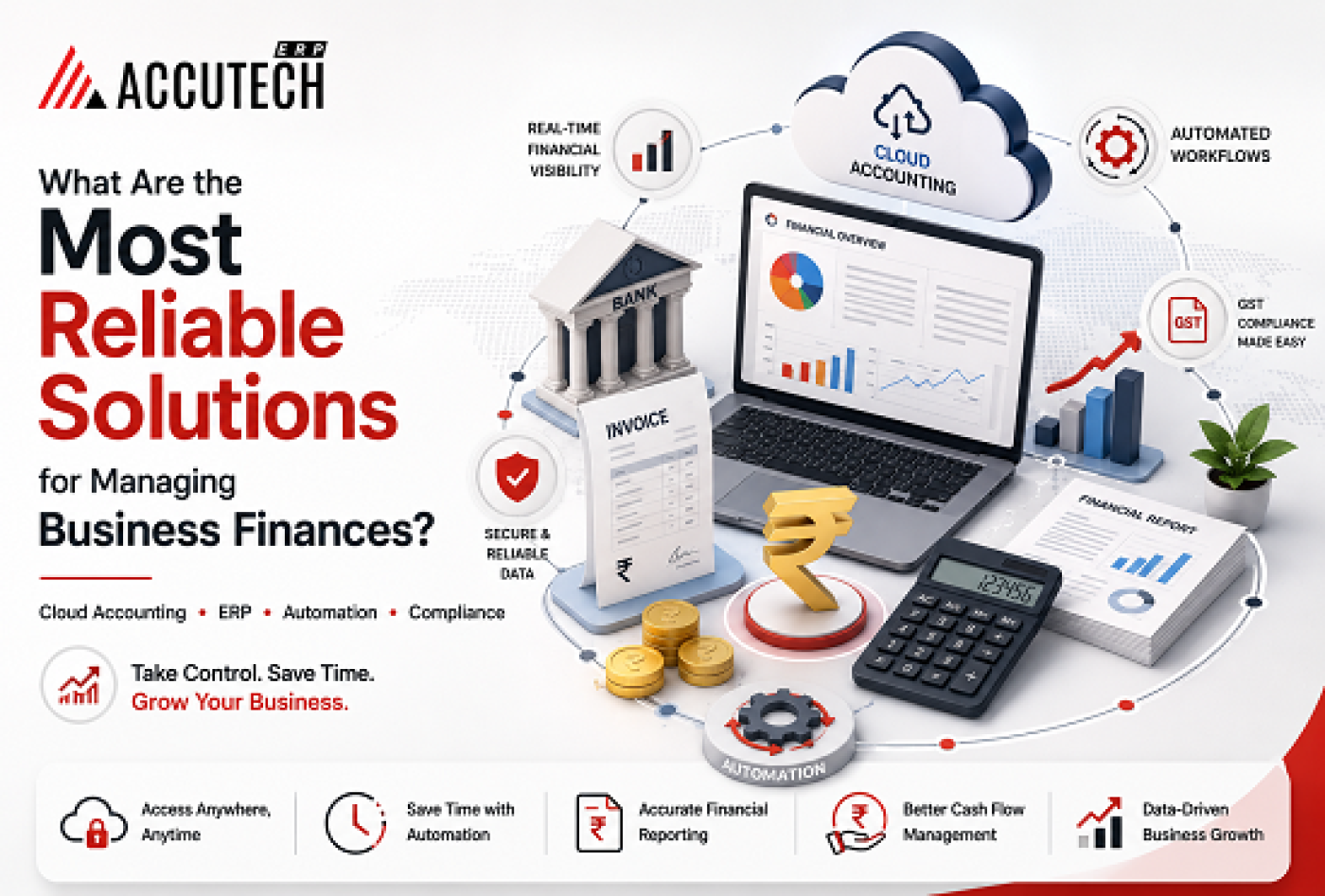
Cloud accounting software is fundamentally different from traditional accounting tools. Rather than storing financial data on local computers or filing cabinets, it lives in secure digital clouds, accessible from anywhere with an internet connection.
The leading cloud accounting software in India combines three essential capabilities:
- Real-time Financial Visibility: You can see your business's financial health at any moment. How much have you earned this month? What's your current cash position? These answers are available instantly, not after weeks of manual reconciliation.
- Automated Compliance: GST calculations happen automatically. Tax compliance becomes less stressful. The software ensures you're following all regulatory requirements without manual intervention.
- Intelligent Integration: These systems connect with your banking, payment platforms, inventory systems, and customer databases. Data flows automatically, reducing manual data entry by up to 95%.
Cloud ERP Accounting: The Advanced Approach
While basic cloud accounting software in India handles financial transactions, cloud ERP accounting solutions integrate accounting with your entire business operations.
Imagine a system that simultaneously manages your inventory, tracks your sales, monitors customer behavior, handles your accounting, and generates comprehensive business insights. That's what cloud ERP accounting delivers.
For a manufacturing business, this means raw material costs automatically flow into production expenses and then into finished goods inventory. For a service company, project costs connect to project revenue and profitability analysis. For a retail business, sales integrate with inventory, procurement, and cash flow management seamlessly.
The Transformation: Real Stories of Business Success
Let's return to Rajesh, the manufacturing owner we met earlier. After implementing a leading cloud accounting software in India, his accounting time reduced from 40 hours per week to 8 hours. Here's what changed:
His accountant could now focus on strategy instead of data entry. They analyzed why certain product lines weren't profitable and recommended adjustments that increased overall profit margins by 12%.
With real-time cash flow visibility, Rajesh could make better decisions about inventory purchases. He reduced working capital requirements by 18%, freeing up ₹25 lakhs that he invested in growing the business.
GST compliance became automatic. He never missed a deadline, avoided penalties entirely, and reduced the anxiety around tax filings significantly.
When his banker asked for financial projections, they were available in minutes, not weeks. He secured a working capital loan faster and at better terms.
Key Benefits: Why Businesses Are Moving to Cloud Accounting
Accessibility and Flexibility
One of the greatest advantages of cloud-based accounting is the ability to access your financial information from anywhere. Whether you're in your office in Mumbai, visiting a client in Delhi, or working from a café in Goa, your data is always available. This flexibility has become essential for modern businesses.
Cost Efficiency
Implementing traditional accounting systems required significant capital investment, expensive software licenses, server infrastructure, and IT support. Cloud solutions operate on a subscription model. You pay only for what you use, typically between ₹500 to ₹5,000 per month depending on the plan. This reduces both initial investment and ongoing costs.
Automatic Updates and Compliance
Tax laws and compliance requirements change constantly. Manual systems require you to stay updated and implement changes yourself. Cloud solutions automatically update to reflect new regulations, ensuring your business remains compliant without any action needed from you.
Collaboration and Integration
Your accountant, financial team, business manager, and even your banker can access relevant financial data simultaneously. No more emailing files back and forth or dealing with conflicting versions. Everyone works with the same real-time information.
Enhanced Security
Cloud providers invest heavily in security infrastructure. Your data is encrypted, backed up multiple times, and protected against cyber threats far better than most small business IT setups could achieve independently.
Scalability
As your business grows more customers, more transactions, more complexity your accounting system grows with you. You don't need to replace or upgrade the entire system. Simply adjust your subscription tier.
Myths vs. Facts: Clearing the Confusion
MYTH: Cloud accounting software is complicated and requires technical expertise.
FACT: Modern cloud accounting software is designed for non-technical users. Most businesses report that their teams become proficient within 1-2 weeks. Providers offer extensive training, tutorials, and customer support.
MYTH: Cloud solutions aren't secure. My financial data will be vulnerable.
FACT: Enterprise-grade cloud providers use military-level encryption and security protocols. Your data is actually more secure in the cloud than on local computers that may lack proper backup and security systems. Cloud providers comply with international security standards like ISO 27001.
MYTH: I need internet connectivity all the time; if the internet goes down, I can't work.
FACT: Most modern cloud applications have offline capability. You can continue working offline, and when your internet reconnects, the data synchronizes automatically.
MYTH: Switching to cloud accounting will disrupt my current business processes.
FACT: Good cloud accounting providers handle data migration smoothly. They work with you to minimize disruption and often provide dedicated support during the transition period.
Choosing the Leading Cloud Accounting Software in India
With numerous options available, selecting the right leading cloud accounting software in India requires careful evaluation. Consider these factors:
GST Compliance Features: Ensure the software handles your specific GST requirements, including input tax credit, multiple warehouse operations, and e-way bill management.
Integration Capabilities: Can it connect with your current banking platform, payment gateways, e-commerce platforms, and CRM systems?
Reporting Flexibility: Does it generate the reports your business actually needs? Can you customize reports, or are you limited to predefined formats?
Customer Support: Is support available in your timezone? Can they handle issues quickly? Many Indian businesses prefer providers with local support teams.
Scalability: Will it grow with your business? Can you add more users, warehouses, or entities as you expand?
Cost Transparency: Understand the pricing model. Is it per user, per month, per transaction, or a combination? Are there hidden fees?
Trial Period: Most reputable providers offer a free trial. Use this to test the software with your actual business data before committing.
Implementation Guide: Getting Started with Cloud Accounting
Moving to cloud accounting software doesn't have to be stressful. Here's a practical approach:
Month 1: Preparation and Planning
Audit your current financial processes. Document how you currently handle invoicing, expense tracking, inventory, and tax compliance. Identify pain points and what you want to improve. This audit becomes your roadmap.
Month 2: Software Selection and Trial
Shortlist 3-4 leading cloud accounting software in India options. Run pilots with each, using your actual business scenarios. Involve your team in testing to ensure everyone feels comfortable with the chosen solution.
Month 3: Data Migration and Setup
Work with the provider to migrate your historical financial data. Set up customer records, supplier information, product catalogs, and charts of accounts accurately. Take time to configure the system correctly; this foundation is crucial.
Month 4: Staff Training and Parallel Run
Train your team thoroughly. Run the new system parallel to your existing system for 2-4 weeks, ensuring everything matches before completely switching over.
Month 5 Onwards: Optimization and Growth
Monitor usage and continuously optimize processes. Use the insights from the software to improve your business operations. Most businesses start seeing significant benefits after 60-90 days of operation.
Advanced Features: Going Beyond Basic Accounting
Modern cloud erp accounting solutions offer capabilities that go far beyond simple accounting:
Predictive Analytics: AI-powered systems can forecast cash flow, identify spending trends, and alert you to potential financial issues before they become problems.
Multi-entity Management: If you have multiple businesses, warehouses, or branch locations, manage them all within one system while maintaining separate financial records.
Inventory Accounting: Track inventory valuation methods (FIFO, LIFO, weighted average), manage warehouse transfers, and maintain accurate inventory costing.
Project Accounting: Allocate costs to specific projects, track profitability by project, and generate project-specific financial reports.
Automated Reconciliation: Bank reconciliation, supplier reconciliation, and customer account reconciliation happen with minimal manual intervention.
Frequently Asked Questions:
Q1: How much does cloud accounting software cost in India?
Pricing varies significantly based on features and business size. Basic plans start at ₹500-₹1,000 per month for small businesses with limited transactions. Mid-range solutions cost ₹2,000-₹5,000 monthly. Enterprise cloud ERP accounting solutions can range from ₹10,000 to ₹50,000+ monthly depending on customization and team size.
Q2: Is my financial data safe in the cloud?
Absolutely. Reputable cloud accounting providers employ military-grade encryption (256-bit AES), comply with international security standards (ISO 27001, SOC 2), maintain multiple redundant backups, and have dedicated security teams. Your data is safer in the cloud than on local servers without professional security infrastructure.
Q3: Can I switch from one cloud accounting solution to another?
Yes, though it requires planning. Most providers can export your data in standard formats (Excel, CSV, or accounting software formats). The process involves data preparation, transformation, and validation in the new system. Many providers offer migration support to smooth the transition.
Q4: What if my business has complex requirements that standard software doesn't handle?
Many leading cloud accounting solutions offer customization options and API access. You can integrate custom modules or build workflows tailored to your specific business needs. Alternatively, select a platform built for enterprise customization from the start.
Q5: How long does implementation typically take?
For small to medium businesses, implementation typically takes 4-12 weeks, depending on complexity and data migration volume. Some simple setups can be operational within 2-3 weeks. Enterprise implementations with multiple locations or complex requirements may take 3-6 months.
Comparing Approaches: Traditional vs. Cloud Accounting
Traditional Manual Accounting vs. Cloud Accounting Software
- Time Required: Traditional requires 40+ hours/week; Cloud requires 5-10 hours/week
- Accuracy: Traditional is error-prone with multiple manual steps; Cloud achieves 99.9% accuracy with automation
- Compliance: Traditional requires constant monitoring of regulations; Cloud updates automatically
- Cost: Traditional requires expensive accountants and servers; Cloud costs ₹500-₹5,000/month
- Data Access: Traditional requires visiting office; Cloud provides instant access from anywhere
- Scalability: Traditional breaks down with growth; Cloud scales seamlessly
The Wellness Angle: How Better Accounting Improves Business Owner Well-being
Let's talk about something rarely discussed in business articles: how poor financial management affects your health and happiness.
Business owners spend countless sleepless nights worrying about finances. They experience chronic stress from not knowing their true financial position. Many report anxiety around tax deadlines, regulatory compliance, and cash flow uncertainty.
When you implement modern cloud accounting software in India, you're not just improving your business finances; you're reclaiming your peace of mind:
- Reduced Stress: Real-time financial visibility eliminates uncertainty. You know exactly where your business stands, reducing anxiety significantly.
- More Free Time: With accounting automated, you reclaim 30+ hours monthly. Time to focus on what truly grows your business or time to spend with family.
- Better Decision Making: With accurate financial data, decisions come from confidence, not gut feeling. This reduces decision fatigue.
- Improved Work-Life Balance: No more late nights reconciling accounts or panicking before tax deadlines. Your business works for you, not the other way around.
2026 Trends: What's New in Cloud Accounting in India
- AI and Machine Learning Integration: Cloud accounting systems are becoming smarter. AI now handles expense categorization, fraud detection, and even predictive cash flow analysis automatically.
- Real-time Collaboration: Teams can collaborate on financial data in real-time, with granular permission controls ensuring security.
- Mobile-First Design: Complete accounting functionality is now available on smartphones, enabling business owners to manage finances on the move.
- Sustainability Reporting: Growing demand for ESG (Environmental, Social, Governance) reporting. Modern cloud systems help track and report sustainable business metrics.
- API-First Architecture: Cloud solutions are increasingly built for integration, allowing businesses to connect with dozens of third-party tools seamlessly.
Practical Wisdom: Getting Maximum Value from Cloud Accounting
Tip 1: Automate Everything Possible
Don't manually enter data if your system can import it automatically. Set up bank feeds, connect your payment gateways, and automate invoice creation from your sales platform.
Tip 2: Establish Clear Chart of Accounts
Spend time designing your chart of accounts before implementation. This makes financial analysis easier later and ensures consistent categorization across your business.
Tip 3: Regular Reconciliation
Even with cloud systems, reconcile your accounts regularly—ideally monthly. This catches errors early and maintains data integrity.
Tip 4: Leverage Reports for Decision Making
Most business owners generate reports but don't use them for decision-making. Review profitability by product, customer, or department. Analyze cash flow trends. Use data to identify growth opportunities.
Tip 5: Build a Technology Stack
Your cloud accounting software should be the central hub connecting your CRM, inventory system, payment gateways, and banking. Integration eliminates duplicate data entry and ensures consistency.
The Business Impact: Real Numbers Behind the Transformation
Studies of Indian businesses that transitioned to cloud accounting show consistent improvements:
- 35-40% reduction in accounting costs through automation and reduced need for full-time accountants.
- 50-60% faster financial closing processes. What took weeks now happens in days.
- 20-25% improvement in cash flow management through better visibility and faster invoice processing.
- 15-20% improvement in business profitability through better decision-making enabled by accurate data.
- 90%+ reduction in compliance-related errors and penalties.
These aren't theoretical benefits, they're what real businesses have achieved by modernizing their financial management approach.
Your Journey to Financial Excellence Begins Now
Remember Rajesh from the beginning of this article? He represents millions of business owners who felt overwhelmed by financial management. But his story also represents the transformation possible when you adopt modern solutions.
The question isn't whether your business needs cloud accounting software in India anymore. In 2026, the question is how quickly you can implement it to stay competitive.
The leading cloud erp accounting solutions available today are mature, reliable, and purpose-built for Indian businesses. They handle GST complexity, integrate with your banking, scale with your growth, and transform how you manage finances.
More importantly, they give you back your time, peace of mind, and confidence in your business decisions.
Your next step is simple: audit your current accounting process, identify where pain points exist, and evaluate solutions that address those specific challenges. Start with a free trial, involve your team, and take time to understand which solution truly fits your business.
The businesses that implement cloud accounting solutions today will be better positioned to scale, more compliant with regulations, and infinitely less stressed about their financial health.
The transformation is waiting for you. Your financial future and your peace of mind is just one decision away.