When Raj Kumar, a pharmaceutical manufacturing director at a mid-sized company, walked into his office three years ago, he was drowning in spreadsheets. Inventory data scattered across multiple systems. Compliance reports prepared manually, taking weeks to compile. Manufacturing schedules that never quite aligned with actual production. Real materials and timelines, but a very real problem that thousands of pharmaceutical companies still face today.
Today, Raj manages the same operation with a modern pharmaceutical ERP system that has transformed how his team works. Real-time inventory tracking. Automated compliance documentation. Predictive analytics that prevent stockouts before they happen. This isn't a fantasy, it's the reality that modern pharma ERP software is delivering to the industry right now.
But here's what keeps pharmaceutical executives up at night: the technology landscape is evolving faster than ever. What was cutting-edge two years ago is becoming standard today. And the trends emerging for 2026 are not just about optimization, they're about survival and competitive advantage in an increasingly digital, regulated, and complex pharmaceutical landscape.
Whether you're running a small pharmaceutical manufacturer or managing a global pharmaceutical operation, understanding the pharmaceutical manufacturing erp software trends of 2026 isn't optional anymore it's essential. This comprehensive guide breaks down exactly what's coming, why it matters, and how you can prepare your organization to leverage these innovations.
Let's dive into the transformative trends that are reshaping pharmaceutical manufacturing software and what you need to know to stay ahead.
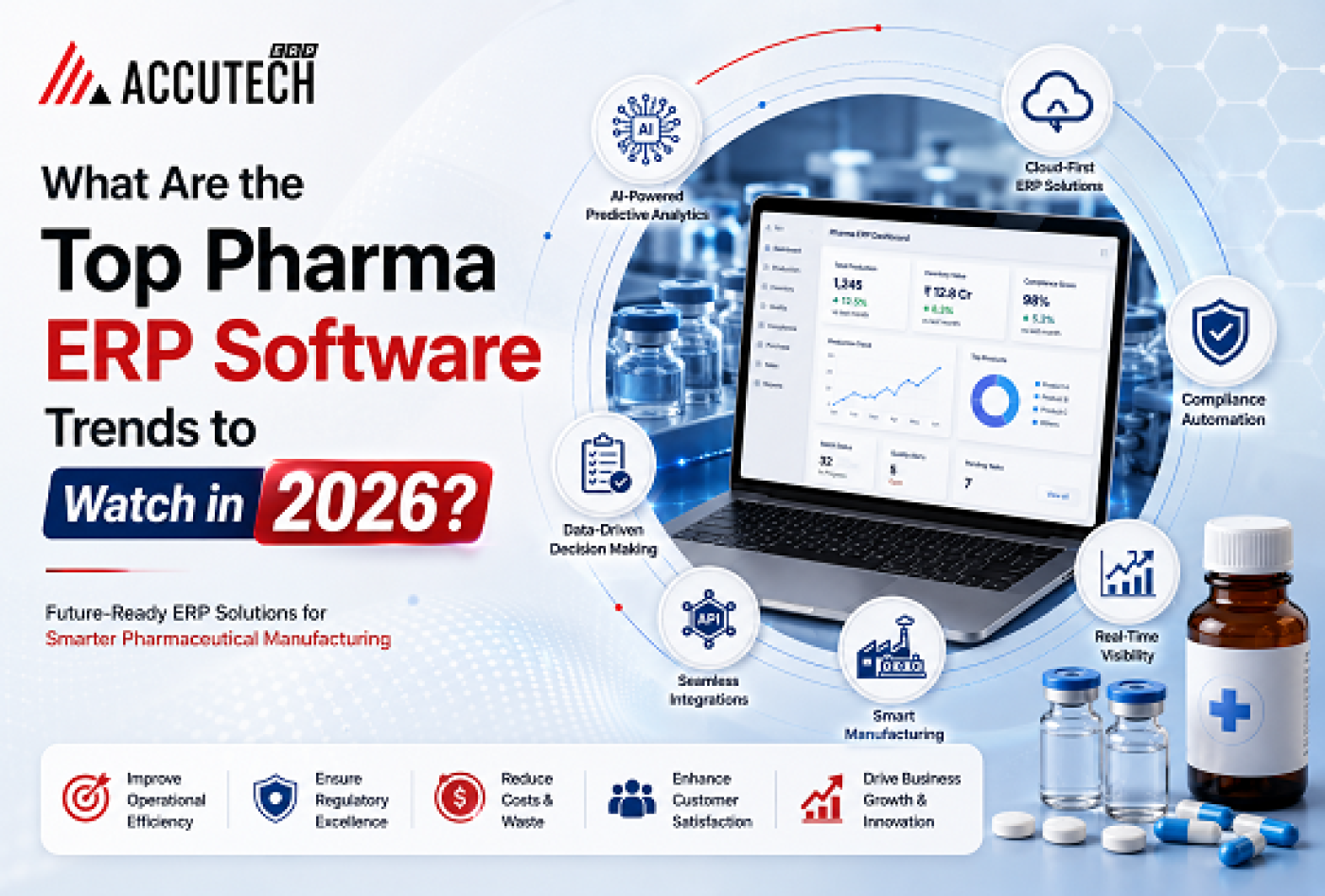
Trend #1: AI-Powered Predictive Analytics Moving From Nice-to-Have to Essential
Artificial intelligence has quietly become the backbone of modern pharmaceutical operations, and 2026 is the year it stops being a luxury feature and becomes the standard expectation.
Three years ago, AI-powered analytics in pharmaceutical ERP systems were mostly experimental fancy dashboard features that caught executives' attention at trade shows but rarely drove real operational value. Today, that's changed dramatically.
Here's what's happening: Modern pharma ERP software is now using machine learning algorithms that learn from your historical production data, supply chain patterns, and market demands to predict exactly what will happen next.
Real-World Impact:
• Demand forecasting that's 40-60% more accurate than traditional methods
• Automatic alerts for potential supply chain disruptions weeks in advance
• Predictive maintenance that catches equipment issues before they cause production stoppages
• Optimized production scheduling that reduces waste and maximizes throughput
What makes 2026 different is that this technology is becoming accessible even to mid-market pharmaceutical companies. Previously, only mega-corporations with massive IT budgets could implement sophisticated predictive analytics. Now, cloud-based pharmaceutical manufacturing ERP software providers are democratizing these capabilities.
Trend #2: Cloud-First Architecture Becoming Non-Negotiable
Remember when 'cloud' felt like a risky, theoretical concept in pharma? Those days are gone. In 2026, the question isn't whether to go cloud, it's which cloud architecture makes the most sense for your specific operations.
The migration from on-premises to cloud-based pharmaceutical ERP systems has accelerated dramatically. Here's why: Cloud infrastructure provides the flexibility, scalability, and security that modern pharmaceutical manufacturing demands.
Key Advantages Driving Cloud Adoption:
• Automatic security updates and compliance patches critical for regulated industries
• Seamless scalability as your manufacturing volumes grow or fluctuate
• Global accessibility your team can access the system from anywhere, anytime
• Reduced IT overhead and infrastructure costs
• Built-in disaster recovery and business continuity capabilities
For pharmaceutical companies, particularly those managing complex multi-site operations, cloud-based pharma ERP software provides unprecedented visibility and control. You can monitor production metrics across all your facilities in real-time, coordinate supply chains globally, and respond to issues with agility that on-premises systems simply can't match.
Trend #3: Regulatory Compliance Automation Transforming a Burden Into a Competitive Advantage
Here's a statistic that resonates with every pharmaceutical manufacturer: compliance-related tasks now consume 30-40% of operational time in most organizations. FDA regulations, GxP requirements, traceability mandates, quality documentation the regulatory landscape is a labyrinth that keeps getting more complex.
2026 marks a turning point. Modern pharmaceutical manufacturing ERP software is embedding compliance automation at its core, transforming what used to be a purely manual, error-prone process into something streamlined and intelligent.
Compliance Features Now Standard in Leading ERP Solutions:
• Automated batch record generation that meets FDA 21 CFR Part 11 requirements
• Real-time track-and-trace capabilities for complete supply chain visibility
• Integrated quality management systems that capture data at the point of production
• Automatic audit trail generation with tamper-proof documentation
• Built-in alerts for upcoming compliance deadlines and regulatory changes
Think about the real-world impact: An audit that used to require three weeks of team members pulling documents and compiling reports can now be completed in days. Your pharmaceutical ERP system automatically maintains the documentation that regulators need, letting your quality assurance team focus on actually improving processes rather than creating compliance paperwork.
Trend #4: Integration Ecosystem and API-First Design
No pharmaceutical company operates in isolation. You're using specialized software for quality management, perhaps a separate system for supplier relationship management, maybe another for demand planning. Your pharma ERP software needs to talk seamlessly with all of these tools.
In 2026, the best pharmaceutical manufacturing ERP software solutions are designed with an API-first architecture. This means they're built from the ground up to integrate with other systems, rather than integration being an afterthought.
Why This Matters:
• Data flows seamlessly between systems without manual entry or transformation
• You're not locked into a single vendor's ecosystem you can choose best-of-breed solutions for each function
• Your system can integrate with emerging technologies and tools as they become available
• Total cost of ownership decreases because you avoid custom coding for integrations
Trend #5: Real-Time Visibility and Advanced Analytics Dashboards
Here's something that would have seemed like science fiction ten years ago: A pharmaceutical plant manager can now pull up a real-time dashboard on their phone and see exactly what's happening across their entire manufacturing operation. Production rates, inventory levels, quality metrics, equipment status all updating in real-time.
Modern pharmaceutical ERP systems are incorporating sophisticated analytics dashboards that provide visibility into every aspect of your operation. And 2026 is seeing these dashboards become increasingly intelligent, predictive, and personalized.
The Evolution of Dashboards:
• From static reports to dynamic, interactive visualizations
• From historical data to real-time insights and forward-looking predictions
• From generic dashboards to role-specific views that show each user exactly what they need
• From desktop-only access to mobile-first design that works everywhere
Practical Example: A quality manager can see which batches are approaching specification limits before the issue becomes critical. A supply chain manager can identify potential supplier disruptions days in advance. A production scheduler can optimize line assignments to minimize changeovers. All of this is powered by real-time data flowing through their pharmaceutical manufacturing ERP software.
Myths vs. Facts: Understanding Pharmaceutical ERP Software in 2026
Myth #1: Implementing a new ERP system will disrupt our operations for months
Fact: Modern cloud-based pharma ERP software can be implemented using phased approaches or parallel implementations, minimizing disruption. Many companies successfully transition in 3-6 months with minimal impact on daily operations. The key is choosing an implementation partner with pharmaceutical industry expertise.
Myth #2: Cloud ERP solutions aren't secure enough for regulated pharmaceutical environments
Fact: Leading cloud-based pharmaceutical ERP systems actually provide superior security compared to on-premises systems. They include enterprise-grade encryption, multi-factor authentication, regular security audits, and compliance certifications (like SOC 2, ISO 27001) that exceed what most pharmaceutical companies could achieve independently.
Myth #3: You need to replace all your existing systems to benefit from modern ERP
Fact: Modern pharmaceutical manufacturing ERP software is designed to work alongside your existing tools through APIs and integrations. You can implement a new ERP system gradually, maintaining your legacy systems until you're ready to migrate, reducing risk and cost.
Myth #4: Implementation costs for ERP systems are prohibitively expensive
Fact: While ERP implementation requires investment, cloud-based solutions have significantly lower total cost of ownership than on-premises systems. You eliminate infrastructure, IT staff, and maintenance costs. Many cloud-based pharmaceutical ERP systems also offer subscription models that spread costs over time, making them more financially manageable for mid-market companies.
Practical Implementation Tips: Making Your Transition Smooth
If you're considering implementing a new pharmaceutical ERP system in 2026, here are practical steps to ensure success:
- Conduct a Thorough Current State Assessment
Before you make any decisions, understand exactly how your current operations work. Document your processes, identify pain points, and understand your data structures. This foundation is critical for selecting the right solution and implementing it effectively.
- Define Clear Business Objectives
What do you want to achieve? Better compliance? Improved inventory management? Faster production cycles? Clear objectives guide the selection process and help you measure success. They also keep stakeholders aligned throughout the project.
- Prioritize Change Management
Technology is important, but people are critical. Invest in comprehensive training, maintain open communication with your teams, and address concerns proactively. Users who understand why the change is happening and how it benefits them become champions rather than resistors.
- Plan for Data Migration Carefully
Data quality is crucial. Before migration, clean your data, validate completeness, and establish backup procedures. Poor data migration can undermine the benefits of your new system. Many implementation problems trace back to data quality issues.
- Take a Phased Implementation Approach
Rather than going live with everything at once, implement your pharmaceutical manufacturing ERP software in phases. Maybe you start with financials and manufacturing, then add supply chain, then advanced features. This reduces risk and gives your team time to adapt.
- Establish Strong Governance
Have clear ownership and decision-making processes. Establish a steering committee that includes key stakeholders from operations, IT, quality, and finance. This governance structure keeps the project moving forward and ensures alignment across departments.
Frequently Asked Questions:
Q1: How long does it typically take to implement a pharmaceutical ERP system?
Implementation timelines vary based on the complexity of your operations and your current systems landscape. For mid-market pharmaceutical companies using a phased approach, expect 3-6 months. Larger implementations with complex integrations might take 8-12 months. The key is working with experienced implementation partners who understand pharmaceutical workflows.
Q2: What should we look for when choosing a pharmaceutical ERP vendor?
Look for vendors who have deep pharmaceutical industry expertise, especially in your specific market segment (APIs, finished goods, contract manufacturing, etc.). Verify their compliance certifications, check their security and disaster recovery capabilities, and ask for references from companies similar to yours. Ensure they have robust APIs and integration capabilities. Finally, evaluate their roadmap. Do they continue to innovate and address emerging industry needs?
Q3: How does cloud-based pharmaceutical ERP handle data security and FDA compliance?
Leading cloud-based pharmaceutical ERP systems are specifically designed to meet FDA 21 CFR Part 11 requirements. They include data encryption in transit and at rest, comprehensive audit trails, user authentication and authorization controls, and immutable records. They undergo regular third-party security audits and maintain compliance certifications. Many offer specific compliance modules designed for pharmaceutical manufacturing.
Q4: Can we integrate our new ERP with our existing quality management system?
Yes, modern pharma ERP software is built with an API-first architecture specifically designed for integrations. Most vendors offer pre-built connectors to popular quality management systems. If a specific connector doesn't exist, the open API allows for custom integration development.
Q5: What is the typical ROI timeline for implementing pharmaceutical ERP software?
Most pharmaceutical manufacturers see measurable ROI within 12-18 months of implementation, with some benefits appearing within the first 3-6 months. The ROI comes from reduced manual processes, fewer compliance issues, improved inventory management, and better production efficiency. Cloud-based solutions typically show faster ROI due to lower infrastructure and implementation costs.
Q6: How do we ensure employee adoption of new pharmaceutical manufacturing software?
Employee adoption is critical to ERP success. Best practices include: comprehensive training programs, dedicated super-users who champion the system, change management strategies that address concerns, and phased rollouts that allow users to adapt gradually. Modern systems with intuitive interfaces also help if the software is easy to use, adoption naturally follows.
Specialized Pharmaceutical Solutions: Understanding Pharma PCD Focus
It's worth noting that some pharmaceutical ERP solutions specialize in specific business models. Pharmaceutical PCD (Pharma Cooperative Distribution) operations have unique requirements distinct from traditional pharmaceutical manufacturing. While general-purpose pharmaceutical ERP systems can handle PCD operations, specialized solutions designed specifically for this model often provide better fit.
PCD-focused systems typically excel at managing:
• Complex distributor-manufacturer relationships and incentive structures
• Territory management and direct sales force operations
• Stockist inventory management across multiple locations
• Regulatory compliance specific to distributed pharmaceutical operations
• Demand generation and market feedback integration
If your pharmaceutical business operates through the PCD model, evaluating pharma ERP software solutions with specific PCD expertise can provide significant advantages in implementation speed and ongoing operational efficiency.
Looking Forward: Preparing Your Organization for 2026 and Beyond
The pharmaceutical industry is at an inflection point. The trends shaping 2026 AI-powered analytics, cloud-native architecture, compliance automation, advanced integration capabilities, and real-time visibility aren't temporary fads. They're fundamental shifts in how successful pharmaceutical companies operate.
The question for you isn't really whether these trends matter. They do. The question is: how quickly can you adopt them? The competitive advantage belongs to companies that embrace modern pharmaceutical ERP systems today, not tomorrow.
Companies that wait too long will find themselves behind. Their compliance costs will continue to be high. Their operational inefficiencies will compound. Their teams will be doing the same manual work that was standard a decade ago. And they'll find that catching up becomes increasingly difficult as the technology gap widens.
But here's the encouraging part: The path forward is clear. The technologies exist. The proven implementations are there. References from companies just like yours show that these transitions work. What's required is commitment and the right partner to guide you through the journey.
Conclusion:
Remember Raj Kumar from the beginning of this article? Three years ago, his company was struggling with spreadsheets and manual processes. Today, they're operating a modern, efficient, compliant pharmaceutical manufacturing business powered by cloud-based pharmaceutical manufacturing ERP software. His story could be yours.
The trends we've covered in this article AI-powered analytics, cloud-first architecture, compliance automation, advanced integrations, and real-time visibility represent real opportunities for pharmaceutical manufacturers to improve operations, reduce costs, enhance compliance, and position themselves for future growth.
2026 is the year when modern pharma ERP software transitions from 'competitive advantage' to 'basic requirement.' The companies that make this transition successfully will thrive. Those that delay will find themselves increasingly at a disadvantage.
If you're running a pharmaceutical manufacturing or PCD operation, now is the time to evaluate your current systems, understand your options, and start planning your path to modern pharmaceutical ERP systems. The investment you make today will pay dividends for years to come.
Ready to Explore Your Options?
If you'd like to learn how modern pharmaceutical ERP solutions can transform your operations, we're here to help. Visit Accutech ERP to explore how our specialized pharma ERP software can address your specific needs.