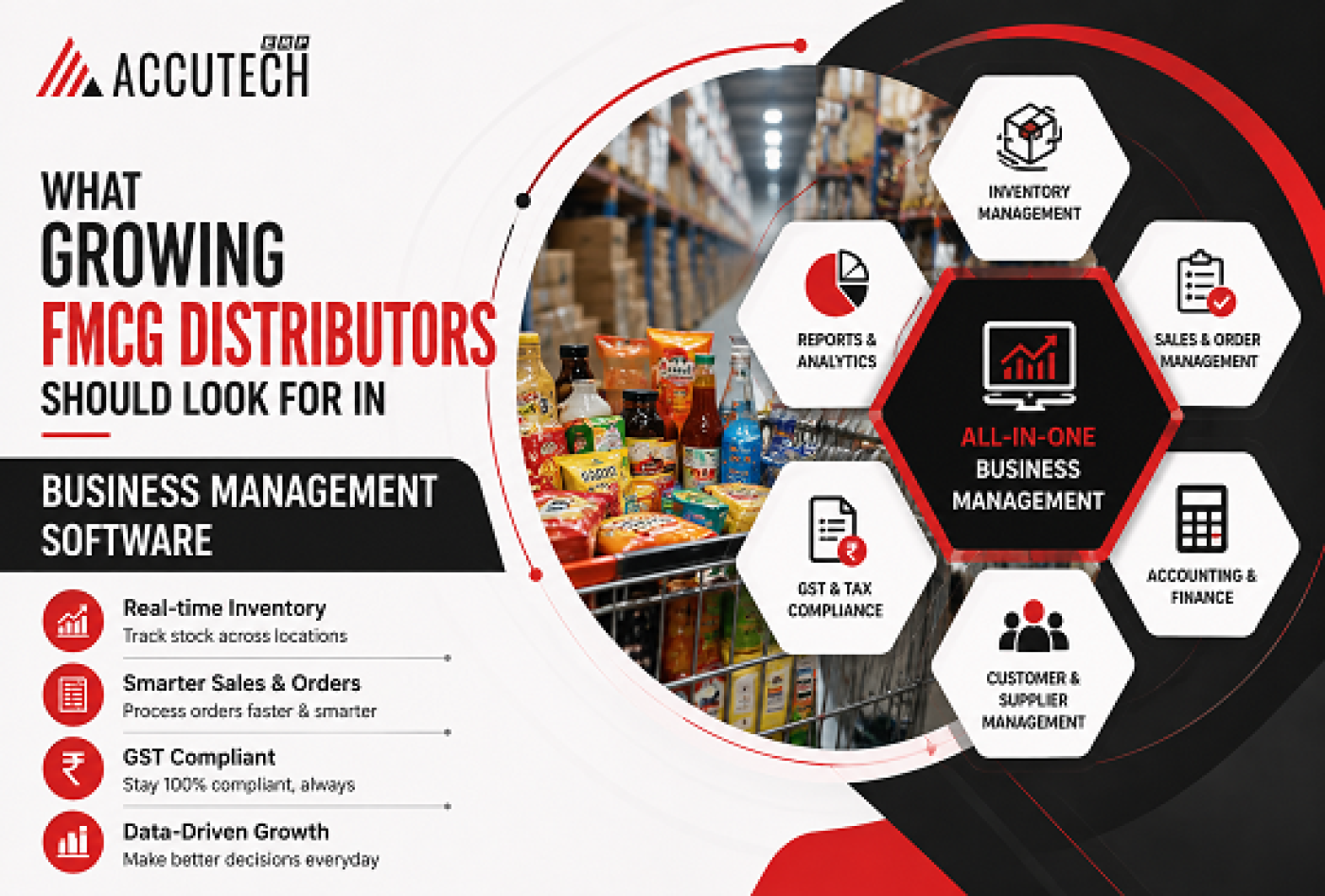
The Fast-Moving Consumer Goods (FMCG) industry operates at an unprecedented pace. Businesses managing this sector face constant pressure to deliver products faster, maintain optimal inventory levels, ensure regulatory compliance, and make data-driven decisions all while scaling operations. This is where FMCG distribution ERP software becomes indispensable.
As your distribution network grows from managing a single warehouse to overseeing multiple locations, manual processes become your biggest bottleneck. Spreadsheets fail to track real-time inventory. Traditional accounting systems struggle with GST compliance. Sales teams lack visibility into stock levels. Suppliers complain about delayed order confirmations. Customers demand faster deliveries.
A robust FMCG distribution business software solves these challenges by integrating inventory, sales, accounting, and compliance into one unified platform. But with countless options available, how do you choose the right system for your business?
This comprehensive guide walks you through everything growing FMCG distributors should evaluate when selecting business management software. Whether you're just starting your distribution journey or scaling to multiple states, this article provides actionable insights to guide your decision.
Understanding FMCG Distribution Challenges
Before selecting the right solution, it's crucial to understand the specific pain points that FMCG distributors face daily.
Inventory Management Complexity
FMCG products come with short shelf lives, high turnover rates, and constantly fluctuating demand. Managing hundreds of SKUs across multiple distribution centers without real-time visibility leads to stockouts and overstocking simultaneously, a costly problem affecting your profitability.
GST Compliance Burden
India's Goods and Services Tax system requires meticulous documentation and regular filing. A single error in HSN classification, tax rate application, or invoice generation can trigger compliance issues. Manual tracking across invoices, credit notes, and reconciliations becomes increasingly difficult as transaction volume grows.
Multi-Location Coordination
Expanding from a single warehouse to multiple cities introduces complexity in coordinating inventory, pricing, and sales data. Maintaining consistent standards while allowing regional customization requires a system that can handle multi-entity operations seamlessly.
Demand-Supply Misalignment
Without real-time sales and inventory insights, predicting demand becomes guesswork. This leads to lost sales opportunities, increased carrying costs, and poor cash flow management.
Why Business Management Software Matters
FMCG distribution ERP software transforms your business operations by automating manual processes and providing real-time business intelligence. Here's why investing in proper ERP for FMCG distribution is critical for growth:
Operational Efficiency
Automation reduces manual data entry errors and accelerates order processing. When your team spends 60% of their time entering data into spreadsheets, they're not focused on growing relationships or solving customer problems. Proper FMCG distribution software eliminates this waste.
Financial Accuracy
Integrated accounting ensures consistent financial records across all operations. Real-time P&L statements, cash flow tracking, and receivables management help you make informed financial decisions quickly.
Compliance Assurance
Built-in GST workflow automation reduces compliance risks. The system tracks all transactions, generates required reports automatically, and maintains audit trails crucial for passing tax audits with confidence.
Scalability
As you expand to new locations, FMCG erp software scales effortlessly. Multi-branch support, inter-location transfers, and centralized reporting enable growth without system limitations.
Key Features to Look For
Not all systems are created equal. When evaluating business management software for FMCG operations, prioritize these essential features:
Feature Category | What to Look For |
Inventory Management | Real-time stock tracking, multi-location warehouse support, automatic reorder points, batch/expiry tracking, transfer management |
Sales & Orders | Fast invoice generation, bulk order processing, credit note management, sales return tracking, customer-wise reporting |
GST Compliance | Automated GSTR-1/2 filing, HSN classification, tax rate mapping, return visibility, invoice-level audit support |
Accounting | Automated journal entries, real-time P&L, balance sheet generation, outstanding tracking, account reconciliation |
Reporting | Party-wise sales reports, product-wise sales, pending order tracking, financial statements, dashboards |
Inventory Management Excellence
Core to any FMCG distribution business software is sophisticated inventory management. Here's what matters:
Real-Time Stock Visibility
Your team should see current stock levels across all warehouses instantly. When a sales representative calls a customer, they need immediate confirmation on product availability. Outdated inventory data leads to missed opportunities and customer dissatisfaction.
Multi-Warehouse Coordination
Growing FMCG distributors operate from multiple locations. Quality business management software should automatically route orders to the nearest warehouse, manage inter-location transfers, and consolidate inventory reports across all locations seamlessly.
Batch & Expiry Tracking
FMCG products have expiry dates. Your system must track batches, alert you before expiry, and prioritize batch rotation (First In First Out). This prevents waste and ensures customers receive fresh products.
Automated Reorder Management
The system should automatically suggest purchase orders when stock reaches minimum levels. This prevents stockouts and reduces carrying costs critical for profitability in the FMCG sector.
Real-Time Sales & Order Management
FMCG distributors process high-volume transactions daily. Your FMCG erp software must handle this with speed and accuracy:
Bulk Invoice Generation
Processing 100+ invoices daily manually is time-consuming and error-prone. The system should generate professional invoices automatically with correct tax calculations, party details, and item specifications.
Mobile Order Processing
Field sales teams need to process orders on-the-go. Mobile compatibility allows your team to take orders, confirm availability, and update stock immediately improving customer service and reducing order cycle time.
Sales Return Management
Damaged goods, quality issues, or customer returns are common in FMCG. The system should process credit notes, reverse journal entries, and update inventory automatically.
Customer Analytics
Understanding which customers contribute most to your revenue is vital. FMCG distribution software should provide party-wise sales trends, average order value, and purchase history.
GST Compliance & Automated Reporting
For Indian FMCG distributors, GST compliance is non-negotiable. The right business management software simplifies this complexity:
Automated HSN Classification
Each FMCG product requires correct HSN (Harmonized System of Nomenclature) coding and tax rate application. The system should maintain a product master with pre-configured HSN codes to prevent tax rate errors in invoices.
GSTR-1 & GSTR-2A Support
Filing monthly GST returns should be automated. FMCG distribution ERP software generates GSTR-1 (outbound) and reconciles with GSTR-2A (inbound) automatically. This reduces manual effort and filing errors significantly.
Tax Audit Trail
During tax audits, you need to produce invoice-level transaction details instantly. The system should maintain complete audit trails showing which invoice was issued, when, to whom, and at what tax rate.
ITC Tracking
Input Tax Credit (ITC) tracking ensures you claim all eligible tax credits on purchases. The system should automatically match supplier invoices and GST payments with your records.
Multi-Branch & Multi-Entity Support
Growth means expansion. Your FMCG distribution business software must scale across locations:
Centralized Dashboard
View consolidated performance across all branches from one dashboard. See total sales, inventory levels, profitability, and compliance status at a glance.
Branch-Level Autonomy
Different branches may have different pricing strategies, customer bases, and operational challenges. The system should allow branch-level customization while maintaining corporate standards.
Inter-Location Transfers
Moving stock between branches should be automated. The system tracks transfer requests, automatically reduces stock at the source location, and increases it at the destination maintaining inventory accuracy.
Advanced Analytics & Business Intelligence
Data-driven decisions separate successful distributors from struggling ones:
Sales Trend Analysis
Identify which products are selling faster, which customers are most profitable, and which time periods show peak demand. This helps inventory planning and marketing decisions.
Profitability Reports
See profit margins by product, customer, and region. Some high-volume sales may have razor-thin margins while others generate substantial profits. Understanding this is crucial.
Forecast Tools
Predictive analytics help forecast demand based on historical trends. This enables better inventory planning and cash flow management.
Integration Capabilities
Your FMCG distribution software doesn't exist in isolation. It should integrate seamlessly with:
Banking Systems
Direct bank feeds eliminate manual reconciliation. The system automatically imports bank statements and matches them with your records.
E-commerce Platforms
If you sell online, the system should sync orders, inventory, and customer data automatically with your e-commerce platform.
Mobile Apps
Field staff need mobile access to process orders, check inventory, and update deliveries. The system should have a robust mobile application.
Cost Considerations
Budget is always a concern. When evaluating FMCG erp software costs, consider:
Software Licensing
Options range from per-user seat licenses to unlimited user models. For growing distributors with many field staff, unlimited seat licenses often provide better value.
Implementation & Setup
Data migration, system configuration, and team training are often separate costs. Budget 2-3 months for implementation and expect costs proportional to your complexity.
ROI Timeline
Look for systems promising 6-12 month ROI through efficiency gains. A robust FMCG distribution business software should reduce manual hours, minimize errors, and improve cash flow offsetting its cost quickly.
Choosing the Right Solution
With numerous options available, follow this decision framework:
Assess Your Current Pain Points
Document specific challenges your team faces. Are you struggling with inventory accuracy? Manual invoicing consuming time? GST compliance worries? Prioritize solutions addressing your biggest pain points.
Request Detailed Demos
See the system in action using your data. Don't just watch a polished sales demo test it with realistic transaction volumes and workflows.
Check Industry Expertise
Is the vendor experienced with FMCG distribution? Do they understand your industry's unique challenges? References from similar businesses are invaluable.
Evaluate Support & Training
Excellent software with poor support becomes a nightmare. Ensure the vendor provides responsive support, comprehensive training, and accessible documentation.
Implementation Best Practices
Choosing good business management software is half the battle. Implementation determines real success:
- Start with a Pilot Program
Implement at one branch or region first. Learn lessons before full rollout across all operations. This reduces risk and allows optimization before company-wide deployment.
- Clean Your Master Data
Before migration, audit and clean your existing data. Migrate with complete, accurate records. Garbage in, garbage out poor data entry before migration creates problems lasting months.
- Comprehensive Team Training
Invest heavily in training. Every team member using the system should understand its capabilities. Offer role-specific training: accountants learn reporting, warehouse staff learn inventory management, field staff learn mobile app usage.
- Phased Rollout
Don't switch everything overnight. Gradually transition from old systems to the new FMCG distribution business software. Run both systems in parallel initially to ensure accuracy before full cutover.
Common Mistakes to Avoid
Lessons from failed implementations:
Choosing Based on Price Alone
The cheapest FMCG distribution software often lacks features, support, and scalability. Consider the total cost of ownership, not just upfront price.
Inadequate Change Management
Teams comfortable with legacy systems resist new software. Without proper change management and communication, adoption suffers.
Poor Configuration
Rushing configuration leads to systems not matching your workflows. Business management software should adapt to how you work, not force you to change established processes.
Ignoring Data Security
Your financial and customer data is sensitive. Ensure the vendor provides robust security, regular backups, and compliance with data protection regulations.
Frequently Asked Questions (FAQs)
Q1: What is FMCG distribution ERP software?
FMCG distribution ERP software is an integrated system managing inventory, sales, accounting, and compliance for Fast-Moving Consumer Goods distributors. Any distributor handling multiple SKUs, multiple locations, or significant transaction volumes benefits from this specialized solution.
Q2: How does FMCG erp software help with GST compliance?
The software automates tax calculations, maintains audit trails, generates GSTR-1/2 returns automatically, tracks HSN classifications, and enables invoice-level tax reporting. This dramatically reduces manual compliance effort.
Q3: Can FMCG distribution business software handle multiple warehouse locations?
Yes. Modern business management software is designed for multi-location operations. It tracks inventory across warehouses, routes orders optimally, manages inter-location transfers, and provides consolidated reporting.
Q4: What's the typical implementation timeline?
Implementation typically takes 2-4 months depending on your business complexity. This includes data migration, system configuration, user training, and parallel testing before full cutover.
Q5: How does FMCG distribution software improve inventory accuracy?
Real-time inventory tracking, automated stock transfers, batch rotation (FIFO), expiry alerts, and automatic reorder suggestions contribute to inventory accuracy. This reduces stockouts and overstocking significantly.
Q6: What kind of reporting does the software provide?
Comprehensive reporting includes sales summaries, party-wise sales analysis, product-wise performance, pending order tracking, financial statements (P&L, balance sheet), GST reports, and custom dashboards.
Q7: Is mobile access important for distributors?
Yes, absolutely. Field teams need mobile apps to check inventory, process orders, confirm deliveries, and update records on-the-go. Mobile capabilities significantly improve operational efficiency.
Q8: How much does FMCG distribution business software cost?
Costs vary based on business size and features. Cloud solutions typically cost ₹10,000-50,000+ monthly. On-premise solutions involve higher upfront costs but lower ongoing expenses. Implementation costs usually range from ₹50,000-500,000+ depending on complexity.
Q9: What support should I expect?
Quality vendors provide comprehensive training, documentation, video tutorials, and ongoing support. Look for live support (chat, phone, email), dedicated account managers, and regular system updates.
Q10: Can FMCG distribution software integrate with existing systems?
Most modern FMCG erp software supports integrations with banking systems, e-commerce platforms, payment gateways, and other business tools through APIs. This ensures smooth data flow across your entire ecosystem.
Conclusion:
Growing FMCG distributors face a clear choice: continue struggling with outdated manual processes, or invest in modern FMCG distribution business software that drives efficiency, accuracy, and growth.
The right business management software is not about having unnecessary or complicated features. It is about solving real operational challenges such as inventory accuracy, GST compliance, multi-branch coordination, order management, accounting, and real-time reporting. Solutions like Accutech ERP help FMCG distributors manage these important business processes through a more organized and centralized system.
Implementation requires commitment from management support to comprehensive team training. But the payoff is substantial: reduced manual work, improved accuracy, faster order processing, better customer service, and increased profitability.
Before making a final decision, businesses should evaluate their options carefully. Request detailed product demonstrations, understand the features, speak with existing customers, and review the quality of after-sales support. Choosing Accutech ERP based on specific operational requirements can help FMCG distributors build a more efficient, scalable, and growth-ready business.