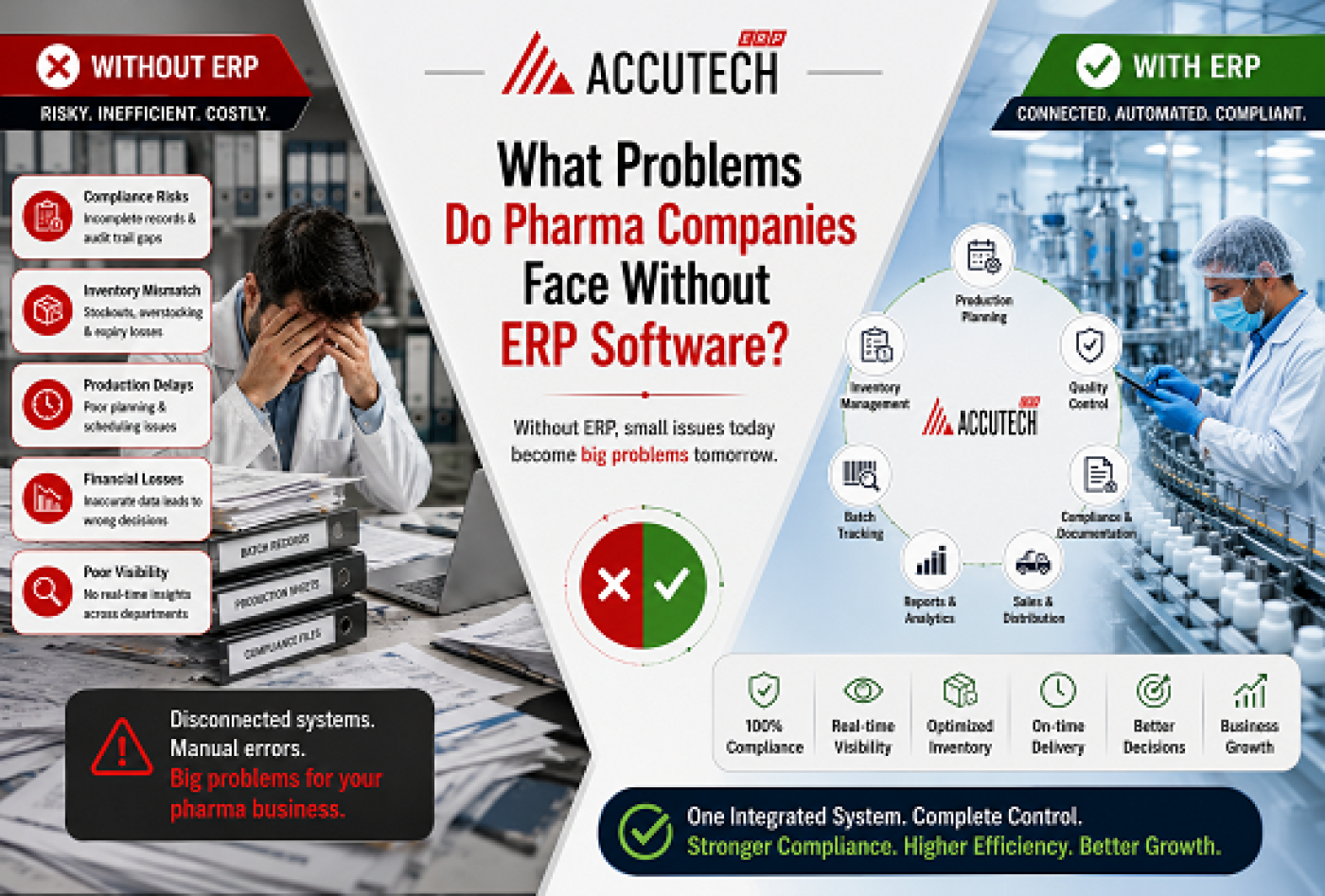
The pharmaceutical industry operates under unprecedented pressure. Strict regulatory requirements, complex supply chains, volatile market demands, and stringent quality standards create an environment where inefficiency isn't just a business problem, it's a compliance risk.
Yet countless pharma and PCD (Propaganda for Cyclopentadiene-based products, more accurately Pharma Company Distributor) companies continue operating with fragmented legacy systems, manual processes, and disconnected spreadsheets. The consequences are severe: regulatory violations, medication errors, inventory mismanagement, missed deadlines, and hemorrhaging operational costs.
This article explores the critical problems pharma companies face without modern ERP software and why implementing a robust pharma manufacturing software solution like Accutech ERP has become essential for survival in 2026.
Whether you operate a small PCD business, manage a mid-sized pharmaceutical manufacturer, or oversee complex multi-facility operations, understanding these challenges is the first step toward operational transformation.
Critical Problems Pharma Companies Face Without ERP Software
The pharmaceutical manufacturing landscape has fundamentally changed. What worked five years ago cobbled-together systems, manual data entry, disparate databases has become a liability. Modern pharma companies require integrated pharmaceutical manufacturing ERP software to remain competitive and compliant.
The problem is acute. According to industry research, 70% of pharmaceutical manufacturing errors stem from manual data entry and process breakdowns. Meanwhile, regulatory bodies impose stricter penalties annually for compliance violations.
Without proper pharma ERP software, companies operate in a state of organized chaos and they often don't realize it until an audit, recall, or production crisis forces the issue.
The Pharmaceutical Industry Landscape in 2026
Current Market Challenges
The pharmaceutical industry faces a perfect storm of pressures:
Regulatory Complexity
- GMP (Good Manufacturing Practices) requirements have become increasingly stringent
- FDA, EMA, and regional regulators demand complete traceability from raw materials to final product
- Audit trails must be tamper-proof and comprehensive
- Documentation requirements have exploded exponentially
Supply Chain Volatility
- Post-pandemic supply disruptions continue affecting raw material availability
- Geopolitical tensions impact ingredient sourcing
- Quality variations from different suppliers require rigorous testing
- Demand forecasting has become increasingly unpredictable
Competitive Pressure
- Margins are tightening as generic competition increases
- Development timelines for new drugs are shrinking
- Customer expectations for delivery speed have risen dramatically
- Cost efficiency has become a primary differentiator
Operational Complexity
- Multi-facility operations require centralized coordination
- Batch sizes vary dramatically across product lines
- Customer specifications and customization requests increase daily
- Quality standards demand zero tolerance for errors
This landscape demands pharmaceutical manufacturing software that can handle complexity while maintaining rigid compliance standards. Yet many companies still rely on outdated systems that were never designed for modern pharmaceutical challenges.
Critical Problems Without Pharma Pcd ERP Software
Problem 1: Compliance & Regulatory Failures
The Core Issue
Regulatory agencies don't care about your excuses. They care about documentation, traceability, and proof of compliance. Without pharma PCD ERP software, maintaining compliant operations becomes nearly impossible.
Specific Challenges:
Incomplete Audit Trails: Manual processes create gaps in documentation. When auditors request complete manufacturing records, companies struggle to compile comprehensive, chronological data across all operations.
Batch Traceability Problems: Without automated batch tracking pharmaceutical systems, linking raw materials to finished products becomes a time-consuming detective exercise. One failed batch might affect hundreds of units with no clear way to identify which ones.
Record Keeping Nightmares: Regulatory bodies require documentation that proves:
- Quality testing at every stage
- Temperature monitoring during storage
- Personnel credentials and training records
- Equipment calibration histories
- Deviation investigations and resolutions
Manual systems fail spectacularly at maintaining this documentation comprehensively.
Compliance Inconsistency: Different facilities might follow slightly different procedures. Without a centralized pharmaceutical manufacturing ERP software system enforcing standardization, compliance becomes inconsistent and unpredictable.
Real Cost:
A single FDA warning letter can cost millions in remediation, legal fees, and lost business. Non-compliance can result in:
- Complete facility shutdown
- Product recalls affecting entire batches
- Criminal liability for executives
- Permanent business damage
Problem 2: Production Planning & Scheduling Chaos
The Core Issue
Manufacturing without proper planning software resembles controlled chaos. Production teams juggle multiple orders, react to emergencies, and scramble to meet deadlines all while maintaining quality standards.
Specific Challenges:
- Inaccurate Demand Forecasting: Without pharmaceutical manufacturing software that integrates sales data, companies guess at production needs. This leads to either:
- Overproduction of slow-moving products (wasted resources and shelf life concerns)
- Underproduction of high-demand items (missed revenue and customer frustration)
Resource Bottlenecks: Pharma production requires specialized equipment, trained personnel, and validated processes. Without optimization:
- Production lines sit idle waiting for resources
- Rush orders disrupt carefully planned schedules
- Equipment maintenance gets deferred to meet deadlines
- Quality suffers when rushing products through the line
Scheduling Conflicts: Multiple product batches compete for limited manufacturing capacity. Without pharma ERP software optimization:
- Priority conflicts cause chaos
- Rush orders disrupt planned production
- Lead times become unpredictable
- Customer commitments are frequently missed
No Production Visibility: Management has no real-time view of production status. Questions like "Will we meet this week's commitments?" require manual investigation rather than dashboard visibility.
Changeover Inefficiencies: Switching between products on the same line requires extensive cleaning and validation. Without optimization:
- Unnecessary changeovers waste time and resources
- Improper sequencing creates rework
- Validation gaps risk contamination
Real Cost:
Production delays directly impact revenue. A single delayed shipment might cost:
- Missed quarterly targets
- Unhappy customers switching to competitors
- Penalties for late delivery
- Lost goodwill in the market
Problem 3: Quality Control & Batch Management Failures
The Core Issue
Quality isn't optional in pharmaceuticals, it's fundamental. Yet without pharmaceutical quality assurance software, maintaining consistent quality across all batches becomes nearly impossible.
Specific Challenges:
Inconsistent Testing Standards: Different technicians might interpret quality requirements differently. Without standardized pharmaceutical quality assurance software:
- Some batches pass that should fail (patient safety risk)
- Some batches fail that should pass (waste and unnecessary costs)
- Testing protocols lack consistency
- Documentation of testing rationale is incomplete
Quality Issues Go Undetected: Without real-time monitoring and batch tracking pharmaceutical systems:
- Equipment malfunctions aren't noticed until products fail testing
- Temperature deviations during storage aren't recorded
- Contamination events happen undetected until final testing
- Root causes of failures remain unclear
Incomplete Investigation Records: When batches fail quality testing:
- Root cause analysis becomes fragmented and incomplete
- Corrective actions aren't systematically tracked
- Learning from failures doesn't transfer across the organization
- Similar failures recur because lessons aren't embedded
Lack of Real-Time Quality Data: Production supervisors don't know quality status until testing is complete often weeks after production. By then, corrective action is impossible.
Batch Reconciliation Problems: Tracking materials in versus final products out becomes difficult:
- Materials mysteriously go missing (or are found in wrong places)
- Batch yields don't match calculations
- Accounting can't reconcile inventory with production records
- Waste calculations are inaccurate
Real Cost:
Quality failures trigger cascading problems:
- Product recalls (regulatory requirement)
- Damaged customer relationships
- Reputation damage in the market
- Patient safety incidents (worst case scenario)
- Substantial regulatory penalties
Problem 4: Inventory Management Chaos
The Core Issue
Pharmaceutical inventory management is far more complex than standard warehousing. Without pharmaceutical inventory management software, tracking becomes a nightmare.
Specific Challenges:
Inaccurate Stock Levels: Manual inventory records frequently don't match physical stock. This creates:
- Unexpected stockouts when you "think" you have product
- Overstocking because counts were wrong
- Inability to fulfill customer orders on time
- Unnecessary emergency purchases at premium prices
Shelf-Life Management Failures: Pharmaceutical products have specific shelf lives. Without automated tracking:
- Products expire before use (wasted cost and inventory)
- Expired products are accidentally shipped to customers (compliance disaster)
- First-in-first-out (FIFO) protocols aren't followed systematically
- Shelf-life extensions aren't properly documented and approved
Storage Condition Violations: Many pharmaceuticals require specific temperature, humidity, and light conditions. Without automated monitoring:
- Temperature excursions go unnoticed
- Humidity damage occurs silently
- Products are stored in improper conditions
- Documentation proving proper storage doesn't exist
Duplicate Orders & Overstocking: Without visibility into actual inventory:
- Multiple people order the same raw materials
- Overstock accumulates unnecessarily
- Cash is tied up in excess inventory
- Storage space becomes a constraint
Lost or Misplaced Materials: Without pharma warehouse management systems:
- Materials can't be located when needed
- Inventory searches consume hours of labor
- Rush ordering occurs unnecessarily
- Shrinkage and loss rates are unknown
No SKU Visibility: Companies don't know:
- Which products are high-turnover
- Which items are slow-moving
- Which raw materials have supply chain risks
- Where inventory is physically located
Real Cost:
Inventory inefficiency drains profitability:
- Wasted products due to expiration
- Obsolete inventory consuming storage
- Emergency purchases at premium costs
- Working capital tied up unnecessarily
- Labor wasted searching for materials
Problem 5: Supply Chain Visibility Gaps
The Core Issue
Pharmaceutical manufacturing is a complex supply chain. Without pharmaceutical supply chain management software, visibility becomes impossible.
Specific Challenges:
No Supplier Performance Data: Companies don't systematically track:
- Which suppliers consistently deliver quality materials
- Whose delivery times are most reliable
- Which suppliers have quality issues
- Cost competitiveness between suppliers
This leads to poor supplier relationships and missed negotiation opportunities.
Regulatory Traceability Failure: Regulations require complete traceability from raw material suppliers through to the final customer. Without integrated pharmaceutical manufacturing ERP software:
- Traceability chains have gaps
- Recall procedures take weeks instead of hours
- Customers can't be notified quickly of issues
- Regulatory penalties escalate
Demand Planning Disconnect: Sales, production, and procurement operate in silos without integrated pharma manufacturing software:
- Procurement orders don't align with actual production needs
- Expedited orders disrupt supply chains unnecessarily
- Supplier relationships suffer from communication breakdowns
- Raw material shortages surprise operations
Quality Source Issues: Without tracking:
- Quality problems from specific suppliers aren't identified
- The same supplier issue repeats across multiple orders
- Supplier qualification becomes inconsistent
- Documentation of supplier validation is incomplete
No Demand Forecasting: Without integrating sales data into pharmaceutical manufacturing software:
- Supply chain can't anticipate needs
- Expensive expedited shipping becomes routine
- Supplier relationships become strained
- Inventory swings wildly between surplus and shortage
Real Cost:
Supply chain inefficiency cascades through the organization:
- Production delays due to material shortages
- Expedited shipping costs eat into margins
- Supplier relationships deteriorate
- Quality issues traced to unvetted suppliers
- Regulatory traceability failures during recalls
Problem 6: Cost Control & Financial Leakage
The Core Issue
Without pharmaceutical manufacturing software integrating production with financial systems, profitability becomes invisible.
Specific Challenges:
Hidden Waste: Companies don't know their true waste rates:
- Scrap and rework costs accumulate silently
- Yield calculations are estimated rather than precise
- Cost of quality failures isn't quantified
- Equipment downtime costs remain unknown
Inaccurate Costing: Without proper pharma ERP software:
- Product costs are estimated rather than calculated
- Profitability analysis is unreliable
- Pricing decisions are made on flawed data
- Unprofitable products aren't identified
This can lead to unprofitable products being produced because true costs are unknown.
Untracked Overhead: Manufacturing overhead (utilities, maintenance, depreciation) isn't allocated to products accurately:
- True product costs remain unclear
- Profitability analysis becomes meaningless
- Pricing strategies aren't based on reality
- Investment decisions suffer from poor data
Labor Inefficiency: Without pharma manufacturing software:
- Time tracking is manual and often inaccurate
- Productivity metrics aren't calculated
- Labor bottlenecks aren't identified
- Overstaffing or understaffing go unnoticed
Emergency Spending: Without planning visibility:
- Unexpected shortages trigger expensive emergency purchases
- Rush orders incur premium charges
- Expedited shipping becomes normal (not exceptional)
- Equipment breakdowns trigger emergency maintenance costs
No Variance Analysis: Financial teams can't answer:
- Why did this month's costs exceed budget?
- Which products are most profitable?
- Where is money being wasted?
- What's driving margin compression?
Real Cost:
Cost control failures directly impact the bottom line:
- Margins compress from unknown waste
- Pricing decisions lack data foundation
- Profitability analysis is unreliable
- Investment decisions lack proper justification
- Competitive advantage erodes as costs exceed competitors'
Problem 7: Data Security & Information Fragmentation
The Core Issue
Pharmaceutical companies handle sensitive data: formulations, regulatory records, customer information, and compliance documentation. Without integrated pharmaceutical manufacturing software, security and data integrity become major risks.
Specific Challenges:
No Centralized Data: Information scattered across multiple systems:
- Production data in one system
- Quality records in spreadsheets
- Inventory in another system
- Financial data separate from manufacturing data
This fragmentation creates:
- Data inconsistencies (same information in multiple places with different values)
- Difficulty answering comprehensive business questions
- Security vulnerabilities from multiple systems
- Regulatory audit nightmares
Security Vulnerabilities: Spreadsheet-based processes create massive security risks:
- Spreadsheets are easily modified without audit trails
- Regulatory agencies reject spreadsheets as unreliable
- Data breaches are difficult to detect
- Access controls are non-existent
- Sensitive formulations could be accidentally shared
Lack of Audit Trails: Without pharma ERP software:
- Changes to critical data leave no record
- Regulatory investigators can't determine who changed what and when
- Compliance audits become impossible
- Data integrity is questionable
Information Access Problems: Without proper database controls:
- Sensitive information becomes accessible to unauthorized personnel
- Formulations could be leaked to competitors
- Quality audit results might be modified
- Compliance documentation could be altered
No Backup & Recovery: Spreadsheet-based data lacks:
- Automated backups
- Disaster recovery procedures
- Data redundancy
- Protection against accidental deletion
A single hard drive crash could destroy years of critical manufacturing data.
Regulatory Non-Compliance: FDA regulations (21 CFR Part 11) require:
- Secure electronic data storage
- Complete audit trails
- Access controls
- Data integrity validation
Spreadsheet-based systems fail all these requirements.
Real Cost:
Data security and fragmentation create multiple risks:
- Regulatory audit failures
- Potential data breaches
- Compliance violations with significant penalties
- Loss of critical business information
- Inability to prove regulatory compliance
Problem 8: Resource Allocation Inefficiencies
The Core Issue
Pharmaceutical manufacturing requires optimized resource allocation: equipment capacity, personnel expertise, and facility utilization. Without planning software, resources are wasted systematically.
Specific Challenges:
Equipment Underutilization: Without pharmaceutical manufacturing software optimization:
- Expensive equipment sits idle for significant periods
- Multiple machines perform similar tasks (redundancy)
- Equipment utilization rates are unknown
- Maintenance windows aren't optimized
- Changeover time wastes capacity
Personnel Misallocation: Without workforce planning:
- Skilled personnel are underutilized
- Bottlenecks occur because key people are unavailable
- Training records don't ensure qualified personnel
- Cross-training opportunities are missed
- Labor costs remain high due to inefficiency
Facility Space Constraints: Without optimization:
- Inventory consumes excessive space
- Storage isn't organized efficiently
- Warehouse utilization is poor
- Facility expansion becomes necessary prematurely
- Leased space is underutilized
Production Scheduling Inefficiency: Without pharma production planning software:
- Products are produced in arbitrary sequences
- Changeover time isn't minimized
- Equipment maintenance is scheduled poorly
- Rush orders cause constant disruption
- Batch sequencing isn't optimized
No Capacity Planning: Management can't answer:
- Can we accept this large customer order?
- When can we feasibly deliver?
- Do we need additional equipment?
- Can we expand production without new investment?
Real Cost:
Resource inefficiency compounds costs throughout operations:
- Equipment investment doesn't generate adequate returns
- Labor productivity is lower than industry benchmarks
- Facility costs are higher due to inefficiency
- Production capacity is constrained unnecessarily
- Growth opportunities are missed due to capacity concerns
Real-world Consequences of Manual Processes
The problems outlined above aren't theoretical. They materialize as concrete business crises:
The Recall Scenario
A pharmaceutical manufacturer receives a quality complaint from a customer. Without batch tracking pharmaceutical software, investigating requires:
- Customer provides batch number and date received
- Quality team manually searches for production records (takes hours)
- Production supervisor retrieves physical batch records (may be in storage)
- Raw material traceability requires searching supplier documentation (may take days)
- Customer notification occurs too late
- Regulatory notification happens after the fact
- Public impact from delayed recall response
With integrated pharma PCD ERP software, this investigation takes minutes:
- Batch lookup instantly shows all materials used
- Traceability to customers is immediate
- Regulatory notifications happen immediately
- Recall is contained quickly
- Reputation damage is minimized
The Audit Failure Scenario
A regulatory auditor arrives and requests:
- Complete documentation of a specific batch
- Proof that all quality testing was performed
- Temperature records during storage
- Personnel training records for everyone involved
Without pharma manufacturing software:
- Information is scattered across multiple locations
- Some documentation might be incomplete
- Audit trails don't exist
- Auditor observation: "Non-compliant facility"
Result: Warning letter, remediation costs, reputation damage
The Financial Crisis Scenario
Year-end financial closing reveals:
- Profitability is lower than expected
- Cost structure is unclear
- Waste rates are unknown
- Inventory is higher than predicted
Management can't explain why costs are high because:
- True product costs are unknown
- Waste isn't tracked
- Overhead allocation isn't calculated
- Production inefficiency is invisible
Without pharmaceutical manufacturing ERP software, improving profitability becomes impossible you can't manage what you can't measure.
How Pharma Manufacturing Software Transforms Operations
Implementing integrated pharma manufacturing software (specifically pharma PCD ERP software like Accutech ERP) transforms operations across multiple dimensions:
Compliance & Regulatory Excellence
With Pharma ERP Software:
- Automatic audit trail creation (21 CFR Part 11 compliant)
- Complete batch traceability instantly available
- Regulatory documentation generated systematically
- Compliance validation happens automatically
- Audit preparation takes hours instead of weeks
Production Planning & Scheduling
With Pharma Manufacturing Software:
- Demand forecasting integrates sales data automatically
- Production scheduling optimizes equipment utilization
- Resource allocation is calculated mathematically
- Real-time production visibility at all times
- Bottlenecks are identified and resolved proactively
Quality Control & Batch Management
With Pharmaceutical Quality Assurance Software:
- Standardized testing protocols enforced consistently
- Real-time quality monitoring during production
- Automatic alert when quality metrics deviate
- Batch reconciliation happens automatically
- Root cause analysis is systematic and documented
Inventory Management
With Pharmaceutical Inventory Management Software:
- Real-time stock visibility across all locations
- Automatic reorder point calculation
- Shelf-life expiration tracking and alerts
- FIFO implementation is automatic
- Storage condition monitoring with temperature/humidity sensors
Supply Chain Optimization
With Integrated Pharmaceutical Supply Chain Software:
- Supplier performance metrics tracked automatically
- Demand-driven procurement aligned with production
- Traceability from suppliers through customers
- Quality tracking by supplier
- Forecast-driven supply chain planning
Cost Control & Profitability
With Pharma ERP Software:
- Actual product costs calculated automatically
- Waste tracking and reporting
- Equipment downtime costs quantified
- Labor productivity metrics generated
- Profitability analysis by product, customer, facility
Data Security & Integrity
With Integrated Pharma ERP Software:
- Centralized, secure data repository
- Role-based access controls
- Complete audit trails of all changes
- Automated backups and disaster recovery
- Regulatory-compliant data management
Resource Optimization
With Pharma Manufacturing Software:
- Equipment utilization optimized
- Workforce scheduling and cross-training
- Facility space utilization calculated
- Production scheduling minimizes changeovers
- Capacity planning supports growth decisions
Accutech ERP: The Pharmaceutical Solution
Accutech ERP is purpose-built pharmaceutical manufacturing software designed specifically for pharma and PCD companies operating in the complex 2026 regulatory environment.
Why Accutech ERP Stands Out
Pharma-Specific Functionality
- Batch tracking and traceability built for pharmaceutical manufacturing
- GMP compliance embedded in every process
- Regulatory reporting automated
- Quality management system integrated throughout
- Lot serialization and track-and-trace capabilities
Manufacturing Execution
- Production planning optimized for batch operations
- Real-time production floor visibility
- Equipment management with maintenance scheduling
- Changeover optimization and documentation
- Recipe management and validation
Quality Management
- Quality control workflows standardized
- Batch testing integration and results tracking
- Supplier quality management
- Non-conformance and deviation tracking
- Document control and regulatory compliance
Inventory Management
- Real-time stock visibility across facilities
- Shelf-life tracking and expiration management
- Storage condition monitoring
- Multi-warehouse and multi-location support
- Inventory optimization and forecasting
Supply Chain
- Supplier management and performance tracking
- Demand forecasting integration
- Purchase order automation
- Material tracking from suppliers through production
- Quality verification at receiving
Financial Integration
- Actual cost calculation by batch
- Profitability analysis by product and customer
- Variance analysis and reporting
- Budget forecasting and management
- Comprehensive financial reporting
Compliance & Security
- 21 CFR Part 11 compliant
- Complete audit trails
- Role-based access controls
- Data encryption and security
- Automated backup and disaster recovery
Learn more about how Accutech ERP transforms pharmaceutical manufacturing operations. The implementation process includes:
- Assessment of current operations
- System design tailored to your needs
- Data migration from legacy systems
- User training and change management
- Go-live support and optimization
Implementation Best Practices
Successfully implementing pharma manufacturing software requires more than just selecting software. Here are best practices for successful implementation:
- Executive Sponsorship & Change Management
- Secure strong executive commitment
- Assign dedicated program management
- Develop change management strategy
- Prepare organization for process changes
- Address resistance proactively
- Comprehensive Planning
- Define clear project scope
- Establish realistic timelines
- Allocate adequate resources
- Develop detailed implementation roadmap
- Set measurable success metrics
- Data Preparation
- Audit existing data quality
- Plan data migration strategy
- Cleanse data before migration
- Validate data after migration
- Establish master data governance
- Process Design
- Document current-state processes
- Design future-state processes with best practices
- Standardize processes across facilities
- Define clear process ownership
- Establish process governance
- User Training
- Develop comprehensive training program
- Create role-specific training materials
- Conduct hands-on training before go-live
- Establish superuser support model
- Plan ongoing training updates
- Testing & Validation
- Conduct functional testing thoroughly
- Execute integration testing across systems
- Perform user acceptance testing (UAT)
- Execute data validation testing
- Conduct compliance/regulatory testing
- Go-Live Preparation
- Develop contingency plans
- Establish support structure
- Monitor system performance closely
- Track issues and resolutions
- Communicate status regularly
- Post-Implementation Support
- Continue user support through stabilization
- Monitor system performance
- Optimize configuration based on experience
- Plan for continuous improvement
- Establish regular system review meetings
Frequently Asked Questions
Q1: What size pharmaceutical company benefits most from pharma PCD ERP software?
Companies of all sizes benefit, but the ROI is clearest for those with:
- Multiple manufacturing facilities
- Complex product portfolios
- Regulatory compliance requirements
- Significant inventory investment
- Supply chain complexity
Even small PCD companies see benefits from improved compliance and cost control. Mid-size manufacturers typically see ROI within 12-18 months through efficiency gains and waste reduction.
Q2: How does pharma ERP software improve regulatory compliance?
Pharma manufacturing software automates compliance by:
- Creating automatic audit trails for all transactions
- Enforcing standard operating procedures
- Generating required regulatory documentation
- Tracking batch status and traceability
- Managing change control and validation
- Documenting all quality testing and results
This makes audits faster and reduces non-compliance risk dramatically.
Q3: What's the typical implementation timeline for pharmaceutical manufacturing ERP software?
Implementation typically takes 6-12 months depending on:
- Company size and complexity
- Number of facilities
- Data migration requirements
- Existing system integration needs
- Organizational change readiness
Smaller implementations can occur in 3-6 months, while complex multi-facility implementations may take 12-18 months.
Q4: Can pharma manufacturing software handle multiple product formulations?
Yes, pharma ERP software is designed to manage:
- Unlimited product SKUs
- Complex multi-step formulations
- Variant recipes with ingredient substitutions
- Batch size variations
- Customer-specific specifications
- Recipe versioning and change control
Accutech ERP specifically handles pharmaceutical product complexity.
Q5: How does pharmaceutical inventory management software reduce costs?
Cost reduction occurs through:
- Reducing excess inventory holding
- Minimizing waste and obsolescence
- Optimizing reorder quantities
- Reducing emergency/expedited purchases
- Improving asset utilization
- Eliminating inventory search time/labor
Typical savings range from 5-15% of inventory carrying costs.
Q6: Is pharma ERP software compatible with existing quality systems?
Yes, modern pharma manufacturing software integrates with:
- Quality management systems (QMS)
- Laboratory information management systems (LIMS)
- Electronic batch record (EBR) systems
- Customer relationship management (CRM)
- Financial accounting systems
Accutech ERP is designed to work within pharmaceutical quality ecosystems.
Q7: How does batch tracking pharmaceutical software prevent recalls?
Batch traceability software enables rapid recall response by:
- Instantly locating all batches containing specific materials
- Identifying all customers who received affected batches
- Documenting complete material usage history
- Supporting regulatory investigation
- Enabling rapid corrective action
- Minimizing recall scope and impact
This speeds recall response from weeks to hours.
Q8: What training is required for pharmaceutical manufacturing software implementation?
Comprehensive training includes:
System fundamentals for all users
- Role-specific functional training
- Hands-on production floor training
- Quality and compliance training
- Financial and reporting training
- Continuous learning after go-live
Most organizations budget 2-4 weeks for implementation training.
Q9: How does pharma PCD ERP software handle regulatory audits?
Pharma manufacturing software supports audits by:
- Generating complete audit trails
- Providing batch documentation on demand
- Tracking training records automatically
- Documenting equipment maintenance
- Recording all quality testing and deviations
- Generating regulatory reports automatically
Audit preparation that once took weeks now takes hours.
Q10: What's the cost savings potential from implementing pharmaceutical manufacturing ERP software?
Typical cost savings include:
- 10-20% reduction in production costs (through efficiency gains)
- 5-15% reduction in inventory carrying costs
- 20-30% reduction in quality failure rates
- 40-60% reduction in recall response time
- 50-70% reduction in audit preparation time
- Significant reduction in compliance risk (preventing penalties)
ROI typically achieves 18-30 months with payback often occurring in 1-2 years through combination of cost reduction and compliance risk mitigation.
Conclusion
The pharmaceutical industry is becoming more regulated, competitive, and quality-driven every year. Relying on manual processes, disconnected software, or spreadsheets is no longer sustainable for manufacturers aiming to grow while maintaining compliance and product quality.
Modern pharmaceutical manufacturing ERP software helps businesses streamline production, maintain regulatory compliance, improve inventory accuracy, strengthen quality control, and gain complete visibility across operations. Instead of managing separate systems, organizations can operate with a single, integrated platform that supports every stage of the manufacturing lifecycle.
Accutech ERP is purpose-built for pharmaceutical manufacturers and PCD businesses, offering industry-specific features that simplify complex operations. From production planning, batch tracking, and quality management to inventory control, regulatory compliance, financial integration, and complete audit trails, it provides everything needed to run a modern pharmaceutical manufacturing business efficiently.
Choosing the right pharma manufacturing ERP software is not just a technology upgrade it's a strategic investment that helps improve productivity, ensure compliance, reduce operational costs, and build a scalable foundation for long-term business growth.