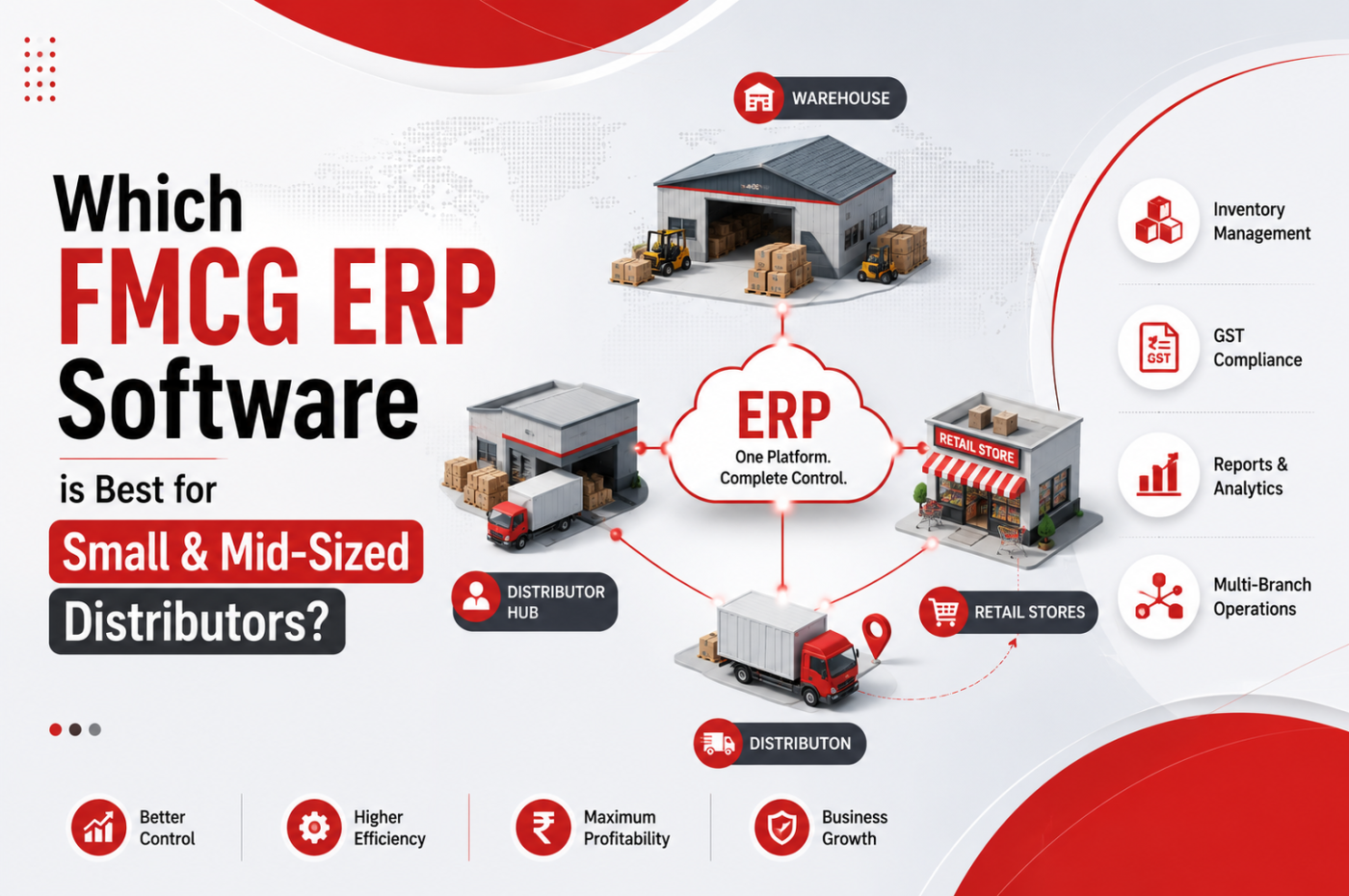
The FMCG (Fast-Moving Consumer Goods) distribution landscape has undergone a fundamental transformation in recent years. What once relied on manual spreadsheets, phone calls, and paper-based records has evolved into a sophisticated ecosystem of real-time inventory tracking, automated workflows, and data-driven decision-making. For small and mid-sized distributors, the challenge is clear: how can they compete with larger players while maintaining profitability and operational efficiency? The answer lies in leveraging enterprise-grade technology, specifically an ERP for FMCG distribution that is designed to manage the unique demands of the industry.
This comprehensive guide explores every aspect of FMCG distribution ERP software, helping you understand what it is, why your business needs it, and how to select and implement the right solution. Whether you are managing multiple branches, dealing with complex GST compliance, or struggling with inventory visibility, this guide provides actionable insights based on industry expertise and practical experience.
What Is FMCG Distribution ERP Software?
FMCG distribution ERP software is an integrated business management platform specifically engineered to handle the unique requirements of fast-moving consumer goods distributors. Unlike generic ERP systems, these solutions are built to address the distinct challenges of FMCG distribution: high-volume transactions, multiple SKUs, rapid inventory turnover, complex pricing structures, and stringent regulatory compliance particularly GST in India.
At its core, FMCG distribution ERP software unifies five critical business functions:
- Inventory Management: Real-time tracking of stock levels, warehouse locations, and movement across multiple distribution centers.
- Sales & Order Processing: Automated order capture, fulfillment, invoicing, and delivery tracking.
- Accounting & Financial Management: Complete ledger control, receivables and payables tracking, and financial reporting.
- Regulatory Compliance: Automated GST filing, invoice generation with tax classification, and audit trails.
- Analytics & Reporting: Business intelligence dashboards, trend analysis, and performance metrics.
Why Small & Mid-Sized Distributors Need Dedicated ERP Solutions
The FMCG distribution sector in India is experiencing unprecedented growth. The organized retail market is expanding, modern trade is increasing its penetration into Tier 2 and Tier 3 cities, and consumer demand for diverse products is at an all-time high. However, this growth also creates significant operational challenges for small and mid-sized distributors. Implementing reliable FMCG management software can help businesses manage inventory, sales, billing, distribution, and compliance more efficiently while supporting sustainable growth.
Critical Challenges Without a Dedicated ERP
- Inventory Inaccuracy: Manual stock tracking leads to overstock or stockouts, directly affecting profitability. Studies show 68% of mid-sized FMCG distributors struggle with inventory accuracy, resulting in a 12–15% loss in potential sales.
- Delayed Financial Reporting: Without real-time accounting, monthly reconciliation can take weeks, delaying crucial business decisions.
- GST Compliance Risk: Manual invoice management and return tracking often result in GST filing errors and penalties. Companies spend an average of 40+ hours monthly on manual tax compliance.
- Fragmented Operations: Different teams using different systems create data silos and prevent unified decision-making.
- Limited Scalability: As transaction volume grows, manual processes become impossible to sustain and may halt business expansion.
- Poor Customer Service: A lack of visibility into order status frustrates customers and increases churn.
Key Features of FMCG ERP Software for Distributors
1. Real-Time Inventory Management
The foundation of any FMCG ERP system is robust inventory management.
- Stock-level tracking
- Multi-warehouse management
- SKU hierarchy
- Automatic reorder points
- Stock valuation methods
- Batch and expiry tracking
2. Advanced Invoicing & Sales Order Management
Efficient order processing is critical for high-volume FMCG distribution.
- Order-to-invoice automation
- Dynamic pricing
- GST-compliant invoicing
- Return management
- Delivery tracking
- Credit note generation
3. Integrated Accounting Module
A dedicated accounting module provides complete financial visibility and control.
- Chart of accounts
- Automatic journal entries
- Real-time financial reports
- Outstanding analysis
- Bank reconciliation
- Multi-currency support
4. GST Compliance & Tax Automation
In India, GST compliance is non-negotiable. Dedicated FMCG ERP systems can provide:
- Automated GSTR-1 and GSTR-3B preparation
- Input tax credit (ITC) tracking
- HSN classification
- E-invoice generation
- Tax audit reports
- Reverse charge handling
Top 10 Benefits of Implementing FMCG ERP Systems
1. Reduced Inventory Carrying Costs (20–30% reduction)
Real-time visibility eliminates overstock, reduces warehouse space requirements, and minimizes obsolete inventory write-offs.
2. Improved Order Fulfillment Speed (40–50% faster)
Automated processing reduces fulfillment time from days to hours, improving customer satisfaction.
3. Enhanced Inventory Accuracy (75% to 98%+)
Automated tracking eliminates manual errors and prevents costly stockouts.
4. Faster Month-End Closing (10–15 days to 2–3 days)
Automated accounting enables faster financial closing and decision-making.
5. GST Compliance Confidence (100% error elimination)
Automated calculations eliminate filing errors and penalties, saving thousands annually.
6. Better Cash Flow Management (10–15% improvement)
Accurate receivables aging enables faster collections and improved working capital.
7. Reduced Operational Errors (60–70% reduction)
Automation eliminates data-entry mistakes and accounting discrepancies.
8. Increased Selling Capacity (15–25% growth)
Staff can focus on customer development instead of manual data entry.
9. Data-Driven Decision-Making (Weekly instead of monthly)
Real-time dashboards provide timely insights into sales trends and profitability.
10. Scalability for Growth (Linear scaling)
The system grows with the business without proportional increases in overhead.
How to Choose the Best FMCG ERP Software
Step 1: Define Your Requirements
Before evaluating software, clearly define what your business needs:
- Number of branches and warehouses
- Monthly transaction volume
- Number of SKUs
- Integration requirements
- Budget constraints
- Technical infrastructure preferences
Step 2: Evaluate Core Functionality
Essential features (must-have): Real-time inventory, GST compliance, multi-branch support, sales and purchase tracking, financial reporting, and mobile access.
Nice-to-have features: Advanced analytics, delivery tracking, CRM integration, and EDI support.
Usually not required for pure distribution: A manufacturing module and complex project management functionality.
Step 3: Assess Implementation & Support
Ask each shortlisted vendor about:
- Implementation timeline for your business size
- Availability of a regional implementation team
- Training included in the proposal
- Support model and service-level agreements (SLAs)
- Customization and integration costs
- References from similar distributors
- Cloud uptime SLA of at least 99.5%
- Security certifications such as ISO 27001 and SOC 2
FMCG ERP Implementation: Step-by-Step Guide
Phase 1: Pre-Implementation | 2–4 weeks
- Finalize vendor selection and contracts
- Assemble the implementation team
- Audit existing data quality
- Map business processes to ERP workflows
- Plan the data migration strategy
- Identify key users and schedule training
- Define the go-live cutover window
Phase 2: Configuration & Testing | 4–8 weeks
- Configure the chart of accounts
- Set up the product master and inventory locations
- Configure sales and purchase workflows
- Set up GST tax configuration
- Create master data for customers and suppliers
- Configure user roles and permissions
- Conduct user acceptance testing (UAT)
- Create documentation and process guides
Phase 3: Data Migration | 1–2 weeks before go-live
- Extract data from legacy systems
- Validate and cleanse the data
- Perform a test migration
- Run parallel trial operations
- Create reconciliation reports
- Resolve data-quality issues
- Prepare the cutover checklist
Phase 4: Go-Live & Support | 1–4 weeks
- Execute the final data migration
- Activate the system
- Monitor performance and adoption
- Address immediate issues
- Run post-implementation reconciliation
- Conduct a team debrief
- Transition to the standard support model
Common Mistakes When Selecting FMCG Distribution Software
Mistake 1: Choosing Based on Price Alone
The cheapest solution rarely delivers the best value. Low-cost systems that require extensive customization or offer poor support can cost far more through lost productivity.
Mistake 2: Ignoring GST Compliance Capabilities
Manually managing GST compliance and correcting errors often costs far more than selecting GST-ready software from the start.
Mistake 3: Underestimating Implementation Time & Cost
Budget 20–30% more than the quoted amount. Hidden costs for customization, training, and support can add up quickly.
Mistake 4: Insufficient User Training
Even excellent software fails without proper training. Poor adoption creates data-quality issues that undermine the entire system.
Mistake 5: Lack of Executive Buy-In
ERP implementation requires leadership commitment. Without executive sponsorship, change management and adoption often suffer.
Mistake 6: Poor Data Preparation
Garbage in, garbage out. Inadequate data cleansing before migration is a common cause of implementation failure.
Mistake 7: Choosing an Over-Featured System
Avoid complex systems filled with unnecessary features. A streamlined platform matched to your needs is easier to implement and adopt.
Best Practices for FMCG ERP Adoption
1. Establish Clear Governance & Ownership
Designate a project sponsor and implementation team leads. Clear ownership prevents delays and ensures accountability.
2. Conduct Comprehensive Change Management
Communicate the “why.” Help employees understand how the new system improves their work and address concerns proactively.
3. Create Detailed Process Documentation
Document every critical business process. Create step-by-step guides with screenshots for ongoing support.
4. Implement Robust User Training
Train in phases: administrators first, then functional leads, followed by general users. Use role-specific materials and provide ongoing refresher training.
5. Run Parallel Operations During Transition
Run the old and new systems simultaneously for one to two weeks to verify data accuracy before final cutover.
6. Define & Monitor Key Performance Indicators
Define expected improvements such as inventory accuracy, fulfillment time, DSO, and closing time. Track these metrics for three to six months after go-live to validate ROI.
Comparison of Leading FMCG ERP Solutions
Solution | Deployment, Price & Timeline | Best Fit & Strengths |
Accutech ERP | Cloud & on-premise | Best for FMCG distributors in India and small to mid-sized teams of 10–100 users. Strengths include GST-native workflows, multi-branch operations, and strong accounting. |
Tally ERP 9 | On-premise | Best for SMBs with traditional accounting needs and one or two branches. Strengths include simplicity, affordability, and GST readiness. |
SAP Business One | Cloud or on-premise | Best for larger and more complex distributors, including multinational supply chains. Strengths include enterprise-grade functionality and integrations. |
Zoho Books | Cloud only | Best for cloud-first, tech-savvy SMEs with simpler distribution requirements. Strengths include ease of use and integrations. |
Frequently Asked Questions
Q1. What is the typical cost of FMCG ERP software for small distributors?
Cloud solutions may cost ₹50,000–₹3,00,000 per year. On-premise solutions may involve ₹2–10 lakh in licensing plus ₹3–15 lakh for implementation. Budget an additional 20–30% for training, customization, and support.
Q2. How long does FMCG ERP implementation typically take?
For small to mid-sized distributors with 10–50 users and one to five branches, implementation usually takes 8–16 weeks. Allow additional time when migrating from legacy systems with poor data quality.
Q3. Will FMCG ERP software integrate with existing systems?
Most modern solutions offer APIs and standard connectors for e-commerce platforms, payment gateways, and banking systems. Complex integrations may require custom development.
Q4. What training do employees need?
Administrators may need 40–60 hours, functional leads 20–30 hours, and general users 8–16 hours. Use role-specific materials and provide quarterly refresher training.
Q5. How does FMCG ERP help with GST compliance?
It automates tax calculations, generates HSN-classified invoices, prepares GSTR files, tracks ITC, and maintains audit records. This can reduce manual compliance work by 80–90%.
Q6. Can FMCG ERP handle multiple warehouses?
Yes. Enterprise solutions provide real-time inventory visibility, centralized accounting with branch reporting, and automated inter-branch transfers.
Q7. Cloud-based or on-premise ERP which is better?
Cloud systems generally offer lower upfront costs, automatic updates, stronger accessibility, and simplified maintenance. On-premise systems provide greater infrastructure control and customization but usually involve higher costs. Cloud is often the better fit for small and mid-sized distributors.
Q8. How can ROI from FMCG ERP be measured?
Track inventory-cost reduction, fulfillment time, DSO, closing time, and error rates. A typical target is 30–50% ROI within 12–18 months.
Q9. What if the business needs to switch vendors later?
Well-implemented ERP systems should support exporting data in formats such as CSV or XML. Switching is still expensive and disruptive, so ensure the vendor formally commits to data portability.
Q10. What support should be expected after go-live?
Look for 24/7 technical support, dedicated account management, system optimization reviews, and quarterly updates. Vendors should commit to SLAs, such as responding to critical issues within four hours.
Conclusion:
The FMCG distribution landscape is increasingly competitive. Businesses compete not only on price but also on operational efficiency, customer service, and financial agility. The difference between thriving and struggling businesses increasingly comes down to technology and operational excellence.
Implementing a dedicated FMCG ERP system is not just about managing inventory and invoices, it is about transforming the business to compete at the next level. The right system provides stronger visibility, greater speed, and better decision-making confidence.