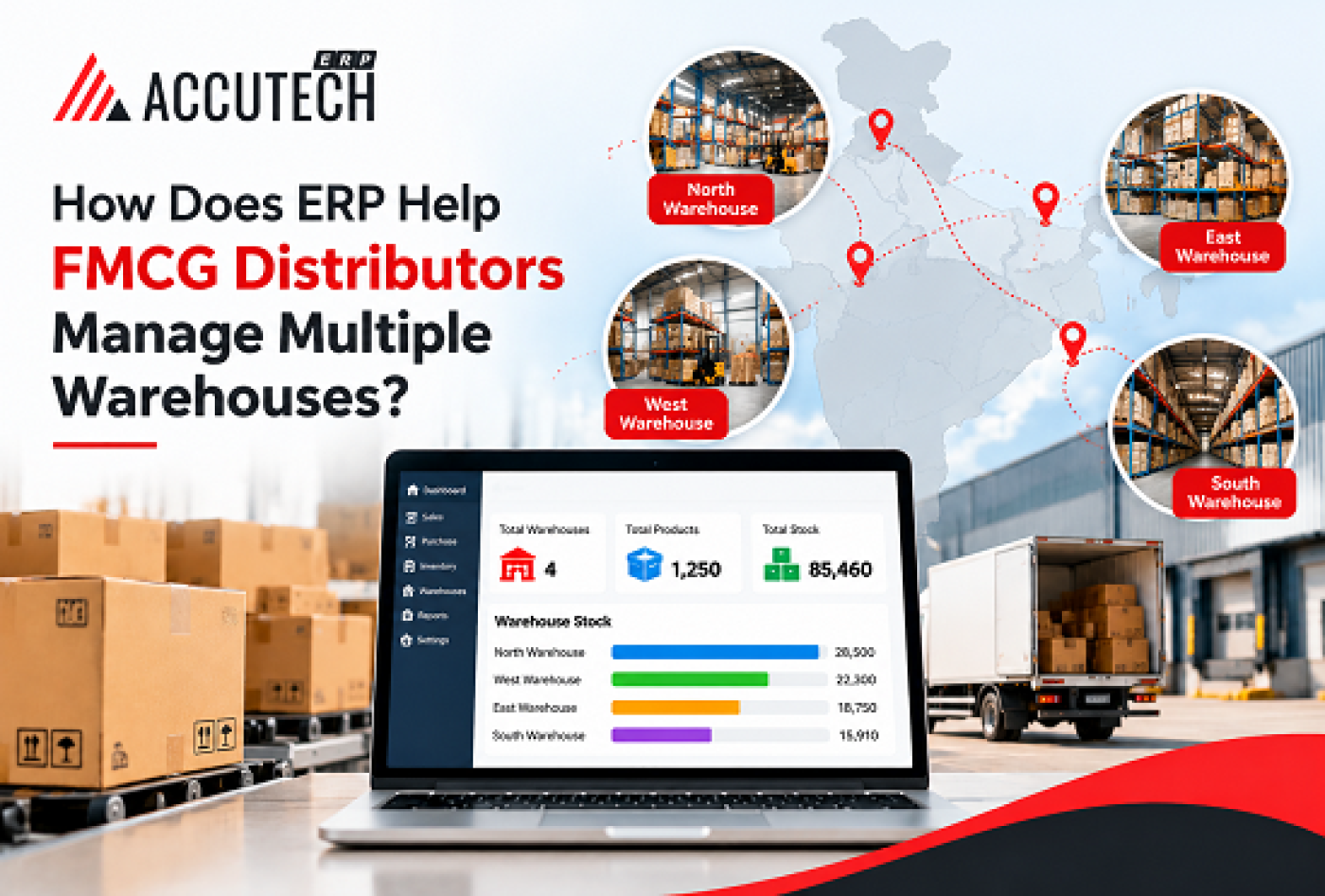
How Does ERP Help FMCG Distributors Manage Multiple Warehouses?
In today's highly competitive FMCG sector, managing multiple warehouses across different regions is one of the most critical operational challenges businesses face. Fast-moving consumer goods distributors often operate 3-10+ warehouses simultaneously, serving retailers, supermarkets, and wholesale outlets across diverse geographical areas. The complexity increases exponentially when you consider stock management, order processing, inventory reconciliation, and regulatory compliance across all these locations.
Without a robust FMCG distribution ERP software system in place, managing such operations becomes increasingly difficult. Distributors struggle with delayed deliveries, stock inconsistencies, financial inaccuracies, and compliance issues. This is where modern warehouse management solutions come into play. A dedicated ERP platform can transform the way your business operates, providing centralized control, real-time visibility, and automated processes across all warehouse locations.
This comprehensive guide explores how modern ERP technology supports multi-warehouse management, enhances operational efficiency, and drives business growth in the fast-moving consumer goods industry.
Understanding ERP Solutions for FMCG Distribution
FMCG distribution ERP software represents an integrated business management solution specifically designed for fast-moving consumer goods distributors. Unlike generic ERP systems, FMCG-focused solutions address the unique challenges of high-volume, low-margin businesses with complex distribution networks. These systems consolidate inventory management, order processing, financial accounting, GST compliance, and reporting into a single, unified platform.
Key Components of Modern Distribution Software:
- Centralized inventory management across multiple warehouse locations
- Real-time stock tracking and level monitoring
- Automated order-to-delivery processes
- Multi-entity and multi-branch support capabilities
- Integrated GST compliance and tax management
The primary advantage of implementing FMCG software in your distribution business is the elimination of manual data entry, paper-based processes, and siloed information. When your entire business operates as an integrated ecosystem, your team gains unprecedented visibility into operations, inventory levels, customer orders, and financial performance across all warehouse locations simultaneously.
Core Challenges Without Proper Warehouse Management Systems
Many FMCG distributors still rely on spreadsheets and fragmented software solutions. This fragmented approach creates numerous operational and financial problems:
Challenge | Impact on Business |
Stock Discrepancies | Lost sales, customer dissatisfaction |
Delayed Orders | Extended delivery times, reduced loyalty |
Poor Visibility | Inefficient decisions, missed opportunities |
Compliance Errors | GST penalties, tax audits, legal risks |
How FMCG Distribution ERP Software Manages Inventory Across Multiple Warehouses
The core strength of FMCG distribution ERP software lies in its ability to provide centralized inventory management across geographically dispersed warehouse locations. Unlike traditional systems where each warehouse operates independently, a modern ERP solution creates a unified ecosystem where inventory movements, stock levels, and supply chain activities are synchronized in real-time.
Centralized Inventory Dashboard:
When the ERP system is properly implemented, all warehouse locations feed data into a single, centralized database. This allows business managers to view stock levels, product movement, and inventory turnover across all warehouses from one dashboard. If a warehouse in Delhi shows low stock, the system can automatically recommend transfers from a warehouse in Punjab where stock is abundant, preventing both stockouts and overstock situations simultaneously.
The platform enables:
- Real-time stock reconciliation across all locations
• Automated low-stock alerts that trigger purchase orders
• Precise tracking of product expiry dates and batch numbers
• Comprehensive audit trails for compliance
For FMCG distributors, having this level of inventory control is transformative. An effective ERP solution can help reduce unnecessary stock holding and minimize stockout situations through better visibility and inventory planning.
Real-Time Visibility and Stock Tracking Benefits
One of the most critical advantages of implementing an ERP solution for FMCG distribution is the real-time visibility it provides into inventory movements and stock levels. In the FMCG industry, where products move quickly and shelf life is a constant concern, having accurate, up-to-the-minute stock information is essential for business success.
Real-Time Visibility Features:
Live Stock Levels: Every warehouse location shows current inventory quantities, allowing managers to make informed decisions in seconds rather than days.
Movement Tracking: Monitor exactly when products enter or leave warehouses and where they end up in the supply chain. This transparency is crucial for managing the product lifecycle in FMCG.
Demand Forecasting: AdvancedFMCG distributor software can analyze historical sales patterns to predict future demand, enabling proactive inventory planning.
Alert Systems: Automated notifications alert managers when stock drops below minimum levels or when products are nearing expiry.
These real-time capabilities directly impact the bottom line. Retailers appreciate distributors who can fulfill orders promptly. A well-integrated distribution system that provides this level of operational visibility can strengthen customer relationships and create competitive advantages.
Automated Order Processing and Distribution
Order processing represents a significant operational challenge in FMCG distribution. Manual order entry, picking, and shipping processes are error-prone and time-consuming. A robust ERP solution automates these workflows, dramatically improving efficiency and accuracy.
When a customer places an order with an ERP-enabled distribution system in place, the system automatically:
- Validates the order against real-time inventory
- Identifies the optimal warehouse for fulfillment
- Generates picking lists and shipping documents
- Updates inventory levels across all locations
- Integrates with shipping providers for tracking
- Generates invoices and financial records
Automating these activities can significantly reduce order processing time and minimize manual errors, helping distributors improve customer satisfaction.
Multi-Location Warehouse Operations Simplified
Operating multiple warehouse locations simultaneously is inherently complex. Each location has different staff, operational procedures, and challenges. Coordinating activities across distributed locations while maintaining consistency and efficiency requires sophisticated systems. FMCG distributor software specifically addresses this complexity by providing standardized operations across all locations.
Standardized Operations Across Locations:
Configuration within the ERP allows you to establish uniform business rules and procedures that apply across all warehouse locations. For example, minimum stock levels, reorder quantities, and expiry date handling can be standardized, ensuring consistent operations regardless of location.
Inter-Warehouse Transfers:
When one warehouse has excess inventory and another faces stockouts, the system enables seamless inter-warehouse transfers. It tracks these movements and updates stock levels across locations.
The result is a distributed network that operates with the coordination of a single, centralized facility. This is particularly valuable for FMCG distributors serving large geographic areas.
GST Compliance and Tax Management Across Warehouses
For FMCG distributors operating multiple warehouses across different states, GST management becomes exponentially more complicated. Different transactions and goods movements may have different tax and compliance implications depending on warehouse location and destination. Modern ERP platforms for FMCG distribution are designed to help businesses manage these requirements more systematically.
GST Features in Distribution Software:
Automated Tax Calculation: The software calculates applicable GST based on product type, warehouse location, and destination, helping improve billing accuracy.
State-Specific Compliance: The system can support inter-state supply transactions and location-based tax requirements.
Real-Time Return Filing Support: Generate data required for GSTR-1 and other GST-related reporting directly from the system.
Input Tax Credit Management: Track and manage ITC-related records across warehouse locations to support accurate reconciliation.
For FMCG distributors, GST compliance using manual methods can consume substantial resources and create significant risks. A purpose-built FMCG distributor software solution helps simplify these processes and maintain accurate records.
Best Practices for Implementing Distribution ERP
Implementing an ERP system for FMCG distribution requires careful planning and execution discipline. Here are critical best practices:
1. Thorough Requirements Analysis
Before selecting a distribution ERP solution, analyze your current processes, pain points, and requirements. Engage stakeholders from all warehouse locations to ensure the solution truly addresses your specific needs.
2. Phase Implementation Strategically
Rather than implementing the ERP across all locations simultaneously, phase the rollout. Start with one pilot warehouse, then expand to additional locations.
3. Invest in Comprehensive Training
The ERP system is only as effective as your team's ability to use it. Invest heavily in training programs tailored to different user groups and roles.
4. Establish Data Governance
Data quality is fundamental to ERP success. Establish clear protocols for data entry, validation, and maintenance across all locations.
Measuring ROI: Key Metrics and Performance Indicators
ERP implementation requires significant investment. Measuring return on investment is essential. Here are critical metrics:
Metric | Expected Improvement |
Order Fulfillment Time | 50-70% reduction |
Inventory Accuracy | Increase to 98-99.5% |
Stockout Incidents | 40-60% reduction |
Operational Cost | 25-35% reduction |
Customer Order Accuracy | 96-98% accuracy |
Actual improvements depend on the distributor's existing processes, implementation quality, data accuracy, team adoption, and business scale. Businesses should evaluate their own baseline performance when measuring ERP ROI.
Common Mistakes When Adopting ERP Solutions
While distribution ERP solutions offer tremendous benefits, several common implementation mistakes can undermine success:
Inadequate Change Management: Resistance to change is normal. A new ERP system often requires different workflows and habits.
Insufficient Training: When users don't understand the software's capabilities, they may resort to workarounds and create data errors.
Unrealistic Timelines: ERP implementations are complex. Attempting to compress timelines can create stress and introduce errors.
Ignoring Data Quality: Poor initial data quality leads to poor decisions and erodes confidence in the system.
Over-Customization: Customizing software to replicate every existing process can lead to unnecessary complexity and maintenance challenges.
Future Trends in FMCG Distribution Technology
The FMCG distribution landscape continues evolving rapidly. Understanding emerging trends in distribution technology helps organizations make forward-looking investments.
Artificial Intelligence and Machine Learning: Next-generation ERP platforms increasingly use AI to support predictive inventory management, demand analysis, and operational planning.
Real-Time IoT Integration: IoT devices, RFID systems, and barcode scanning can support faster inventory updates and product movement tracking.
Cloud-Based Solutions: Cloud deployment of modern ERP systems offers scalability, easier accessibility, and centralized management compared with many traditional on-premise systems.
Mobile-First Design: Modern FMCG retail software and distribution platforms increasingly support mobile access, enabling staff to scan products, check inventory, process orders, and update records directly from mobile devices.
Frequently Asked Questions
Q1: What is the best software for FMCG distributors available in India?
The best solution depends on your specific business requirements. Solutions like Accutech ERP are designed for Indian FMCG businesses and address areas such as GST compliance, multi-warehouse management, inventory control, billing, and industry-specific workflows. Prioritize solutions that offer real-time inventory visibility, automated order processing, comprehensive reporting, and strong GST compliance capabilities.
Q2: How does ERP software reduce operational costs?
ERP software can reduce operational costs through automation, reduced manual data entry, improved inventory management, optimized order processing, and better procurement planning. The exact savings depend on business size, current operational efficiency, warehouse structure, and implementation quality.
Q3: Can an ERP system handle multiple state tax regulations?
Yes, modern ERP systems can support state-specific GST requirements, E-way bill processes, and inter-state supply transactions. The solution should calculate applicable taxes based on factors such as warehouse location, customer destination, and transaction type.
Q4: What is the typical implementation timeline for FMCG ERP software?
Implementation timelines vary based on company size and complexity. Small distributors with a limited number of warehouses may require less time, while large distributors with multiple branches, integrations, and customized processes may require several months. A phased rollout can help reduce operational disruption.
Q5: How does ERP software ensure data security and compliance?
Enterprise-grade ERP platforms may incorporate role-based access controls, encrypted communication, database security, audit trails, backups, and system updates. Businesses should request detailed security documentation and applicable certifications from vendors before implementation.
Q6: What support services do ERP providers offer?
Leading providers may offer implementation support, role-specific training, documentation, technical assistance, software updates, and system health checks. Verify that the provider's support availability matches your operational hours and business requirements.
Q7: How does retail ERP integrate with e-commerce platforms?
Modern retail and distribution systems can integrate with e-commerce platforms and marketplaces, helping businesses synchronize inventory, process online orders, manage fulfillment, and maintain unified financial reporting across sales channels.
Q8: What should I look for when comparing distribution software options?
Evaluate solutions based on core functionality such as inventory management, order processing, GST compliance, scalability, ease of use, integration capabilities, vendor stability, pricing transparency, customization flexibility, reporting, and support quality. Request demos and involve your operational team in the evaluation process.
Q9: How does the software manage product expiry and lot traceability?
The system can track product lot numbers, batches, and expiry dates at warehouse level. It can flag products nearing expiry, support FIFO or other configured stock movement methods, and provide lot-level traceability when required.
Q10: What improvements should I expect within the first year of implementation?
Improvements vary significantly between businesses. A well-implemented ERP can help improve inventory accuracy, shorten order fulfillment time, reduce stockout incidents, decrease manual work, strengthen GST-related record keeping, and provide better visibility into warehouse operations. Businesses should define measurable KPIs before implementation to evaluate actual results.
Conclusion:
Managing multiple warehouse locations is one of the most significant operational challenges faced by FMCG distributors. Without proper systems, complexity multiplies, costs increase, and customer satisfaction can suffer. FMCG distribution ERP software addresses these challenges by bringing inventory, orders, warehouse movements, compliance, and financial information into a centralized system.
A robust FMCG distributor software solution provides centralized visibility into inventory, automated order processing, real-time reporting, GST management, improved operational control, and better customer service. Accutech ERP helps FMCG distributors manage multi-warehouse operations with greater visibility, control, and efficiency while reducing dependence on disconnected or manual processes.
If you operate multiple warehouse locations and manage FMCG product distribution, choosing the right FMCG software or FMCG retail software such as Accutech ERP can help simplify operations, improve control, and support sustainable business growth.